

Executive Overview
The rapid acceleration of robotics research continues to redefine the boundaries of what machines can achieve in unstructured, real-world environments. In this edition of IEEE Spectrum’s Video Friday, we curate the most compelling, innovative, and occasionally eccentric developments emerging from laboratories and industrial floors worldwide. From breakthrough robot foundation models capable of zero-shot and one-shot physical learning to heavy-duty hydraulic retrofits and biomimetic aerial navigation, the global robotics community is pushing past traditional programming paradigms toward true physical intelligence.
As the industry prepares for a dense conference season—including the Humanoids Summit Seoul (September 22–23, 2026), IROS 2026 in Pittsburgh (September 27–October 1, 2026), and CoRL 2026 in Austin (November 9–12, 2026)—the technological discourse has shifted from mere proof-of-concept locomotion to complex commercial viability, generalizability, and human-robot collaboration.
This report provides an in-depth analysis of the latest video demonstrations featured in Video Friday. We examine how foundational artificial intelligence models are compressing learning curves from days to seconds, how aerial and ground-based systems are mastering agile maneuvers through first-principles optimization, and how the perennial debate surrounding humanoid utility is evolving in the face of practical industrial constraints.
Detailed Chronology and Technical Breakdown
The latest tranche of robotics disclosures showcases an unprecedented diversity of form factors and operational modalities. Below is a detailed review of the key technical demonstrations highlighted this week.
1. Rapid Skill Acquisition: Generalist’s GEN-1.5 Foundation Model
One of the most significant cognitive leaps featured this week comes from Generalist, which debuted its GEN-1.5 robot foundation model. Historically, teaching a robot a new physical manipulation task required extensive demonstration datasets, reward function engineering, and gradient updates or fine-tuning.
Traditional Workflow: [Task Concept] -> [Data Collection (Hours)] -> [Fine-Tuning/Training] -> [Deployment]
GEN-1.5 Workflow:     [Task Concept] -> [Single Demonstration]    -> [Immediate Execution]
According to Generalist’s development team, GEN-1.5 exhibits the unprecedented ability to learn a new task in seconds from just one or a few examples:
"Humans have a remarkable ability to perform new physical skills from only one or a few examples. Our latest robot foundation model, GEN-1.5, exhibits the beginnings of that same ability: It can learn a new task in seconds, from a single example, without gradient updates or fine-tuning. It displays broad capabilities across one-shot and few-shots learning from demonstration, as well as zero-shot physical generalization."
While the tasks demonstrated in the initial release remain relatively simple and short-horizon, industry analysts note that this represents the first time one-shot and few-shots physical learning has emerged at scale without localized training overhead. However, roboticists maintain a healthy dose of skepticism regarding claims of zero-shot generalization, noting that verifying the absolute absence of relevant pretraining data across massive web-scale datasets remains notoriously difficult.
2. Biomimetic Agility and Dynamic Locomotion
Nature continues to serve as an indispensable blueprint for roboticists tackling extreme dynamics.
- BeanBot (IIT): Inspired by the erratic, unpredictable movement of Mexican jumping beans, the Italian Institute of Technology showcased BeanBot. By exploiting internal shifting masses and resonant frequencies, the system achieves dynamic self-propulsion without traditional wheels or articulated legs, offering potential applications in confined-space inspection.
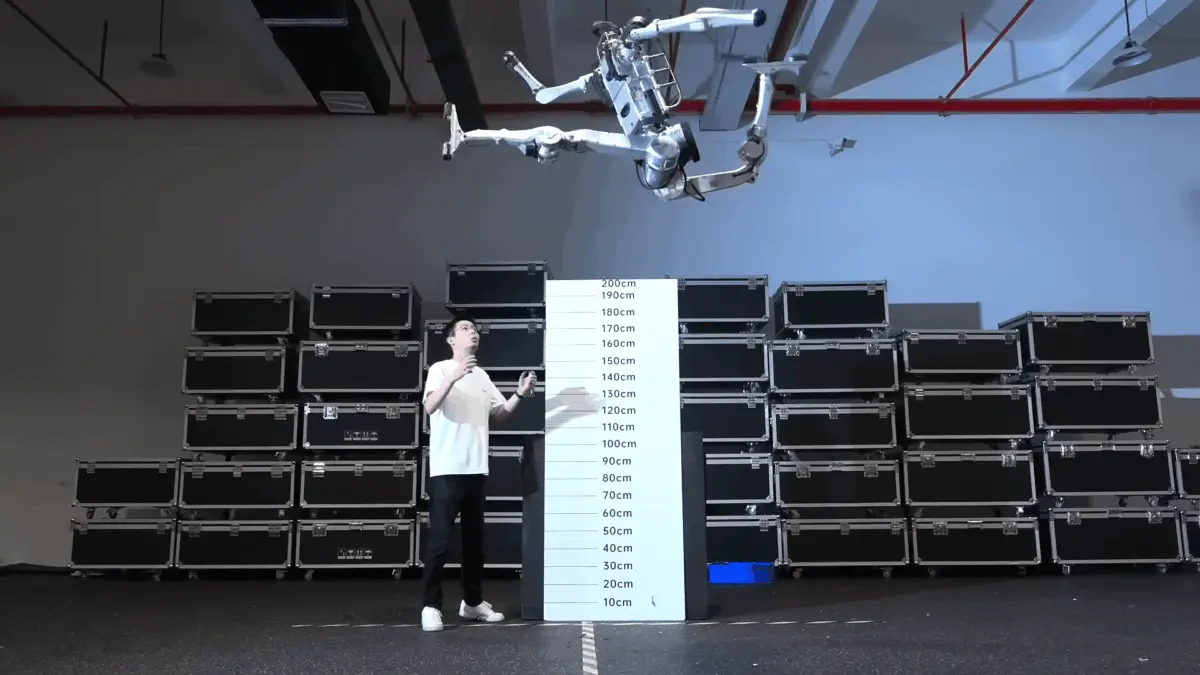
- Acrobatic Brachiation (EVARL, University of Tokyo): Mastering brachiation—the arm-over-arm swinging locomotion perfected by gibbons—requires instantaneous transitions between grasping and releasing bars alongside whole-body momentum management. The EVARL team introduced a learning-based framework centered on waypoint-guided reinforcement learning (WGRL). By constraining the robot’s end effector through spatial waypoints while allowing reinforcement learning to explore dynamic whole-body behaviors, their life-size dual-arm robot successfully traversed four consecutive bars in real-world experiments.
- Omnidirectional Multirotors (DRAGON Lab & AIMS Group): Moving beyond conventional quadrotor flight, researchers from the University of Tokyo and Hong Kong Polytechnic University developed a sequential-convex-programming-based trajectory-optimization framework. This first-principles analytical model commands both conventional and omnidirectional aerial robots to execute high-speed, continuous sequences of arbitrary poses with extreme precision.
3. Industrial Autonomy and Heavy Machinery Integration
While humanoid and legged robots capture mainstream media attention, industrial automation is quietly revolutionizing sectors such as construction, agriculture, and heavy manufacturing through intelligent retrofits.
- Gravis Robotics Retrofit Kit: Heavy construction machinery operates in some of the most hazardous environments on earth. Gravis Robotics introduced a retrofit kit—the Gravis Rack—that transforms off-the-shelf hydraulic excavators and loaders into autonomous agents. By integrating cameras, LiDAR, and onboard compute alongside learning-based control, the system enables standard machinery to operate continuously near its performance limits, optimizing earth-moving cycles without requiring operators to sit in the cab.
- Advanced Shipbuilding and Agriculture: Kawasaki Robotics presented specialized arc-welding automation tailored for the complex, confined geometries of shipyards, while Flexiv demonstrated precision force-controlled manipulation for delicate agricultural tasks, proving that compliant robotics is finally bridging the gap between factory floors and biological unpredictability.
Supporting Context and Metrics
To contextualize the trajectory of modern robotics, industry observers track several critical metrics regarding deployment timelines, compute efficiency, and hardware reliability.
| Technology Domain | Primary Metric / Focus Area | Current Industry Benchmark | Emerging Paradigm Shift |
|---|---|---|---|
| Foundation Models | Training/Adaptation Time | Hours to days of fine-tuning | Seconds via one-shot learning (e.g., GEN-1.5) |
| Humanoid Robots | Domestic Utility & Cost | High cost, fragile manipulation | Questioning commercial use cases vs. wheeled bases |
| Heavy Machinery | Autonomous Earthmoving | Manual operation / basic GPS | Sensor-agnostic hydraulic retrofits (Gravis Rack) |
| Aerial Robotics | Pose Optimization Speed | Heuristic trajectory planning | Sequential-convex-programming framework |
The Humanoid Dilemma: Utility vs. Novelty
A recurring theme across this week’s commentary—echoed by reviewers analyzing home humanoids from Zhejiang Lab and dynamic bipedal systems from Unitree—is the ongoing skepticism regarding commercial utility. While watching a bipedal robot navigate complex terrain or manipulate household objects is undeniably captivating, engineers frequently grapple with fundamental economic realities:
- The Cost of Complexity: Bipedal locomotion requires high-torque actuators, intricate gearboxes, and massive battery reserves simply to maintain balance, driving hardware costs well beyond practical return-on-investment thresholds for standard domestic tasks.
- The Fragility Factor: If a humanoid robot trips or drops a glass in a home environment, the resulting mechanical damage and safety liabilities present severe adoption barriers compared to simpler wheeled or stationary robotic arms.
- Task Specialization: Critics argue that specialized form factors (such as robotic arms on mobile bases or dedicated gantry systems) will continue to outcompete humanoids in structured industrial settings, leaving humanoids relegated to niche or highly unstructured environments where human-centric architecture is strictly mandatory.
Official Statements and Expert Insights
The intersection of academic rigor and industrial pragmatism was prominently featured in official project disclosures this week:
"Robust brachiation requires precise hand movements to grasp and release bars together with highly coordinated whole-body motion. To address this challenge, we propose a learning-based framework centered on waypoint-guided reinforcement learning (WGRL). […] In the real world, our life-size dual-arm robot successfully traversed four consecutive bars."
— EVARL Research Team, University of Tokyo
On the software and foundation model front, the push toward generalized physical intelligence relies on moving away from hardcoded heuristics:
"Through a collaboration between the AIMS Group at the Hong Kong Polytechnic University and DRAGON Lab at the University of Tokyo, we developed the first sequential-convex-programming-based trajectory-optimization framework for generalized multirotors, covering both conventional and omnidirectional platforms."
— DRAGON Lab & AIMS Group
Finally, addressing the operational reality of heavy machinery, Gravis Robotics emphasized the economic imperative of retrofitting existing industrial fleets:
"Our retrofit kit, the Gravis Rack, turns off-the-shelf hydraulic machines into robots. Cameras, lidar, and onboard compute lets your machine see and understand its surroundings, and learning-based control lets it work close to its limits, moving more dirt with full, fast cycles."
— Gravis Robotics
Future Outlook
As the robotics community looks ahead to the autumn 2026 conference circuit—culminating in the Humanoids Summit Seoul, IROS 2026, and CoRL 2026—several clear trajectories are shaping the next decade of research and commercialization:
- Convergence of Vision-Language-Action (VLA) Models: The success of models like GEN-1.5 signals that generalized physical reasoning is no longer a distant theoretical goal. Over the next 18 months, expect rapid integration of multi-modal foundation models into commercial robotic platforms, drastically reducing the programming bottleneck for custom automation.
- Pragmatic Industrial Autonomy: While humanoid hype persists, the most rapid financial returns will be realized in retrofitted industrial environments—such as construction, agriculture, and maritime logistics—where capital expenditure can be minimized while safety and throughput are maximized.
- Sim-to-Real Refinement: As demonstrated by dynamic systems like the brachiation robot and omnidirectional drones, advanced simulation environments coupled with constrained reinforcement learning (such as WGRL) will continue to bridge the gap between virtual training and physical deployment, enabling robots to master high-risk, highly dynamic tasks safely.
Stay tuned to IEEE Spectrum for continued coverage as these technologies debut live on the exhibition floors in Seoul, Pittsburgh, and Austin.
