

Executive Overview
The landscape of software engineering has shifted fundamentally. AI coding agents—such as Claude Code, OpenAI’s Codex, Cursor, GitHub Copilot Agent, and Gemini CLI—have evolved far beyond simple autocomplete utilities. Today’s state-of-the-art tools can autonomously read entire code repositories, execute multi-file edits, run system commands, generate pull requests, and resolve complex, multi-step software development tasks.
Yet, this surge in capability has not eliminated engineering complexity; rather, it has transformed it. According to HackerRank’s 2025 Developer Skills Report, an astounding 97% of professional developers now utilize at least one AI assistant, with nearly a third of all modern codebases consisting of AI-generated content. However, the report highlights a critical caveat: AI introduces unprecedented delivery pressure without removing the fundamental necessity of strong engineering judgment.
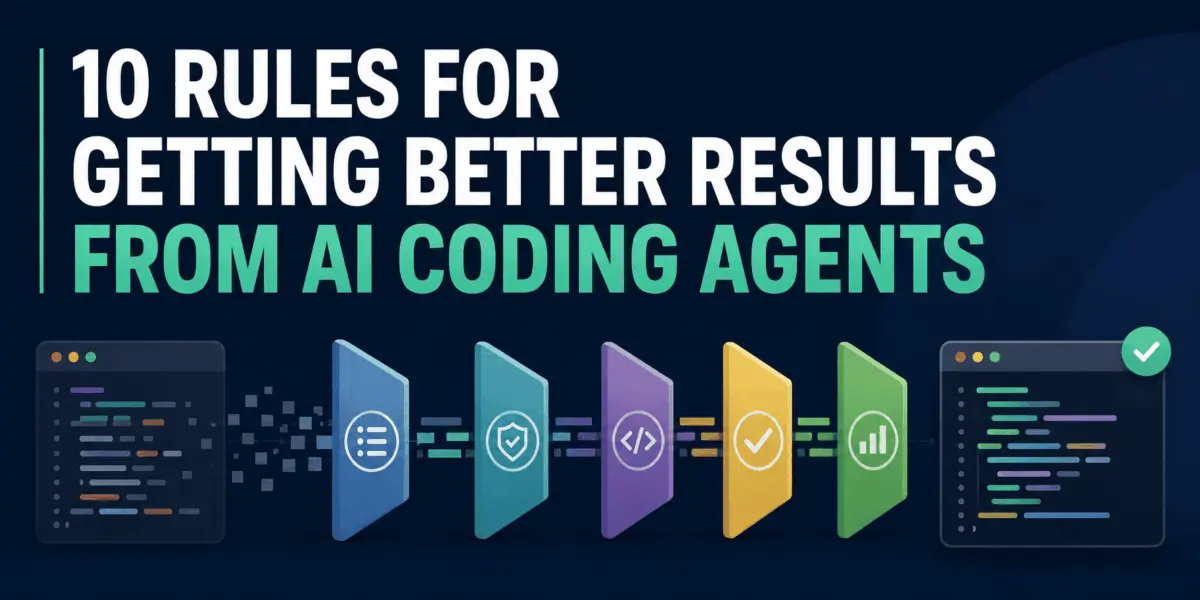
The division between developers who thrive alongside AI coding agents and those plagued by frustration boils down to workflow discipline. AI coding agents excel when deployed within a structured environment characterized by unambiguous goals, explicit project context, strict validation parameters, and safe feedback loops. To help engineers navigate this transition, this report outlines 10 practical rules for maximizing productivity and code quality when working with AI coding agents.
Detailed Chronology and Evolution of AI-Assisted Development
To understand why modern workflows require rigorous management, it is necessary to examine how coding assistants evolved from static snippet generators into autonomous development agents.
Phase 1: The Autocomplete Era (2020–2022)
Early tools relied primarily on large language models trained to predict the next few lines of code based on immediate local context. While helpful for boilerplate syntax, these tools lacked systemic understanding of broader architectures, often resulting in isolated code suggestions that required significant manual refactoring.
Phase 2: Integrated Chat and Sidebar Interfaces (2023–2024)
The introduction of conversational interfaces embedded directly into integrated development environments (IDEs) allowed developers to highlight code blocks and request localized refactoring, explanations, or test generation. Tools like early iterations of GitHub Copilot and ChatGPT plugins reduced context-switching but remained tethered to human-initiated, single-file interventions.
Phase 3: The Autonomous Agentic Era (2025–Present)
Modern systems function as semi-autonomous agents capable of terminal access, file traversal, and iterative self-correction. Platforms like Claude Code and Cursor can ingest complex instructions, formulate implementation plans, execute shell commands to run tests, and debug their own errors.
This leap in autonomy, however, exposes new vulnerabilities: unconstrained models can introduce architectural drift, execute dangerous shell commands, or bloat repositories with redundant dependencies. Consequently, the industry’s focus has shifted from raw model capability to orchestrating agent workflows effectively.
Supporting Context, Metrics, and Technical Insights
Recent academic research and industry surveys provide empirical backing for the structural rules required to manage modern AI coding agents.
The Problem with Bloated Instructions
An emerging body of research, including recent studies on repository-level configuration files (AGENTS.md and CLAUDE.md), has identified common systemic anti-patterns. In an analysis of 100 popular open-source repositories utilizing agent instructions:
- 62% suffered from "lint leakage," where outdated or conflicting style rules polluted the context window.
- 42% experienced severe "context bloat," crowding out crucial task-specific tokens with unnecessary documentation.
The Role of Specifications and Bootstrapping
Research into coding-agent bootstrapping (such as recent findings published under arXiv:2603.17399) underscores that for autonomous agents, a well-defined specification serves as the stable artifact of record. Because agent implementations are frequently prone to iterative regeneration, anchoring the process in a strict, specification-driven framework ensures that the ultimate business logic remains aligned with developer intent.
The 10 Rules for Getting Better Results from AI Coding Agents
1. Start With a Specification, Not a Vague Prompt
Coding agents thrive on structure, not ambiguity. Asking an agent to "build a feature" invites hallucination and architectural misalignment.
- Bad Prompt: "Build a customer churn dashboard."
- Better Prompt:
Build a customer churn dashboard.
Goal:
Show churn rate, active customers, monthly revenue, and top churn risk factors.
Scope:
- Add a dashboard page at /dashboard.
- Use the existing API client.
- Reuse the current chart component.
- Do not change the database schema.
Acceptance criteria:
- Page loads without console errors.
- Metrics match the /analytics/churn endpoint.
- Add tests for the data transformation function.
- Run lint and tests before final response.
Treat the specification as a professional definition of done. Include explicit goals, constraints, impacted paths, and validation criteria.
2. Implement Repository-Level Configuration Files (AGENTS.md)
Avoid repeating foundational project instructions in every prompt. Establish persistent guidelines using repository-level files such as AGENTS.md, CLAUDE.md, or .github/copilot-instructions.md. Adopted by over 60,000 open-source projects, the AGENTS.md standard acts as a README for machines:
# AGENTS.md

## Setup
- Install dependencies with `pnpm install`.
- Start the app with `pnpm dev`.
- Run tests with `pnpm test`.

## Code style
- Use TypeScript strict mode.
- Prefer functional components.
- Do not add new dependencies without approval.

## Before finishing
- Run lint.
- Run relevant tests.
- Summarize changed files and why they changed.
3. Keep Agent Instructions Short and Useful
An instruction file is not an engineering handbook dump. As Anthropic’s skill-authoring guidance notes, every token in an instruction file competes for attention within the model’s context window. Keep rules concise, test them against real usage, and eliminate redundant linting or styling instructions that can be automated via pre-commit hooks.
4. Require the Agent to Inspect Before Editing
For non-trivial tasks, instruct the model to analyze the codebase before modifying any files.
Before editing, inspect the relevant files and summarize:
1. which files control authentication,
2. where the bug likely lives,
3. what tests already cover this area,
4. the smallest safe change.
Do not modify files until after this summary.
This minimizes the risk of the agent applying plausible fixes in entirely incorrect modules.
5. Balance Planning Based on Task Complexity
Use planning modes selectively. For massive architectural migrations or multi-module refactors, demand a structured implementation plan. For minor bug fixes or localized style adjustments, heavy planning introduces unnecessary latency.
6. Make Tests the Contract
AI-generated code often looks correct before it functions correctly. According to HackerRank’s debugging analysis, code verification remains paramount. Use test suites as an immutable contract:
Write failing tests first for this bug.
Confirm they fail.
Then implement the smallest fix.
Do not modify the tests after implementation unless the test itself is wrong.
Run the relevant test suite before finishing.
Tests provide the necessary algorithmic feedback loop for the agent to optimize for working software rather than superficial plausibility.
7. Provide Concrete Style Examples
Abstract requests like "make it clean and production-ready" lead to stylistic drift. Instead, anchor the agent to existing codebase patterns:
Follow the style of `src/features/billing/CreateInvoice.tsx`.
Use the same error-handling pattern as `src/lib/apiClient.ts`.
Use the existing `Result<T>` type instead of throwing raw errors.
8. Control Dependencies and Permissions
Autonomous agents frequently attempt to solve problems by installing new third-party packages or broadening security permissions. Implement strict dependency policies:
- Prohibit unapproved production dependencies.
- Mandate the use of existing internal utilities.
- Utilize execution hooks (such as Claude Code hooks) to enforce deterministic checks at specific lifecycle stages.
9. Conduct Rigorous Code Reviews
Never review AI output by simply asking whether it "looks good." Evaluate submissions against rigorous engineering standards:
- Does the code introduce security vulnerabilities or injection vectors?
- Are edge cases and failure modes adequately handled?
- Does the implementation maintain performance parity with existing systems?
- Are the added abstractions genuinely necessary?
10. Continuously Iterate on Your Agent Instructions
When an agent makes an error, treat it as a failure of documentation, not just code. Update your AGENTS.md or custom instruction files to patch the vulnerability permanently. If an agent modifies generated files directly, update the rules to explicitly restrict access to those directories.
Official Perspectives and Industry Insights
Industry leaders emphasize that the integration of AI coding agents does not diminish the role of the human engineer; rather, it elevates it.
Kanwal Mehreen, machine learning engineer, technical writer, and co-author of Maximizing Productivity with ChatGPT, notes that successful AI adoption relies fundamentally on systematic engineering discipline. "The goal is not to ‘vibe code’ your way through production systems," Mehreen explains. "The goal is to turn the agent into a faster implementation partner inside a controlled engineering workflow."
Similarly, technical governance frameworks from major platform providers highlight that models perform best when treated as junior engineering assistants requiring clear guardrails, comprehensive test suites, and strict architectural oversight.
Future Outlook
As AI coding agents mature over the coming years, their capabilities will expand deeper into autonomous system maintenance, continuous integration monitoring, and real-time security auditing. We can anticipate the emergence of standardized agent communication protocols, highly specialized domain-specific reasoning models, and native IDE integrations capable of predicting infrastructural bottlenecks before code is even committed.
However, the core thesis of software engineering will remain unchanged: tools evolve, but accountability does not. Developers who master the art of writing precise specifications, designing robust validation feedback loops, and maintaining rigorous architectural oversight will define the next generation of software craftsmanship. Success in the AI age is not determined by the sophistication of the model, but by the discipline of the engineer wielding it.
