

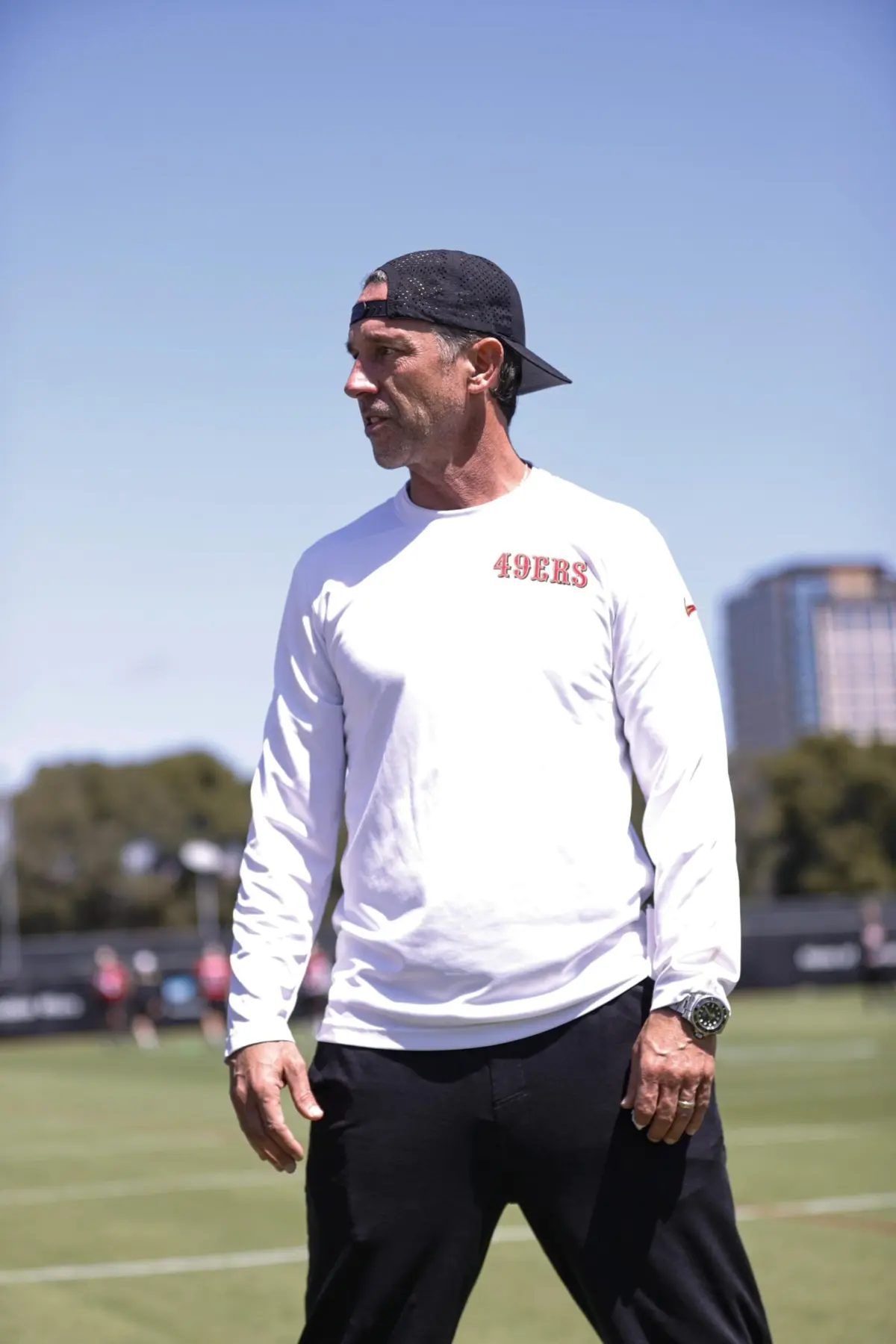
By Terrence O’Brien
Published August 9, 2026
Executive Overview
The intersection of human error and automated driving technology remains one of the most volatile arenas in modern transportation. This tension was thrust back into the national spotlight following recent revelations concerning San Francisco 49ers head coach Kyle Shanahan, who disclosed that his Tesla’s Autopilot system was engaged during a vehicular collision near downtown Palo Alto four weeks ago.
While initial reports of the accident were minimal—with Shanahan taking immediate, broad responsibility for the mishap—subsequent remarks during a media session have ignited a renewed, high-stakes debate surrounding driver accountability, semi-autonomous vehicle capabilities, and the psychological comfort that breeds complacency behind the wheel.
Shanahan’s candid admission—that he has utilized Tesla’s Autopilot feature for nearly a decade and views driving as a "partnership" rather than a fully delegated task—encapsulates the complex paradox defining contemporary advanced driver-assistance systems (ADAS). On one hand, drivers are enticed by the convenience and long-term reliability of semi-autonomous software. On the other hand, federal regulators, safety advocates, and legal experts continually emphasize that systems like Autopilot and Full Self-Driving (FSD) do not absolve the human operator of continuous, undivided vigilance.
This article explores the details of Shanahan’s accident, the technical and psychological nuances of long-term ADAS usage, the broader regulatory and legal landscapes surrounding Tesla, and what this high-profile incident means for the future of human-machine interaction on public roadways.
Detailed Chronology: From Palo Alto to the Press Room
The Incident
The collision occurred roughly four weeks prior to Shanahan’s public clarification, unfolding along a stretch of roadway near downtown Palo Alto, California. At the time of the accident, local reports briefly touched upon the incident, noting that the prominent NFL coach had been involved in a fender-bender or minor crash. Initial public statements from Shanahan were sparse, characterized primarily by an acknowledgment that the event was his fault, though specific operational details of the vehicle were omitted from the immediate police and media summaries.
The Evolution of the Narrative
For weeks, the minor collision remained a footnote in the local news cycle. However, during a subsequent press conference, Shanahan addressed the incident with unexpected candor, shedding light on the mechanics leading up to the impact. It was during this briefing that the 49ers coach revealed his Tesla’s Autopilot system was active at the time of the crash.
Rather than attempting to shield himself from scrutiny or point fingers at the vehicle’s onboard software, Shanahan leaned directly into personal accountability, despite acknowledging the ambiguity of the final seconds before impact:
"I’ve had Autopilot for nine years, so I’m pretty comfortable with it and, you know, who knows what happened when I turned around? Whether it malfunctioned or whether I knocked it off? That’s something I don’t know yet. But regardless, that’s… it is always your fault, whether you’re on Autopilot or not. You can’t take your eyes off the road. It’s a partnership driving, you don’t just turn it over to a computer."
This quote crystallizes the core dilemma of modern semi-autonomous motoring: the fine line between utilizing driver-assist technologies to reduce cognitive fatigue and falling victim to the dangerous illusion of complete vehicle autonomy.
Supporting Context & Metrics: The Shadow of Autopilot
To understand the broader implications of Shanahan’s accident, one must examine the wider historical and safety data surrounding Tesla’s suite of driver-assist technologies. Over the past decade, Tesla’s Autopilot and FSD systems have transitioned from novel Silicon Valley experiments into ubiquitous features found on millions of vehicles worldwide. However, this massive deployment has been accompanied by intense scrutiny from federal safety regulators, independent researchers, and legal tribunals.
Regulatory Scrutiny and Federal Investigations
The National Highway Traffic Safety Administration (NHTSA) has spent years investigating Tesla’s implementation of Autopilot, specifically focusing on how the system ensures driver engagement and handles complex, unexpected roadway obstacles.
- The Recall Data: Federal mandates and voluntary recalls have forced Tesla to update its software to include more robust driver-monitoring mechanisms, designed to detect whether a driver’s hands remain on the steering wheel and whether their eyes are focused ahead.
- Crash Statistics: Government databases and independent safety monitors have linked Tesla’s driver-assist technologies to hundreds of reported crashes and dozens of fatalities over the life of the platform. These incidents frequently involve scenarios where the vehicle fails to detect stationary emergency vehicles, lane markings, or cross-traffic while operating under semi-autonomous control.
Legal Precedents and Accountability
The civil litigation landscape surrounding Autopilot-related incidents has also matured dramatically. Plaintiffs’ attorneys have successfully pursued—and in some cases won—high-profile jury trials and massive financial settlements from automakers when software limitations, combined with driver distraction, result in catastrophic harm.
These legal outcomes have reinforced a fundamental tenet of tort law: advanced driver-assistance systems are legally classified as Level 2 automation under the Society of Automotive Engineers (SAE) taxonomy. This means the human driver remains the designated "fallback ready" agent, legally responsible for every action and reaction of the vehicle at all times.

The Psychology of Automation: Why Even Veterans Crash
Kyle Shanahan’s admission that he has utilized Tesla’s Autopilot for nine years highlights a fascinating, and often perilous, psychological phenomenon known in human factors engineering as automation complacency and mode confusion.
The Nine-Year Veteran Effect
Drivers who adopt new technologies early and maintain them over long periods often develop a high degree of operational trust. Having driven hundreds of thousands of miles with a system that successfully navigates highways, manages cruising speeds, and centers itself within lanes, the human brain naturally begins to offload routine cognitive tasks.
Over nine years, Autopilot transitioned for Shanahan from a novel gadget into an invisible co-pilot. When a driver reaches this level of familiarity, the threshold for distraction lowers. A momentary head turn—whether to check on a passenger, look at a navigation readout, or simply glance away—carries vastly higher risks when the driver assumes the vehicle is effectively managing the driving environment.
The "Partnership" Fallacy
Shanahan referred to driving with Autopilot as a "partnership." While poetic, safety engineers argue that this framing can be dangerously misleading. A true partnership implies a shared division of labor where each party possesses reliable, predictable capabilities.
In Level 2 autonomy, however, the human-machine interface is profoundly asymmetrical:
- The Machine executes lateral and longitudinal control based on probabilistic sensor arrays (cameras, radar, ultrasonic sensors) that can be blinded by glare, heavy rain, or sudden obstruction.
- The Human is expected to act as an instantaneous, hyper-vigilant supervisor, capable of overriding the system within fractions of a second despite experiencing the natural sedative effects of sustained passive monitoring.
Human beings are biologically poorly adapted to monitor automated systems for long periods without active participation. When the system encounters a rare or edge-case scenario, the human often lacks the situational awareness required to react safely in time.
Official Statements and Industry Reactions
The public disclosure by a prominent cultural figure like Kyle Shanahan has triggered widespread commentary across automotive, sports, and tech media spheres.
The Industry Perspective
Automotive safety advocates have offered a mixed reaction to Shanahan’s statements. On one hand, safety organizations applaud his unequivocal acceptance of blame. Unlike many motorists involved in ADAS-related collisions who attempt to shift full liability onto software glitches or perceived system failures, Shanahan explicitly stated: "It is always your fault, whether you’re on Autopilot or not."
On the other hand, critics argue that the very existence of a system requiring a driver to "turn around" or wonder whether they "knocked it off" points to systemic design flaws in how these technologies communicate their limitations. If a system can be disengaged inadvertently or if its operational boundaries are so fluid that a driver can lose track of its status, the human-machine interface requires immediate re-engineering.
Tesla’s Stance
Tesla has consistently maintained that its vehicles are among the safest on the road when utilized in conjunction with attentive drivers. The company’s user manuals, digital prompt screens, and ongoing software updates continuously remind operators that Autopilot requires hands on the wheel at all times and that the driver must remain ready to take over immediately.
However, tech critics and safety watchdogs argue that marketing nomenclature—such as terms like "Autopilot" and "Full Self-Driving"—creates a psychological disconnect that directly contradicts the fine-print safety disclaimers.
Future Outlook: Navigating the Road Ahead
As the automotive industry accelerates toward higher levels of autonomy (ranging from advanced Level 2 systems to genuine Level 3 and Level 4 conditional automation), incidents like Kyle Shanahan’s Palo Alto crash serve as crucial case studies for the future of transportation policy, legal frameworks, and consumer education.
What Needs to Change?
- Advanced Driver Monitoring Systems (DMS): Infrared camera-based eye-tracking systems—already deployed by select luxury automakers—must become standard across all vehicles equipped with semi-autonomous features. If a driver looks away for more than a few seconds, the vehicle should issue escalating warnings and ultimately disable the system safely.
- Standardized Terminology: Regulatory bodies, such as the NHTSA and international equivalents, may need to enforce stricter naming conventions for driver-assist features to eliminate consumer confusion regarding the true capabilities of their vehicles.
- Enhanced Training and Onboarding: Dealerships and manufacturers could implement mandatory tutorial sessions or software-gated learning modules before a driver is granted access to high-level cruise control and lane-centering features.
Conclusion
Kyle Shanahan’s unfortunate encounter with a Palo Alto roadway obstruction is more than just a minor celebrity traffic incident; it is a microcosm of the awkward, transitional era of transportation we currently inhabit. As long as semi-autonomous systems require human supervision while actively encouraging human complacency, crashes will continue to occur.
Shanahan’s willingness to take responsibility sets an admirable moral standard for drivers, but the broader technological ecosystem must also evolve to ensure that human error and machine limitations do not intersect with such costly frequency. Until true, unsupervised autonomy becomes a safe and widely accessible reality, the golden rule of the modern highway remains absolute: the human being behind the wheel is always the captain of the ship, and the computer is merely an assistant that can never be fully trusted alone.
