

Executive Overview
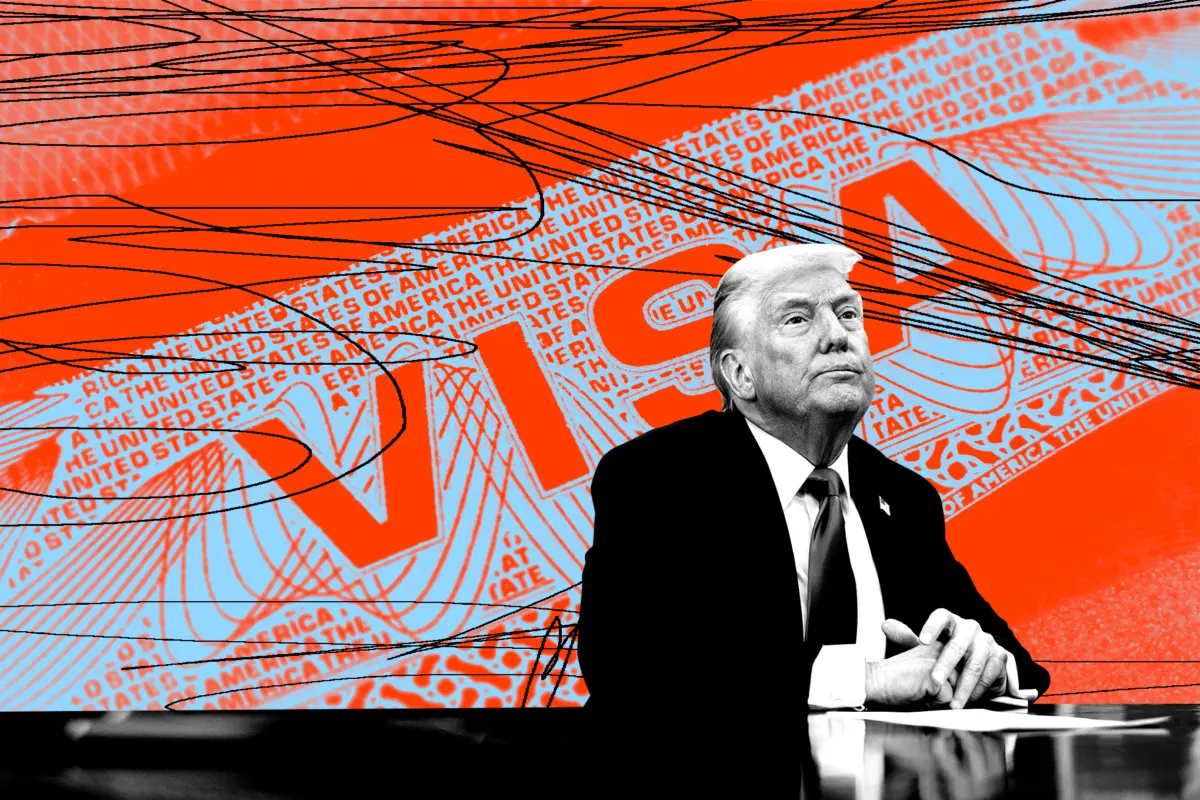
In the span of a single afternoon, the architecture of American immigration policy shifted dramatically, signaling a profound escalation in the second term of President Donald Trump. On a Monday that sent shockwaves through corporate boardrooms, legal clinics, and advocacy groups alike, the Department of Homeland Security (DHS) announced a staggering new fee structure that prices high-skilled H-1B visas at over $103,000 per applicant. Simultaneously, news emerged from the State Department outlining an unprecedented plan to revoke the valid nonimmigrant visas of up to 200,000 asylum seekers already residing within the United States.
According to reports from The Associated Press, this latter initiative represents the largest mass visa revocation in modern U.S. history.
More than a year into President Trump’s second term, a distinct operational reality has crystallized: to achieve the aggressive deportation and demographic reshaping metrics promised on the campaign trail, the administration has realized it cannot rely solely on traditional enforcement mechanisms like Immigration and Customs Enforcement (ICE) raids and detentions. Instead, it is systematically stripping legal immigrants of their status, weaponizing bureaucratic hurdles, imposing punishing civil fines, threatening asset seizures, and fostering an environment of coercive "self-deportation."
This all-of-government approach targets not only prospective arrivals but also individuals who have lived, worked, and built lives in the United States for years. By erecting insurmountable financial and legal barriers across every category of legal immigration—from high-tech labor pools to humanitarian protections—the administration is fundamentally reshaping the American economy and workforce. The long-term consequences threaten to starve critical sectors of essential talent, penalize rural communities already grappling with severe labor shortages, and effectively dismantle the nation’s remaining pathways for humanitarian relief.
Detailed Chronology: A Monday of Unprecedented Policy Shifts
The events of Monday unfolded with a synchronized precision that underscored the administration’s coordinated strategy. The timing left little doubt that the White House is intent on squeezing legal foreign nationals out of the country through prohibitive costs and sudden administrative invalidations.
The day began with the Department of Homeland Security’s formal rollout of the updated H-1B visa pricing schedule. Under the new directive, the cost to secure or renew these high-skilled employment visas was pushed to a prohibitive $103,265. This move follows a contentious legal battle earlier in the year when a federal judge in Boston struck down a previous iteration of the Trump administration’s $100,000 fee hike. However, that judicial intervention came only after more than 70 U.S. businesses had already capitulated and paid the exorbitant sum to retain critical employees. Rather than abandoning the policy, the administration recalibrated, raising the price even higher while simultaneously signaling that the Optional Practical Training (OPT) program for international students would soon face an identical $100,000 tariff.
Hours after the DHS announcement, investigative reporting broke the news regarding the State Department’s sweeping directive. Officials confirmed plans to rescind up to 200,000 business, tourist, and student visas issued between 2016 and 2026 to individuals who subsequently applied for asylum after arriving on U.S. soil.
This one-two punch illustrated the breadth of the administration’s offensive. While the H-1B fee hike targets the economic utility of high-skilled professionals, the visa revocation initiative strikes directly at the heart of the humanitarian legal framework. Together, these actions demonstrate a systematic campaign to close every open door, transforming temporary or legal pathways into dead ends or financial traps.
Supporting Context & Metrics: The Broad Economic and Social Fallout
The administration’s strategy of attrition extends far beyond the corporate campuses of Silicon Valley, generating severe downstream effects across diverse sectors of the American economy.
The Impact on Big Tech and Innovation
H-1B visas have long been viewed as the lifeblood of the American technology sector. Tech giants such as Amazon, Meta, and Microsoft rely heavily on these visas to recruit top-tier engineering and scientific talent from around the globe. While these multi-billion-dollar corporations possess the balance sheets to absorb steep regulatory costs—though even they argue the fees are punitive and counterproductive—the broader tech ecosystem is far more vulnerable.
Industry analysts point out that smaller startups and mid-tier firms cannot compete with these pricing structures. Consequently, top global talent is increasingly bypassing the United States in favor of Canada, the United Kingdom, or European Union nations, taking intellectual property, startup capital, and future tax revenues with them.
Catastrophe in Rural Communities and Public Services
While the narrative surrounding H-1B visas often focuses on software engineers in Seattle or San Francisco, the reality of high-skilled immigration is far more geographically diverse. The previous iteration of the administration’s fee hikes laid bare the devastating impact on non-tech sectors that rely on foreign professionals out of sheer necessity.
Rural hospitals across the United States—struggling with severe physician shortages—have increasingly turned to H-1B holders to staff emergency rooms and specialized care units. Similarly, public school districts in remote regions, such as parts of Alaska, have relied on foreign educators to fill classrooms amid acute local teacher shortages.
For a tech conglomerate, a $100,000 fee is a severe annoyance; for a rural county hospital operating on razor-thin margins or a cash-strapped school district, it is utterly catastrophic. The policy has accelerated the flight of essential professionals from areas that can least afford to lose them, deepening regional disparities in healthcare and education.
The Threat to International Students and the OPT Program
Immigration advocates are now bracing for the anticipated assault on the Optional Practical Training (OPT) program. OPT allows international students graduating from U.S. universities to work in their field of study for 12 months, with extensions of up to 24 months granted to science, technology, engineering, and math (STEM) graduates.
President Trump once publicly promised to attach green cards to university diplomas for international graduates, generating optimism among academic institutions that rely on foreign tuition revenue. However, the current reality diverges sharply from those promises. By hinting at a $100,000 fee for OPT participation, the administration is effectively pricing international students out of post-graduation employment in the U.S., driving them—and their advanced degrees—back to their home countries or to competing international economies.
The Humanitarian Crisis and the Rescission of 200,000 Visas
The State Department’s plan to revoke up to 200,000 valid nonimmigrant visas held by asylum seekers targets individuals who entered the country legally on tourist, business, or student visas before filing for asylum. Under U.S. and international law, individuals must be physically present on U.S. soil to request asylum; there is no legal mechanism to apply from an embassy or consulate abroad.
By punishing individuals who utilized legal entry channels and subsequently pursued their legally guaranteed right to seek asylum, the administration is effectively criminalizing the navigation of the system itself. While the immediate practical effect for many of these individuals—whose asylum cases are already stalled in a multi-year administrative backlog—may be limited to the loss of travel rights, immigration experts warn that this is a psychological and legal prelude to mass deportations. It strips these individuals of any secondary legal standing, rendering them entirely vulnerable to immediate removal should their asylum claims be denied.
Official Statements and Rationales
The administration defends its actions through the lens of border integrity, national security, and the elimination of administrative loopholes.
Articulating the White House’s position on the asylum visa revocations, State Department spokesperson Tommy Pigott offered a direct defense to the press:
"We are coordinating with DHS to identify and revoke the nonimmigrant visas of foreigners who have come to the United States claiming to be short-term visitors, but then file for asylum to stay here permanently."
The administration argues that utilizing a tourist or business visa with the underlying intent of seeking asylum constitutes a subversion of the nonimmigrant visa system. Officials contend that temporary visas are intended strictly for temporary stays, and that individuals seeking permanent protection should utilize designated humanitarian channels—channels that the administration has simultaneously choked off or effectively shuttered.
Conversely, immigrant advocacy groups and legal experts view these justifications as a smokescreen for an ideological campaign of demographic engineering and exclusion.
Todd Schulte, president of FWD.us—an immigration reform organization co-founded in 2013 by prominent tech executives including Mark Zuckerberg—offered a scathing assessment of the administration’s cumulative strategy:
"This is clearly unlawful. We don’t have to guess what this is for. This is to get rid of the OPT and H-1B program, which will have upstream and downstream devastating consequences: companies will be started elsewhere, people will be hired elsewhere."
Schulte emphasized that the administration’s tactics represent a synchronized, multi-agency assault on both employment-based and humanitarian immigration:
"Every single other pathway is harder, outlawed, eliminated, more bureaucratic, more difficult across the board. It’s an all-of-government approach."
Legal scholars have echoed Schulte’s assessment regarding the legality of the measures. Civil rights organizations and immigration bar associations are preparing immediate legal challenges, arguing that the executive branch is exceeding its statutory authority by imposing punitive, de facto prohibitions disguised as administrative fees and retroactive visa revocations.
Future Outlook: Economic Competitiveness and Humanitarian Isolation
As the Trump administration pushes deeper into its second term, the long-term trajectory of American immigration policy points toward unprecedented restrictionism. By making legal pathways financially prohibitive and administratively treacherous, the White House is deliberately manufacturing an environment where remaining in the United States legally becomes nearly impossible for millions of workers, students, and asylum seekers.
The broader implications for the United States are profound. Economically, the systematic dismantling of programs like H-1B and OPT threatens America’s historic status as the global magnet for innovation, scientific research, and entrepreneurial talent. When top-tier engineers, medical professionals, and researchers conclude that the United States is hostile to their presence, global capital and intellectual horsepower will migrate to more welcoming jurisdictions.
Humanitarianly, the targeted revocation of 200,000 visas—combined with ongoing border restrictions, record-low refugee admissions, and discriminatory prioritization metrics favoring specific demographics—signals the virtual extinction of the United States’ historic commitment to providing refuge for the persecuted. The administration has effectively codified a restrictive vision of national identity: one where immigrants are welcome only if they possess extraordinary personal wealth or conform to narrow demographic preferences.
As lawsuits wind their way through the federal judiciary to challenge the legality of the $103,000 H-1B fees and the mass visa revocations, the nation stands at a critical crossroads. The outcome of these legal battles will determine not only the immediate fate of hundreds of thousands of residents and workers, but also the foundational character of the American economy and society for generations to come.
