

Executive Overview
For years, the public narrative surrounding humanoid robotics has been dominated by viral internet videos. Sleek bipedal machines showcase impressive athletic feats—doing backflips, dancing in corporate boardrooms, or delicately folding laundry in idealized laboratory settings. Yet, beneath the polished marketing campaigns lies a sobering economic reality: the vast majority of these humanoid platforms are nowhere near financially viable. They are technological marvels searching for a business model.
Enter Persona AI, a stealth-turned-prominent robotics startup taking a radically pragmatic approach. Founded by industry heavyweights Nicolaus Radford—former head of the Valkyrie program at NASA’s Johnson Space Center and founder of Nauticus Robotics—and Jerry Pratt—former lead of IHMC’s DARPA Robotics Challenge team and former CTO of Figure—Persona AI is bypassing the crowded, high-friction consumer markets. Instead, the company is targeting one of the oldest, most grueling, and economically vital sectors on the planet: heavy industrial manufacturing, specifically shipyard welding.
Rather than attempting to compete in the hyper-saturated, low-margin domain of "unskilled" labor—such as basic warehousing or domestic chores—Persona AI is positioning its humanoids at the intersection of high-value skilled trades and complex tool usage. By focusing on shipyard welding, the company aims to solve a pressing macroeconomic crisis: a crippling labor shortage in global heavy industries where shipyards are operating at historic multi-year backlogs.
This deep-dive investigation explores Persona AI’s strategic pivot, the unique engineering challenges of deploying bipedal robots into messy, unstructured maritime environments, and why this "last-mover advantage" could redefine the commercial future of humanoid robotics.
Detailed Chronology: From NASA and DARPA to Industrial Shipyards
The genesis of Persona AI traces back to a convergence of decades-long robotics research, frustration with the industry’s obsession with consumer novelty, and a calculated reassessment of where automation actually makes financial sense.
2022–2023: The Foundation and Early Exploration
Persona AI was officially founded by Nicolaus Radford and Jerry Pratt, two veterans of the advanced robotics community whose credentials read like a history of modern autonomy. Radford spent years spearheading NASA’s Valkyrie program, designing an advanced superhero-like humanoid intended for deep-space and planetary exploration, before founding Nauticus Robotics. Pratt, meanwhile, spent years leading the Institute for Human and Machine Cognition’s (IHMC) DARPA Robotics Challenge team, later serving as the Chief Technology Officer at humanoid heavyweight Figure.
When IEEE Spectrum first spoke with the co-founders shortly after Persona AI’s inception, the young startup was grappling with the classic identity crisis plaguing early-stage robotics ventures. As Radford candidly admitted in retrospect, "We were all over the place. Warehousing, automotive, we probably even mentioned the home."
Like almost every other well-funded humanoid company at the time, Persona AI initially considered chasing the massive, albeit intensely competitive, markets for general labor in logistics and automotive assembly. However, the founders quickly realized a fundamental flaw in the prevailing industry thesis: simply building a robot that can perform a task is a far cry from building a robot that can generate a sustained, positive return on investment (ROI) for both the manufacturer and the end client.
2024: The Strategic Pivot to Skilled Trades
By early 2024, the leadership team had abandoned the shotgun approach of targeting generalized, unskilled labor pools. They recognized that while consumer and basic warehouse applications sound appealing to venture capitalists, they introduce punishing price pressures and razor-thin margins.
Instead, Persona AI formulated a new thesis centered entirely around skilled trades and tool usage. By targeting expensive, scarce skilled labor—where the economic value added by a successful automation deployment is exponentially higher—the company unlocked a path to immediate profitability. They embraced what Radford terms the "last-mover advantage": observing the missteps, over-promises, and strategic blind spots of the broader humanoid boom, and charting a radically different course.
The Present: Strategic Partnerships in South Korea
Moving from abstract theory to hard execution, Persona AI has secured crucial strategic alignments with global industrial titans. The company has forged high-profile partnerships with HD Hyundai, the world’s largest shipbuilder, and POSCO, one of the world’s leading steel producers, both based in South Korea. Rather than deploying prototypes for public relations stunts, Persona AI is embedding its hardware into real-world industrial supply chains designed to scale into hundreds of units per location.
Supporting Context & Metrics: The Economics and Engineering of Shipyard Welding
To understand why Persona AI chose shipyard welding as its inaugural proving ground, one must examine both the unique physical demands of maritime manufacturing and the precise mechanics of the welding process itself.
Why Welding? The Physics of the Task
Welding is far from a trivial undertaking; it represents one of the pinnacle challenges of industrial automation. As Jerry Pratt notes, "Tool use is pretty difficult. And we want to use the same tools that humans do, which makes it more difficult."
However, welding possesses unique physical characteristics that make it paradoxically well-suited for robotic execution:
- Controlled Velocity: Because metal can only melt and fuse at a finite rate governed by thermodynamics, the top speed for industrial welding is an easily manageable centimeter per second. There are no frantic, high-speed twitch movements required.
- Repetitive Precision: High-quality welding demands millimeter-scale repeated motions over extended periods. While human welders suffer from fatigue, loss of focus, and physical strain, industrial robots thrive on relentless consistency.
- The Scale of Need: In shipbuilding, efficiency is measured not just in speed, but in volume. A single large commercial vessel requires hundreds of kilometers of linear welds. Even if a robot matches human speed rather than exceeding it, the sheer volume of required welds creates a bottomless demand for execution.
Why Bipedal Humanoids over Wheeled or Gantry Systems?
For decades, shipyards have utilized fixed automation, gantry systems, and specialized robotic arms for specific, highly constrained manufacturing tasks. Yet, these systems fail in the complex, unstructured topography of a shipyard under construction.

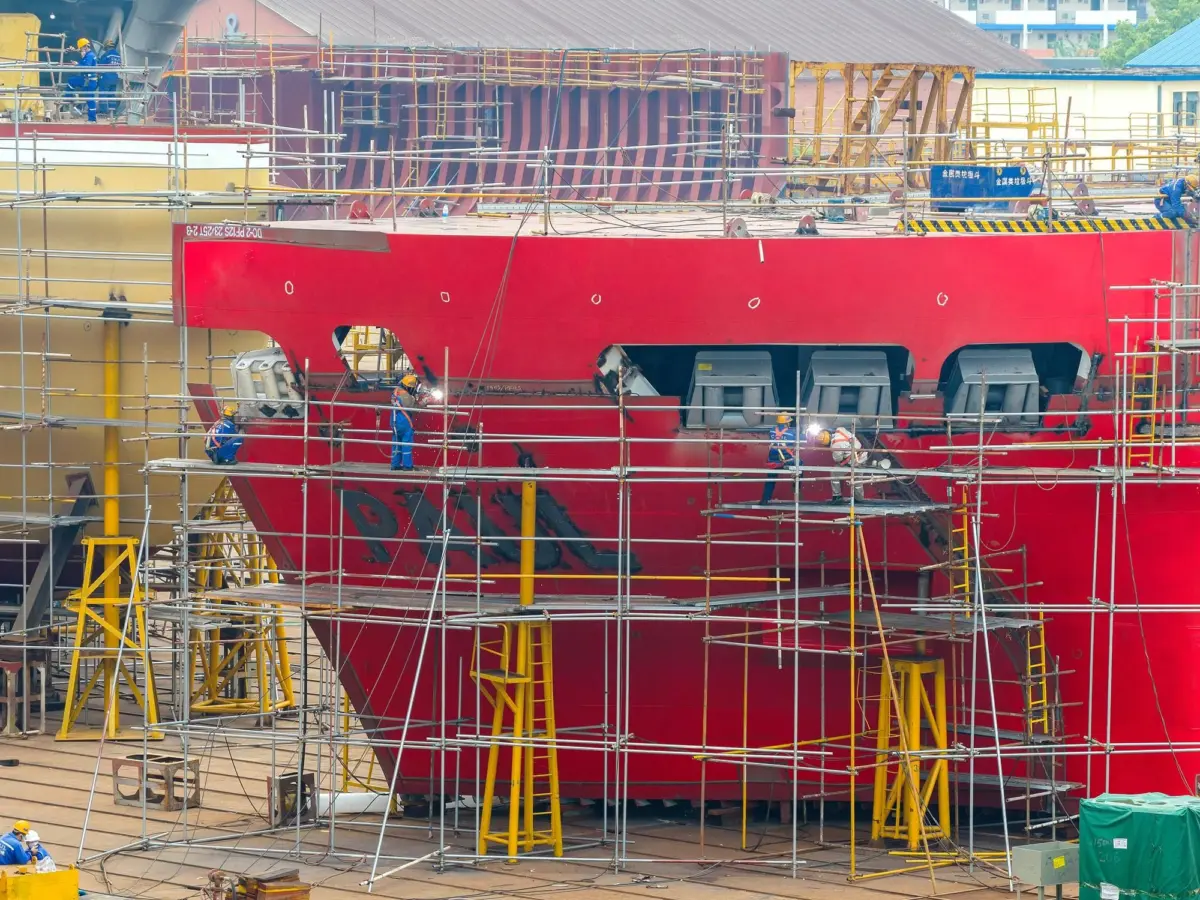
Open-air and dry-dock shipyards span hundreds of meters, littered with horizontal and vertical steel spars, scaffolding, and uneven terrain. Workers must navigate tight spaces, climb ladders, duck through portholes, and operate on slippery, elevated surfaces.
Radford and Pratt evaluated alternative form factors, including quadrupeds and multi-legged crawlers, but ultimately concluded that a two-legged humanoid is the least disruptive form factor to existing shipyard workflows. Because shipyards are explicitly designed around human dimensions, tools, stairwells, and passageways, a humanoid robot can seamlessly integrate into these environments without requiring multi-million-dollar facility redesigns.
Economic Value: Top-Line Revenue vs. Bottom-Line Cost-Cutting
The economic rationale behind Persona AI’s go-to-market strategy defies conventional automation logic. Traditional industrial automation is almost exclusively pitched as a cost-cutting measure: replacing expensive human workers to reduce operational expenditures (the bottom line).
Persona AI, however, is targeting a different economic metric. Global shipbuilders are currently drowning in historic order backlogs; they are severely labor-constrained, unable to hire enough certified human welders to meet surging demand.
As Radford explains, Persona AI’s value proposition is focused on boosting the customer’s top line:
"Our current partnerships are running at a significant backlog, and they’re labor-constrained. So we want to help our customers’ top line, not necessarily their bottom line… Even if our robot was more expensive than a human, that would still be valuable to these companies, because it could unlock additional revenue."
By unlocking otherwise unattainable production capacity, the robots pay for themselves not by displacing workers, but by enabling shipyards to deliver vessels faster and capture millions in untapped revenue.
Furthermore, because shipyards are high-risk industrial environments already populated by trained personnel wearing heavy personal protective equipment (PPE), the safety concerns surrounding bipedal robots—such as occasional hardware faults or balancing issues—are vastly lower than they would be in a consumer household or a retail storefront.
Official Statements and Industry Insights
The philosophy driving Persona AI represents a refreshing departure from the speculative hype cycle dominating the broader artificial intelligence and robotics sectors. Key quotes from the leadership team highlight a shared commitment to grounded, utility-driven engineering:
- On Industry Skepticism: "It hurts us a little bit. We’ve been told that we’re not thinking big enough." — Nicolaus Radford, acknowledging criticism from tech investors who prefer nebulous "general-purpose" consumer dreams over heavy industrial niches.
- On Tool Usage: "Tool use is pretty difficult. And we want to use the same tools that humans do, which makes it more difficult." — Jerry Pratt, emphasizing Persona AI’s commitment to leveraging existing human-grade tools rather than custom-engineered, proprietary effectors.
- On Shared Technical Challenges: "A lot of the technical problems are the same no matter whether you’re in a house or a shipyard. Everybody’s got a great team and smart people, and we’re all knocking these problems out together." — Jerry Pratt, reflecting on the collaborative state of modern humanoid robotics research.
Future Outlook: Building the World’s Largest Repository of Industrial Skills
While shipyard welding serves as Persona AI’s strategic beachhead, the company’s long-term ambitions extend far beyond joining two pieces of structural steel.
Expanding the Industrial Footprint
Once a humanoid platform has successfully mastered linear welding within the confines of a shipyard, the adjacent market opportunities are vast. Jerry Pratt notes that shipbuilding acts as a natural gateway to other heavy fabrication disciplines:
- Grinding and Surface Preparation: A notoriously hazardous, high-vibration task that causes severe repetitive strain injuries in human workers.
- Industrial Painting and Coating: Requiring precise arm articulation and endurance in toxic or confined spaces.
- Structural Assembly and Fitting: Moving beyond welding into material handling, bolting, and collaborative construction.
Ultimately, Radford articulates Persona AI’s ultimate corporate vision with striking clarity: to become the largest repository of industrial skills in the world.
The Road Ahead
Achieving this vision will not happen overnight. The path forward requires thousands of hours of expert human demonstration data collection, the creation of hyper-realistic physics simulations, and rigorous real-world iterative testing in harsh maritime climates.
Persona AI still faces the ultimate trial confronting every humanoid robotics venture: proving that an economically self-sustaining, scalable robotics enterprise can successfully bridge the chasm between promising lab prototypes and profitable factory-floor deployment.
Yet, by anchoring its ambitions in real-world economics, targeting high-value skilled trades where labor deficits are acute, and solving genuine manufacturing bottlenecks for industrial giants like HD Hyundai and POSCO, Persona AI has charted a remarkably sensible course. While other humanoid robots continue to chase internet fame by performing choreographed dance routines, Persona AI’s machines are preparing to punch the clock and earn an honest day’s pay.
