
Executive Overview
The global race for autonomous vehicle (AV) dominance shifted into a higher gear with a landmark partnership announcement between three industry heavyweights: Uber Technologies, Lucid Group, and robotics pioneer Nuro, Inc.
This tripartite alliance aims to disrupt the urban mobility landscape by combining Lucid’s benchmark-setting electric vehicle (EV) engineering, Nuro’s field-tested Level 4 autonomous driving system, and Uber’s unrivaled global ridesharing platform. At the center of this multi-million-dollar agreement is a firm commitment: Uber will invest $300 million in Lucid Group alongside an undisclosed capital injection into Nuro, paving the way for the deployment of 20,000 or more Lucid vehicles equipped with the Nuro Driver system over the next six years.
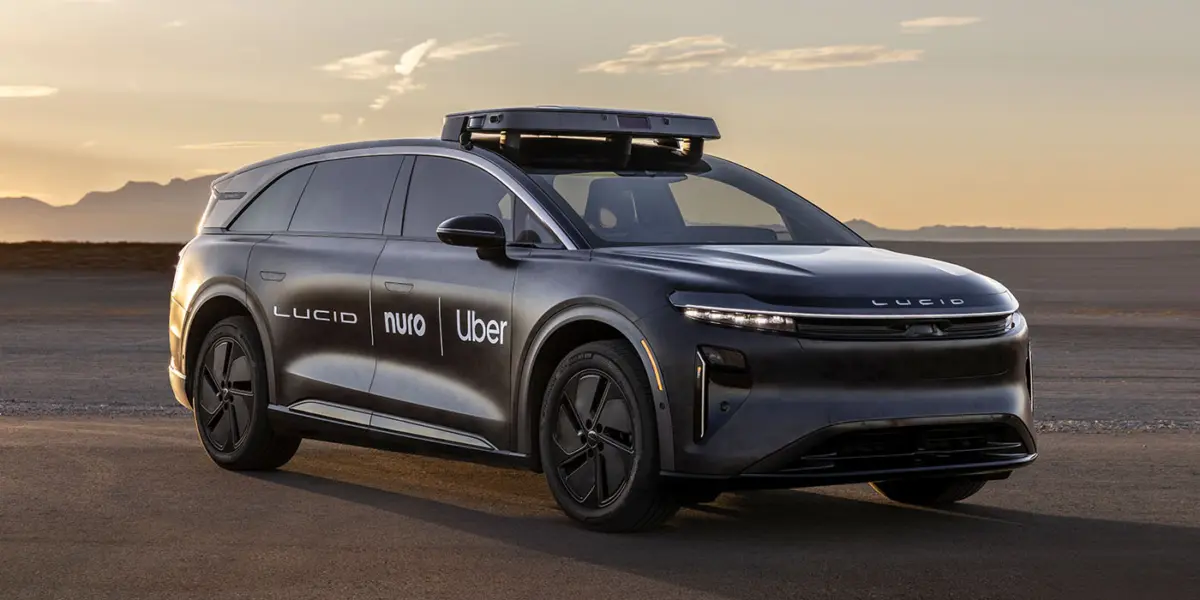
Kicking off in a major United States market as early as 2026, the rollout will initially feature the high-capacity, long-range Lucid Gravity SUV outfitted with advanced sensor suites and AI capabilities. Designed to be operated and maintained via Uber’s expansive fleet management network, these vehicles will be available exclusively through the Uber application.
This strategic move underscores Uber’s aggressive pivot toward an open-ecosystem model for autonomous transit. Rather than building proprietary hardware, Uber is aggressively cementing alliances with best-in-class OEMs (Original Equipment Manufacturers) and artificial intelligence developers. Following recent ventures with May Mobility in Texas and Momenta in Europe, the Lucid-Nuro partnership positions Uber not merely as a ride-hailing app, but as the foundational operating system for the future of global autonomous mobility.
Detailed Chronology: How the Tripartite Deal Came Together
While autonomous vehicle announcements frequently suffer from years of vaporware and delayed timelines, the Uber-Lucid-Nuro collaboration hits the ground running with hardware that already exists and software that has logged millions of validation miles.
Phase 1: Technological Convergence
The genesis of the partnership lies in the complementary strengths of the three enterprises. Lucid Motors, renowned for achieving unprecedented efficiency and range in its luxury EVs, officially launched production of its second flagship vehicle, the Lucid Gravity SUV, following positive industry reception and an EPA range estimated at up to 450 miles.
![Uber to deploy 20,000 Lucid Gravity robotaxis equipped with Nuro Driver, beginning next year [Video]](https://i0.wp.com/electrek.co/wp-content/uploads/sites/3/2025/07/Uber-Lucid-Nuro-Robotaxi-front.jpg?resize=1200%2C628&quality=82&strip=all&ssl=1)
Simultaneously, Nuro—traditionally celebrated for its pioneering work in zero-occupant, autonomous last-mile delivery pods—has systematically refined its AI-enabled "Nuro Driver" system. Having previously established deep integration with Uber through the Uber Eats delivery ecosystem, expanding the Nuro Driver stack to passenger vehicles was a logical evolutionary step.
Phase 2: Closed-Circuit Validation
Long before making headlines, the engineering teams quietly integrated the Nuro Driver autonomy hardware—including LiDAR, radar, cameras, and compute units—onto the architecture of the Lucid Gravity SUV.
This integrated prototype bypassed the drawing board and moved directly to rigorous testing. At Nuro’s dedicated proving grounds in Las Vegas, Nevada, the Nuro-equipped Lucid Gravity has already completed extensive, fully autonomous operations on closed circuits. Prototypes are actively demonstrating safe navigation, dynamic path-planning, and precise localization without human intervention.
Phase 3: The Financial and Operational Agreement
The culmination of these efforts resulted in this morning’s joint announcement. The agreement is structured across multiple tiers:
- Financial Commitment: Uber is investing $300 million directly into Lucid Group, fortifying Lucid’s balance sheet as it scales EV production, alongside a substantial investment in Nuro.
- Fleet Commitment: Uber has committed to deploying a minimum of 20,000 purpose-built Lucid robotaxis over a six-year deployment window.
- Operational Framework: The vehicles will be managed, maintained, and operated across Uber’s network of fleet partners, ensuring maximum vehicle uptime and seamless integration with the existing rideshare infrastructure.
Supporting Context & Metrics: Decoding the Players
To understand the profound market implications of this partnership, one must examine the specific trajectories and technological metrics of the three companies driving the initiative.
Lucid Group: Setting the Standard for EV Efficiency
Lucid Motors has long been praised by automotive journalists and engineers alike for its proprietary powertrain technology, which extracts more miles per kilowatt-hour than almost any competitor on the market. However, transitioning from a boutique luxury manufacturer to a high-volume producer has been a challenging capital-intensive endeavor.
![Uber to deploy 20,000 Lucid Gravity robotaxis equipped with Nuro Driver, beginning next year [Video]](https://electrek.co/wp-content/uploads/sites/3/2025/07/Uber-Lucid-Nuro-Robotaxi-front.jpg?quality=82&strip=all&w=1400)
The launch of the Lucid Gravity SUV represents a critical turning point for the brand. Offering an expansive interior, supercar-like utility, and a targeted 450-mile EPA range, the Gravity provides the ideal physical chassis for a robotaxi. Passenger comfort, rapid charging architecture, and cargo versatility make it uniquely suited for multi-passenger ride-hailing fleets. Furthermore, Uber’s $300 million cash infusion provides Lucid with crucial financial runway and guaranteed volume demand.
Nuro, Inc.: Level 4 Maturity Beyond Delivery
Founded in 2016, Nuro carved out a unique niche in the autonomous vehicle sector by focusing on commercial, zero-occupant delivery vehicles. While competitors stumbled attempting to solve the hyper-complex variables of human-centric robotaxis too quickly, Nuro methodically perfected its Level 4 Nuro Driver system in controlled delivery environments.
Level 4 autonomy means the vehicle can perform all driving functions under specific conditions without human intervention. By transitioning the Nuro Driver stack from lightweight delivery bots to the heavy, passenger-carrying Lucid Gravity, Nuro is proving the scalability and modularity of its AI stack. This partnership marks Nuro’s high-profile entry into the lucrative human passenger transport market.
Uber Technologies: The Orchestrator of Global Mobility
Uber’s strategic evolution over the past decade is a masterclass in corporate adaptability. Having divested its internal Advanced Technologies Group (ATG) years ago to focus on its core software platform, Uber has systematically positioned itself as the universal aggregator for autonomous vehicle developers.
By refusing to marry a single AV provider, Uber can onboard multiple autonomous fleets—such as May Mobility, Momenta, and now Lucid/Nuro—across different geographic regions. This hedges Uber’s risk while ensuring its app remains the ultimate destination for consumers seeking on-demand transit, whether human-driven or autonomous.
| Company | Role in Partnership | Key Contribution |
|---|---|---|
| Lucid Group | Vehicle OEM & Financial Beneficiary | Supplies the Lucid Gravity SUV platform; receives $300M investment. |
| Nuro, Inc. | Autonomy Stack Provider | Integrates the Level 4 AI-enabled "Nuro Driver" hardware and software suite. |
| Uber Technologies | Network Operator & Investor | Funds the partnership, manages fleet operations, and provides the demand platform. |
Official Statements and Industry Perspectives
The announcement drew immediate commentary from executive leadership across all three organizations, highlighting a shared vision for the future of urban transport.
![Uber to deploy 20,000 Lucid Gravity robotaxis equipped with Nuro Driver, beginning next year [Video]](https://electrek.co/wp-content/uploads/sites/3/2025/07/Uber-Lucid-Nuro-Robotaxi-rear.jpg?quality=82&strip=all&w=1024)
Uber CEO Dara Khosrowshahi emphasized the transformative potential of the collaboration:
"Autonomous vehicles have enormous potential to transform our cities for the better. We’re thrilled to partner with Nuro and Lucid on this new robotaxi program, purpose-built just for the Uber platform, to safely bring the magic of autonomous driving to more people across the world."
While the exact timeline for specific markets remains tightly guarded, industry insiders note that the initial deployment cities will likely be chosen based on regulatory friendliness, climate predictability, and existing municipal mapping data. Based on current operational footprints and autonomous testing ecosystems, major urban centers in San Francisco, Las Vegas, and Austin emerge as the most probable candidates for the 2026 launch.
When queried regarding whether Lucid’s flagship sedan, the Lucid Air, might eventually join the robotaxi fleet, Lucid representatives indicated that while the Gravity SUV will spearhead the initiative, the companies maintain the flexibility to "consider future vehicles"—subtly nodding toward Lucid’s upcoming mid-size vehicle platform as production scales.
Future Outlook: The Road to 2026 and Beyond
The formation of the Uber-Lucid-Nuro alliance signals a mature phase in the autonomous vehicle industry. The era of reckless, venture-funded experimentation has largely given way to strategic consolidation, where hardware experts (Lucid), software specialists (Nuro), and demand aggregators (Uber) pool their core competencies.
For consumers, the promise of summoning a luxury, ultra-efficient electric SUV that drives itself via the familiar Uber interface is no longer a distant sci-fi fantasy—it is scheduled for deployment next year.
![Uber to deploy 20,000 Lucid Gravity robotaxis equipped with Nuro Driver, beginning next year [Video]](https://electrek.co/wp-content/themes/ninetofive/dist/images/google-preferred-source-badge-dark.png)
However, significant hurdles remain. Regulatory approvals across dozens of global markets will require meticulous navigation. Safety validation data from Nuro’s Las Vegas proving grounds must translate flawlessly to chaotic, unpredictable urban streetscapes filled with aggressive human drivers, pedestrians, and cyclists. Furthermore, scaling production lines to fulfill a 20,000-vehicle commitment will test Lucid’s manufacturing agility.
If successful, this partnership could fundamentally alter the economics of urban ownership, reducing the necessity of private car ownership while establishing a new gold standard for premium, zero-emission autonomous transit. As the prototype vehicles complete their final laps in Nevada, the countdown to 2026 has officially begun.
