

Executive Overview
The automotive technology landscape shifted fundamentally on December 11, 2026, as Rivian hosted its inaugural AI and Autonomy Day live from Palo Alto, California. Long anticipated since the release of the company’s third-quarter 2025 financial report, the event unveiled a sweeping technological overhaul designed to position the American electric vehicle (EV) maker at the forefront of the autonomous vehicle revolution.
Rivian pulled back the curtain on a comprehensive suite of hardware and software innovations, headlined by its proprietary vision-centric AI silicon chip, the Rivian Autonomy Processor (RAP1), and the Autonomy Compute Module 3 (ACM3). Beyond hardware, the automaker introduced Rivian Unified Intelligence (RUI), a multi-modal, multi-Large Language Model (LLM) data foundation designed to streamline vehicle diagnostics, improve service infrastructure, and power a brand-new, highly anticipated conversational AI assistant.
Perhaps most notably, Rivian staked its claim in the race toward Level 4 autonomy by detailing its Large Driving Model (LDM), an advanced end-to-end neural network trained using Group-Relative Policy Optimization (GRPO). This software architecture will power Universal Hands-Free (UHF) driving across more than 3.5 million miles of roadways in the United States and Canada, accessible via a new subscription service named Autonomy+.
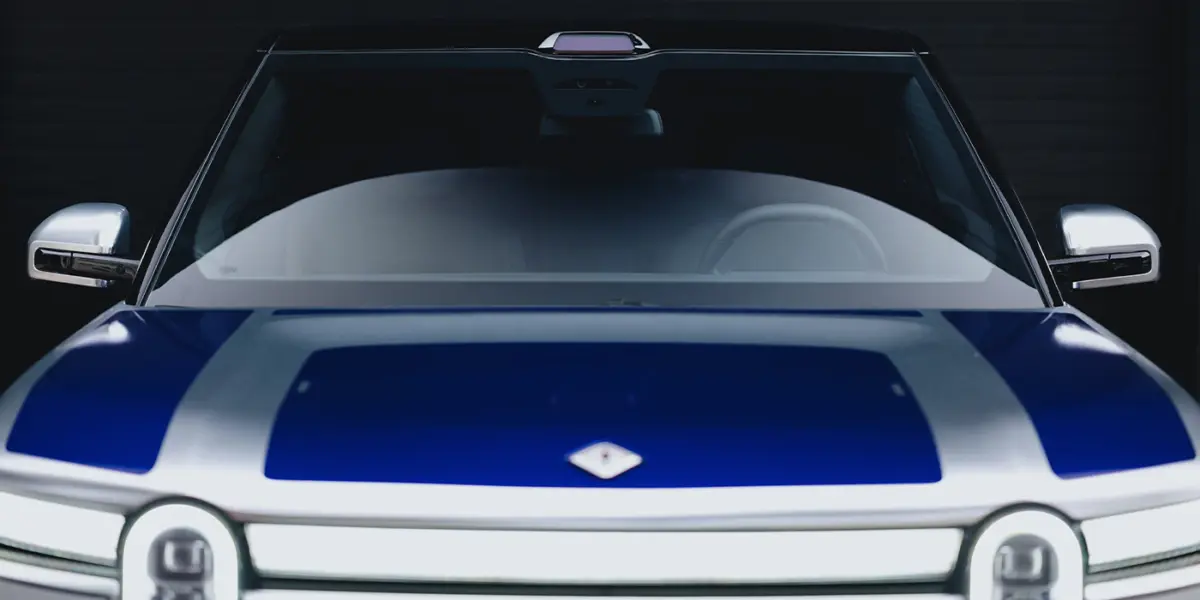
Adding a major plot twist to its sensor strategy, Rivian also showcased an R2 prototype playfully wrapped as Star Wars’ R2-D2 and equipped with LiDAR technology. This confirms that the upcoming, more affordable R2 platform will incorporate LiDAR alongside its camera and radar suites to address complex edge cases in autonomous navigation. Together, these announcements underscore Rivian’s strategic evolution from a pure-play EV manufacturer into a vertically integrated technology and artificial intelligence powerhouse.
Detailed Chronology: From Q3 Teasers to the Palo Alto Reveal
The journey to Rivian’s landmark Palo Alto event began quietly in early November 2025. During the release of its Q3 2025 financial report, the American automaker dropped several subtle yet significant hints about its long-term technological trajectory. Most notably, the company revealed it had quietly founded a new artificial intelligence venture dubbed Mind Robotics, following closely on the heels of its e-bike brand spin-off, ALSO.
When pressed for specifics by automotive journalists and analysts, Rivian’s communications team remained tight-lipped, explicitly instructing stakeholders to hold their questions. The company promised that a dedicated showcase—Rivian’s AI and Autonomy Day—would serve as the official venue for unveiling these clandestine projects. That promise materialized on December 11, 2026, broadcasting live to an audience of investors, tech enthusiasts, and automotive insiders eager to see how Rivian intended to bridge the gap between consumer EVs and advanced autonomy.
![Rivian AI & Autonomy Day: In-house silicon chip, next-gen AI platform, LiDAR for Level 4 self-driving [Video]](https://i0.wp.com/electrek.co/wp-content/uploads/sites/3/2025/12/Rivian-autonomy-R2-LiDAR-front.jpg?resize=1200%2C628&quality=82&strip=all&ssl=1)
The Hardware Leap: RAP1 and ACM3
Kicking off the technical presentations, Rivian introduced its custom-designed silicon strategy. Central to this strategy is the Rivian Autonomy Processor (RAP1), a purpose-built 1,600 sparse TOPS (Tera Operations Per Second) inference chip optimized explicitly for vision-centric AI workloads.
The RAP1 serves as the beating heart of Rivian’s third-generation autonomy computer, known as the Autonomy Compute Module 3 (ACM3). By designing this silicon in-house, Rivian joins an elite tier of automakers—most notably Tesla and select Chinese EV pioneers—that have recognized the necessity of proprietary semiconductor engineering to handle the immense computational loads required for self-driving systems. According to company timelines, this next-generation hardware and its associated software packages are slated to roll out to consumers starting in early 2026.
The Software Core: Rivian Unified Intelligence (RUI)
Rivian’s software ambitions extend far beyond navigation. The automaker debuted Rivian Unified Intelligence (RUI), a unified data architecture that leverages multiple LLMs and multi-modal data streams across the company’s entire business ecosystem.
RUI is engineered to tackle pain points throughout the vehicle lifecycle. On the manufacturing and servicing sides, the platform integrates AI diagnostics to help technicians rapidly identify and remediate complex electrical and mechanical faults. For the end user, RUI powers the brand-new Rivian Assistant, an advanced conversational interface launching in early 2026 for existing Gen 1 and Gen 2 R1 vehicles. This assistant provides hyper-localized vehicle controls, contextual route planning, and natural language query resolution, significantly elevating the cabin user experience.
Supporting Context & Metrics: The Road to Level 4 and Autonomy+
While the consumer-facing AI features captured initial attention, the core engineering meat of the event centered on Rivian’s pursuit of Level 4 autonomous driving capabilities—a stage of automation where a vehicle can handle all safety-critical driving functions under specified conditions without human intervention.
Training the Large Driving Model (LDM)
To achieve this milestone, Rivian has pivoted away from traditional rule-based programming in favor of a Large Driving Model (LDM). Trained in a fashion analogous to Large Language Models, the LDM absorbs massive datasets of human driving behavior to learn optimal navigation strategies.
![Rivian AI & Autonomy Day: In-house silicon chip, next-gen AI platform, LiDAR for Level 4 self-driving [Video]](https://electrek.co/wp-content/uploads/sites/3/2025/12/Rivian-autonomy-R2-LiDAR-front.jpg?quality=82&strip=all&w=1400)
To refine this model, Rivian utilizes Group-Relative Policy Optimization (GRPO), an advanced reinforcement learning technique that evaluates multiple trajectory outputs simultaneously, selecting the safest and most efficient path. This data loop allows the LDM to rapidly adapt to unpredictable real-world scenarios.
Universal Hands-Free (UHF) and Autonomy+
The immediate beneficiary of this training architecture is Rivian’s Universal Hands-Free (UHF) driving feature. Set to deploy to Gen 2 R1 models via software updates, UHF will unlock hands-free operation across an expansive footprint of more than 3.5 million miles of mapped roads throughout the US and Canada.
To monetize these advanced driver-assistance systems (ADAS), Rivian introduced Autonomy+, a dedicated subscription service launching in early 2026. Owners can unlock Autonomy+ and its ongoing algorithmic improvements either through a one-time lifetime fee of $2,500 or via a recurring monthly subscription of $49.99.
Longer-term roadmap teasers indicated that Autonomy+ is the foundational stepping stone toward point-to-point, eyes-off, and personal Level 4 driving capabilities across both Gen 2 R1 vehicles and the upcoming R2 platform.
The LiDAR Plot Twist on the Rivian R2
Perhaps the most visually striking moment of the event occurred when an upcoming Rivian R2—cleverly wrapped in an R2-D2 Star Wars livery—took center stage. Beneath the playful exterior lay a critical technological pivot: the R2 was outfitted with LiDAR (Light Detection and Ranging) sensors.
For years, the EV industry has been deeply fractured over the necessity of LiDAR. While companies like Tesla and, more recently, XPeng have doubled down on pure-vision camera architectures, a significant portion of the automotive sector maintains that LiDAR is indispensable for true autonomous safety. Rivian’s confirmation that it will integrate LiDAR into future R2 models alongside the ACM3 signals a pragmatic, multi-modal sensor strategy.
![Rivian AI & Autonomy Day: In-house silicon chip, next-gen AI platform, LiDAR for Level 4 self-driving [Video]](https://electrek.co/wp-content/uploads/sites/3/2025/12/Rivian-autonomy-AI-assistant.jpg?quality=82&strip=all&w=1024)
According to Rivian engineers, LiDAR will augment the vehicle’s camera and radar suites by providing high-resolution, three-dimensional spatial data. This redundancy is vital for real-time object detection, particularly in low-visibility edge cases—such as heavy rain, snow, or blinding glare—where camera-only systems can occasionally struggle.
Official Statements and Industry Insights
The gravity of Rivian’s announcements was underscored by comments from company leadership, most notably Founder and CEO RJ Scaringe. In his keynote address, Scaringe emphasized the transformative nature of the company’s technological pivot:
"I couldn’t be more excited for the work our teams are driving in autonomy and AI. Our updated hardware platform, which includes our in-house 1,600 sparse TOPS inference chip, will enable us to achieve dramatic progress in self-driving to ultimately deliver on our goal of achieving L4. This represents an inflection point for the ownership experience—ultimately being able to give customers their time back when in the car."
Industry analysts have been quick to dissect the strategic implications of Rivian’s announcements. By developing proprietary silicon, custom software stacks, and a multi-modal sensor suite that includes LiDAR, Rivian is deliberately mirroring the playbook of high-value technology companies rather than traditional Tier-1 automotive suppliers.
Owning the intellectual property (IP) for both its hardware architecture and its AI software gives Rivian immense flexibility. Much like Tesla’s energy and autonomy ventures, or Lucid’s proprietary powertrain engineering, Rivian’s vertically integrated approach creates multiple pathways for future monetization. This could range from direct consumer software subscriptions like Autonomy+ to lucrative B2B licensing agreements—a strategy already validated by Rivian’s multi-billion-dollar joint venture with the Volkswagen Group, which encompasses upcoming vehicles from Scout Motors.
Furthermore, pure-play battery-electric vehicle (BEV) startups enjoy structural freedoms that legacy original equipment manufacturers (OEMs) simply do not possess. While legacy automakers must frantically split their research and development budgets across internal combustion engines (ICE), hybrids, plug-in hybrids (PHEVs), and BEVs, companies like Rivian can focus 100% of their capital on software-defined electric architectures.
![Rivian AI & Autonomy Day: In-house silicon chip, next-gen AI platform, LiDAR for Level 4 self-driving [Video]](https://electrek.co/wp-content/themes/ninetofive/dist/images/google-preferred-source-badge-dark.png)
Future Outlook: What Lies Ahead for Rivian
As the dust settles on the Palo Alto stage, the immediate task for Rivian shifts from theoretical engineering to real-world execution. The success of AI and Autonomy Day will ultimately be judged by how seamlessly these systems transition from staging environments into the driveways of everyday consumers.
The rollout timeline is aggressive:
- Early 2026: Launch of the Rivian Assistant on Gen 1 and Gen 2 R1 vehicles.
- Early 2026: Official debut of the Autonomy+ subscription tier ($2,500 lifetime or $49.99/month) unlocking Universal Hands-Free driving across 3.5 million miles of North American roadways.
- Mid-to-Late 2026 and Beyond: Integration of the ACM3 computer and LiDAR sensor suites into the mass-market R2 platform, laying the hardware foundation for future Level 4 deployments.
For current owners of Gen 2 R1S and R1T models, the prospect of downloading continuous software improvements that grant genuine, hands-free highway capability marks a thrilling new chapter in EV ownership.
Rivian has officially laid its cards on the table. By betting big on in-house silicon, multi-modal sensor arrays featuring LiDAR, and sophisticated AI data loops, the company is proving it is willing to play the long game. If Rivian can successfully deliver on these ambitious software and hardware promises, it will not only cement its status as a premier American EV brand but also redefine what consumers expect from a modern, software-defined vehicle.
