

Executive Overview
The debate surrounding the viability, safety, and societal integration of full-fledged autonomous robotaxis has long been clouded by skepticism, fear, and cultural resistance. While industry visionaries point toward a cleaner, more efficient, and undeniably safer future of urban mobility, everyday commuters continue to harbor deep-seated anxieties about relinquishing control to lines of code and computer vision systems. From local protests—famously symbolized by disgruntled residents placing orange traffic cones on autonomous hoods—to broader public distrust, the road to widespread autonomy has been fraught with psychological and political hurdles.
However, a monumental new empirical study is poised to decisively shift the narrative. Waymo, the autonomous driving subsidiary of Google’s parent company Alphabet Inc., has partnered with global reinsurance giant Swiss Re to release a landmark safety analysis. Utilizing an unprecedented dataset of hundreds of thousands of liability claims, the study evaluates the real-world performance of the "Waymo Driver" platform across 25.3 million fully autonomous miles.
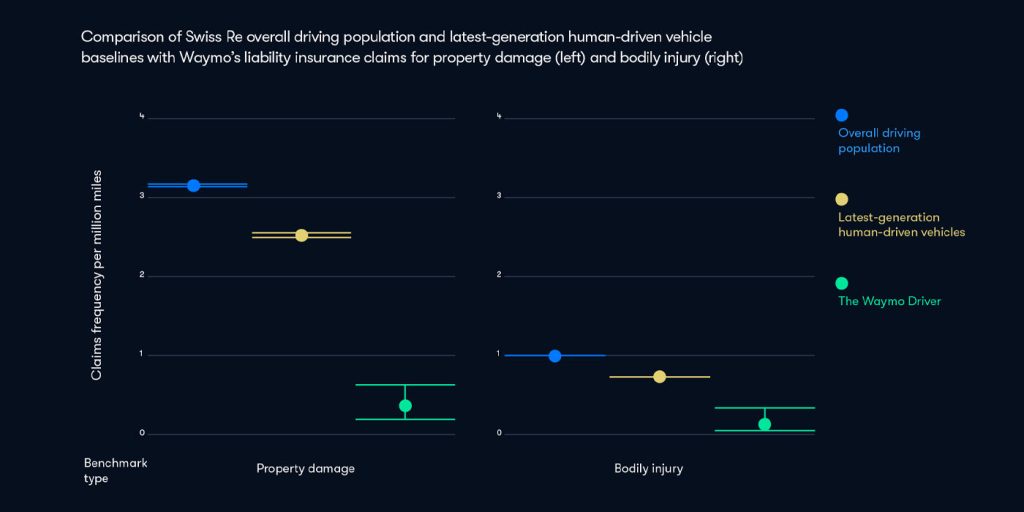
The findings are not merely incremental; they are staggering. According to the data, Waymo’s autonomous fleet achieves an 88% reduction in property damage claims and a 92% reduction in bodily injury claims compared to baseline human-driven vehicles. Even when benchmarked against the most modern, technologically advanced human-driven vehicles equipped with robust Advanced Driver Assistance Systems (ADAS)—such as automatic emergency braking, forward collision warnings, and lane-keeping assist—Waymo still commands an astonishing 86% reduction in property damage claims and a 90% reduction in bodily injury claims.
This comprehensive, independently coordinated research effectively dismantles the prevailing safety stigma surrounding autonomous vehicles (AVs). As Waymo aggressively expands its domestic footprint in major U.S. metropolitan areas and prepares for international deployments—such as its upcoming launch in Tokyo in early 2025—this study provides the hard, actuarial data needed to prove that the future of transportation has arrived, and it is exponentially safer than our own hands behind the wheel.
Detailed Chronology: The Evolution of Waymo and the Path to Empirical Validation
To understand the weight of the Swiss Re study, one must examine the trajectory of Waymo and the turbulent landscape of the autonomous vehicle industry over the past several years.
The Humble Beginnings: From Google X to Commercial Reality
Waymo’s journey began in 2009 as the Google Self-Driving Car Project, an ambitious research initiative housed within Google’s secretive X laboratory. At a time when autonomous driving was treated as science fiction, engineers began logging public road miles in modified Toyota Priuses and Lexus SUVs. By December 2016, the project graduated from a research incubator to become Waymo LLC, an independent subsidiary under the Alphabet corporate umbrella.
As the technology matured, Waymo transitioned from closed-course testing to commercial deployment. It pioneered public robotaxi services, launching Waymo One in Phoenix, Arizona, before expanding systematically into dense urban environments characterized by chaotic traffic, aggressive drivers, unpredictable pedestrians, and complex infrastructure—including San Francisco, Los Angeles, Austin, and Atlanta.
Industry Turbulence and Public Pushback
While Waymo methodically scaled its operations, the broader autonomous vehicle sector experienced wild oscillations of triumph and crisis. Competitors faced severe regulatory setbacks, high-profile software glitches, and catastrophic accidents that shook public confidence. Most notably, rival robotaxi developer Cruise (owned by General Motors) suffered a severe crisis in late 2023 following an accident involving a pedestrian, leading to sweeping safety recalls, voluntary fleet groundings, executive departures, and internal algorithmic reviews that uncovered critical blind spots regarding vulnerable road users like children.
These industry-wide hiccups fueled a wave of public backlash. In cities like San Francisco, a subculture of anti-AV activism emerged. Protesters weaponized mundane objects—most famously orange traffic cones—placing them on the hoods of autonomous vehicles to temporarily disable their sensors and immobilize them. Critics argued that robotaxis were intrusive, unpredictable, and unproven, feeding into a generalized public anxiety about artificial intelligence taking over critical human tasks.
The Turning Point: Embracing Actuarial Science
Despite regional friction and high-profile industry failures, Alphabet continued to bank heavily on Waymo, pouring capital into hardware redundancy, sensor suites (combining LiDAR, radar, and high-definition cameras), and advanced machine learning models.
Realizing that public relations campaigns and internal safety reports would never fully convince a skeptical populace, Waymo sought an unimpeachable third-party arbiter to evaluate its safety record. Enter Swiss Re. As one of the world’s leading reinsurance providers, Swiss Re evaluates risk on a macro scale, relying on hard mathematical models, massive historical datasets, and uncompromising actuarial science. The collaboration—conducted purely as an academic and research-driven partnership with zero financial compensation exchanged between the parties—aimed to analyze Waymo’s collision-related liability claims across 25.3 million miles of fully autonomous driving, setting the stage for the most rigorous safety evaluation in the history of autonomous transit.
Supporting Context & Metrics: What the Swiss Re Data Actually Reveals
The core strength of the Waymo-Swiss Re study lies in its methodology. Rather than relying solely on manufacturer-reported collision logs—which can sometimes be subjective or lack contextual baselines—the researchers utilized auto liability claims aggregate statistics as a direct proxy for at-fault collisions and overall risk exposure.
Insurance claims data is the gold standard for assessing risk because every claim represents a tangible financial loss, property destruction, or physical injury that underwent rigorous financial and legal scrutiny.
The Numbers That Change the Game
Swiss Re compared Waymo’s 25.3 million miles of autonomous operations against its own massive internal databases, which comprise over 500,000 liability claims and more than 200 billion miles of human driver exposure. The statistical contrast is stark:
- Property Damage Claims: Over the course of 25.3 million miles, vehicles powered by the Waymo Driver platform were involved in a mere nine property damage claims. When scaling that exact distance against baseline human driving data, Swiss Re calculated that an average human driver would be expected to generate 78 property damage claims—representing an 88% reduction in risk.
- Bodily Injury Claims: Across the same 25.3 million miles, Waymo vehicles recorded just two bodily injury claims (both of which remain legally open). For an identical distance, human drivers would statistically rack up 26 bodily injury claims—translating to a massive 92% reduction.
Beating the Best Human-Driven Technology
Skeptics often argue that comparing autonomous vehicles to all human drivers is unfair, pointing out that older, poorly maintained cars lack modern safety features. To address this, Swiss Re specifically filtered its baseline to isolate newer vehicle models (manufactured between 2018 and 2021) that come fully equipped with robust Advanced Driver Assistance Systems (ADAS), including automatic emergency braking (AEB), forward collision warnings (FCW), and active lane-keeping assistance.
Even when pitted against the most advanced human-operated consumer vehicles on modern roadways, the Waymo Driver dominated:
- An 86% reduction in property damage claims compared to modern ADAS-equipped human vehicles.
- A 90% reduction in bodily injury claims compared to the same cohort.
The Question of Fault
A critical nuance in evaluating AV safety is determining who caused a collision. Even the safest vehicle in the world can be struck from behind by an aggressive human driver. Waymo’s supplementary safety impact data indicates that across its 25.3 million fully autonomous miles, the vast majority of incidents involving Waymo vehicles were caused by human error on the part of other motorists, with Waymo having zero responsibility in a commanding majority of the cases.
Official Statements and Industry Perspectives
The release of the pre-print study—which has been submitted to a peer-reviewed scientific journal—has sent ripples through the automotive, tech, and insurance sectors. Industry leaders and safety advocates have weighed in on what this means for the future of transportation infrastructure.

Mauricio Peña, Waymo’s Chief Safety Officer, emphasized the unique and pioneering nature of the methodology in a corporate blog post:
"Auto insurance claims data, traditionally used to assess human driver liability and risk, is a powerful tool in evaluating the safety performance of autonomous vehicles. This is a truly groundbreaking study that not only validates the Waymo Driver’s strong safety record, but also provides a scalable framework for ongoing assessment of the impact autonomous vehicles make on road safety."
By framing insurance data as an objective yardstick, Peña highlights how the autonomous vehicle industry can finally move past anecdotal arguments and subjective impressions.
Furthermore, independent insurance analysts have noted that the implications of this study extend far beyond urban mobility services. If autonomous platforms can consistently demonstrate an 80% to 90% reduction in liability claims, the long-term impact on global insurance markets, policy premiums, and municipal infrastructure spending will be profound. Fleet operators could see drastically reduced operational overhead costs related to insurance liabilities, paving the way for faster economic scaling.
Future Outlook: Overcoming the Psychological and Regulatory Hurdles
Despite the undeniable weight of the Swiss Re data, experts agree that establishing superior safety metrics is only half the battle. Winning over the hearts and minds of the general public remains the final frontier for widespread robotaxi adoption.
The Education Gap
Much like the early days of electric vehicle (EV) adoption—where range anxiety, charging infrastructure myths, and unfamiliarity created steep resistance—the robotaxi sector suffers from an education gap. It is an inherent trait of human psychology for individuals to overestimate their own driving competencies. Most people believe they possess above-average driving skills, making them instinctively distrustful of an invisible algorithm making split-second decisions on busy city streets.

However, advocates argue that as data like Swiss Re’s study permeates mainstream consciousness, public perception will inevitably shift. When passengers realize that stepping into a driverless cabin significantly lowers their statistical exposure to property damage and bodily injury, fear will gradually be replaced by consumer preference.
Global Expansion and the Road Ahead
Waymo’s aggressive expansion strategy underscores its internal confidence. Domestically, the company continues to weave its autonomous network deeper into the fabric of major American cities. Globally, the horizon is expanding just as rapidly. Waymo’s planned commercial rollout in Tokyo, Japan, slated for early 2025, represents a monumental leap into ultra-dense, complex international markets with unique driving cultures, narrow streets, and stringent regulatory frameworks.
As Waymo scales globally, it carries with it a new class of empirical validation. The Swiss Re study proves that collisions will still happen—physics cannot be entirely rewritten, and occasional human unpredictability will always pose external risks—but the frequency and severity of those incidents pale in comparison to human-operated vehicles.
Ultimately, the data does not lie. The autonomous vehicle industry has transitioned from an era of speculative prototyping into a proven, mathematically validated reality. The question is no longer if robotaxis are safer than human drivers, but how quickly society will embrace the life-saving technology waiting at the curb.
