

Executive Overview
The intersection of artificial intelligence, advanced materials science, and bipedal locomotion engineering has crossed a historic threshold. At the ongoing World Humanoid Robot Games in Beijing, history was quietly and thunderously rewritten—not by human flesh and bone, but by titanium actuators, optimized neural networks, and high-performance battery packs.
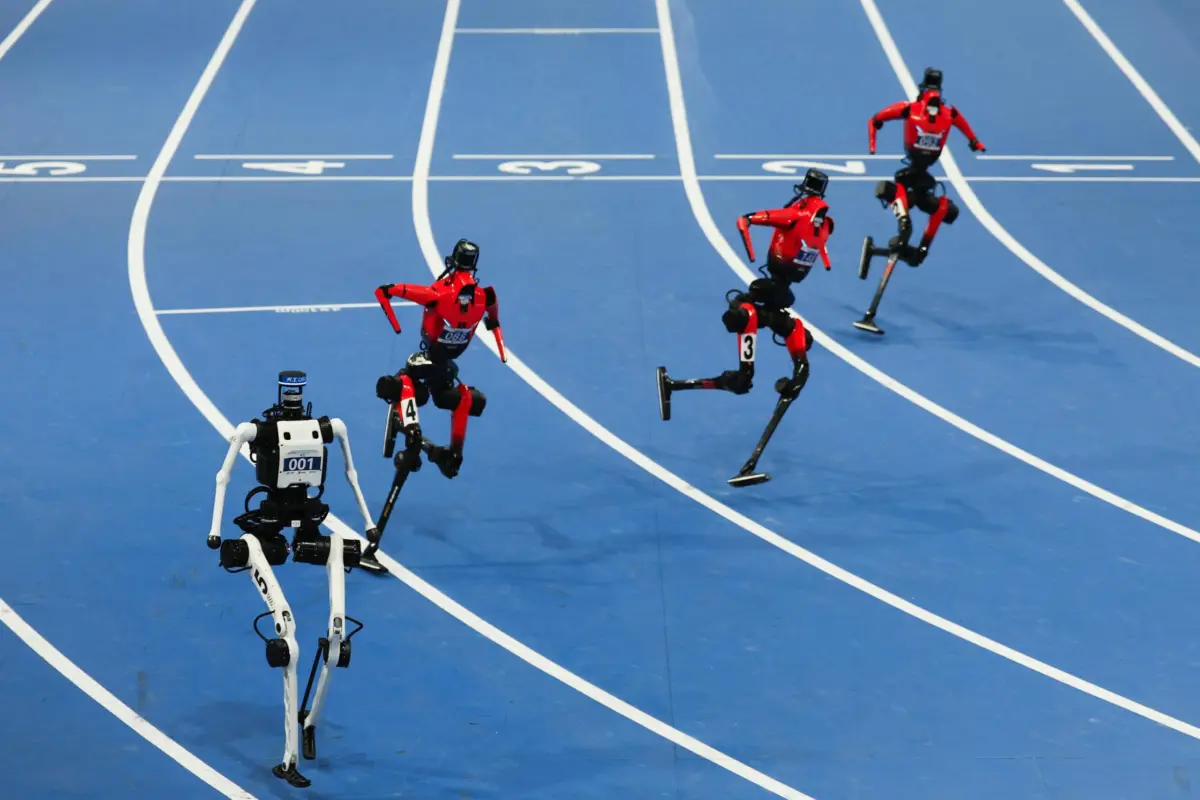
In a staggering display of athletic engineering during the preliminary heats, the Tiangong Ultra—a state-of-the-art bipedal machine developed by the Beijing Humanoid Robot Innovation Center—obliterated one of the most revered records in human sporting history. Tiangong Ultra scorched the 100-meter dash in a blistering 9.39 seconds, easily eclipsing the legendary 9.58-second world record set by Jamaican track icon Usain Bolt at the 2009 World Athletics Championships in Berlin. Close behind was Lightning, a competing robot developed by Honor, which crossed the finish line at 9.47 seconds—also well under Bolt’s historic benchmark.
The assault on human athletic supremacy did not stop at the century sprint. In the 400-meter event, Tiangong Ultra returned to the track to post a time of 38.16 seconds, shattering the long-standing human world record of 43.03 seconds established by South Africa’s Wayde van Niekerk at the 2016 Rio Olympics.
These feats occurred at the World Humanoid Robot Games, an annual international exhibition often dubbed the "Robot Olympics." Established in 2025, the event has rapidly evolved from a niche engineering showcase into a multi-disciplinary global spectacle. This year’s competition features over 2,056 robots representing 16 countries, competing across diverse athletic disciplines that range from sprinting and high jumping to autonomous soccer and robotic boxing.
Yet, while these technological marvels can outpace the fastest humans alive, the event offers a stark reminder of the mechanical realities of robotics: high-speed collisions, structural failures, and robots careening into padded arena walls to be carted away on stretchers underscore that the path to hyper-velocity automation remains perilous, messy, and deeply compelling.
Detailed Chronology: A Weekend of Broken Records in Beijing
The events leading up to the record-breaking weekend at the Beijing arena unfolded against a backdrop of intense international rivalry and rapid iterative testing. Laboratories across Asia, North America, and Europe have spent the past decade refining bipedal movement—a notoriously difficult problem in robotics due to the complex mathematics of maintaining dynamic balance while propelling a machine forward at high velocities.
Saturday Morning Preliminaries: The 100-Meter Heats
The tension in the Beijing stadium was palpable on Saturday morning as teams ran their final pre-heat diagnostics. The 100-meter sprint is considered the ultimate test of acceleration, power-to-weight ratio, and closed-loop balance control.
When the starting signal fired, the visual contrast between human and machine running styles became immediately apparent. Unlike human sprinters who utilize a fluid, rolling stride and explosive blocks, the top-tier humanoid robots deployed hyper-frequency, rigid-joint cadences. Their hips, knees, and ankles articulated with mechanical precision, producing a whirring auditory backdrop that drowned out the crowd’s cheers.
- Heat 3, Lane 4: The Tiangong Ultra launched from the blocks with an aggressive forward lean, its onboard LiDAR and inertial measurement units (IMUs) calculating spatial corrections hundreds of times per second. It crossed the finish line in 9.39 seconds.
- Heat 3, Lane 7: Honor’s Lightning, utilizing an alternative lightweight composite chassis and proprietary balance algorithms, posted a formidable 9.47 seconds.
Both times comfortably surpassed Usain Bolt’s 9.58-second record, which has stood unchallenged since August 16, 2009. The stadium scoreboards flashed the times to stunned silence followed by roaring applause from engineering teams, industry analysts, and international press corps.
The 400-Meter Endurance Test
While the 100-meter sprint highlights raw explosive acceleration, the 400-meter race introduces the compounding challenge of thermal management, power distribution, and structural fatigue.
Later in the weekend, Tiangong Ultra was deployed for the 400-meter event. Maintaining a terrifyingly consistent stride frequency, the robot swept around the curve of the track and powered down the home stretch. It crossed the finish line in 38.16 seconds, obliterating Wayde van Niekerk’s 2016 global standard of 43.03 seconds by nearly five full seconds.
However, the 400-meter event also highlighted the brutal limits of current machine hardware. Several competing models suffered catastrophic motor overheating, gear stripping, and battery management system (BMS) faults before reaching the halfway mark, highlighting the vast engineering chasm between elite contenders like Tiangong and the broader field.
Supporting Context & Metrics: Inside the Technology of Robotic Speed
To understand how these machines outpaced biological limits, one must examine the convergence of hardware engineering and advanced machine learning models that power modern bipedal systems.
The Anatomy of a Record-Breaking Runner
Human sprinters are constrained by biological limits: muscle tear thresholds, oxygen uptake rates ($textVO_2text max$), and the speed at which nerve impulses travel through the spinal cord. Robots face an entirely different set of physical bottlenecks—primarily power-to-weight ratios, traction dynamics, and actuator torque limits.

- Actuation & Torque: Traditional hydraulic actuators have largely been supplemented or replaced in sprinting bots by high-torque brushless DC motors paired with planetary gearboxes. These allow for instantaneous directional changes and explosive foot-strike forces that exceed human muscle output.
- Algorithmic Balance Control: Reinforcement learning (RL) trained in simulated environments allows these robots to adapt to slip, uneven track surfaces, and kinetic shocks in real-time. Rather than relying on rigid pre-programmed gaits, machines like Tiangong Ultra continuously optimize their center of mass relative to their velocity vector.
- Weight Optimization: Carbon-fiber composites, aerospace-grade aluminum alloys, and topology-optimized 3D-printed titanium frames reduce total mass while maximizing structural rigidity, minimizing the energy required to accelerate limbs back and forth at high frequencies.
Comparative Performance Metrics
| Metric / Event | Human Record Holder | Record Time | Robot Record Holder | Robot Time | Performance Delta |
|---|---|---|---|---|---|
| 100-Meter Dash | Usain Bolt (2009) | 9.58s | Tiangong Ultra (2026) | 9.39s | -0.19 seconds |
| 400-Meter Run | Wayde van Niekerk (2016) | 43.03s | Tiangong Ultra (2026) | 38.16s | -4.87 seconds |
| Stride Frequency | ~4.3 steps/sec (Human elite) | N/A | ~8.5 steps/sec (Tiangong) | N/A | Nearly double |
The "Carnage" Factor: Deceleration and Structural Failure
Watching bipedal robots run at nearly 38 kilometers per hour is an experience that straddles the line between awe-inspiring and deeply unsettling. Their limbs move with an erratic, insectoid stiffness, completely devoid of the elastic grace seen in biological runners.
More alarmingly, these machines lack human survival instincts and real-time sensory anticipation for crash physics. When a robot crosses the finish line, stopping safely is a formidable engineering challenge. Throughout the Beijing preliminaries, several high-speed machines failed to decelerate adequately within the designated run-off zones.
Viral video clips from the event showcase multiple humanoid robots colliding with heavy cushioned arena barriers at near-maximum velocity. The resulting impacts routinely send carbon-fiber limbs, lithium-ion battery modules, and sensor suites scattering across the track. Technicians and handlers can frequently be seen rushing onto the field with equipment dollies and stretchers to collect the shattered remains of multimillion-dollar prototypes—a darkly humorous spectacle that underscores how far the technology still has to go in terms of operational reliability.
Official Statements and Industry Impact
The achievements in Beijing have sent shockwaves through both the global robotics industry and the broader athletic community. While sports purists emphasize that mechanical achievements cannot be equated with biological athletic glory, technology analysts view the event as an invaluable stress test for commercial automation.
Dr. Chen Wei, lead systems architect at the Beijing Humanoid Robot Innovation Center, addressed the press following Tiangong Ultra’s record-breaking runs:
"Breaking human sprinting records was never our primary psychological benchmark, but rather a rigorous stress test for our dynamic locomotion controllers. When a bipedal system can maintain stability, thermal equilibrium, and precise foot placement at over nine meters per second, it proves that our spatial awareness and torque-response frameworks are reaching industrial maturity. The lessons learned on this running track will directly translate to logistics, disaster response, and autonomous mobility in unpredictable human environments."
Market analysts point out that events like the World Humanoid Robot Games serve as an aggressive market map. John Koetsier, writing for Forbes, noted that the games act as a public crucible where venture capitalists, defense contractors, and consumer electronics giants gauge the real-world viability of competing actuator designs, power systems, and edge-computing chips.
When consumer tech giants like Honor—traditionally known for smartphones and personal computing—field competitive sprinters like Lightning, it signals an aggressive diversification strategy. The software and hardware pipelines required to run a 100-meter dash in under 9.5 seconds share a direct lineage with the spatial computing, sensor fusion, and low-latency motor control systems demanded by next-generation consumer robotics.
Future Outlook: Beyond the Track
As the World Humanoid Robot Games progress toward their grand finals, the broader implications of these achievements are already coming into focus.
1. From Exhibition Tracks to Industrial Deployment
While sprinting at 38 km/h is an impressive party trick, the core technologies being refined in Beijing—rapid energy discharge, advanced fall-recovery algorithms, and ultra-fast balance correction—are directly applicable to real-world deployment. Warehouses, construction sites, and hazardous disaster zones require bipedal robots that can navigate dynamic, unstructured terrain without tipping over or burning out their actuators.
2. The Evolution of Robotic Competitions
The rapid scaling of the World Humanoid Robot Games—now hosting over 2,000 entrants across 16 nations—indicates that competitive robotics is poised to become a permanent fixture on the global entertainment and technological calendar. Future iterations are expected to introduce more complex multi-agent sports, such as full-contact autonomous soccer and multi-terrain obstacle navigation, further driving hardware durability.
3. The Philosophical Boundary Between Man and Machine
As machines continue to eclipse human biological capabilities across standardized athletic metrics, society faces a growing philosophical question. Athletics has long served as the ultimate canvas for human expression, suffering, and triumph. When a machine built from titanium and rare-earth magnets crosses a finish line faster than any human in history, it redefines our relationship with performance.
Yet, as long as those same record-breaking machines continue to end their races in catastrophic crashes against arena walls, the irreplaceable value of human resilience, adaptability, and biological engineering remains secure. For now, the robots may own the stopwatch, but humanity retains the monopoly on walking away from the finish line under its own biological power.
