

Executive Overview
The debate surrounding the viability, safety, and societal integration of fully autonomous vehicles has long been clouded by skepticism, fear, and high-profile growing pains. While proponents herald robotaxis as the future of sustainable, zero-emission urban mobility, detractors point to stalled vehicles, sporadic traffic disruptions, and an innate human aversion to ceding control to algorithms. However, a landmark study released by autonomous driving pioneer Waymo—conducted in an independent research partnership with global reinsurance giant Swiss Re—seeks to definitively put these safety anxieties to rest.
Analyzing an unprecedented pool of collision-related liability claims drawn from 25.3 million fully autonomous miles driven by the Waymo Driver platform, the study utilizes hard actuarial data rather than theoretical simulations. The findings are staggering: vehicles powered by the Waymo Driver demonstrated an 88% reduction in property damage claims and a 92% reduction in bodily injury claims compared to standard human driver baselines. Even when measured against the latest generation of human-driven vehicles (2018–2021 models) equipped with advanced driver assistance systems (ADAS) like automated emergency braking and lane-keeping support, Waymo maintained a commanding lead, delivering an 86% drop in property damage claims and a 90% drop in bodily injury claims.
As Alphabet-backed Waymo continues its aggressive commercial expansion—stretching from major metropolitan footprints across the United States to international testing horizons like Tokyo, Japan—this data-driven validation arrives at a critical juncture. This in-depth report explores the methodology behind the Swiss Re study, the broader implications for the autonomous vehicle (AV) industry, the persistent psychological hurdles facing public adoption, and what the future holds for global robotaxi networks.
Detailed Chronology: Overcoming Public Skepticism and Pushing Boundaries
The path to commercializing autonomous ride-hailing has been anything but linear. To understand the significance of the Waymo-Swiss Re study, one must examine the turbulent chronology of the autonomous vehicle industry over the past several years.

The Road of Resistance and Resilience
Since commercial robotaxi operations began scaling in dense urban environments like San Francisco, Phoenix, Los Angeles, and Austin, they have faced profound public pushback. Incidents involving autonomous vehicles unexpectedly stopping in traffic or blocking emergency responders fueled a localized backlash. Most notably, a distinct cultural symbol of opposition emerged in California, where protesters began placing orange traffic cones on the hoods of autonomous vehicles to temporarily disable their sensors and register their discontent.
Concurrently, competing players in the autonomous space faced catastrophic hurdles. Regulatory crackdowns, mandatory software recalls, and systemic algorithmic blind spots—such as failing to reliably detect small pedestrians or children—plagued rival companies, occasionally resulting in temporary groundings and severe corporate restructuring.
Yet, throughout this tumultuous landscape, Waymo (subsidiary of Google’s parent company, Alphabet Inc.) methodically pressed forward. By prioritizing incremental safety validation, open dialogue with municipal stakeholders, and rigorous testing protocols, Waymo separated itself from its stumbling competitors.
Global Expansion in 2024 and Beyond
By 2024, the operational footprint of the Waymo Driver had grown exponentially. Millions of commercial rides were successfully completed, proving that the technology could handle complex urban topographies, erratic human pedestrian behavior, unpredictable weather phenomena, and dense rush-hour traffic.
Capitalizing on this domestic momentum, Waymo set its sights globally. In late 2024, the company announced groundbreaking plans to launch its robotaxi services internationally, targeting an early 2025 rollout in Tokyo, Japan. This international expansion signaled a maturing enterprise ready to navigate foreign regulatory frameworks, left-hand traffic systems, and densely populated Asian megacities. However, despite these operational milestones, the psychological barrier among everyday consumers remained stubborn: Can a machine truly drive safer than a human?
Supporting Context & Metrics: The Swiss Re Actuarial Breakdown
To answer the public’s lingering safety doubts, Waymo partnered with Swiss Re, one of the world’s leading and most respected reinsurance organizations. Rather than relying on internal metrics that critics might dismiss as biased, the companies turned to the gold standard of risk assessment: auto insurance liability claims data.
Methodology and Baseline Metrics
Insurance claims serve as an objective, real-world proxy for at-fault collisions and severe driving incidents. Swiss Re analyzed collision-related liability claims generated across 25.3 million fully autonomous miles logged by the Waymo Driver platform.
This vast dataset was then evaluated against two distinct human-driver baselines:
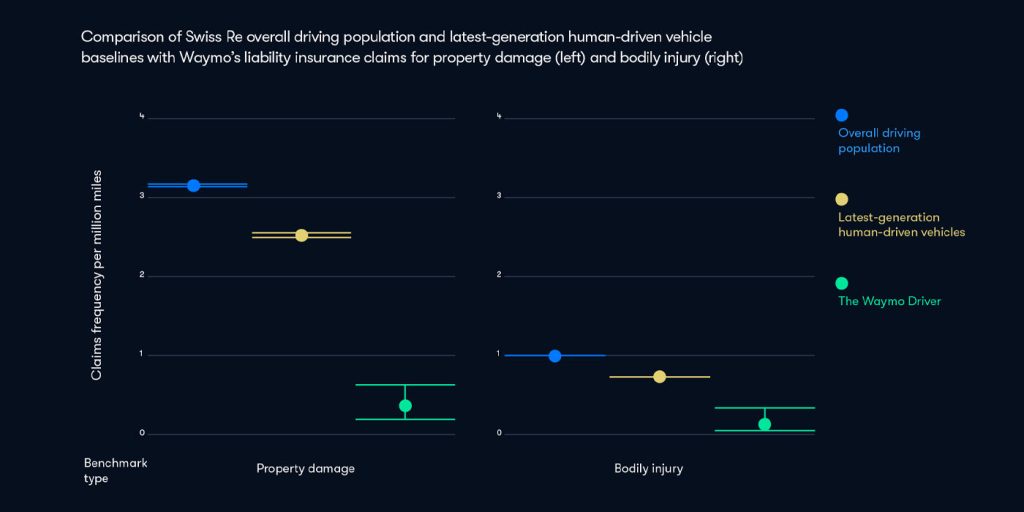
- The General Human Driver Baseline: Sourced from Swiss Re’s internal database, which encompasses over 500,000 claims and more than 200 billion miles of driving exposure across diverse demographics and geographic regions.
- The Modern Vehicle Baseline: Focused specifically on newer vehicles (model years 2018–2021) equipped with robust Advanced Driver Assistance Systems (ADAS), including forward collision warning, automatic emergency braking (AEB), and lane-keeping assistance.
The Numbers That Don’t Lie
The results of the actuarial analysis unequivocally favor machine intelligence over human operation. Over the 25.3 million miles traversed by Waymo vehicles:
- Property Damage Claims: Waymo’s fleet recorded a mere 9 property damage claims. By contrast, statistical projections indicate that human drivers covering the exact same distance would accumulate roughly 78 property damage claims. This translates to an astounding 88% reduction (and an 86% reduction when compared specifically to modern 2018–2021 ADAS-equipped vehicles).
- Bodily Injury Claims: Waymo vehicles recorded only 2 bodily injury claims (both of which remained open and under review at the time of publication). For the same mileage, standard human drivers would be expected to log 26 bodily injury claims. This represents a staggering 92% reduction (and a 90% reduction compared to modern ADAS vehicles).
Furthermore, independent safety impact analyses conducted by Waymo revealed that across those 25 million fully autonomous miles, the Waymo Driver was found to have zero responsibility or fault in the vast majority of the rare multi-vehicle collisions it did experience. Human error—such as drivers rear-ending stationary Waymo vehicles at traffic lights or failing to yield—accounted for the majority of these minor incidents.
Official Statements and Expert Perspectives
The partnership between Waymo and Swiss Re represents a convergence of cutting-edge technology and centuries-old financial risk assessment. Because the study was executed as an independent research partnership with zero monetary compensation exchanged between the parties, its findings carry immense academic and commercial weight. The pre-print paper has been submitted to a peer-reviewed scientific journal, setting a new standard for transparency in the autonomous vehicle industry.
Mauricio Peña, Waymo’s Chief Safety Officer, emphasized the pioneering nature of the research in a company statement:

"Auto insurance claims data, traditionally used to assess human driver liability and risk, is a powerful tool in evaluating the safety performance of autonomous vehicles. This is a truly groundbreaking study that not only validates the Waymo Driver’s strong safety record, but also provides a scalable framework for ongoing assessment of the impact autonomous vehicles make on road safety."
Insurance industry analysts have similarly praised the methodology. By shifting the conversation from self-reported corporate safety logs to hard insurance liabilities, the study provides regulators, municipal planners, and everyday consumers with a verifiable metric of risk reduction. Insurance underwriters are increasingly recognizing that autonomous platforms, free from human flaws such as distraction, fatigue, intoxication, and road rage, represent a fundamentally safer class of vehicle operation.
Future Outlook: Winning Hearts, Minds, and Roads
Despite overwhelming statistical proof, the transition to widespread autonomous mobility faces remaining hurdles that transcend technology.
The Psychological Hurdle: Education Over Innovation
Human beings suffer from a well-documented cognitive bias: we systematically overestimate our own driving capabilities while holding automated systems to an impossibly flawless standard. If a human driver makes a mistake, it is dismissed as an unfortunate accident; if a robotaxi makes a minor error, it becomes headline news.

This psychological friction mirrors the early days of electric vehicle (EV) adoption. Just as consumers once harbored deep-seated anxieties regarding battery range, charging infrastructure, and vehicle fires, today’s prospective robotaxi passengers harbor anxieties about losing physical control.
Industry experts agree that overcoming this hurdle will require sustained public education, transparent data sharing—exemplified by the Swiss Re study—and organic community exposure. As more riders experience smooth, uneventful, and secure autonomous journeys in cities across the United States and soon internationally in Tokyo, cultural acceptance will inevitably follow.
The Path Ahead
Collisions will still occur; physics dictates that no vehicle on Earth can entirely eliminate the risk of an accident in a chaotic, shared-use transportation ecosystem. However, as the empirical data from Swiss Re proves, those numbers will continue to pale in comparison to the carnage wreaked daily by human-operated vehicles.
With multi-million-mile datasets backing up their safety claims, companies like Waymo are no longer selling a futuristic sci-fi dream—they are delivering a statistically proven, life-saving reality. As regulatory bodies review these findings and urban planners look for solutions to traffic congestion and road fatalities, the autonomous robotaxi is rapidly transitioning from a novelty of Silicon Valley to an indispensable pillar of modern, sustainable global transit.
