

By Stevie Bonifield
Published August 5, 2026, 2:13 PM UTC
Executive Overview
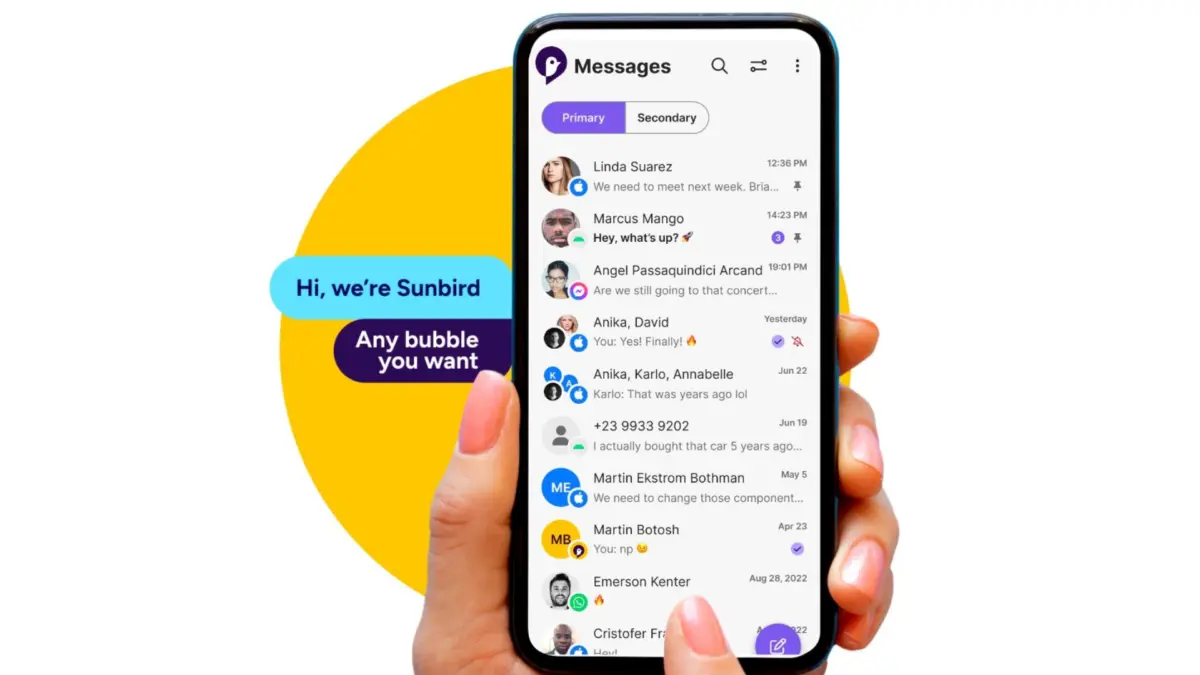
Sunbird Messaging is officially back. Nearly three years after a catastrophic security failure forced the platform to abruptly pull its plugs in late 2023, the controversial app has returned to the Google Play Store. For a subscription fee of $2.99 a month, Android users can once again secure those elusive "blue bubble" privileges inside Apple’s iMessage ecosystem, complete with native reactions, typing indicators, and high-quality video sharing.
Yet, the resurrection of Sunbird is anything but a standard tech comeback story. The app’s sudden shutdown in 2023 occurred after cybersecurity researchers dismantled its infrastructure, exposing massive vulnerabilities that allowed unauthorized parties to access unencrypted media, view user data, and harvest login credentials.
Now, Sunbird’s leadership—spearheaded by CEO Danny Mizrahi—insists that the application has been completely re-engineered from the ground up. Armed with claims of rigorous independent audits, zero-retention login policies, and modern encryption standards, the company is attempting to win back the trust of privacy-conscious consumers.
However, entering the market in 2026 presents a radically different landscape than it did during Sunbird’s initial rollout. Apple and Google have made significant strides in cross-platform messaging through the widespread implementation of RCS (Rich Communication Services). Yet, fundamental divides—such as broken reactions, distorted media, and the cultural stigma of green bubbles—continue to plague cross-ecosystem chats.
This article explores Sunbird’s dramatic relaunch, a detailed chronology of its past security disasters, the technical framework of its new architecture, and whether consumers should trust a company that once left their private data wide open.
Detailed Chronology: From the 2023 Collapse to the 2026 Relaunch
To understand the weight of Sunbird’s current claims, one must look back at the dramatic sequence of events that led to its downfall in November 2023.
Late 2023: The Rise and Rapid Fall of Sunbird
When Sunbird first gained mainstream traction in late 2023, it was heavily promoted as the holy grail for cross-platform messaging. For years, Android users had been locked out of Apple’s walled garden, forced to deal with pixelated videos and broken group chats whenever they interacted with iPhone users. Sunbird promised a seamless bridge, allowing Android owners to log into their Apple IDs and message iPhone users natively.
However, the euphoria was short-lived. Shortly after launch, security researchers—most notably from the tech investigation collective collectively known as SwiftOnSecurity and independent forensic analysts—began reverse-engineering Sunbird’s app package and backend architecture. What they discovered was nothing short of a privacy nightmare.
Investigators revealed that Sunbird was storing user messages, credentials, and attachments in plain text or using severely flawed encryption protocols on unsecure databases. Researchers demonstrated that it was trivially easy for unauthorized third parties to intercept media and chat histories passing through Sunbird’s servers. Furthermore, the partnership Sunbird had formed with Nothing for its short-lived "Nothing Chats" app—which relied entirely on Sunbird’s backend—imploded overnight.
Facing mounting public pressure, overwhelming evidence of security negligence, and threats of regulatory scrutiny, Sunbird pulled the plug on its operations in November 2023, leaving users in the dark and casting a long shadow over the feasibility of third-party iMessage bridges.
2024–2025: The Long Silence and Behind-the-Scenes Rebuild
Following the shutdown, Sunbird went largely dark. While other developers attempted various workarounds—such as Beeper Mini, which faced its own cat-and-mouse game with Apple’s security blocks—Sunbird vanished from public discourse.
Behind closed doors, however, CEO Danny Mizrahi and the engineering team claim they were entirely rewriting the platform. Abandoning the legacy architecture that caused the 2023 breach, the company reportedly gutted its server-side code, hired external cybersecurity consultants, and redesigned its data retention policies.
August 2026: The Official Comeback
On August 5, 2026, Sunbird made its quiet return to the Google Play Store. Priced at a modest $2.99 per month, the app reintroduced its core pitch: bridging Android devices to iMessage. Alongside the iMessage integration, the company has announced plans to unify Google Messages and standard SMS into the app, with native integrations for WhatsApp and Facebook Messenger slated to roll out later in the year.
Technical Framework: How Sunbird Claims to Keep Data Secure
The primary hurdle facing Sunbird’s marketing team is convincing users that the structural flaws of 2023 have been entirely eradicated. In statements given to Android Authority, company executives detailed a multi-layered security overhaul designed to minimize data exposure.
1. End-to-End and Transit Encryption
Sunbird’s technical documentation asserts that messages are now encrypted locally on a user’s Android phone before they ever leave the device. Once packaged, the data travels over certificate-pinned connections protected by AES-256 encryption.

Once the data reaches its final destination on an iPhone, it falls under Apple’s native iMessage end-to-end encryption. Mizrahi emphasizes that Sunbird’s infrastructure never modifies, intercepts, or weakens Apple’s encryption keys during this final leg.
2. Zero-Retention Data Policies
Perhaps the most critical vulnerability of the 2023 iteration was the long-term storage of user data and credentials on cloud servers. Sunbird has introduced aggressive data-purging policies to address this:
- Media Retention: Any media sent or received through the platform is cached temporarily and deleted "typically within 48 hours and never longer than 72 hours."
- In-Transit Protection: The company claims that any message moving through its infrastructure is protected in transit and permanently purged immediately upon successful delivery.
3. Apple ID Password Handling
To connect to iMessage, a third-party client must authenticate with Apple’s servers, historically requiring credentials that could be stored maliciously. Sunbird now asserts that when a user connects their iMessage account, their Apple ID password is used once to establish the initial session and is then immediately destroyed.
Furthermore, the company claims it does not store long-lived authentication tokens that would grant engineers or external actors the ability to silently sign into a user’s Apple account at a later date.
Official Statements and Third-Party Audits
To back up its technical claims, Sunbird has leaned heavily on third-party validation—a standard playbook for companies trying to rebuild consumer trust after a massive data breach.
According to CEO Danny Mizrahi, an independent security auditing firm was brought in to stress-test the entirely rebuilt Sunbird application prior to its August 2026 launch. The audit allegedly resulted in a clean bill of health, with the auditing firm reporting "no critical vulnerabilities."
Despite these assurances, cybersecurity experts remain cautiously skeptical. In the world of consumer software, audits are snapshots in time. While a code review can verify that a specific build of an application is secure on launch day, maintaining that security posture requires continuous monitoring, rapid patch deployment, and absolute transparency—qualities that Sunbird failed to demonstrate during its first iteration.
Supporting Context & Market Dynamics: The 2026 Landscape
To evaluate Sunbird’s viability in 2026, one must examine the broader messaging ecosystem, which has evolved dramatically since 2023.
The RCS Revolution
For years, the justification for using sketchy third-party apps like Sunbird was the glaring communication gap between iOS and Android. Green bubbles meant grainy videos, missing read receipts, and broken group chats.
However, Apple’s eventual adoption of RCS (Rich Communication Services) across iOS has largely bridged this gap for standard carrier-based communication. Today, cross-platform messaging supports high-resolution image sharing, typing indicators, and read receipts natively without requiring third-party workarounds.
Why Do Users Still Want Sunbird?
Given that RCS solves many cross-platform issues, why are users willing to pay $2.99 a month for Sunbird?
The answer lies in the deeply entrenched cultural dominance of iMessage—particularly in North America. Features like native iMessage games, Apple-specific app integrations, persistent group chat threads with specific management tools, and the sheer social stigma attached to the "green bubble" continue to drive demand for true iMessage clients on Android. Furthermore, power users often prefer a unified inbox that aggregates multiple chat platforms into a single interface.
Future Outlook: Can Sunbird Win Back Trust?
Sunbird Messaging is walking a tightrope. On one hand, the app taps into a persistent consumer desire for seamless cross-platform integration. On the other hand, it carries the heavy baggage of a disastrous security history.
In the coming months, the true test of Sunbird will not be its marketing copy or its executive promises, but the scrutiny of the global security community. Independent researchers will undoubtedly attempt to reverse-engineer the 2026 app, sniffing its network traffic, analyzing its local databases, and testing its token-handling mechanisms. If Sunbird has genuinely fixed its infrastructure, it could carve out a lucrative niche among Android enthusiasts willing to pay for aesthetic and functional parity with iOS. If vulnerabilities are found a second time, however, the damage to the company’s reputation will likely be terminal.
As the app rolls out its promised WhatsApp, Facebook Messenger, and AI-powered assistant features later this year, all eyes will remain locked on Sunbird’s servers to see if privacy is finally being prioritized over functionality.
