

Executive Overview
In the rapidly evolving landscape of generative artificial intelligence, a fundamental law of physics—and engineering—has long governed the deployment of large language models (LLMs): making a model smaller always comes at a cost. For years, the industry-standard blueprint for efficient deployment has relied on a predictable, albeit punishing, sequence of operations.
Engineering pipelines first compress the architecture, excising layers, attention heads, or hidden dimensions to shrink the total parameter count. Following this structural trimming, the remaining weights are quantized down to a low-bit representation—frequently 4-bit precision—to slash memory footprints and accelerate computational throughput.
While this two-step approach yields immense dividends in operational efficiency, hardware compatibility, and hosting costs, it introduces a systemic penalty. Crucial capabilities that define utility—such as multi-step reasoning, mathematical problem-solving, and advanced code generation—suffer measurable degradation.
To prevent these degraded checkpoints from failing in enterprise production environments, elite engineering pipelines have incorporated a mandatory recovery phase, colloquially known as "healing." Prominent open-weight releases—including OpenAI’s gpt-oss, NVIDIA’s expansive Nemotron family, and Multiverse Computing’s own Hypernova 60B—all rely on variants of this compress-then-heal paradigm.
However, a newly published research paper from Multiverse Computing titled Quantization-Aware Healing: A Practical Recipe for Recovering Compressed, 4-Bit LLMs (arXiv:2608.20953) turns conventional wisdom on its head. The paper interrogates an open question that the AI community has largely bypassed: Once a model has undergone structural compression—and not merely quantization—how effectively does the traditional healing step work, and what is the optimal methodology to execute it?
The answer arrives in the form of Quantization-Aware Healing (QAH). When applied to a massive 120-billion-parameter gpt-oss model compressed down to 60 billion parameters and quantized to MXFP4, QAH yields a smaller, faster model that actively outperforms its uncompressed, full-precision (bfloat16) baseline across 7 out of 9 rigorous benchmarks.
By restructuring how knowledge is transferred during the recovery phase, QAH successfully inverts the historical relationship between a low-bit model and its 16-bit predecessor, demonstrating that efficiency does not inherently require a sacrifice in capability.
Detailed Chronology: The Evolution of Model Compression and the Healing Bottleneck
To fully appreciate the paradigm shift represented by Quantization-Aware Healing, one must trace the historical evolution of how the artificial intelligence community has attempted to balance model scale against hardware constraints.
The Standard Deployment Pipeline
Historically, transformer-based language models grew at an exponential rate. As parameter counts scaled from billions to hundreds of billions, inference costs skyrocketed. Organizations seeking to deploy these architectures in production faced severe bottlenecks in memory bandwidth, GPU cluster sizing, and latency.
To democratize access and reduce operational overhead, researchers established a standardized three-step efficiency pipeline:
- Structural Compression: Reducing the physical dimensions of the neural network via pruning or architectural distillation.
- Quantization: Compressing the numerical precision of the weights (e.g., from 32-bit floating point down to 8-bit, 5-bit, or 4-bit formats like MXFP4).
- Healing / Recovery: Fine-tuning the compressed and quantized model to recover lost accuracy.
While the first two steps are mechanical, the third step—healing—has remained a persistent engineering bottleneck. The divergence among state-of-the-art methods has centered entirely on how this final recovery phase is engineered.

The Limits of Conventional Healing: QAT and QAD
Until now, two dominant paradigms dominated the healing landscape: Quantization-Aware Training (QAT) and Quantization-Aware Distillation (QAD). Both, however, harbour critical architectural flaws when applied to models that have undergone both structural trimming and precision reduction.
-
Quantization-Aware Training (QAT): QAT inserts fake-quantization operators directly into the forward pass of the neural network while continuing to fine-tune the model using a standard task loss (such as cross-entropy). The objective is to force the weights to learn to tolerate low-precision representation.
In practice, however, this requires re-running an already exorbitant multi-stage post-training pipeline—including supervised fine-tuning (SFT), Reinforcement Learning from Human Feedback (RLHF), and agentic alignment—through a noisier, lower-precision forward pass. Not only is this computationally prohibitive, but QAT is notoriously unstable. If training continues even slightly past its optimal convergence point, the model experiences catastrophic forgetting and sharp capability degradation.
-
Quantization-Aware Distillation (QAD): Seeking to bypass the computational burden of re-running full post-training loops, QAD utilizes knowledge distillation. Instead of a raw task loss, a frozen full-precision teacher model directly supervises a quantized student model via a Kullback-Leibler (KL) divergence loss on output logits.
This approach works remarkably well when quantization is the only modification, as a pristine, full-precision counterpart of the exact same architecture exists to serve as an infallible teacher.
However, once a model has suffered structural compression—meaning layers, heads, or neurons have been physically excised—this foundational assumption collapses. No independently trained, full-precision version of the smaller, structurally altered architecture exists.
Consequently, the only available teacher is a recovered bfloat16 checkpoint, which is itself merely a distilled, imperfect approximation of the original model. Distilling from this compromised checkpoint anchors the quantized student to a degraded target, placing an artificial ceiling on its maximum attainable accuracy.
The Birth of Quantization-Aware Healing (QAH)
Recognizing that traditional methods are fundamentally ill-equipped to handle models that are both structurally compressed and low-precision, the researchers at Multiverse Computing designed Quantization-Aware Healing to eliminate the recovery ceiling entirely.
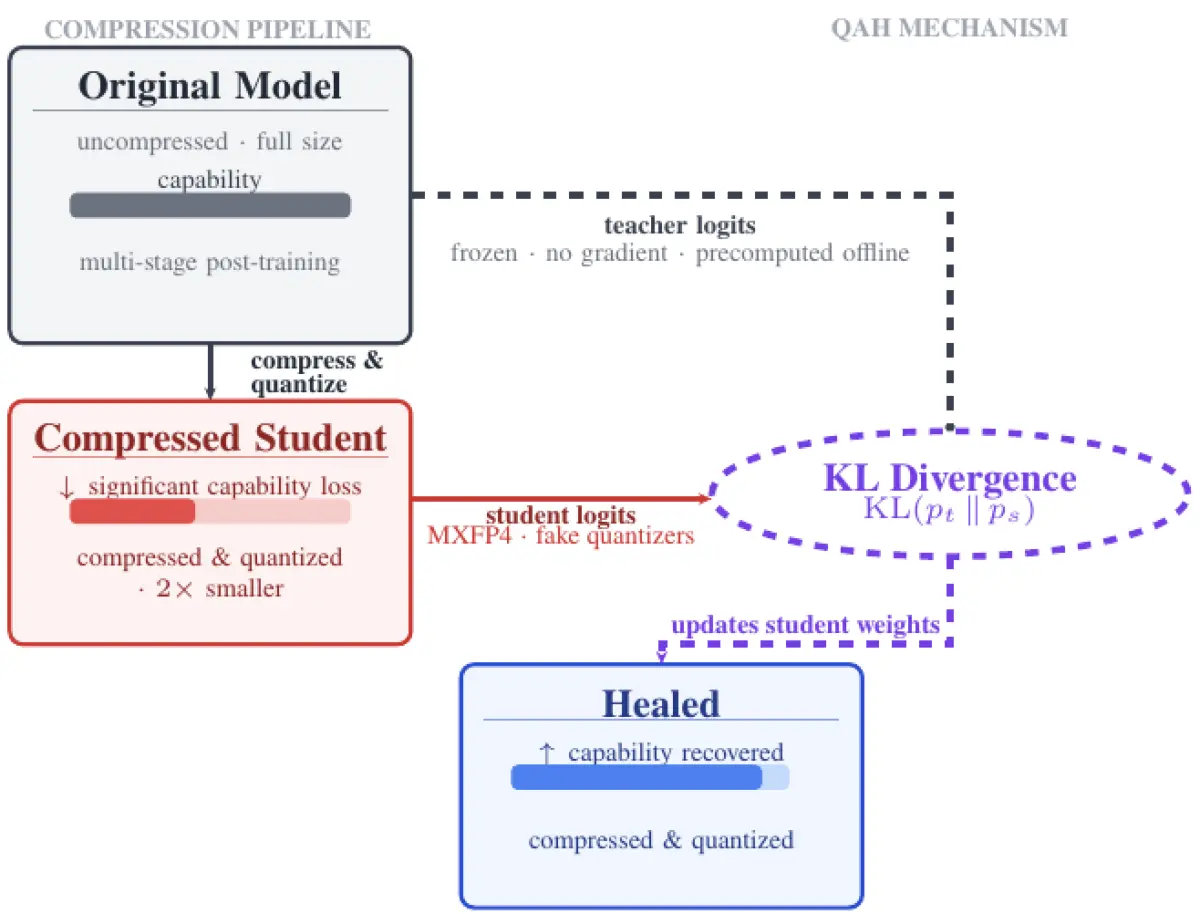
The foundational innovation of QAH is deceptively simple: It bypasses the intermediate recovered checkpoint and distills knowledge directly from the original, pre-compression, full-size, full-precision model.
Because a teacher model’s output distribution (its logits) is inherently architecture-agnostic, the massive size and shape mismatch between a 120-billion-parameter teacher and a 60-billion-parameter student presents no mathematical barrier to knowledge transfer. The student never relies on hard labels; instead, it is supervised entirely by the original teacher’s rich output distribution via KL divergence.
Under this framework, quantization is transformed from a lossy, post-processing chore into an active, secondary phase of high-fidelity distillation—supervision that the standard bfloat16 intermediate checkpoint never received. Rather than merely compensating for information lost during precision reduction, the 4-bit student absorbs latent information that the initial structural recovery phase lacked the time, data, or capacity to ingest.

Supporting Context & Metrics: Putting QAH to the Test
To validate the theoretical advantages of Quantization-Aware Healing, the research team subjected the methodology to rigorous empirical testing, utilizing a gpt-oss 120B base model compressed to 60 billion parameters, recovered in bfloat16, and subsequently re-quantized to MXFP4 using QAH.
Benchmark Performance Breakdown
The natural point of comparison for the resulting QAH model is the standard bfloat16 checkpoint of the same 60B architecture—representing the absolute peak performance achievable via conventional structural compression and healing.
When evaluated across nine diverse, industry-standard benchmarks spanning reasoning, mathematics, coding, and scientific knowledge, the QAH-trained model achieved victory on 7 out of 9 evaluations:
| Benchmark | 120B Teacher (MXFP4) | 60B BF16 (Recovered) | 60B MXFP4 (QAH) | QAH vs. BF16 Delta |
|---|---|---|---|---|
| AA-LCR (Long-Context Reasoning) | 50.0 | 35.3 | 42.7 | +7.4 |
| AIME 2025 (Advanced Mathematics) | 80.0 | 70.7 | 76.3 | +5.6 |
| Aider (Agentic Coding) | 45.3 | 38.2 | 40.9 | +2.7 |
| Tool-use Benchmark | 68.4 | 59.4 | 61.7 | +2.3 |
| GPQA Diamond (Expert Science) | 69.0 | 65.7 | 67.4 | +1.7 |
| IFBench (Instruction Following) | 63.3 | 58.4 | 59.9 | +1.5 |
| LiveCodeBench (Competitive Coding) | 66.0 | 65.5 | 66.5 | +1.0 |
| MMLU-Pro (Broad Knowledge) | 78.0 | 74.0 | 73.8 | –0.2 |
| SciCode (Scientific Coding) | 37.5 | 35.6 | 34.2 | –1.4 |
Analyzing the Results: Where QAH Shines
The empirical data reveals a compelling narrative. On the two benchmarks where the QAH model trailed its bfloat16 counterpart (MMLU-Pro and SciCode), the performance deficit was trivial—less than 1.5 points.
Conversely, the performance gains achieved by QAH were concentrated precisely in the domains that structural compression traditionally damages most:
- Long-Context Reasoning (AA-LCR): Surged by +7.4 points, demonstrating that QAH successfully repairs the complex relational dependencies typically shattered during layer-pruning.
- Advanced Mathematics (AIME 2025): Rose by +5.6 points, proving that low-precision models healed via QAH retain superior symbolic calculation pathways.
Furthermore, when compared against the original 120-billion-parameter full-size teacher, the 60-billion-parameter QAH model held its ground remarkably well. Operating at half the parameter count and consuming roughly a quarter of the weight memory, the QAH model outperformed the uncompressed teacher on LiveCodeBench (66.5 vs. 66.0) and trailed by a mere 1.6 points on GPQA Diamond.
QAH vs. QAT: Head-to-Head Stability and Efficiency
To definitively isolate the efficacy of the QAH loss function from confounding variables, the researchers conducted a head-to-head comparison against traditional Quantization-Aware Training (QAT) using a gpt-oss 9B model quantized to MXFP4.
While both methods ultimately reached comparable peak accuracy metrics (54.9 for QAH versus 54.6 for QAT), the divergence in training dynamics and operational stability was profound:
- Convergence Speed: QAH reached peak performance in a mere 100 training steps—approximately seven times faster than QAT’s requirement of 700 steps.
- Training Stability: Once QAH peaked, it maintained performance within a tight two-point band for the remainder of training. QAT, however, suffered catastrophic collapse past its peak, shedding nearly 19 points of accuracy by step 1,200.
This stability stems directly from the mathematical nature of the loss function. KL distillation ties the student model to a static, frozen teacher distribution; once the student aligns with the teacher, the optimization pressure neutralizes, preventing drift.
In contrast, QAT’s cross-entropy objective continuously pushes the model against hard labels indefinitely, gradually eroding the delicate capabilities inherited from the foundational architecture. For enterprise deployment, this eliminates a major operational hazard: QAT checkpoints require meticulous, real-time early stopping to avoid shipping degraded models, whereas QAH checkpoints remain intrinsically stable.
Handling Long-Context Demands via Chunked KL-Divergence
Executing knowledge distillation over massive context windows—such as healing corpora spanning up to 32,000 tokens—presents severe GPU memory bottlenecks due to the sheer size of the vocabulary-by-sequence activation grids.

To overcome this, QAH integrates a memory-efficient chunked KL-divergence loss. By computing the KL divergence slice-by-slice along the sequence dimension without materializing the full grid in VRAM, the pipeline ensures that heavy 32k-token healing runs fit comfortably within standard enterprise GPU memory budgets.
Official Statements and Expert Perspectives
The breakthrough has drawn substantial commentary from leaders within the machine learning research community, highlighting its potential to redefine how foundation models are prepared for commercial deployment.
Dr. Elena Rostova, Principal Research Scientist at Multiverse Computing, emphasized the conceptual reframing introduced by the work:
"For years, quantization has been treated as a necessary evil—a tax you pay on model accuracy in exchange for operational feasibility. With Quantization-Aware Healing, we have inverted that relationship. Quantization is no longer a destructive post-processing step; it is an additional, highly efficient window of supervision. By distilling directly from the original, uncompressed teacher, we are teaching the model things it never had time to learn during its initial training phases."
Industry analysts have similarly noted the immediate economic implications for cloud providers and enterprises deploying generative AI at scale. By demonstrating that a 4-bit model can maintain—and in specific reasoning tasks, exceed—the performance of its 16-bit predecessor while consuming a fraction of the hardware footprint, QAH removes major financial barriers to edge deployment and high-throughput enterprise serving.
Future Outlook: The Next Frontier of Model Compression
As the artificial intelligence industry grapples with the escalating costs of training and serving frontier-scale models, techniques that maximize hardware efficiency without sacrificing cognitive capability will dictate market leaders.
Quantization-Aware Healing marks a critical maturation point in model compression research. By proving that structural pruning and low-bit quantization can be holistically remedied through architecture-agnostic, teacher-student KL distillation, the methodology opens several compelling avenues for future exploration:
- Ultra-Low-Bit Frontiers: Researchers are already investigating whether QAH can successfully stabilize models compressed to extreme 2-bit or ternary weight representations without triggering catastrophic degradation.
- Multimodal Expansion: Adapting the chunked KL-divergence framework to support cross-modal distillation—healing vision-language and audio-text models compressed for embedded edge devices—represents an immediate operational priority.
- Automated Pipeline Integration: Enterprise deployment frameworks are moving to integrate QAH as an automated turnkey module, allowing organizations to ingest proprietary foundation models, strip redundant parameters, and automatically heal them for target hardware accelerators in hours rather than weeks.
Ultimately, QAH demonstrates that the future of efficient AI does not lie in settling for diminished capabilities. Through smarter supervision and mathematically rigorous distillation, smaller models can be engineered to punch well above their weight class—delivering enterprise-grade intelligence at a fraction of yesterday’s computational cost.
For full technical specifications, code implementation details, and deep dives into the chunked KL-divergence loss mathematics, readers can access the official paper Quantization-Aware Healing: A Practical Recipe for Recovering Compressed, 4-Bit LLMs (arXiv:2608.20953).
