

Executive Overview
For the past half-decade, the artificial intelligence landscape has been dominated by a singular, obsessive metric: scale. From the 175 billion parameters of early language models to the staggering multi-trillion-parameter architectures of today, the industry has evaluated progress through the lens of brute-force intelligence. Whoever possessed the largest models, trained on the most sprawling compute clusters and evaluated against the most rigorous academic benchmarks, claimed the crown.
That era is rapidly drawing to a close. As enterprise AI transitions from experimental proofs-of-concept (PoCs) to heavy, continuous production workloads, the primary bottleneck constraining growth is no longer intelligence—it is utilization.
Much like the aviation industry discovered decades ago, owning a massive fleet of assets guarantees nothing if those assets spend half their lives sitting idle or running sub-optimally. Today, enterprise AI is running into this exact structural reality on a different piece of hardware: the Graphics Processing Unit (GPU). A GPU accrues financial liability by the calendar hour through capital financing, depreciation, power draw, and cooling infrastructure, regardless of whether it is executing critical inference jobs or sitting dormant in a rack. Its economic return, conversely, accrues strictly by the compute hour.
As corporate budgets shift from variable API consumption models to heavy capital expenditures (CapEx) for owned clusters, two companies with identical GPU budgets can achieve radically divergent outcomes. The differentiator is no longer raw compute ownership, but the operational discipline required to keep that hardware meaningfully engaged. To understand the trajectory of enterprise AI over the next decade, organizations must recognize that the frontier of competitiveness has shifted upward from the model layer to the infrastructure orchestration layer.
Detailed Chronology: From Model Scarcity to Compute Deficits
To grasp how the industry arrived at this infrastructure crisis, it is instructive to trace the evolution of scarcity across the AI boom.
Phase One: The Reign of Model Quality (2018–2021)
In the initial wave of the modern AI revolution, the market was constrained almost entirely by algorithmic capability and raw model quality. Success required proving that neural networks could reason, translate, generate code, and comprehend context at a human or near-human level. During this period, parameter counts and leaderboard placements dominated executive boardrooms and academic conferences.
The hardware required to train these models was immense, but it was largely centralized within a handful of elite research labs. Notably, in 2020, Microsoft constructed a dedicated supercomputer for OpenAI comprising over 10,000 GPUs and 285,000 CPU cores—celebrated at the time as one of the five most powerful computing systems globally. It appeared to be an astronomical concentration of hardware, suggesting that compute scarcity would soon be solved for whichever entities could secure access to elite infrastructure partnerships.
Phase Two: The Great Hardware Bottleneck (2022–2024)
As foundational models proved their utility, enterprise demand exploded. The constraint rapidly shifted upstream and outward: models were no longer the primary hurdle, but the specialized silicon required to run and fine-tune them was severely constrained.
Global supply chains buckled under the weight of surging demand for advanced accelerators. Enterprises attempting to scale AI deployments found themselves trapped between two undesirable economic options:

- Consuming models via API: While initially attractive for PoCs, scaling API usage resulted in costs that grew linearly with token consumption, transforming production-scale deployments into unpredictable financial liabilities.
- Procuring private clusters: To escape variable API costs, companies began purchasing their own GPUs, treating them as long-term infrastructure investments.
However, acquiring the hardware merely opened a Pandora’s box of operational challenges. Procurement teams could buy silicon with a signed purchase order, but keeping those expensive accelerators fully utilized proved to be an entirely different operational beast.
Phase Three: The Era of Infrastructure Orchestration (2025–Present)
By 2026, even the best-capitalized technology labs on Earth treated compute access not as a settled baseline, but as a perpetual strategic constraint. Anthropic made waves by securing simultaneous, multi-gigawatt commitments across four competing hardware vendors—Amazon, Google, Microsoft, and AMD—layered within months of one another. Simultaneously, Meta committed to massive, multi-gigawatt infrastructure expansions of its own.
When companies with effectively limitless capital are forced to spread massive hardware commitments across four distinct semiconductor ecosystems simultaneously, it signals a fundamental market shift. The bottleneck has officially migrated. The race is no longer simply about how many GPUs an organization can acquire, but how efficiently those silicon assets are utilized across a complex, highly heterogeneous operational environment.
Supporting Context & Metrics: The Economics of Utilization
The structural parallels between aviation and enterprise AI provide a powerful framework for understanding this new economic paradigm.
The Aviation Precedent
For most of commercial aviation history, the single most reliable predictor of an airline’s long-term survival was not the absolute size of its fleet, but its aircraft utilization rate—specifically, the percentage of the day each aircraft spent airborne.
An aircraft incurs costs continuously by the calendar hour:
- Capital financing and hull depreciation
- Hangar rent, insurance, and scheduled maintenance
- Long-term crew contracts and administrative overhead
Conversely, revenue is generated exclusively by the flight hour. Every hour an aircraft sits grounded on the tarmac shrinks the revenue side of the ledger while fixed costs run unabated. Furthermore, utilization sits downstream of nearly every operational discipline an airline practices. Turnaround times, gate scheduling, crew rostering, network design, and spare parts availability all manifest in that single utilization metric. If any link in the operational chain breaks, the plane stays on the ground.
The Enterprise AI Parallel
Enterprise AI clusters operate under an identical economic structure. A modern GPU cluster accrues massive costs by the calendar hour—power, liquid cooling, data center real estate, depreciation, and financing—whether it is processing high-value enterprise queries or idling in a state of low utilization.
[Fixed Costs: Depreciation, Power, Cooling, Financing] (Accrues by Calendar Hour)
                                  vs.
[Output Value: Inference & Training Workloads] (Accrues by Compute Hour)
As organizations transition from cloud APIs to owned infrastructure, they face the harsh reality of the utilization curve. While API costs scale linearly with usage, owned infrastructure introduces a fixed cost baseline that demands constant, high-volume throughput to achieve return on investment (ROI).

Cost
  ^
  |                  / [API Cost (Scales linearly with usage)]
  |                 /
  |                /  <-- Breakeven Point
  |  -------------/-- [Owned Infrastructure Cost (Fixed CapEx)]
  |  ____________/
  +--------------------------------------> Usage Volume
Past the breakeven point, owned infrastructure becomes drastically more economical—provided the hardware is kept busy. However, keeping a modern AI cluster busy is exponentially harder than keeping an aircraft flying.
Unlike an idle commercial airliner—which can typically be rerouted from Chicago to Denver with minimal friction—an idle GPU can only absorb workloads that match its specific memory footprint, quantization level, and latency tolerance. A cluster running continuous enterprise operations does not face a singular workload; it juggles training runs, fine-tuning jobs, real-time inference, batch processing, embedding generation, and model evaluations simultaneously.
Each workload makes wildly different demands on the hardware:
- Real-time inference requires ultra-low latency; a delayed response is functionally a failed request.
- Batch inference prioritizes high throughput and comfortably tolerates hours of delay.
- Model training locks down clusters continuously for days or weeks.
- Quantization and evaluation require massive compute bursts that materialize briefly and disappear just as fast.
A naive scheduler will routinely misallocate these resources, leaving clusters reporting high average occupancy while critical production queues starve for specific GPU shapes that happen to be tied up in low-priority batch jobs.
Official Industry Perspectives & Expert Analysis
Industry leaders and infrastructure architects are increasingly vocal about the shifting nature of enterprise constraints.
Dr. Elena Vance, Distinguished Systems Architect at a major cloud infrastructure provider, notes the philosophical shift in how engineering teams view AI hardware:
"For years, we treated GPUs like magical black boxes where you threw inputs in and hoped intelligence came out. We obsessed over model weights and context windows. Today, the conversation in infrastructure review meetings looks remarkably like supply chain logistics. If your orchestration layer isn’t dynamically bin-packing your workloads across heterogeneous accelerators down to the millisecond, you are essentially burning millions of dollars in electricity and depreciation on idle silicon."
Similarly, enterprise software analysts point out that the traditional separation between application developers and infrastructure engineers has collapsed. Chief Technology Officers are discovering that deploying state-of-the-art models without a commensurate investment in GPU management tools is akin to buying a Formula 1 car and hiring a novice driver to navigate rush-hour traffic.
Furthermore, recent economic analyses from enterprise procurement firms highlight that hardware waste in AI clusters often masquerades as high utilization. Systems frequently report high occupancy rates simply because low-priority jobs or inefficiently large models are lingering on the silicon, blocking high-value customer-facing requests from accessing the hardware they require.

Future Outlook: The Convergence of Specialization and Orchestration
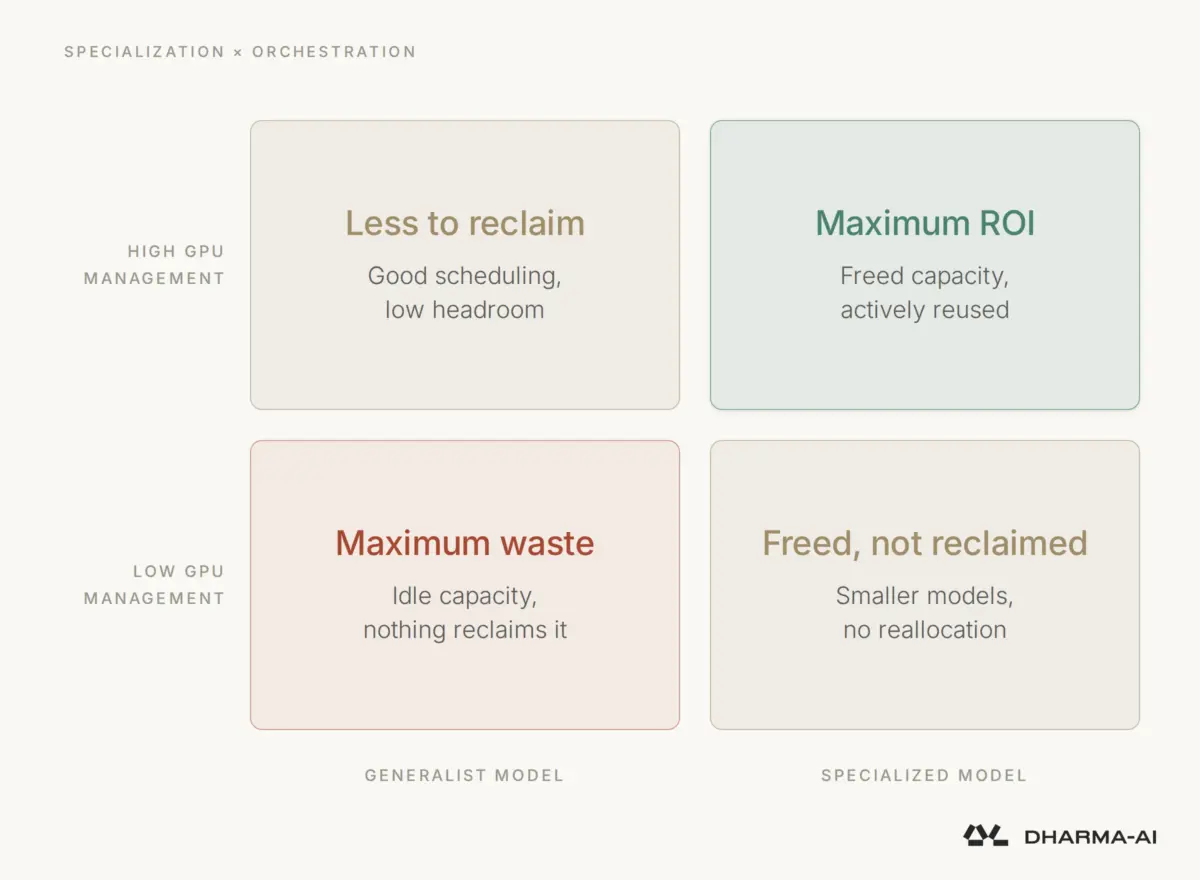
As the enterprise AI market matures over the remainder of the decade, solving the utilization constraint will require mastering two interdependent, bivalent strategies: Model Specialization and Infrastructure Orchestration.
1. Specialization Frees Capacity
The era of defaulting to massive, general-purpose frontier models for every enterprise task is coming to an end. Organizations are increasingly adopting smaller, highly specialized task-specific models that deliver equivalent domain performance at a fraction of the parameter footprint.
By replacing a monolithic generalist model with a nimble, specialized architecture, enterprises can dramatically reduce the memory and compute footprint required for a given workflow. Capacity that was once entirely monopolized by heavy general-purpose queries is suddenly freed.
2. Orchestration Spends Capacity
However, specialization alone is insufficient. Unmanaged freed capacity does not automatically translate into ROI; it simply becomes a different flavor of waste—invisible on superficial dashboards, but equally non-productive.
This realization has birthed an entirely new software discipline: GPU Management and Orchestration. Sitting between raw hardware, models, and application workloads, modern orchestration layers continuously evaluate incoming traffic, model priorities, latency requirements, and hardware availability. Every time a training job concludes or an inference request arrives, the orchestration layer executes real-time allocation decisions at a frequency and complexity that human engineers could never manage manually.
The Next Decade of Competition
The formula for market leadership in enterprise AI is undergoing a permanent metamorphosis.
[Model Specialization (Shrinks workload footprint)]
                       +
[GPU Orchestration (Maximizes infrastructure ROI)]
                       =
          [Sustainable AI Advantage]
A bigger fleet of GPUs will always provide a foundational advantage, just as a larger fleet of aircraft helps an airline scale. But among enterprises operating with comparable hardware budgets, the ultimate winners will not be those who simply bought the most silicon. The victors will be those who pioneered the most disciplined orchestration layers, maximizing the output of every single accelerator in their data centers. Intelligence brought the AI industry to its current frontier; utilization is where the battle for economic dominance will be won or lost.
