

Executive Overview
The landscape of generative artificial intelligence has long been constrained by a stark hardware divide. While massive diffusion transformers can synthesize stunning images, photorealistic videos, intricate audio clips, and dense textual structures, running them locally has remained an elusive goal for mainstream hardware consumers. Loading a modern text-to-image foundation model in standard bfloat16 (BF16) precision frequently demands anywhere from 20 GB to 30 GB of VRAM. This steep requirement effectively bars these architectures from executing on the vast majority of consumer-grade GPUs.
Historically, quantization has served as the primary mechanism to bridge this accessibility gap. Within the Hugging Face diffusers ecosystem, developers have leveraged established quantization backends such as bitsandbytes, GGUF, torchao, and Quanto. However, these mainstream quantization frameworks are predominantly weight-only systems. They store model weights in compressed low-precision formats but must dequantize them back to higher precision on-the-fly during active compute cycles. While this strategy drastically shrinks memory footprints, it rarely accelerates inference speeds and can occasionally introduce minor latency overheads due to runtime dequantization math.
Enter SVDQuant and its companion reference CUDA inference engine, Nunchaku, which disrupt this paradigm by utilizing a 4-bit weight and activation (W4A4) quantization scheme. Until recently, running these specialized checkpoints required complex, separate inference libraries and dedicated local CUDA compilation pipelines.
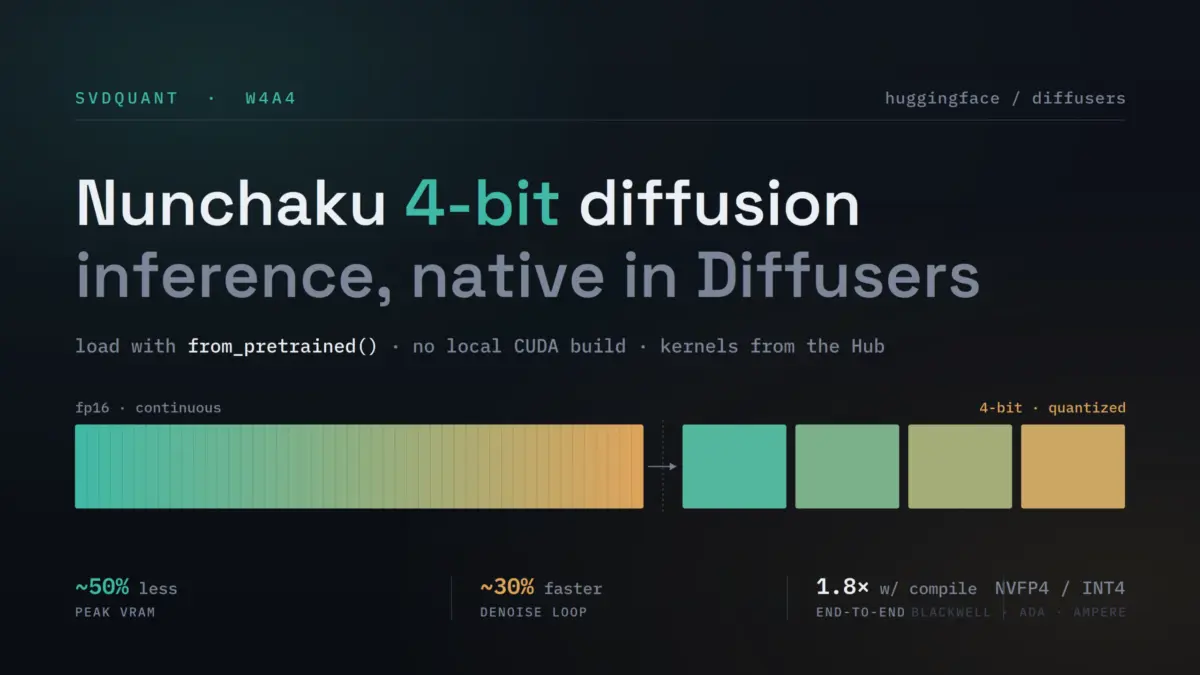
That barrier has officially fallen. Through a seamless new integration, Nunchaku Lite now enables native checkpoint loading directly within standard diffusers pipelines via a simple from_pretrained() call, completely eliminating local CUDA compilation hurdles thanks to the Hugging Face kernels package. Paired with the open-source diffuse-compressor toolkit, developers can now natively quantize novel architectures, package them, and publish them as standard repositories on the Hugging Face Hub. This technical milestone slashes VRAM requirements by up to 50% while accelerating generation loops by approximately 30%—and up to 80% when combined with torch.compile.
Detailed Chronology & Technical Mechanics
To understand the engineering breakthrough behind Nunchaku Lite, one must first examine the inherent mathematical challenges of compressing diffusion transformers. Standard 4-bit quantization methods struggle mightily when applied to diffusion models because both the model’s static weights and dynamic activations contain massive outlier values. Left unchecked, these outliers distort the quantization grid, resulting in severe degradation of output image quality.
The SVDQuant Solution
SVDQuant resolves this bottleneck through a clever decomposition technique:

- Outlier Relocation: It isolates difficult activation outliers and shifts them cleanly into the model weights.
- Low-Rank Decomposition: The most challenging segments of each weight matrix are isolated and represented using a compact, high-precision 16-bit low-rank branch.
- Residual Quantization: The remaining residual components are aggressively quantized down to 4 bits.
The reference Nunchaku engine accelerates this entire pipeline by engineering specialized, fused CUDA kernels that execute the 4-bit path and the low-rank branch concurrently. Specifically, Nunchaku fuses the low-rank down-projection directly with the input quantization kernel, and fuses the low-rank up-projection directly with the subsequent 4-bit matrix multiplication. This eliminates the traditional memory access overhead associated with maintaining a separate 16-bit branch.
The Evolution to Nunchaku Lite
While the original Nunchaku engine achieves blistering speeds, it derives much of that performance from model-specific fused execution pathways—such as combined QKV projections and fused GELU/MLP layers. Because these optimizations are hardcoded to specific module layouts and checkpoint structures, supporting a brand-new model family typically requires tedious, manual integration work.
Nunchaku Lite was engineered to bypass this architectural rigidity. Instead of relying on bespoke, model-specific codebases, Nunchaku Lite operates as a generalized integration path inside the diffusers library.
- Runtime Patching: Before a checkpoint is loaded, Nunchaku Lite dynamically patches the relevant
nn.Linearmodules of a standard, stock diffusers model with runtime SVDQ/AWQ linear layers (SVDQW4A4LinearorAWQW4A16Linear). - On-Demand Kernels: The underlying CUDA kernels are fetched dynamically from the Hugging Face Hub via the
kernelspackage upon first execution.
While foregoing architecture-specific deep fusions means Nunchaku Lite cannot quite match the raw speed ceiling of the standalone Nunchaku engine, this minimalist implementation still achieves an impressive ~30% end-to-end speedup while matching its predecessor’s aggressive VRAM reduction metrics.
Supporting Context & Quantitative Benchmarks
The integration has undergone rigorous validation across professional-grade hardware environments. All benchmark figures below were measured on an NVIDIA RTX PRO 6000 (Blackwell architecture) operating at a 1024×1024 resolution using the rootonchair/ERNIE-Image-Turbo-nunchaku-lite-int4-bnb4-text-encoder repository.
End-to-End Latency and Memory Footprint
| Configuration | Full Pipeline Latency | Denoise Loop Latency | Peak VRAM Consumption | Speedup Factor |
|---|---|---|---|---|
| BF16 Baseline | 3.00 s | 2.86 s | 31.1 GB | 1.0x |
| Nunchaku Lite NVFP4 | 2.27 s | 2.13 s | 20.6 GB | 1.35x |
Nunchaku Lite NVFP4 + torch.compile |
1.68 s | 1.53 s | 20.6 GB | 1.8x |
| Nunchaku Lite NVFP4 + NF4 Text Encoder | 2.29 s | 2.13 s | 16.0 GB | 1.35x |
Granular Hardware Compatibility Matrix
The framework deploys distinct kernel variations depending on the target GPU architecture and the quantization precision of the chosen checkpoint:

| Quantization Scheme | Precision Format | Supported GPU Architectures |
|---|---|---|
svdq_w4a4 |
nvfp4 |
NVIDIA Blackwell Generation (RTX 50-series, RTX PRO 6000, B200) |
svdq_w4a4 |
int4 |
Turing, Ampere, Ada Lovelace (RTX 30 & 40 series, A100, L40S) |
awq_w4a16 |
int4 |
Turing, Ampere, Ada Lovelace (RTX 30 & 40 series, A100, L40S) |
Note: Volta and Hopper architectures are currently unsupported by these 4-bit kernels. The quantizer automatically validates the host GPU’s CUDA compute capability at load time, raising a descriptive error rather than generating corrupted outputs.
Getting Started: Implementation Guide
Integrating Nunchaku Lite into existing Python workflows requires minimal code modifications. First, ensure your environment is provisioned with a recent version of diffusers, transformers, accelerate, and the kernels package:
pip install -U diffusers transformers accelerate kernels bitsandbytesOnce installed, loading a pre-quantized pipeline follows the familiar, native Hugging Face pattern without requiring custom pipeline classes or local compilation steps:
import torch
from diffusers import ErnieImagePipeline

# Load the pre-quantized Nunchaku Lite pipeline directly from the Hub
pipe = ErnieImagePipeline.from_pretrained(
    "lite-infer/ERNIE-Image-Turbo-nunchaku-lite-nvfp4_r32-bnb4-text-encoder",
    torch_dtype=torch.bfloat16,
).to("cuda")

# Execute the generation loop
image = pipe(
    prompt="A cinematic portrait of a red fox in a misty forest at sunrise, detailed fur, volumetric light",
    height=1024,
    width=1024,
    num_inference_steps=8,
    guidance_scale=1.0,
    generator=torch.Generator("cuda").manual_seed(42),
).images[0]

image.save("output.png")
Unlocking Maximum Performance
Developers seeking absolute maximum throughput can compound Nunchaku Lite savings with standard optimization primitives:
- Leveraging
torch.compile: Compiling the transformer graph increases end-to-end acceleration from a 1.35x baseline up to an impressive 1.8x speedup:# Compile the entire transformer or repeated internal blocks pipe.transformer.compile(fullgraph=True) # Alternatively, compile repeated blocks for faster compilation times: # pipe.transformer.compile_repeated_blocks(fullgraph=True) - Quantizing Text Encoders: Because foundational text encoders like T5 or Qwen3 consume substantial memory independently, pairing the transformer with a bitsandbytes NF4 text encoder reduces peak VRAM usage by an additional 22%.
- CPU Offloading: Standard diffusers memory utilities such as
enable_model_cpu_offload()remain fully compatible for hardware setups operating under tight resource constraints.
Quantizing Custom Architectures
For researchers and engineers looking to apply this compression methodology to entirely new model families, the companion diffuse-compressor toolkit offers an end-to-end SVDQuant workflow encompassing calibration, quantization, packaging, and publishing.
Taking FLUX.2 Klein 4B as a case study, the deployment pipeline follows four sequential stages:

Step 1: Inspect Quantization Targets
The generic scanner evaluates the target architecture, automatically designating compatible linear layers within transformer blocks as SVDQ W4A4 targets, recognized modulation linears as AWQ W4A16 targets, and leaving outer layers dense:
python examples/text_to_image/quantize_hf.py black-forest-labs/FLUX.2-klein-4B
  --precision int4 --rank 32 --inspect-config
Step 2: Execute Quantization
Run the SVDQuant algorithm on the transformer model to write out the compressed .safetensors checkpoint:
python examples/text_to_image/quantize_hf.py black-forest-labs/FLUX.2-klein-4B
  --precision int4
  --output outputs/checkpoints/svdq-int4_r32-flux-2-klein-4b.safetensors
(Substitute --precision int4 with nvfp4 when building natively for Blackwell-generation hardware).
Step 3: Package into a Diffusers Pipeline
Bundle the quantized weights with the base pipeline configuration, injecting the compact nunchaku_lite configuration block:
python examples/convert_nunchaku_lite_diffusers.py
  --checkpoint outputs/checkpoints/svdq-int4_r32-flux-2-klein-4b.safetensors
  --model-id black-forest-labs/FLUX.2-klein-4B
  --bnb4-text-encoder text_encoder
  --compute-dtype bfloat16
  --output-dir outputs/diffusers/FLUX.2-klein-4B-nunchaku-lite-int4-bnb4-text-encoder
Step 4: Verify and Publish
Load the locally packaged model to verify visual fidelity before pushing directly to the Hugging Face Hub:
import torch
from diffusers import DiffusionPipeline

pipe = DiffusionPipeline.from_pretrained(
    "outputs/diffusers/FLUX.2-klein-4B-nunchaku-lite-int4-bnb4-text-encoder",
    device_map="cuda",
)
image = pipe(
    "A glass robot in a greenhouse, cinematic lighting",
    num_inference_steps=4,
    guidance_scale=1.0,
    generator=torch.Generator("cuda").manual_seed(12345),
).images[0]

# Push to Hub for public accessibility
# pipe.push_to_hub("your-username/FLUX.2-klein-4B-nunchaku-lite-int4")
Future Outlook & Community Implications
The integration of Nunchaku Lite into the Hugging Face ecosystem marks a watershed moment for local AI deployment. By democratizing access to 4-bit weight-and-activation quantization without demanding complex local compilation toolchains, the barrier to entry for running state-of-the-art diffusion models has plummeted.

As consumer hardware continues to evolve—exemplified by NVIDIA’s Blackwell architecture and native FP4 tensor support—low-precision generative pipelines will increasingly become the default standard rather than an exotic exception. Developers, researchers, and hobbyists are encouraged to experiment with the diffuse-compressor toolkit, publish their quantized checkpoints to the Hub, and join the ongoing dialogue within the community Discord channels.
Acknowledgements
The successful realization of this integration was made possible through the collaborative efforts of the Diffusers maintainers for their rigorous code reviews and architectural guidance, alongside the MIT HAN Lab and the Nunchaku team for pioneering the underlying SVDQuant methodology. Special thanks are extended to Marc Sun and Álvaro Somoza for rigorous testing, feedback, and validation of the nunchaku-lite runtime. Additional gratitude is expressed to SilverAI for providing the computational environment and infrastructural support necessary to drive this development forward.
