

Executive Overview
As filmmaker Jane Schoenbrun commands the contemporary cinematic landscape with their latest feature, Teenage Sex and Death at Camp Miasma, alongside the resonant cultural impact of I Saw the TV Glow, the broader conversation surrounding modern indie horror inevitably loops back to where it all began. Released to critical acclaim at the 2021 Sundance Film Festival, Schoenbrun’s feature-length directorial debut, We’re All Going to the World’s Fair, established a distinct blueprint for capturing the psychological contours of internet-native isolation.
Rather than relying on traditional supernatural conceits or conventional jump scares, World’s Fair operates at the intersection of Alternate Reality Games (ARGs), creepypasta folklore, and deeply intimate body horror. The film follows Casey, an isolated adolescent who immerses herself in an online ritual known as the "World’s Fair Challenge." By examining Casey’s trajectory, the film interrogates the digital age’s paradox: a hyper-connected global network that frequently leaves its youngest and most vulnerable participants entirely alone in the dark.
This retrospective analysis explores the anatomy of Schoenbrun’s breakout film, contextualizing its narrative structure, thematic rejection of conventional coming-of-age tropes, and profound resonance within the contemporary landscape of digital-era cinema.
Detailed Chronology: The Descent into the World’s Fair
The Initiation and the Webcast
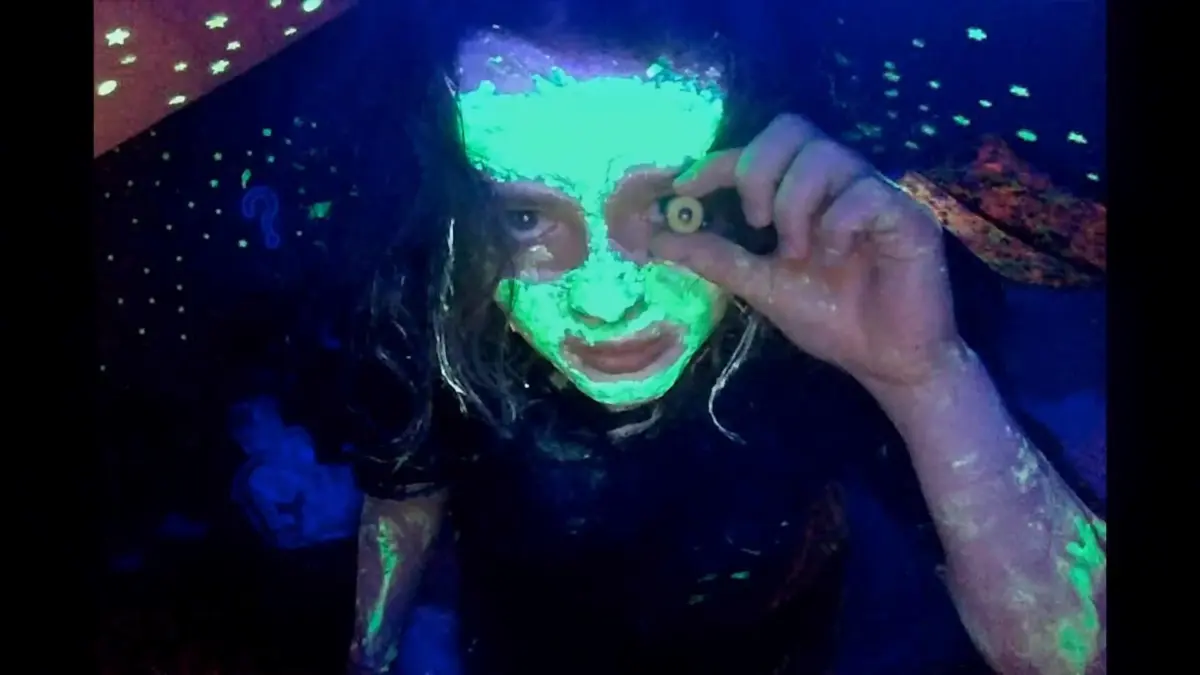
The narrative of We’re All Going to the World’s Fair wastes no time thrusting the viewer directly into the uncanny ecosystem of internet subcultures. We are introduced to our protagonist, Casey, as she initiates her participation in the titular challenge. The ritual plays like a dark pastiche of viral internet phenomena—a hybrid of an ARG, a creepypasta mythos, and the physical endurance tests of the mid-2010s.
The mechanics of the challenge are deceptively simple: participants must repeat a specific mantra three times while staring into a webcam, prick their skin to draw blood, and watch a hypnotic, glitch-art video. To the seasoned horror fan, these components function as a rapid-fire speedrun of conventional horror tropes. However, the domestic, unvarnished realism of the delivery strips away any cinematic safety nets. Framed entirely through the static, unblinking eye of a bedroom webcam, Casey’s performance feels uncomfortably real. The physical toll of the ritual is immediate and visceral; the moment Casey repeatedly jabs herself with a pin to draw blood serves as a wincing reminder of the self-harming lengths to which isolated youth will go to feel something—anything—real.
The Symptoms of Transformation
Once the ritual is completed, participants are instructed to document and upload video logs detailing their supposed transformations. The challenge posits that the ritual alters the individual in nebulous, terrifying ways. Users report grotesque symptoms: their bodies slowly turning into plastic, their internal organs rearranging into Tetris blocks, or their physical forms dissolving into digital artifacts.
For Casey, the challenge becomes a fixation. She is never shown interacting with peers of her own age, and her domestic environment is defined by its emotional vacuum. Her father remains an off-screen presence—a disembodied voice echoing down the hallway, contributing nothing to her life save for muffled, irritable shouting. In the absence of a nurturing family structure or offline friendships, Casey leans heavily into her online persona, uploading video after video documenting her imaginary, horrifying bodily changes as a desperate plea for validation and witness.
The Intervention of JLB and the Voyeuristic Horizon
As Casey’s digital footprint expands, the film introduces its only major counterweight: a lonely, middle-aged man who goes by the online handle JLB. Watching Casey’s increasingly erratic and distressed video logs, JLB reaches out via direct message, claiming that the young girl is in profound danger and that he is uniquely positioned to protect her.
This dynamic introduces a thick layer of psychological unease. World’s Fair masterfully blurs the boundary between supernatural horror and the terrifyingly mundane dangers of the digital world. The relationship between JLB and Casey has an undeniable voyeuristic quality. While the film leaves its exact intentions in a state of ambiguous suspension, the undertones of online grooming are pervasive. JLB’s paternal concern quickly curdles into something possessive and invasive, turning the screen into a two-way mirror that traps Casey between the digital void she sought refuge in and the predatory gaze of an older man exploiting her loneliness.
Supporting Context & Metrics: The Mechanics of Digital-Age Horror
Redefining the Coming-of-Age Narrative
Traditional cinematic coming-of-age stories are overwhelmingly preoccupied with sexual awakening, identity formation through social friction, and peer-to-peer relationships. We’re All Going to the World’s Fair consciously subverts this entire cinematic lineage.
- Avoidance of Sexualization: Unlike many indie dramas that use early adolescent trauma or sexual exploration as a narrative engine, Schoenbrun entirely avoids the sexualization of their protagonist. Casey’s body is not viewed through the lens of emerging desire or predatory attraction (aside from the thematic implications of JLB’s interest, which the film critiques rather than indulges).
- The Search for Belonging: Instead of navigating high school corridors or social cliques, Casey’s coming-of-age journey occurs entirely within the glowing blue light of a monitor. Her primary conflict is not how to fit in with the kids at school, but how to prove to an anonymous, indifferent digital void that she actually exists.
Body Horror in the Era of Screen-Life Cinema
Schoenbrun’s deployment of body horror differs fundamentally from the practical gore spectacles of the 1980s or the Cronenbergian mutations of the late 20th century. In World’s Fair, the horror is psychological, existential, and mediated by compression artifacts and low-resolution video files.
| Metric / Feature | Conventional Body Horror | We’re All Going to the World’s Fair |
|---|---|---|
| Primary Medium | Practical effects, cinematic framing, theatrical soundscapes | Webcam footage, glitch art, ambient electronic sound design |
| Source of Trauma | External monsters, biological infections, surgical experiments | Digital isolation, dissociation, performative self-harm |
| Resolution of Fear | Confrontation, physical escape, or tragic demise | Perpetual ambiguity, unresolved digital ghost towns |
By utilizing the "screen-life" aesthetic, Schoenbrun captures the specific texture of modern alienation. The film understands that for Generation Z and younger demographics, identity is frequently performed online before it is experienced offline. The fear of "disappearing" isn’t physical death, but digital irrelevance—being left behind on a dead forum or unwatched video channel.
Official Statements and Critical Reception
Upon its premiere at the 2021 Sundance Film Festival, We’re All Going to the World’s Fair drew widespread acclaim for its uncompromising atmosphere and profound psychological depth. Critics noted that while the film operates on a micro-budget, its emotional resonance punches far above its weight class.
In interviews surrounding the film’s release, Jane Schoenbrun spoke extensively about the inspirations behind the project, emphasizing a desire to capture the specific phenomenology of the internet age:
"I wanted to make a movie about the internet that didn’t feel like an older person’s cautionary tale about screens being bad," Schoenbrun noted during festival press rounds. "Instead, I wanted to explore the genuine poetry, sadness, and profound community—as well as the deep, terrifying isolation—that comes with growing up online. The internet is where young people go to find themselves, even when the things they find there are monstrous."
Film critics also lauded the film’s refusal to provide neat narrative closures. By leaving the ultimate fate of Casey and the true nature of JLB’s intentions shrouded in ambiguity, Schoenbrun mirrored the open-ended, unmoderated nature of internet lore. As noted in retrospective reviews accompanying the rollout of I Saw the TV Glow, World’s Fair laid the crucial thematic groundwork for Schoenbrun’s recurring artistic fascinations: the fragility of identity, the transience of digital spaces, and the ways in which contemporary media constructs our inner lives.
Future Outlook: The Legacy of Schoenbrun’s Cinematic Universe
As Jane Schoenbrun solidifies their status as a defining voice in 21st-century horror and queer independent cinema, the reappraisal of We’re All Going to the World’s Fair takes on heightened significance. While later works like I Saw the TV Glow and Teenage Sex and Death at Camp Miasma achieve broader surrealist and camp heights, the raw, minimalist power of World’s Fair remains unmatched in its specific brand of digital melancholy.
Looking forward, the influence of World’s Fair can be seen rippling through a new wave of indie filmmaking that rejects traditional Hollywood slickness in favor of lo-fi authenticity, deep psychological introspection, and an unblinking examination of online subcultures. As streaming platforms such as the Criterion Channel, Kanopy, and Hoopla continue to make World’s Fair accessible to new generations of cinephiles, the film’s chilling mantra—"We’re all going to the world’s fair"—serves as both an invitation and a warning.
In an era where our lives are increasingly mediated by algorithms, glowing rectangles, and performative identities, Schoenbrun’s debut remains an essential, haunting artifact of our collective digital anxieties. It reminds us that while the internet can connect us to millions of voices across the globe, it is entirely possible to scream into the void and hear nothing back except the echoing hum of our own computers.
