

Executive Overview
For as long as automated speech recognition (ASR) systems have been developed, a persistent and frustrating discrepancy has haunted engineers and researchers alike: the yawning chasm between benchmark performance and real-world deployment. A model that posts near-perfect Word Error Rates (WER) on pristine, clean-speech evaluation datasets like LibriSpeech will frequently stumble, degrade, or fail entirely once it encounters the chaotic acoustic realities of a physical room. Reverberation, background hums, transient noises, and the physical distance between a speaker and a microphone introduce complex physical interactions that pristine studio recordings simply cannot capture.
To confront this challenge head-on, Treble Technologies—a pioneer in advanced acoustic simulation—has partnered with Hugging Face to launch the Far-Field ASR (FFASR) Leaderboard. Now live to the public, this is the industry’s first open, community-driven benchmark engineered explicitly to evaluate ASR models under realistic far-field acoustic conditions.
By leveraging Treble’s cutting-edge hybrid wave-based simulation engine, the FFASR Leaderboard subjects submitted models to rigorous, standardized evaluations across 14 fully furnished simulated rooms. It rigorously measures not just accuracy, but the trade-offs between Word Error Rate and computational speed (RTFx) on standardized hardware. As voice-enabled technologies rapidly expand beyond headphones and smartphones into humanoid robotics, smart glasses, in-car assistants, and enterprise conference systems, the FFASR Leaderboard arrives as an essential tool to quantify, analyze, and ultimately eliminate the performance degradation that has plagued the industry for decades.
Detailed Chronology: The Evolution of Far-Field Evaluation
The launch of the FFASR Leaderboard represents the culmination of years of iterative research into acoustic simulation, sim-to-real validation, and the democratization of machine learning evaluation pipelines.
The Historical Bottleneck: Clean-Speech Dominance
Historically, the trajectory of speech recognition has been shaped by clean-speech benchmarks. Datasets recorded in quiet, controlled environments allowed researchers to rapidly iterate on neural architectures, leading to the phenomenal accuracy leaps seen with transformer-based models and self-supervised learning approaches like wav2vec 2.0 and Whisper.
However, these datasets created a localized optimization trap. While models became exceptionally good at understanding close-microphone, anechoic speech, they were rarely tested systematically against the physics of wave propagation in real architecture. Although historical academic challenges such as CHiME, URGENT, and NOIZEUS made commendable strides in addressing noisy and distant speech, the field lacked a unified, continuously updated, open-access leaderboard framework where any developer could drop in a model and immediately see how it handles complex acoustics.
Laying the Foundation: The Treble10 Milestone
The technological bedrock for the FFASR Leaderboard was laid a year prior with the release of the Treble10 dataset. Utilizing Treble Technologies’ proprietary simulation engine—which uniquely merges wave-based solvers for low-to-mid frequencies with geometrical-acoustics modeling for high frequencies—the project successfully demonstrated that simulated room impulse responses (RIRs) could be reliably used to train and test robust speech models.
Treble10 proved that simulation could bypass the prohibitive costs and logistical nightmares of physically recording thousands of acoustic variations in the real world. By modeling physical phenomena such as diffraction, scattering, interference, and modal behavior, Treble established a pipeline where synthetic acoustic data could mirror reality with astonishing fidelity.
The Launch of FFASR (June 2026)
Building directly on this foundation, Treble Technologies and Hugging Face officially unveiled the FFASR Leaderboard. Moving beyond static datasets, the initiative transformed acoustic simulation into an active, automated evaluation engine. Housed on Hugging Face Spaces, the benchmark was designed from the ground up to accept standard model IDs from the Hub, running them server-side against a secure, held-out evaluation set comprising 2,000 anechoic speech samples processed through 14 distinct virtual rooms across multiple Signal-to-Noise Ratio (SNR) tiers.

Furthermore, the platform introduced advanced beta tracks, including moving-source evaluations—simulating dynamic speakers such as walking robots or mobile users—and established a sim-to-real validation track comparing lab-measured data against lab-simulated outputs to continuously prove the accuracy of the underlying physics engine.
Supporting Context & Metrics: Unmasking the Acoustic Reality
The metrics coming out of the early days of the FFASR Leaderboard confirm what field engineers have long suspected: the performance gap between near-field and far-field speech recognition is not only real, but it is vast.
The Physics of Degradation
When a sound wave travels from a speaker’s mouth to a microphone several meters away, it does not arrive intact. It undergoes multiple reflections off walls, ceilings, and floors (reverberation), mixes with ambient environmental sound (background noise), and picks up unpredictable local disturbances (transient noises like coughs or door slams).
Across all models submitted to the FFASR benchmark, a consistent pattern has emerged:
- The SNR Gradient: As the Signal-to-Noise Ratio decreases, far-field Word Error Rates consistently climb to multiples of their near-field equivalents.
- The Brittleness Factor: Many models that boast state-of-the-art accuracy on clean benchmarks demonstrate acute brittleness when subjected to low-SNR far-field conditions, exposing a heavy reliance on pristine audio features rather than robust semantic-acoustic decoding.
Evaluating the Pareto Front: Accuracy Meets Latency
In real-world deployments—such as an automated drive-thru, a factory-floor robotic assistant, or a smart-home hub—accuracy in a vacuum is meaningless if the system takes ten seconds to infer a response. Real-time factor (RTFx, measured as audio seconds processed per inference second) is just as critical as WER.
To address this, the FFASR Leaderboard incorporates a Pareto front analysis view on an NVIDIA L4 GPU. By plotting average WER against RTFx under identical standardized conditions, developers can visualize the exact trade-offs of every submitted architecture:
- Speed-Optimized Models: Systems that sacrifice marginal accuracy points to achieve lightning-fast throughput.
- Accuracy-Heavy Architectures: Models that process complex contextual audio deeply at the expense of higher latency.
- Balanced Frontiers: A rare tier of submissions that manage to secure competitive positions on both axes, offering practical viability for production environments.
Rigorous Methodological Architecture
To ensure absolute fairness and scientific integrity, the FFASR benchmark enforces a strict evaluation protocol:
- Held-Out Test Set: Comprising approximately 8 hours of audio per condition, the 2,000 anechoic test samples remain entirely hidden from developers to prevent any form of test-set contamination or overfitting.
- Standardized Normalization: Whisper-style text normalization is applied universally across all outputs to ensure scoring discrepancies are purely acoustic, not formatting-based.
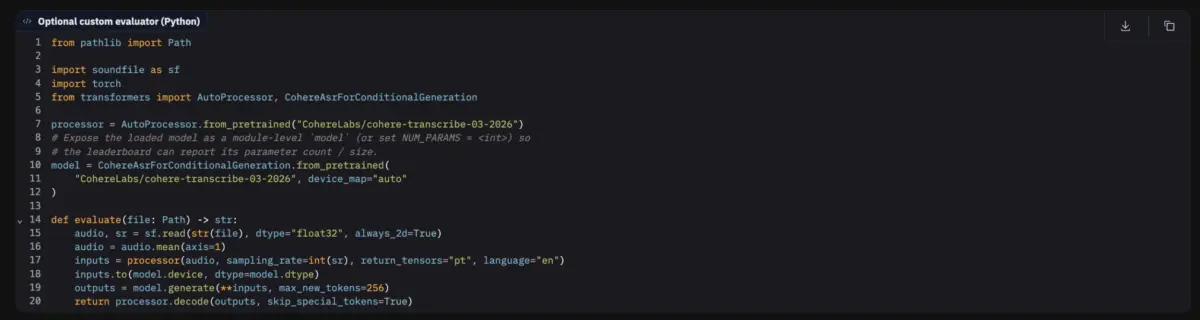
- Custom Evaluator Flexibility: For advanced deployment stacks—such as pipelines combining deep neural speech enhancement front-ends with ASR back-ends—developers can supply custom
evaluate()functions executed safely on Hugging Face Hub Jobs following moderator review.
Official Statements and Industry Perspectives
The collaboration between Treble Technologies and Hugging Face bridges two distinct worlds: advanced architectural room acoustics and open-source machine learning democratization.
Industry analysts and technical leads have noted that the launch of FFASR marks a mature turning point for speech AI. For years, the machine learning community has treated audio ingestion as a solved problem, focusing almost entirely on scaling language models and generative speech synthesis. However, the physical edge—where AI meets the messy, noisy physical world—remains the ultimate bottleneck for hardware integration.

By opening the evaluation pipeline to any model on the Hugging Face Hub—ranging from Whisper variants, IBM Granite Speech, and Cohere Transcribe to Wav2Vec2, HuBERT, and SpeechBrain CTC heads—the platform empowers individual researchers and enterprise engineering teams alike. It democratizes access to industrial-grade acoustic simulation, leveling the playing field so that smaller open-source contributors can benchmark their models against the same harsh virtual rooms used by major technology firms.
Furthermore, leaders from the acoustic engineering sector emphasize that the validation tracks (Lab Measured vs. Lab Simulated) provide a crucial psychological and scientific bridge. By proving that simulated room impulse responses yield the exact same error behaviors as physical laboratory recordings, the FFASR benchmark validates hybrid wave-based simulation as a legitimate, scalable substitute for physical data collection.
Future Outlook: What Lies Ahead for Far-Field ASR
The launch of the FFASR Leaderboard is merely the opening salvo in a broader campaign to align speech recognition benchmarks with physical reality. As the developer community populates the leaderboard and stress-tests various architectures, the roadmap for future iterations is already taking shape.
1. Multi-Talker Scenarios
Current evaluations primarily focus on single-target speaker environments. However, real-world deployment spaces—such as bustling offices, family living rooms, and customer service desks—frequently involve multiple people speaking simultaneously. Future tracks will introduce overlapping speech conditions to test how models handle cocktail-party problem dynamics in far-field settings.
2. Microphone Array Support and Spatial Filtering
As devices increasingly move toward multi-microphone configurations (such as smart speakers and wearable smart glasses), beamforming and spatial filtering become critical preprocessing steps. Future FFASR expansions will incorporate microphone array data, allowing researchers to evaluate hardware-software co-designs that isolate sound sources spatially before transcription.
3. Acoustic Echo Cancellation (AEC)
Any device that outputs audio while simultaneously listening—such as a voice assistant playing music while being interrupted by a user command—must contend with internal acoustic feedback. Integrating echo cancellation into the benchmark framework will address one of the most persistent hurdles in consumer hardware development.
Community-Driven Expansion
Ultimately, the trajectory of the FFASR Leaderboard will be dictated by the engineers who use it. Through the active Hugging Face community forums, developers are invited to submit feature requests, propose new acoustic environments, and highlight blind spots in current deployment paradigms.
As ambient computing and physical AI continue their explosive growth, benchmarks like FFASR ensure that the models powering our future voice interfaces are truly built to withstand the noise, echoes, and distances of the real world. To explore the current rankings, test your own models against held-out room acoustics, and join the community discussion, visit the FFASR Leaderboard on Hugging Face Spaces.
