

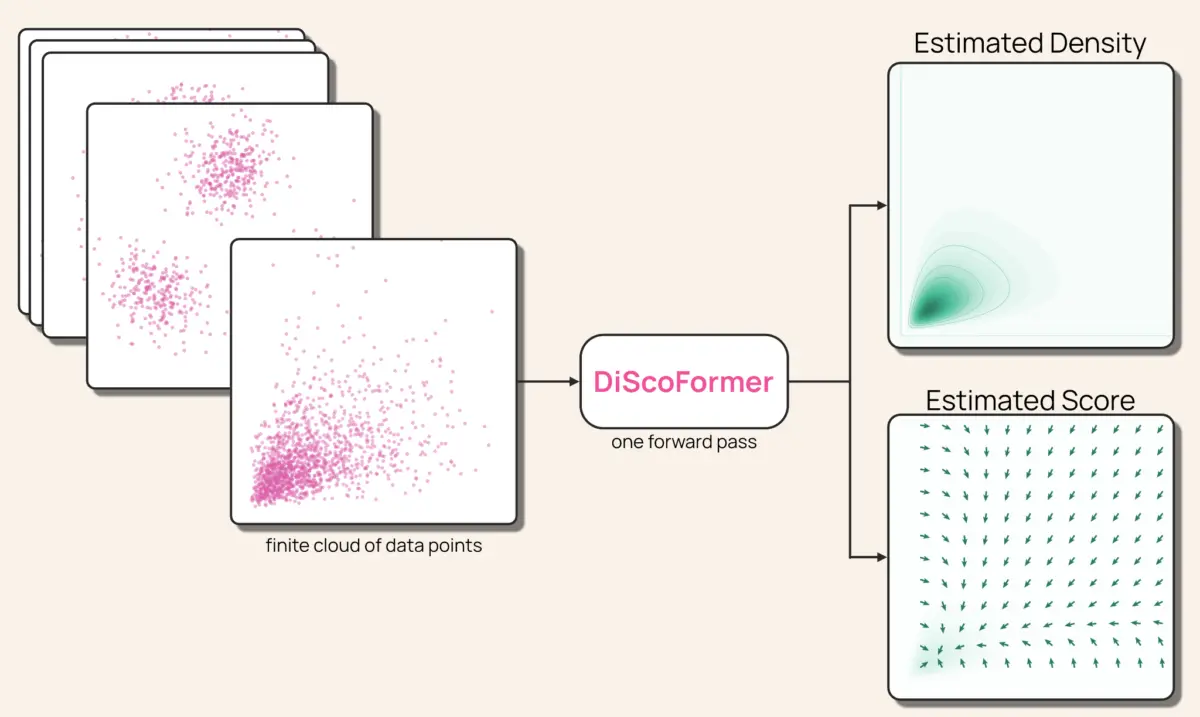
Executive Overview
In the vast landscape of machine learning, statistical mechanics, and quantitative sciences, a foundational problem recurs with stubborn persistence: given a discrete collection of observed data points, how does one accurately recover the underlying probability distribution from which they were sampled? Pinpointing this distribution requires estimating two critical mathematical quantities: density (which indicates where points cluster versus where they are scarce, acting as a smooth counterpart to a histogram) and score (the gradient of the log-density, which points in the direction of steepest ascent toward more probable regions).
Historically, researchers and practitioners have been forced into an uncompromising compromise. Classical nonparametric methods, such as Kernel Density Estimation (KDE), are intuitive, require no training, and generalize to arbitrary distributions, but they buckle under the curse of dimensionality, failing catastrophically as dimensions scale up. Conversely, modern neural network-based score-matching models thrive in high dimensions, powering state-of-the-art generative models like Stable Diffusion and DALL-E, but they suffer from a crippling rigidity: each model must be trained from scratch for a single, specific distribution, rendering them useless as plug-and-play estimators for novel, unseen data.
Enter DiScoFormer (Density and Score Transformer), a breakthrough architecture developed by researchers at Ai2. DiScoFormer shatters this long-standing paradigm by introducing a single, pretrained transformer model capable of estimating both the density and the score of an arbitrary data distribution in a single forward pass—without any retraining. By proving that self-attention mechanisms are a strict, generalized evolution of classical Gaussian kernels, the Ai2 team has built a universal plug-in estimator that dramatically outperforms classical benchmarks, cutting score error by over 6-fold and density error by more than 37-fold in high-dimensional spaces.
This technical report explores the architecture, mathematical underpinnings, empirical performance, and broader scientific implications of DiScoFormer, a model poised to transform fields ranging from generative AI to Bayesian inference and plasma physics.
Detailed Chronology: The Evolution of Distribution Estimation
To understand the magnitude of the DiScoFormer breakthrough, it is necessary to trace the historical tension between classical statistical theory and modern deep learning.
The Classical Era: Nonparametric Estimation and the Curse of Dimensionality
For decades, quantitative scientists relied on nonparametric statistics to infer data distributions without making rigid assumptions about their underlying mathematical form. The cornerstone of this era is Kernel Density Estimation (KDE), introduced in the mid-20th century. KDE computes the density at any spatial location by placing a kernel function (typically a Gaussian) over each observed data point. The density at a target location is simply the aggregated influence of all nearby points.
While KDE boasts elegant theoretical properties and requires zero training time, it possesses a fatal flaw: the curse of dimensionality. As the number of dimensions ($d$) grows, the volume of the space grows exponentially. To maintain a constant density of data points, the required sample size must scale exponentially as well. In high-dimensional regimes (e.g., $d > 50$), classical KDE becomes computationally intractable and statistically uninformative, often devolving into memory-overflow errors or flat, uniform estimates. Furthermore, KDE relies on a single, globally fixed bandwidth parameter—a predetermined radius determining how far each point’s influence extends—making it incapable of adapting to complex, multi-scale data topologies.
The Deep Learning Revolution: Score-Matching and Neural Generative Models
The advent of deep learning largely bypassed traditional density estimation in favor of parametric and implicit modeling. Modern diffusion-based generative models—the engines behind cutting-edge text-to-image systems—do not explicitly compute probability densities. Instead, they focus entirely on the score function (the vector field pointing toward regions of high data density).
Score-matching neural networks, popularized over the last decade, are trained via objective functions that teach a deep network to approximate the score of a target distribution. Once trained, these models can generate novel samples by starting from random Gaussian noise and iteratively following the score vector field (via Langevin dynamics or reverse stochastic differential equations). The same score functions drive advanced Bayesian sampling techniques and particle simulations in physics, such as modeling plasma turbulence or molecular dynamics.
However, these deep learning solutions introduced a new bottleneck. A score-matching neural network is inextricably bound to the specific training distribution it was optimized on. If a researcher wishes to evaluate the score or density of a completely new dataset, physics simulation, or Bayesian posterior, they must collect massive amounts of data, configure a custom architecture, and retrain the model from scratch—a process requiring days or weeks of compute time and extensive hyperparameter tuning.
The DiScoFormer Convergence
Recognizing this dichotomy, the Ai2 research team sought to bridge the gap between the sample-efficiency and zero-shot nature of classical nonparametric methods and the high-dimensional scalability of neural networks. By reimagining the transformer architecture through a statistical lens, they designed DiScoFormer: a model that views an entire dataset not as a static training objective, but as a contextual prompt passed directly into a transformer.

Architectural Mechanics & Mathematical Foundations
DiScoFormer is built upon a profound mathematical realization: the transformer’s cross-attention mechanism is a direct, generalized mathematical evolution of classical kernel density estimation.
From Kernels to Attention
In classical KDE, every data point exerts a fixed, isotropic influence governed by a bandwidth parameter $sigma$. The Ai2 team demonstrated analytically that a single attention head’s query-key-value weights, when properly structured, act almost identically to a Gaussian kernel over the context data points.
Rather than stopping at a single, rigid bandwidth, DiScoFormer leverages multi-head attention to learn multiple spatial scales simultaneously. The transformer dynamically adjusts these scales across different regions of the data space, effectively acting as an adaptive, multi-bandwidth KDE that overcomes the limitations of classical formulas.
[Observed Data Points (Context)]
               │
               ▼
   [Transformer Backbone]
   (Cross-Attention Layers)
               │
               ├──────────────────────────┐
               ▼                          ▼
     [Density Output Head]      [Score Output Head]
               │                          │
               └──────────┬───────────────┘
                          ▼
             [Label-Free Consistency Loss]
           (Self-Adapting Gradient Steps)
Dual-Head Architecture and Label-Free Consistency
Mathematically, density ($p$) and score ($s$) are intrinsically linked: the score is precisely the gradient of the log-density:
$$s(x) = nabla_x log p(x)$$
DiScoFormer exploits this rigid mathematical coupling by employing a shared transformer backbone that branches into two distinct output heads: one dedicated to estimating density ($p$) and the other dedicated to estimating score ($s$).
This shared dependency unlocks a powerful inference-time mechanism known as label-free consistency loss. Because the score head must mathematically match the gradient of the log-density head at every query point, any divergence between the two outputs exposes an internal inconsistency. During inference, DiScoFormer can hold the context data fixed, take a few rapid gradient steps on this internal consistency loss, and autonomously adapt itself to out-of-distribution (OOD) inputs on the fly—without requiring any ground-truth supervision.
Training via Universal Gaussian Mixture Models (GMMs)
To train a model capable of universal distribution estimation, the researchers needed a training dataset consisting of infinitely diverse, highly complex distributions with known ground-truth densities and scores. They solved this by utilizing Gaussian Mixture Models (GMMs) as their foundational training curriculum.
GMMs serve two vital purposes:
- Universal Approximators: By the mathematical principle of mixture approximation, any smooth probability distribution can be approximated to arbitrary precision by a sufficiently complex GMM.
- Closed-Form Exactness: GMMs possess explicit, closed-form mathematical equations for both their densities and scores.
During training, the pipeline dynamically generates a fresh, randomized GMM for every batch, creating a virtually infinite reservoir of target distributions. The transformer is trained to ingest samples drawn from these synthetic GMMs and predict their exact theoretical density and score, ensuring robust generalization across diverse topological structures.
Supporting Context & Empirical Metrics
The Ai2 research team subjected DiScoFormer to rigorous empirical benchmarking against classical baselines, testing its performance across varying dimensions, sample sizes, and out-of-distribution scenarios.

High-Dimensional Scaling Performance
While classical KDE performs adequately in low-dimensional spaces (1 to 5 dimensions), its accuracy degrades exponentially as dimensions increase. DiScoFormer reverses this trend entirely.
- 100-Dimensional Evaluation: In a rigorous 100-dimensional benchmark against hand-tuned classical KDE, DiScoFormer demonstrated staggering superiority:
- Score Error: Reduced by approximately 6.5×.
- Density Error: Reduced by more than 37×.
- Sample Scaling: Unlike KDE—which suffers from severe memory bottlenecks and computational explosion as the number of context points increases—DiScoFormer’s accuracy continuously improves as more data points are fed into its context window, demonstrating exemplary sample efficiency.
Robustness to Out-of-Distribution (OOD) Topologies
A critical test for any universal estimator is its ability to handle data distributions that deviate sharply from its training curriculum. Because DiScoFormer was trained primarily on synthetic GMMs, the researchers tested it on heavy-tailed and asymmetric distributions it had never encountered during training, including Laplace and Student-t distributions, as well as multi-modal mixtures far exceeding the mode-count of its training batches.
The model maintained high fidelity across all tested topologies. Thanks to its inference-time consistency adaptation, DiScoFormer successfully recalibrated its internal representations to accurately map these exotic distributions without requiring retraining or fine-tuning.
| Evaluation Metric / Feature | Classical Kernel Density Estimation (KDE) | Modern Score-Matching Neural Networks | DiScoFormer (Ai2) |
|---|---|---|---|
| Training Requirement | Zero Training | Heavy Training per Distribution | Pretrained Once, Zero Retraining |
| High-Dimensional Scaling ($d=100$) | Fails catastrophically (Memory/Accuracy drop) | Excellent | Superior (6.5× lower score error, 37× lower density error) |
| Generalization / Zero-Shot | High | Low (Requires retraining per domain) | High (Adapts via inference-time consistency loss) |
| Outputs Provided | Density only (Score requires numerical differentiation) | Score only | Both Density and Score simultaneously |
Official Statements & Scientific Implications
The release of the DiScoFormer technical report has generated significant discussion within the machine learning and computational science communities. The core innovation lies in shifting away from the paradigm of "one model per distribution" toward a universal statistical utility.
"Score estimation is not merely a trick for training image generators; it is a shared foundational dependency across an extraordinary breadth of scientific and computational disciplines," noted the research team in their technical publication. "By building a pretrained, plug-in estimator that maintains high fidelity in high dimensions without requiring problem-specific retraining, we can slash computational overhead across generative AI, Bayesian inference, and complex physical simulations all at once."
Impact Across Disciplines
- Generative Modeling: By providing rapid, high-dimensional score and density estimates, DiScoFormer can serve as a diagnostic tool for evaluating generative model collapse, mode dropping, and sample quality in diffusion frameworks.
- Bayesian Inference: Posterior distributions in advanced probabilistic programming are often intractable. DiScoFormer can ingest Markov chain Monte Carlo (MCMC) samples and immediately provide smooth density and score approximations essential for advanced variational inference and thermodynamic integration.
- Scientific Computing and Physics: In plasma physics and molecular dynamics, researchers simulate millions of interacting particles. Estimating the phase-space density and score fields of these particle systems is vital for understanding turbulent transport and stability—tasks where classical KDE fails due to high dimensionality.
Future Outlook
DiScoFormer marks a pivotal philosophical shift in how machine learning approaches statistical estimation. Rather than treating neural networks as black boxes that replace classical mathematics, DiScoFormer demonstrates that modern deep learning architectures—specifically transformers—can mathematically subsume, generalize, and vastly accelerate classical statistical theory.
As the Ai2 team refines the architecture, future research directions will likely explore scaling DiScoFormer to even higher dimensional spaces, integrating temporal dynamics for time-series distributions, and deploying the model as an open-source foundational utility within popular machine learning frameworks.
For researchers, engineers, and scientists wrestling with the complexities of high-dimensional data, the era of retraining custom models for every new distribution may soon be a relic of the past. DiScoFormer offers a tantalizing glimpse into a unified future: one universal model, reused everywhere score and density show up.
To read the full technical report, examine the mathematical proofs, and access the open-source codebases, visit the official ArXiv Preprint (2511.05924).
