

Executive Overview
For years, the artificial intelligence community has enjoyed a golden era of rapid algorithmic advancement. Vision-Language-Action (VLA) models, diffusion frameworks, flow-matching policies, and sophisticated world models have evolved at a breakneck pace. Driven by massive GPU clusters and increasingly clever neural architectures, the "brain" of modern robotics is remarkably capable. Yet, a glaring physical discrepancy persists: robots still struggle to fold laundry, unload dishwashers, or reliably assemble components in unstructured, real-world environments.
The limiting factor is no longer computational power or model architecture. It is data.

Training a generalizable robot policy requires vast, diverse, and high-fidelity real-world manipulation datasets. Historically, acquiring this data has meant deploying expensive, brittle, and logistically nightmarish teleoperation rigs. Researchers needed access to actual robotic arms, specialized master-slave controllers, and controlled laboratory environments—a financial and operational barrier that severely restricted the scale of data collection.
Enter Grabette, a radical, low-cost, open-source hardware and software ecosystem developed by Pollen Robotics. By decoupling data collection from the robot itself, Grabette allows humans to record physical manipulation tasks simply by picking up a handheld gripper, performing the action manually, and utilizing an automated browser-based processing pipeline to convert the recording into a robot-ready dataset.

Inspired by Stanford’s pioneering Universal Manipulation Interface (UMI), Grabette strips away the complexities of traditional robot teleoperation. It relies on off-the-shelf components—a Raspberry Pi, standard Pi and OAK-D depth cameras, and magnetic encoders—allowing anyone with a workbench to build a recording device. Paired with "Gripette," its robotic arm end-effector twin, Grabette aims to spark an open, collaborative data-sharing movement on the Hugging Face Hub, utilizing the LeRobot ecosystem. By making demonstration recording as effortless as shooting a video, this initiative promises to bypass the industry’s data bottleneck and usher in a new era of community-driven robot learning.
Detailed Chronology: The Evolution of Accessible Data Collection
To understand the significance of Grabette, one must trace the lineage of data acquisition in robotic learning and the systemic hurdles that have constrained the field.

The Era of Proprietary Teleoperation (Pre-2023)
In the early days of deep visuomotor policy learning, data collection was overwhelmingly monopolized by well-funded industrial labs and elite academic institutions. Researchers relied on cumbersome master-slave systems—two identical robotic arms where a human operator physically manipulated the "master" arm to guide the "slave" arm through tasks.
While effective for narrow, highly constrained behaviors, these setups suffered from fatal flaws:

- Prohibitive Costs: Owning even a single pair of industrial-grade robotic arms could cost tens or hundreds of thousands of dollars.
- Fragility and Maintenance: Joint motors overheated, calibration drifted, and hardware breakdowns required specialized technical intervention.
- Limited Scope: Teleop rigs were generally bolted to laboratory tables, making it impossible to capture tasks in diverse, real-world environments like messy apartments, dynamic kitchens, or cramped workshops.
The UMI Breakthrough (2023–2024)
The paradigm shifted dramatically with the introduction of the Universal Manipulation Interface (UMI) from Stanford University. UMI proved a counter-intuitive yet powerful hypothesis: you do not need a robot to collect robot data.
By outfitting a handheld mechanical gripper with a fisheye camera and leveraging Simultaneous Localization and Mapping (SLAM) algorithms, UMI demonstrated that a human could record precise 6-DoF (Degrees of Freedom) end-effector trajectories "in the wild." The physical robot was completely removed from the data-gathering loop. Instead, a human simply carried the gripper around, interacting with objects naturally.

However, despite its elegance, UMI and subsequent closed-source iterations (such as Agibot’s MEgo gripper, Genrobot’s DAS gripper, and Sunday Robotics’ skill capture glove) remained somewhat inaccessible to independent developers, hobbyists, and smaller research groups due to pipeline complexity, specialized assembly requirements, or proprietary software lock-in.
The Birth and Release of Grabette (Present Day)
Recognizing that accessibility was the final frontier in solving the data bottleneck, Pollen Robotics spent months designing, refining, and field-testing Grabette. Released as a fully open-source hardware and software project, Grabette takes the foundational insights of UMI and streamlines the pipeline from end to end.

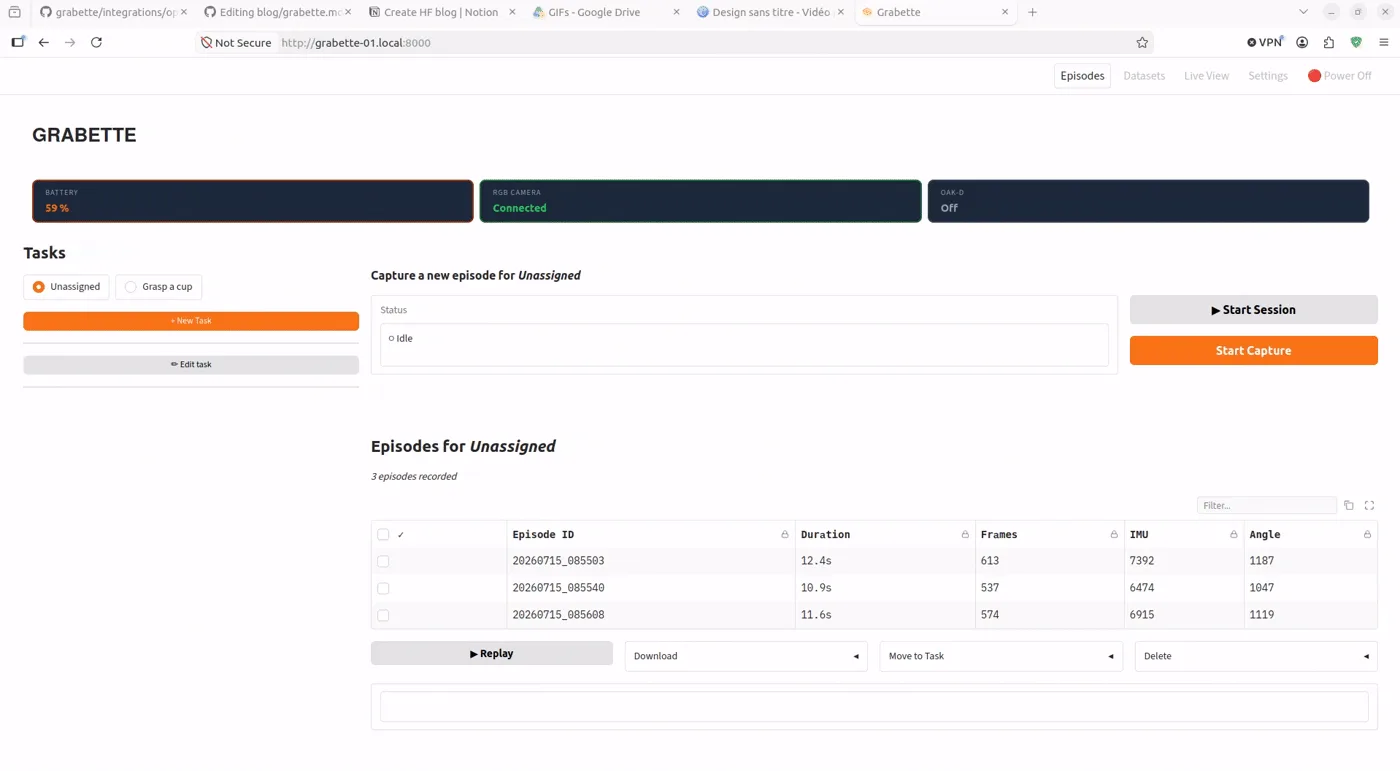
By integrating modern web technologies, the team eliminated local software installation hurdles. Users can now record episodes via a Raspberry Pi-powered handheld device, upload or process data locally through a browser dashboard, and instantly format outputs for the Hugging Face Hub using the LeRobot standard. Furthermore, the ecosystem is expanding horizontally: Pollen Robotics has teased "Casquette," a head-mounted POV device currently in development for egocentric data capture, signaling a continuous evolution toward multi-modal, human-centric dataset generation.
Supporting Context & Metrics: Architecture and Ecosystem
The technical brilliance of Grabette lies in its deliberate hardware-software co-design. Every component was chosen to balance precision, cost, and reproducibility.

Hardware Anatomy: Dual-Camera Synchronization
Grabette is engineered as a handheld gripper instrumented to capture all spatial and mechanical variables required to reconstruct a manipulation task. Its sensor suite is meticulously structured around two distinct cameras, each fulfilling a specialized role:
- The Wide Fisheye Camera: Providing a context-rich, wrist-camera-style perspective, this low-cost sensor captures the broader scene and the spatial relationship between the gripper and target objects. It feeds the neural policy the visual input it needs during execution.
- The RGBD Camera (OAK-D): This off-the-shelf depth camera handles the heavy computational lifting of robust 6-DoF spatial tracking, providing high-resolution color and depth data.
These visual streams are paired with magnetic encoders on the gripper fingers and an Inertial Measurement Unit (IMU) on the tracking camera. Crucially, all data streams are bound to a single shared clock managed by an onboard Raspberry Pi. This meticulous synchronization prevents temporal drift between visual frames and joint states—a common failure mode in DIY capture setups.

The Robotic Counterpart: Gripette
While Grabette captures the human demonstration, its robotic twin—Gripette—executes the learned behaviors. Gripette serves as the robotic arm end-effector twin, sharing the exact hardware DNA of Grabette. This ensures seamless transferability: a trajectory recorded by a human hand interacting with the physical world maps cleanly onto the kinematic constraints of Gripette mounted on an open-source robotic arm.
Software Integration and the Open Ecosystem
Grabette was built from the ground up to integrate with the modern open-source robotics stack:

- LeRobot Datasets: Data formatting complies natively with LeRobot, ensuring universal compatibility with state-of-the-art imitation learning algorithms.
- Hugging Face Hub: Datasets can be shared publicly with a single click, fostering a global repository of manipulation knowledge.
- Browser-Based Processing: Eschewing complicated Python environments or heavy local compilation, the post-processing pipeline runs directly inside a web browser via custom WebAssembly/cloud integrations, allowing users to convert raw recordings into training-ready episodes effortlessly.
Official Statements and Community Vision
The philosophy underpinning the Grabette release challenges traditional corporate and academic gatekeeping in robotics R&D.
Pierre-Louis Cabvel, lead engineer on the project at Pollen Robotics, emphasizes the collaborative imperative behind the launch:

"The data bottleneck doesn’t get solved by one lab working in isolation, but by a global community recording demonstrations everywhere. By removing the hardware barrier—allowing anyone to pick up a handheld gripper, record a task, and push a clean dataset to the Hub—we are changing the economics of robot learning."
Industry analysts have similarly noted that open datasets are becoming the primary competitive moat in embodied AI. While proprietary companies attempt to build internal data moats through massive, closed data-collection fleets, projects like Grabette offer a decentralized alternative reminiscent of the early days of open-source software.

By ensuring the hardware bill of materials consists entirely of accessible, off-the-shelf parts (Raspberry Pi, standard Pi cameras, OAK-D depth sensors, and magnetic encoders), Pollen Robotics has explicitly rejected vendor lock-in. The project is fully robot-agnostic at the capture level; demonstrations are stored as camera-local 6-DoF Cartesian poses paired with gripper states, meaning the resulting datasets can theoretically drive diverse robotic arm morphologies, provided they are equipped with a matching Gripette-style end-effector.
Future Outlook: The Road Ahead for Open-Source Embodied AI
The launch of Grabette marks the end of an isolated design phase and the beginning of a community-powered scaling experiment. However, several milestones and challenges lie ahead for the ecosystem:

- Scaling the Open Dataset: The immediate success of Grabette will be measured by the volume and diversity of community contributions on the Hugging Face Hub. If researchers, hobbyists, and educators around the world begin uploading hundreds of thousands of varied manipulation episodes—ranging from opening stubborn jars and sorting hardware to delicate soldering and culinary prep—the resulting open dataset could rival proprietary corpuses.
- Expanding Modalities with Casquette: As Pollen Robotics continues development on "Casquette," their head-mounted egocentric capture device, the field will likely see deeper integration between eye-tracking, first-person perspective vision, and fine-grained manipulation datasets. This multi-modal approach mirrors human learning, combining hand-object interaction dynamics with human visual attention fields.
- Closing the Sim-to-Real and Real-to-Real Transfer Gaps: As diverse datasets flow into LeRobot-compatible training pipelines, researchers will test the limits of cross-environment policy generalization. Training a single VLA model on data collected by hundreds of different operators across disparate rooms and lighting conditions will test the robustness of modern diffusion and flow-matching policies.
Conclusion: Now It’s Your Turn
For decades, dreaming of building a functional, intelligent household or industrial robot meant accepting the harsh reality of steep capital expenditures, calibration nightmares, and walled-garden datasets. Grabette dismantles that paradigm.
By proving that a Raspberry Pi, a couple of standard cameras, a 3D-printed shell, and a human hand are all it takes to generate enterprise-grade robot training data, Pollen Robotics has democratized the foundational input of embodied AI. The infrastructure is built; the processing pipeline lives in your web browser; the datasets share space on the Hugging Face Hub.

The bottleneck is broken. The rest is up to the community.
