

Executive Overview
In the rapidly evolving landscape of generative artificial intelligence, few technical challenges have proven as stubborn—or as vital to user experience—as latency in voice-based systems. While recent breakthroughs in transformer architectures, acoustic modeling, and dataset curation have yielded staggering improvements in raw model intelligence, the psychological friction of interacting with voice AI remains anchored to response times. When a user speaks, every millisecond of dead air acts as a jarring reminder that they are conversing with a machine. Traditional production systems frequently suffer from frustrating multi-second delays, particularly at the 95th percentile (P95) of response times, and these bottlenecks compound exponentially when complex tool calls or multi-turn reasoning steps are introduced.
Today, a joint initiative by Hugging Face and Cerebras is fundamentally shifting this paradigm. By coupling an entirely open, modular speech-to-speech (S2S) architecture with industry-leading, high-throughput hardware inference, the collaboration has unlocked a conversational experience that mirrors the seamless cadence of human-to-human dialogue. Instead of waiting for an AI to digest text, generate tokens, and render audio through legacy computing stacks, conversations now flow in real time.
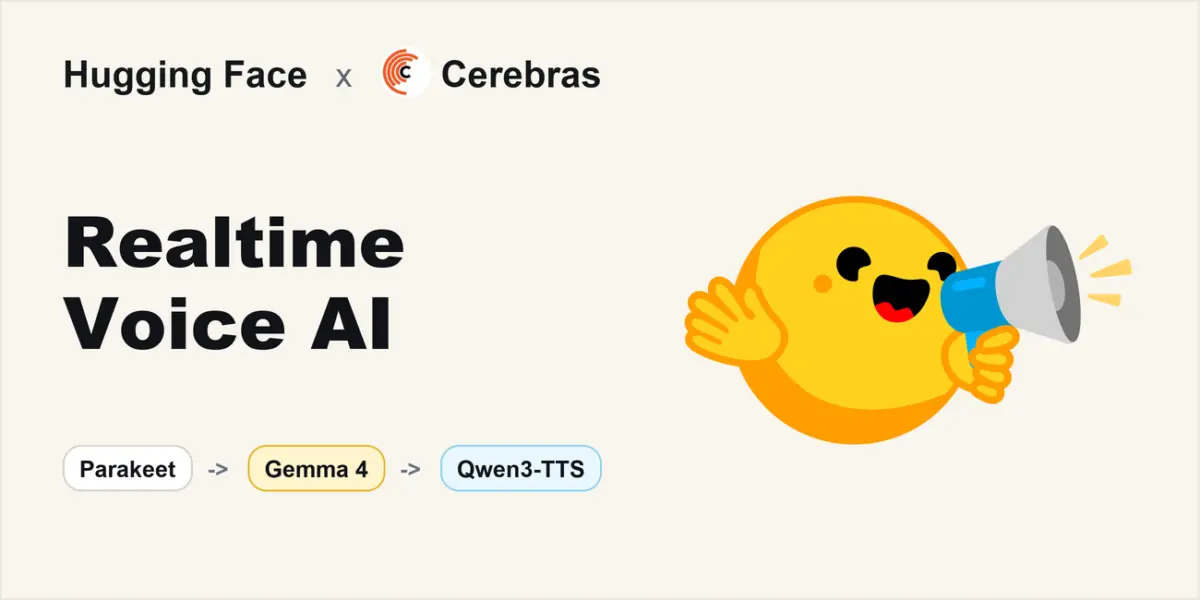
This breakthrough is not merely a cosmetic optimization. By integrating state-of-the-art open-source components—including NVIDIA’s Parakeet for speech recognition, Google DeepMind’s Gemma 4 (31B) for visual-linguistic reasoning, and Alibaba’s Qwen3TTS for text-to-speech—running atop Cerebras’s ultra-fast inference hardware, the project demonstrates that openness and extreme performance are no longer mutually exclusive. Already powering thousands of autonomous edge devices like Reachy Mini robots in the wild, this open-source S2S pipeline establishes a new baseline for robotics, voice assistants, and embodied AI systems worldwide.
Detailed Chronology
The Long-Standing Bottleneck of Voice Latency
Since the consumerization of deep learning-based speech assistants, the industry has chased the holy grail of natural conversational flow. Early voice interfaces relied on a rigid, multi-stage pipeline: audio was captured and transcribed into text via automatic speech recognition (ASR), processed by a core large language model (LLM), and subsequently converted back into synthesized audio via text-to-speech (TTS) engines.
While effective in controlled environments, this cascaded approach introduced accumulated latency at every handoff. Even as GPUs grew more powerful, the underlying memory-bandwidth constraints of traditional processors meant that generating auto-regressive text tokens took precious hundreds of milliseconds. More critically, while median latency figures often looked acceptable in laboratory benchmarks, real-world deployment exposed severe long-tail latency spikes. P95 and P99 delays frequently stretched past two to three seconds during peak loads, or whenever an agent needed to execute external tool calls. For human users, this stutter broke the "suspension of disbelief," reducing voice agents to frustratingly sluggish digital switchboards.
The Rise of Open-Source Modular Architectures
Recognizing that proprietary black-box ecosystems restricted developer flexibility, Hugging Face embarked on a mission to design a fully transparent, highly composable speech-to-speech stack. Rather than forcing developers into rigid end-to-end models that obscure internal states, Hugging Face championed a modular architecture where each layer—perception, reasoning, and generation—could be independently inspected, swapped, and optimized.
The resulting open cascaded loop streamlined data movement between best-in-class open-source projects:
- Speech Input & Recognition: Raw audio streams are ingested and transcribed instantaneously using NVIDIA’s highly optimized Parakeet ASR model.
- Cognitive Processing & Reasoning: The transcribed text (and associated multimodal inputs) are fed directly into Google DeepMind’s Gemma 4 31B Vision-Language Model (VLM).
- Voice Synthesis: The generated textual responses are piped into Alibaba’s advanced Qwen3TTS engine, transforming tokens back into expressive, lifelike spoken audio with minimal phase distortion.
The Cerebras Integration: Eliminating the Inference Bottleneck
While the modular pipeline provided unprecedented flexibility and quality, the core mathematical challenge remained: token generation speed within the LLM layer. To achieve human-level conversational responsiveness, the system required an inference engine capable of bypassing the traditional memory-bandwidth walls that plague conventional GPU clusters.
By integrating Cerebras as the inference engine for the Gemma 4 VLM, the collaboration effectively neutralized the primary computational bottleneck. Cerebras’s wafer-scale engine architecture processes entire neural network layers concurrently with massive on-chip SRAM capacity, dramatically accelerating token output speed and obliterating long-tail latency spikes.
Today, this fully realized integration is publicly accessible via interactive demonstrations and open-source codebases, allowing developers worldwide to inspect, deploy, and scale real-time voice architectures tailored to their own specialized hardware and domain requirements.
Supporting Context & Metrics
Deconstructing the Open Speech-to-Speech Pipeline
To fully appreciate the engineering achievement behind the Hugging Face and Cerebras integration, one must examine the specific mechanics of the data flow across the open stack:
$$textAudio Input xrightarrowtextNVIDIA Parakeet textTranscription xrightarrowtextCerebras + Gemma 4 31B textTokens xrightarrowtextAlibaba Qwen3TTS textSpoken Response$$
- Perception Layer (NVIDIA Parakeet): Optimized for low-latency streaming transcription, Parakeet converts acoustic waveforms into clean textual representations with minimal WER (Word Error Rate), ensuring downstream language models receive accurate context without waiting for complete sentence boundaries.
- Reasoning Layer (Gemma 4 31B via Cerebras): Operating on Cerebras hardware, Google DeepMind’s 31-billion parameter model handles complex contextual reasoning, dialogue management, and multi-step tool execution at speeds previously reserved for drastically smaller, highly quantized models.
- Generation Layer (Alibaba Qwen3TTS): Delivering natural prosody, emotional inflection, and low algorithmic delay, Qwen3TTS translates the high-speed text stream into fluid, human-like speech output.
The Math of Latency: Median vs. P95 Stability
In conversational AI, stability is just as important as average speed. A system that averages 400ms response times but occasionally jumps to 2,000ms feels erratic and untrustworthy.
[Traditional GPU Pipeline]
Median: 600ms  |████████████░░░░░░░░░░░░░░░░░░|
P95:    2400ms |██████████████████████████████| (Frustrating Spikes)

[Cerebras + Hugging Face Pipeline]
Median: 180ms  |████░░░░░░░░░░░░░░░░░░░░░░░░░░|
P95:    280ms  |██████░░░░░░░░░░░░░░░░░░░░░░░░| (Rock-Solid Stability)
By leveraging Cerebras’s wafer-scale processing, the variance in time-to-first-token (TTFT) and inter-token latency is compressed drastically. This eliminates the multi-second stalls that typically plague multi-turn interactions, tool invocations, and multimodal reasoning tasks.
Real-World Embodied AI: Beyond the Screen
This high-performance S2S pipeline is not confined to browser-based proofs of concept. The architecture already serves as the cognitive backbone for Reachy Mini robots, with over 9,000 units deployed globally in research labs, educational institutions, and commercial environments.
For embodied AI and robotics, low latency is an absolute operational requirement. When a physical robot interacts with humans, physical timing cues—such as head tilts, eye contact synchronization, and verbal acknowledgement—must align perfectly. A delayed voice response breaks the illusion of agency and makes physical interaction awkward or hazardous. By driving latency down to human-parity thresholds, the Hugging Face and Cerebras stack imbues physical hardware with a responsive, living presence.
Official Statements and Industry Implications
The collaboration underscores a broader philosophical shift within the artificial intelligence community: the refusal to choose between cutting-edge performance and open-source accessibility.
Industry analysts and open-source advocates note that while proprietary ecosystems (such as closed-door voice assistants from major tech conglomerates) have long boasted low latencies, they do so at the cost of developer lock-in, zero model auditability, and restricted data privacy. Conversely, open-source communities have historically struggled to unify disparate inference backends, audio models, and language models into cohesive, low-latency production pipelines.
By bridging Hugging Face’s modular orchestration framework with Cerebras’s hardware acceleration, the partnership proves that the open ecosystem can out-execute closed silos. Developers are no longer forced to surrender control of their model weights or data pipelines to achieve commercial-grade responsiveness. Every layer—from the speech recognition weights to the core VLM parameters and synthesis voices—remains fully inspectable, forkable, and extensible.
Future Outlook
As real-time conversational agents transition from novelty chat interfaces to ubiquitous personal assistants, autonomous vehicle co-pilots, industrial automation supervisors, and empathetic companion robots, the demand for sub-second, human-speed voice infrastructure will only intensify.
The successful demonstration of the Hugging Face and Cerebras speech-to-speech stack points toward several critical trajectories for the immediate future:
- Hyper-Personalized Voice Cloning and Emotion Modeling: With faster inference reducing systemic overhead, future iterations will likely incorporate real-time emotion recognition and dynamic voice adaptation without sacrificing latency budgets.
- Edge-Cloud Hybrid Scaling: While wafer-scale hardware dominates centralized high-throughput applications, the principles established in this open pipeline will inform lighter-weight edge implementations for localized robotics.
- Deepening Tool-Use Competency: As agents take on increasingly complex operational tasks—such as booking flights, querying enterprise databases, or manipulating physical machinery—the elimination of P95 latency spikes will ensure that multi-turn reasoning feels as fluid as a direct verbal reply.
Hugging Face and Cerebras have issued an open invitation to the global developer community to explore the live implementation, audit the codebase, and contribute to the next evolution of real-time voice infrastructure.
- Explore the Live Demo: Hugging Face Space – hf-realtime-voice
- Access the Open-Source Repository: GitHub – huggingface/speech-to-speech
