

Executive Overview
In the modern landscape of artificial intelligence development, a frustrating logistical friction plagues engineering teams worldwide: models and datasets live in a siloed bucket within one specific cloud provider’s region, while the specialized silicon—the coveted GPUs required for development, heavy training, and low-latency serving—increasingly reside elsewhere.
The moment these two vital components are separated across disparate cloud architectures, organizations are forced to pay a heavy "cross-cloud transfer tax" simply to read their own training data onto their own compute clusters. Egress fees, regional boundaries, and vendor lock-in have historically dictated where AI infrastructure can live, frequently forcing machine learning teams to compromise on cost, architectural flexibility, and performance.
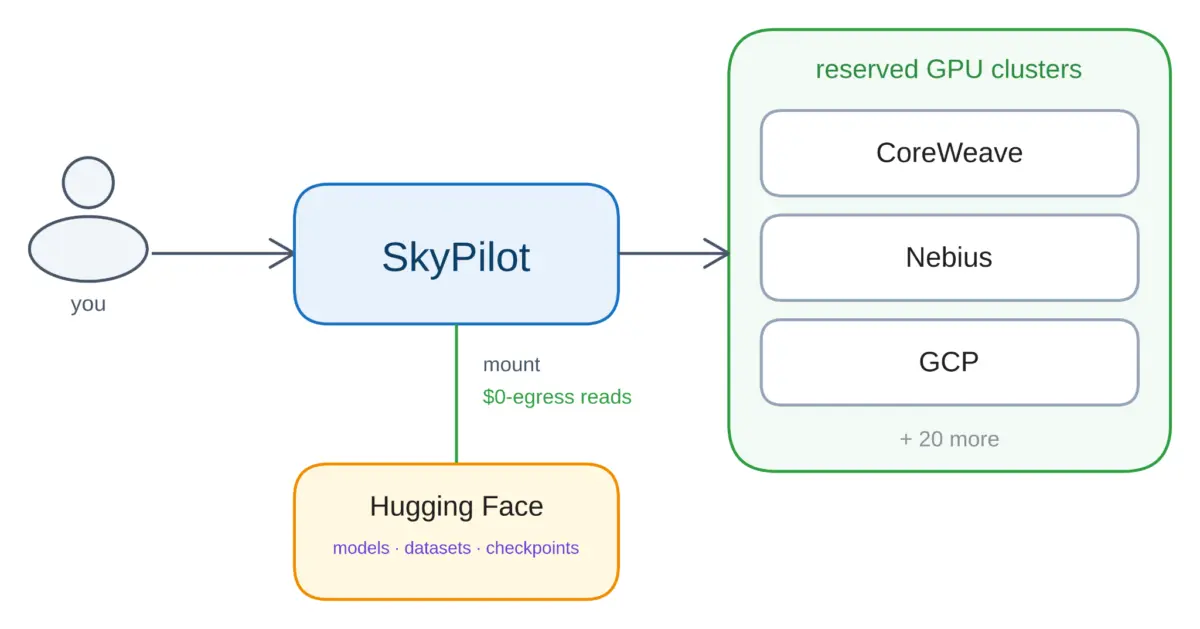
Today, this paradigm is undergoing a fundamental shift. In a landmark collaboration, SkyPilot and Hugging Face have formally integrated their ecosystems, bridging the traditional divide between compute orchestration and model storage. Under this new integration, models and datasets remain natively on the Hugging Face Hub, while SkyPilot dynamically provisions and executes compute tasks—spanning development, training, and serving—on whichever cluster or cloud vendor possesses available GPU capacity.
By leveraging a single hf:// URL paired with standard Hugging Face authentication tokens (HF_TOKEN), engineers can now mount Hugging Face Buckets or any Hub repository directly into a SkyPilot job. Because Hugging Face charges zero egress fees for data reads, organizations can feed their compute clusters from anywhere in the world without incurring the punitive bandwidth penalties typically levied by traditional hyperscalers. This development effectively severs the traditional link between where data is stored and where compute is executed, opening a new era of multi-cloud AI agility.
Detailed Chronology: Solving the Cross-Cloud Dilemma
The journey toward a unified multi-cloud AI storage backend did not happen overnight. It represents the culmination of open-source collaboration, community contribution, and rigorous engineering across multiple core platforms.
The Genesis of the Integration
The initial groundwork for store: hf support in SkyPilot began as an open-source contribution spearheaded by developer Nikhil Jha via GitHub pull request #9418. Recognizing the immense friction caused by traditional cloud object storage—where teams had to manually mirror datasets across AWS, GCP, Azure, and private infrastructure—Jha proposed a native mechanism to link SkyPilot’s multi-cloud orchestrator directly with Hugging Face repositories.
Engineering Robustness and Upstream Fixes
Recognizing the massive potential of this architecture, the core engineering teams at Hugging Face and SkyPilot stepped in to carry the initiative forward. Hugging Face developers tackled critical upstream infrastructure challenges, notably refining the hf-mount FUSE (Filesystem in Userspace) backend to support unprivileged container execution—a strict requirement for seamless operation within modern Kubernetes clusters, which often run restricted containers by default.
Concurrently, the SkyPilot team wired the new backend directly into their core storage architecture. Through subsequent pull requests (such as PR #9698), the combined engineering groups transformed experimental code into a first-class, enterprise-ready storage backend. Today, the entire pipeline—from SkyPilot’s orchestrator to Hugging Face’s hf-mount and the foundational huggingface_hub client—remains completely open-source, empowering the global AI community to inspect, audit, and extend the technology.
Architectural Mechanics: How hf:// Unifies the AI Lifecycle
In SkyPilot’s ecosystem, tasks have historically read and written to traditional cloud object stores (such as Amazon S3, Google Cloud Storage, Azure Blob Storage, and Cloudflare R2) by mounting them at local directory paths. Hugging Face Storage now joins this elite tier as a native storage type (store: hf), accessed seamlessly via the hf:// scheme.
file_mounts:
  # A Hugging Face Bucket, read-write, for checkpoints, logs, and processed data.
  /checkpoints:
    source: hf://buckets/my-org/qwen-sft
    store: hf
    mode: MOUNT # or COPY

  # A model repository, mounted read-only.
  /base-model:
    source: hf://Qwen/Qwen3.5-4B
    store: hf
    mode: MOUNT

  # A dataset repository, pinned to a specific revision, read-only.
  /data:
    source: hf://datasets/my-org/my-dataset@main
    store: hf
    mode: MOUNT
This single, intuitive syntax covers the entire lifecycle of an AI model:
- Reading the Base Model & Datasets: Training loops pull weights and raw data directly from their respective Hub repositories.
- Writing Checkpoints: Intermediate model checkpoints and training logs are written securely to a managed Hugging Face Bucket in real-time.
- Publishing & Serving: Finished models can be pushed directly back to a Hub repository and subsequently pulled onto distributed inference servers without altering workflows.
Because most AI development teams already utilize the Hugging Face Hub as their primary registry, this integration introduces zero migration steps and eliminates the need to provision redundant cloud storage accounts.
Lazy Loading via FUSE and Xet-Backed Storage
At the filesystem layer, the MOUNT mode utilizes Hugging Face’s hf-mount FUSE backend. Buckets and repositories appear as standard local file paths right alongside SkyPilot’s existing FUSE mounts (gcsfuse, blobfuse2, rclone, and goofys).
Instead of forcing a heavy, blocking download of entire multi-gigabyte datasets before execution can begin, the system relies on lazy loading. When training code issues a read() system call, the driver intelligently fetches only the specific bytes required from the underlying storage backend.
- Immediate GPU Utilization: Compute clusters no longer sit idle—and rack up expensive billing hours—while multi-terabyte datasets copy down. Training begins almost instantaneously on the very first epoch.
- On-Disk Caching:
hf-mountmaintains a localized on-disk cache, ensuring that repeat reads stay local. While SkyPilot historically differentiates betweenMOUNT(streaming without local caching) andMOUNT_CACHEDfor other storage systems, thehfstore automatically applies caching semantics to both modes for optimal read performance. - Xet-Backed Deduplication: Hugging Face Buckets are architected on top of Xet, utilizing content-defined chunking to divide files into ~64 KB segments. Each unique chunk is stored precisely once. When iterative fine-tuning generates new model checkpoints, only modified data chunks leave the machine. This provides staggering storage savings for teams managing frequent training checkpoints, model variants, and large-scale datasets.
Supporting Context & Metrics: The Economics of Multi-Cloud AI
To fully appreciate the financial and operational impact of this integration, one must examine the current state of enterprise GPU provisioning.
The Multi-Cloud Reality of GPU Shortages
The days when an enterprise could rely entirely on a single hyperscaler for all its compute needs are long gone. To secure high-performance accelerators—such as NVIDIA H100s, H200s, and upcoming architectures—AI teams must scatter their workloads across reserved and committed capacity blocks with multiple vendors simultaneously. An organization might hold a dedicated reservation on AWS, spin up clusters on specialized neoclouds (like Nebius or CoreWeave), lease on-demand instances via Lambda Labs, and maintain an on-premise Kubernetes cluster.

SkyPilot was built specifically to solve this orchestration headache, allowing developers to write a single job specification and schedule it across more than 20 different clouds and infrastructure types, landing wherever free capacity appears.
The Financial Burden of Egress
Object storage, however, has remained a stubborn bottleneck. Traditional object stores are inherently regional and vendor-locked. Feeding an inference server or a GPU training cluster operating in one vendor’s data center with data residing in another’s requires either duplicating the data across every provider’s bucket or paying steep cross-cloud transit penalties.
- The Cost of Data Movement: Hyperscalers typically charge approximately $0.09 per gigabyte for data egress when it leaves their network perimeter—fees that also apply across availability zones and regions within the same cloud.
- The Compounding Penalties: Pulling massive base models onto dozens of distributed inference nodes or streaming multi-epoch datasets across cloud boundaries rapidly generates crippling supplementary bills that dwarf the underlying cost of reserved GPU compute. Consequently, engineering teams have long been forced to anchor their training runs to whichever cloud vendor happened to house the physical copy of their data, leaving valuable multi-cloud GPU allocations underutilized.
Eliminating the Read-Side Penalty
Hugging Face Storage fundamentally alters this cost structure. By pairing $12–$18 per terabyte per month storage rates (compared to AWS S3’s baseline of roughly $23/TB plus egress) with zero egress fees for reads, the exact same bucket becomes universally accessible from every compute cluster in an organization’s fleet.
While writing checkpoints back to storage still incurs the standard egress fees of whichever compute cloud the job happens to be running on, the vast majority of AI data operations—specifically data streaming over multiple training epochs and base weights pulled onto distributed nodes—are read-heavy. By removing read-side egress penalties, teams are finally liberated to run their workloads wherever compute is cheapest and most readily available.
Empirical Benchmarks
To quantify real-world performance, the engineering teams executed a standardized fine-tuning benchmark utilizing the Qwen/Qwen3.5-4B model on the HuggingFaceH4/Multilingual-Thinking dataset. Utilizing Hugging Face’s TRL (Transformer Reinforcement Learning) library and its SFTTrainer, the model was mounted read-only from its Hub repository while every training checkpoint was written directly to a Hugging Face Bucket.
A single SkyPilot YAML configuration file was deployed across three distinct cloud environments by simply modifying the --infra flag:
resources:
  accelerators: H100:1  # Automatically adapted to available hardware

file_mounts:
  /base-model:
    source: hf://Qwen/Qwen3.5-4B
    store: hf
    mode: MOUNT
  /checkpoints:
    source: hf://buckets/my-org/qwen-sft
    store: hf
    mode: MOUNT

run: |
  python train.py --model /base-model --output_dir /checkpoints
Observed Checkpoint Write Performance Across Clouds:
- AWS (
us-east-2via L40S GPU): ~168 MB/s - GCP (
us-central1via L4 GPU): ~123 MB/s - Lambda Labs (
us-west-3via H100 GPU): ~112 MB/s
These metrics demonstrate that distributed clusters operating on entirely different cloud providers can concurrently write high-throughput checkpoints to a unified Hugging Face storage backend without administrative friction or complex IAM cross-account key management.
Official Statements and Industry Perspective
The release of native Hugging Face storage integration within SkyPilot has drawn praise from infrastructure leaders and open-source advocates alike.
Industry analysts note that this partnership represents a major milestone in the commoditization of AI infrastructure. By abstracting away the underlying storage plumbing, developers can focus entirely on algorithm design, hyperparameter tuning, and model evaluation rather than wrestling with cloud networking permissions and data replication scripts.
Furthermore, authentication has been streamlined into a unified security model. Engineers simply set their standard HF_TOKEN in their local environment and pass it to a job via SkyPilot’s secret management (--secret HF_TOKEN). This single token authenticates the mount securely across AWS, GCP, Azure, Nebius, Lambda Labs, or localized Kubernetes clusters, completely eliminating the need to juggle dozens of per-cloud bucket access keys and credential rotation schedules.
Future Outlook: The Horizon of Multi-Cloud AI Orchestration
As foundation models grow increasingly massive—pushing well into hundreds of billions of parameters—and multimodal datasets expand into multi-terabyte scales, the traditional approach of static, single-cloud data silos is rapidly becoming obsolete.
The successful unification of SkyPilot’s orchestration layer with Hugging Face’s storage and Xet deduplication engine points toward a future where infrastructure is entirely fluid. In this upcoming era:
- Dynamic Workload Migration: AI training jobs will be able to pause on one cloud provider when spot instances evaporate and seamlessly resume on another provider’s cluster, mounting the exact same remote datasets and model weights instantly via lazy-loading FUSE layers without missing a beat.
- Optimized Cost Arbitrage: Automated schedulers will continuously scan global GPU spot markets, migrating training and inference pipelines to the cheapest available compute regions while maintaining a single, unified source of truth for all data artifacts on the Hugging Face Hub.
- Deepened Enterprise Adoption: By lowering the technical and financial barriers to multi-cloud AI development, smaller research labs and agile startups will gain the operational dexterity previously reserved for hyper-scale technology giants.
Getting Started Today
For engineering teams eager to break free from cloud silos, getting started requires just a few simple terminal commands:
pip install "skypilot[huggingface]"
hf auth login  # Alternatively: export HF_TOKEN=<your-token>
By appending a simple hf:// mount declaration to any standard SkyPilot task configuration, developers can immediately leverage reserved GPU capacity anywhere in the world, backed by zero-egress data reads and automated Xet deduplication. The cloud silo has officially been breached; the era of frictionless, multi-cloud artificial intelligence is here.
