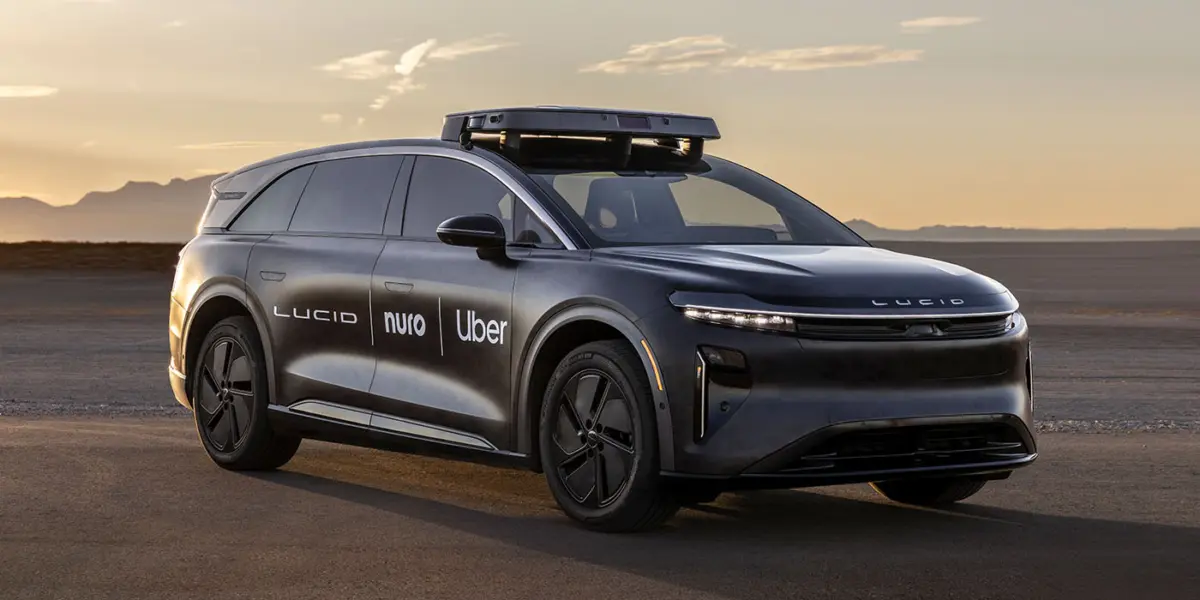
The global race toward autonomous mobility reached a significant inflection point today with the announcement of a groundbreaking three-way partnership between ride-sharing titan Uber Technologies, luxury electric vehicle (EV) pioneer Lucid Group, and Level 4 autonomy developer Nuro, Inc. This strategic alliance aims to reshape the future of urban transport by integrating Nuro’s sophisticated artificial intelligence-driven driving system into Lucid’s flagship Gravity electric SUVs, deploying the resulting fleet exclusively across Uber’s massive global ridesharing platform.
To cement this long-term collaboration, Uber has committed a massive $300 million direct investment into Lucid Group, alongside an undisclosed financial stake in Nuro. The roadmap is aggressive and concrete: the partners plan to roll out a minimum of 20,000 specially equipped Lucid Gravity robotaxis over the next six years, with the initial commercial launch slated for a major metropolitan market in 2026.
This venture represents a convergence of three distinct industry leaders leveraging their respective superpowers. Lucid brings world-class EV efficiency, luxury design, and exceptional battery architecture. Nuro contributes battle-tested, robust Level 4 autonomous software and hardware stacks. Finally, Uber offers the ultimate catalyst: an unmatched global distribution network, advanced fleet management infrastructure, and hundreds of millions of active monthly users. As traditional automakers and tech giants alike grapple with the immense costs and complexities of developing profitable autonomous ecosystems, this alliance signals a pragmatic shift toward modular, cross-industry cooperation.
Detailed Chronology: How the Tri-Party Alliance Came Together
The roots of this landmark partnership did not sprout overnight; rather, they reflect a broader industry-wide consolidation of technological capabilities. Over the past several years, the race to commercialize autonomous vehicles (AVs) has weeded out players unable to scale, while rewarding those capable of forming symbiotic ecosystems.
The Evolution of the Individual Players
For years, Lucid Motors has cemented its reputation in the electric vehicle sector as a technological tour de force. Renowned for engineering some of the most efficient powertrains and highest battery ranges in the automotive industry, Lucid spent its initial years scaling production of its pioneering Lucid Air sedan. However, the true linchpin for Lucid’s long-term commercial viability is its second flagship offering: the Lucid Gravity SUV. With an EPA-estimated range approaching 450 miles and a cavernous interior capable of hauling passengers and cargo alike, the Gravity was inherently designed with commercial fleet scalability in mind.
Meanwhile, Nuro has pursued a unique, highly specialized trajectory in the autonomous space. While many AV companies rushed to build robotaxis for human passengers, Nuro initially focused on zero-occupant, dedicated autonomous delivery vehicles. Through successful, high-profile deployments—most notably its long-standing collaboration with Uber Eats—Nuro’s proprietary AI system, the "Nuro Driver," evolved at a blistering pace. The company accumulated millions of miles of complex urban testing data, refining its Level 4 autonomy stack to navigate chaotic pedestrian zones, unpredictable traffic, and adverse weather conditions.
Uber, on the other hand, has systematically dismantled its internal, cash-burning autonomous vehicle development division (Advanced Technologies Group, which it sold to Aurora in 2020) in favor of an "open-platform" strategy. Rather than building the underlying self-driving technology itself, Uber has positioned itself as the universal aggregator for third-party AV developers. Earlier this year, Uber forged strategic robotaxi partnerships with May Mobility in Texas and Momenta in Europe. The addition of Lucid and Nuro to its roster represents the crown jewel of this platform strategy, bridging the gap between luxury passenger hardware and cutting-edge autonomous software.
From Closed Circuits to Commercial Realities
Behind closed doors, the partnership has already moved past the theoretical stage. Months of engineering collaboration culminated in the successful integration of the Nuro Driver system into the Lucid Gravity architecture.
Currently, fully autonomous prototypes of the Lucid Gravity robotaxi are actively completing rigorous validation trials on a closed-circuit proving ground in Las Vegas. These tests evaluate the vehicle’s dynamic response, sensor suite calibration, and edge-case handling under simulated urban distress. Following the validation phase, the first public deployment will hit an unnamed major U.S. city in 2026, marking the official commercial debut of the world’s first luxury-tier, purpose-built autonomous rideshare fleet.
Supporting Context & Metrics: Decoding the $300 Million Agreement
The financial and operational metrics underpinning this agreement reveal a calculated, high-stakes wager on the future of urban mobility. By committing $300 million to Lucid Group alongside an undisclosed equity or operational investment in Nuro, Uber is putting its balance sheet behind a hardware-software marriage designed to outmaneuver legacy competitors.
Fleet Scale and Deployment Timeline
Total Vehicle Commitment: A minimum of 20,000 Lucid Gravity SUVs outfitted with Nuro Driver technology.
Rollout Window: A six-year deployment horizon, beginning aggressively in 2026.
Geographic Scope: Dozens of global markets, scaling outward from initial U.S. launch cities.
Exclusivity: These purpose-built robotaxis will be available exclusively through the Uber app, integrating seamlessly into the user’s everyday ride-hailing interface.
Vehicle Architecture: Why the Lucid Gravity?
The selection of the Lucid Gravity SUV as the foundational robotaxi platform is no accident. Traditional robotaxis often utilize compact sedans or retrofitted commercial vans, which can limit passenger comfort and cargo capacity. The Gravity, by contrast, offers a unique value proposition:
Unrivaled Efficiency and Range: Lucid’s proprietary powertrain technology minimizes energy consumption per mile, reducing operational downtime associated with frequent charging. For a commercial robotaxi fleet where vehicle utilization equals revenue, minimizing time spent at charging stations is paramount.
Cabin Versatility: The Gravity’s expansive three-row seating configuration allows it to comfortably transport groups, families, or heavy luggage, making it a drop-in replacement for standard UberX and UberXL vehicles.
Advanced Sensor Integration: Nuro’s LiDAR, radar, and camera suites have been meticulously mapped onto the Gravity’s exterior profile, ensuring a 360-degree field of vision without compromising the vehicle’s aerodynamics or aesthetic appeal.
Fleet Management and Maintenance Operations
Deploying 20,000 autonomous vehicles requires a monumental logistics framework. Under the terms of the agreement, the fleet will be managed, operated, and maintained jointly by Uber and carefully selected third-party fleet operators. This shifts the heavy burden of cleaning, servicing, and routine maintenance away from individual car owners and centralizes it within Uber’s optimized operational network.
Official Statements: Leadership Perspectives on the Future of Mobility
The gravity of the announcement was underscored by visionary remarks from the chief executive officers driving the enterprise.
Uber CEO Dara Khosrowshahi emphasized the transformative societal impact of the collaboration:
"Autonomous vehicles have enormous potential to transform our cities for the better. We’re thrilled to partner with Nuro and Lucid on this new robotaxi program, purpose-built just for the Uber platform, to safely bring the magic of autonomous driving to more people across the world."
While neither Lucid nor Nuro executives have publicly detailed every facet of the intellectual property sharing, industry insiders note that the alignment allows each company to focus on its core competency: Lucid manufactures the world’s most advanced electric vehicle platform; Nuro provides elite-tier artificial intelligence and Level 4 driving software; and Uber commands the world’s most potent demand-aggregation and dispatch engine.
Future Outlook: Challenges, Opportunities, and the Road Ahead
As the industry looks toward the 2026 commercial rollout, the tripartite partnership faces both extraordinary opportunities and formidable hurdles.
Navigating the Regulatory Maze
The most immediate challenge for the Uber-Lucid-Nuro alliance is the fragmented regulatory landscape governing autonomous vehicles. While states like Nevada, Texas, and California have established clearer pathways for autonomous testing and commercial deployment, other jurisdictions remain stubbornly resistant. Securing municipal approvals, state-level permits, and public trust will require a concerted, transparent campaign by all three companies.
Competitive Pressures in the Robotaxi Arena
The robotaxi sector is far from empty. Well-capitalized incumbents like Alphabet’s Waymo currently operate commercial robotaxi services in multiple major U.S. markets, while Tesla continues to tease its long-awaited Cybercab ambitions. However, the Uber-Lucid-Nuro model offers a distinct structural advantage: it is a collaborative coalition rather than a vertically integrated monopoly. By decoupling vehicle manufacturing (Lucid) from software development (Nuro) and demand generation (Uber), the partnership creates a modular template that can rapidly scale across multiple vehicle segments and geographical borders.
Potential Expansion Beyond the Gravity SUV
When queried about whether Lucid’s flagship sedan, the Lucid Air, would join the robotaxi fleet, company representatives clarified that the initial focus remains strictly on the Gravity SUV. However, they left the door wide open for future expansion, hinting at the potential inclusion of upcoming vehicle platforms—most notably Lucid’s highly anticipated mid-size EV platform currently in development. If successful, this ecosystem could eventually spawn an entire family of autonomous Lucid vehicles catering to various price points and transit needs on the Uber app.
Conclusion
The partnership between Uber, Lucid, and Nuro marks a mature turning point for the autonomous vehicle industry. Gone are the days of isolated tech startups attempting to build every component of the mobility puzzle from scratch. By combining Lucid’s engineering excellence, Nuro’s sophisticated AI driving system, and Uber’s global logistics network, this $300 million alliance has established a formidable blueprint for the future of transportation. As prototypes log their final miles on test tracks and prepare for public deployment in 2026, the vision of a cleaner, safer, and fully autonomous urban landscape moves one giant step closer to reality.


![Uber to deploy 20,000 Lucid Gravity robotaxis equipped with Nuro Driver, beginning next year [Video]](https://i0.wp.com/electrek.co/wp-content/uploads/sites/3/2025/07/Uber-Lucid-Nuro-Robotaxi-front.jpg?resize=1200%2C628&quality=82&strip=all&ssl=1)
![Uber to deploy 20,000 Lucid Gravity robotaxis equipped with Nuro Driver, beginning next year [Video]](https://electrek.co/wp-content/uploads/sites/3/2025/07/Uber-Lucid-Nuro-Robotaxi-front.jpg?quality=82&strip=all&w=1400)
![Uber to deploy 20,000 Lucid Gravity robotaxis equipped with Nuro Driver, beginning next year [Video]](https://electrek.co/wp-content/uploads/sites/3/2025/07/Uber-Lucid-Nuro-Robotaxi-rear.jpg?quality=82&strip=all&w=1024)
![Uber to deploy 20,000 Lucid Gravity robotaxis equipped with Nuro Driver, beginning next year [Video]](https://electrek.co/wp-content/themes/ninetofive/dist/images/google-preferred-source-badge-dark.png)
