

By the AI Infrastructure Desk
Published in collaboration with Open-Source AI Systems Review
Executive Overview
The landscape of open-source artificial intelligence is undergoing a profound structural shift. As frontier-scale architectures increasingly pivot toward Mixture-of-Experts (MoE) designs to manage computational costs while expanding parameter counts, the underlying software ecosystem faces unprecedented scaling challenges. Routing millions of tokens across hundreds of disparate expert networks, fusing complex matrix multiplications into high-performance kernels, sharding colossal weight matrices across distributed arrays of GPUs, and perfectly overlapping communication with computation require an infrastructure far more robust than general-purpose libraries can provide out of the box.
Enter the powerful synergy between Hugging Face Transformers v5 and NVIDIA NeMo AutoModel.
Recently released, Hugging Face Transformers v5 established a new bedrock for the open-source AI ecosystem by introducing first-class support for MoE models, complete with modular expert backends, dynamic weight loading, and robust distributed execution hooks. Building directly upon this foundation, NVIDIA NeMo AutoModel—an open library housed within the larger NVIDIA NeMo framework—introduces advanced hardware-level optimizations, including true Expert Parallelism (EP), DeepEP fused all-to-all dispatch, and specialized TransformerEngine kernels.
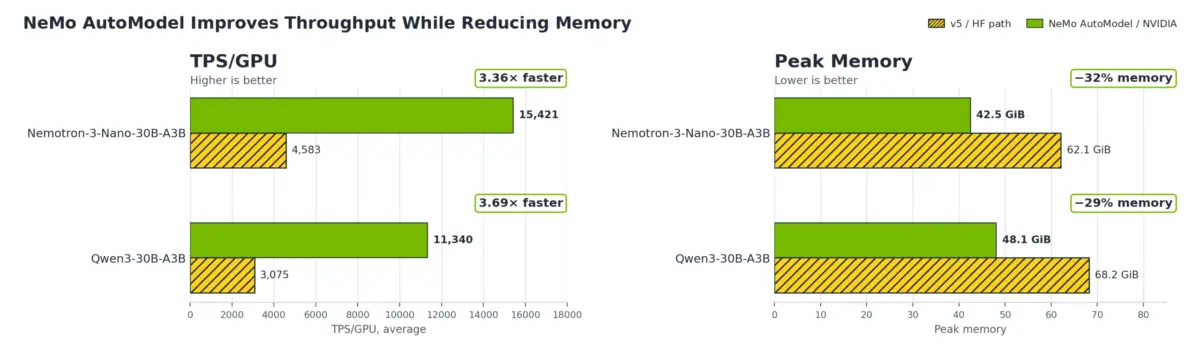
By leveraging Transformers v5’s dynamic weight-loading architecture, NeMo AutoModel bypasses the traditional, error-prone plumbing required for custom model checkpoints. The result is a seamless developer experience: engineers can achieve 3.4 to 3.7 times higher training throughput and 29% to 32% lower GPU memory consumption during MoE fine-tuning compared to native Transformers v5 configurations. Crucially, this performance leap requires zero code rewrites beyond a single import swap, maintaining full API compatibility and ensuring that finalized checkpoints remain fully deployable on inference engines like vLLM and SGLang.
Detailed Chronology & Architectural Evolution
To understand the magnitude of this engineering leap, it is vital to trace the evolution of MoE support across the open-source stack and the specific bottlenecks that necessitated this collaboration.
The Bottlenecks of Legacy Architectures (Transformers v4 Era)
In the era of Transformers v4, scaling MoE models—such as early iterations of Qwen and custom community architectures—introduced severe training instabilities and inefficiencies. For instance, v4 models typically stored MoE experts as a Python ModuleList comprising dozens or hundreds of individual Multi-Layer Perceptron (MLP) modules, each independently wrapped in Fully Sharded Data Parallel (FSDP) containers.
This design triggered a data-dependent forward-pass loop that only executed experts designated to receive tokens for a given batch. Because different GPU ranks processed varying slices of data, different ranks would inevitably skip different subsets of experts. This divergence caused catastrophic mismatches in FSDP AllGather and ReduceScatter communication collectives, resulting in severe deadlocks and indefinite system hangs. Furthermore, the sheer memory footprint of maintaining individual expert modules frequently triggered out-of-memory (OOM) errors during full-parameter fine-tuning, severely limiting experimentation.
The Transformers v5 Paradigm Shift
Recognizing these systemic limitations, the Hugging Face team engineered Transformers v5 from the ground up to treat MoE architectures as first-class citizens. Version 5 introduced three revolutionary infrastructural pillars:

-
Expert Backends (
experts_interface): Transformers v5 categorized expert computation into three distinct backends:- Eager: A standard Python for-loop over selected experts, primarily utilized for debugging and correctness validation.
- Batched Matrix Multiplication (
batched_mm): Duplicates expert parameters to execute a single batched General Matrix Multiply (GEMM) viatorch.bmm, optimized for smaller inputs withtorch.compile. - Grouped Matrix Multiplication (
grouped_mm): Sorts tokens dynamically by their assigned expert and executes a single fused grouped GEMM. This serves as the cornerstone training optimization, eliminating parameter duplication and slashing memory overhead.
-
Expert Parallelism and Distributed Execution: Version 5 integrated PyTorch’s
DeviceMeshdirectly into the foundationalfrom_pretrained()API, providing tensor-parallel plans that allow expert parameters to be intelligently sharded across hardware accelerators. -
Dynamic Weight Loading (
WeightConverter): Version 5 introduced a composable weight-conversion pipeline that transforms checkpoint tensors on-the-fly during instantiation. This allows fused 3D tensor checkpoints to be parsed and manipulated efficiently without custom, model-specific plumbing scripts.
NVIDIA NeMo AutoModel: Supercharging the Foundation
While Transformers v5 established the necessary primitives, NVIDIA NeMo AutoModel builds cleanly on top of this framework by subclassing AutoModelForCausalLM and injecting hyper-optimized hardware acceleration layers.
NeMo AutoModel introduces Expert Parallelism as a dedicated, orthogonal dimension to Data Parallelism. Rather than carving the device mesh solely from data-parallel constraints, NeMo AutoModel utilizes PyTorch’s DTensor with Shard(0) to ensure that the expert mesh and data mesh compose seamlessly. On an 8-GPU node, for example, the system can execute with an expert parallel size (ep_size) of 8 and a data parallel size (dp_size) of 8 concurrently. Consequently, every GPU trains on its distinct data shard while housing only one-eighth of the total expert parameters.
Additionally, NeMo AutoModel integrates DeepEP, an advanced dispatch engine that fuses token routing into optimized GPU kernels. DeepEP effectively overlaps communication overhead with expert computation—a critical optimization that Transformers v5 could not achieve independently.
Supporting Context & Performance Metrics
To quantify the real-world advantages of this integration, NVIDIA evaluated NeMo AutoModel across two distinct operational regimes: multi-node full fine-tuning of a frontier-scale 550-billion parameter model, and single-node benchmarking of 30-billion parameter MoE architectures.
Frontier-Scale Fine-Tuning: Nemotron 3 Ultra 550B A55B
The NVIDIA-Nemotron-3-Ultra-550B-A55B-BF16 is a massive 550-billion parameter hybrid model incorporating Mamba2, LatentMoE, and Multi-Token Prediction (MTP) capabilities. Benchmarking a full fine-tuning run—where every parameter is updated and Adam optimizer states are fully materialized—demands immense infrastructure.
- Hardware Footprint: 16 NVIDIA H100 80GB nodes (totaling 128 GPUs).
- Configuration: Expert Parallelism set to
EP=64, local batch size of 2, sequence length of 4,096, with activation checkpointing and fused linear cross-entropy enabled. - Result: NeMo AutoModel achieved an average throughput of 815 Tokens Per Second (TPS) per GPU, computing at approximately 293 TFLOP/s per GPU with a peak memory footprint of 58.2 GiB.
Context on Baseline: Standard Transformers v5 configurations encounter insurmountable out-of-memory errors at this scale. NeMo AutoModel’s sophisticated expert sharding is the sole mechanism that brings the memory footprint within the hardware budget, enabling training runs that were previously impossible.

Single-Node Benchmarking: 30B MoE Architectures
On a single node equipped with eight NVIDIA H100 80GB GPUs, evaluators compared legacy Hugging Face Transformers v4, optimized Transformers v5, and NeMo AutoModel across popular architectures including Qwen3-30B-A3B and Nemotron 3 Nano 30B A3B.
To ensure pristine comparative validity, the benchmarks utilized a balanced routing gate for NeMo AutoModel. This forces tokens to be distributed uniformly across experts, emulating the ideal steady-state operating point toward which a well-trained MoE converges, thereby neutralizing the noise introduced by random dummy tokens.
Qwen3-30B-A3B Performance Breakdown
- Transformers v4: Suffered fatal deadlocks due to rank divergence in un-fused expert loops.
- Transformers v5 (FA2 + grouped_mm): Achieved 3,075 TPS/GPU with 68.2 GiB peak memory.
- NeMo AutoModel (EP=8 + DeepEP + TE): Achieved 11,340 TPS/GPU—a staggering 3.69x speedup over v5.
- Peak Memory: Reduced to 48.1 GiB, representing a 29% memory reduction.
- Forward + Loss Latency: Cut from 582 ms down to 194 ms (3.00x improvement).
- Backward Latency: Cut from 758 ms down to 178 ms (4.26x improvement).
Nemotron 3 Nano 30B A3B Performance Breakdown
- Transformers v4: 1,807 TPS/GPU with 61.9 GiB peak memory.
- Transformers v5 (FA2 + grouped_mm + Mamba CUDA): 4,583 TPS/GPU with 62.1 GiB peak memory.
- NeMo AutoModel (EP=8): Achieved 15,421 TPS/GPU—a 3.36x speedup over v5.
- Peak Memory: Reduced to 42.5 GiB, representing a 32% memory reduction.
- Forward + Loss Latency: 109 ms (2.60x improvement over v5).
- Backward Latency: 157 ms (3.89x improvement over v5).
Official Statements and Architectural Philosophy
The core engineering team behind NeMo AutoModel—comprising Adil Asif, Hemil Desai, Alexandros Koumparoulis, and Huiying Li—emphasized that the primary design philosophy of the project was frictionless adoption.
"Our central objective was to preserve absolute API compatibility with Hugging Face Transformers," the team noted in technical documentation. "By subclassing
AutoModelForCausalLM, we ensure that any existing codebase written for Hugging Face models works natively with NeMo AutoModel without requiring architectural rewrites. Developers simply change their import statement, pass their distributed configuration, and instantly unlock massive hardware acceleration."
Industry analysts have praised the collaborative nature of this release. Rather than forcing developers into proprietary walled gardens, NVIDIA’s decision to build natively upon Hugging Face Transformers v5 validates the open-source community’s tooling while injecting enterprise-grade performance tuning directly into the standard workflow.
Furthermore, because NeMo AutoModel maintains complete reversibility via v5’s weight conversion pipeline, checkpoints saved via save_pretrained() adhere strictly to standard Hugging Face-format safetensors. This ensures that models fine-tuned using NVIDIA’s high-performance infrastructure can be exported instantly for production deployment on community inference engines such as vLLM and SGLang.
Future Outlook and Next Steps
The successful integration of NVIDIA NeMo AutoModel with Hugging Face Transformers v5 marks a watershed moment for open-source generative AI. As foundation model architectures continue to scale past hundreds of billions—and eventually trillions—of parameters, the traditional divide between rapid, flexible prototyping frameworks and hyper-optimized enterprise training libraries is rapidly dissolving.
For researchers and enterprise developers looking to harness these performance gains, getting started requires minimal friction:
- Installation: Ensure the latest versions of PyTorch, Hugging Face Transformers v5, and NVIDIA NeMo AutoModel are installed in your cluster environment.
- Code Integration: Swap standard Hugging Face imports for
NeMoAutoModelForCausalLM. - Distributed Setup: Configure your
DeviceMeshandBackendConfigparameters to target TransformerEngine kernels and DeepEP dispatch where applicable.
import os
import torch
import torch.distributed as dist
from nemo_automodel import NeMoAutoModelForCausalLM
from nemo_automodel.recipes._dist_utils import create_distributed_setup_from_config

# Initialize distributed training environment
dist.init_process_group(backend="nccl")
torch.manual_seed(0)
torch.cuda.set_device(int(os.environ.get("LOCAL_RANK", 0)))

# Configure distributed setup with FSDP2 and Expert Parallelism
dist_setup = create_distributed_setup_from_config(

        "strategy": "fsdp2",
        "ep_size": 8,
    ,
)

# Instantiate model via standard Hugging Face compatible API
model = NeMoAutoModelForCausalLM.from_pretrained(
    "nvidia/NVIDIA-Nemotron-3-Nano-30B-A3B-BF16",
    dtype=torch.bfloat16,
    distributed_setup=dist_setup,
)

dist.destroy_process_group()
As the open-source AI community embraces Transformers v5 and its enterprise extensions, developers are now equipped to train larger, more capable Mixture-of-Experts models faster, cheaper, and with greater infrastructural stability than ever before. Complete code repositories, reference configurations, and detailed benchmarking scripts remain publicly accessible via the official NVIDIA NeMo AutoModel GitHub repository.
