

Executive Overview
The architecture diagrams of generative AI (GenAI) applications built just two years ago look unrecognizable by today’s standards. What were once praised as state-of-the-art designs now resemble tangled webs of fragile dependencies. Early generation stacks relied on massive vector databases, complex chunking algorithms, heavily abstracted orchestration frameworks, custom API wrappers for every individual tool, and an expensive, direct reliance on frontier models even for the most trivial tasks.
In short, it was an architecture built strictly for rapid prototyping, entirely unfit for the rigorous demands of production-grade systems.
Today, the role of the AI Engineer has undergone a profound maturation. Engineers are no longer frantically wiring disparate APIs together just to see if a language model can accurately summarize a PDF. Instead, the industry has pivoted toward building deterministic systems around non-deterministic engines. Because modern foundation models feature native reasoning and advanced state management, the tooling required to support them has dramatically shrunk.
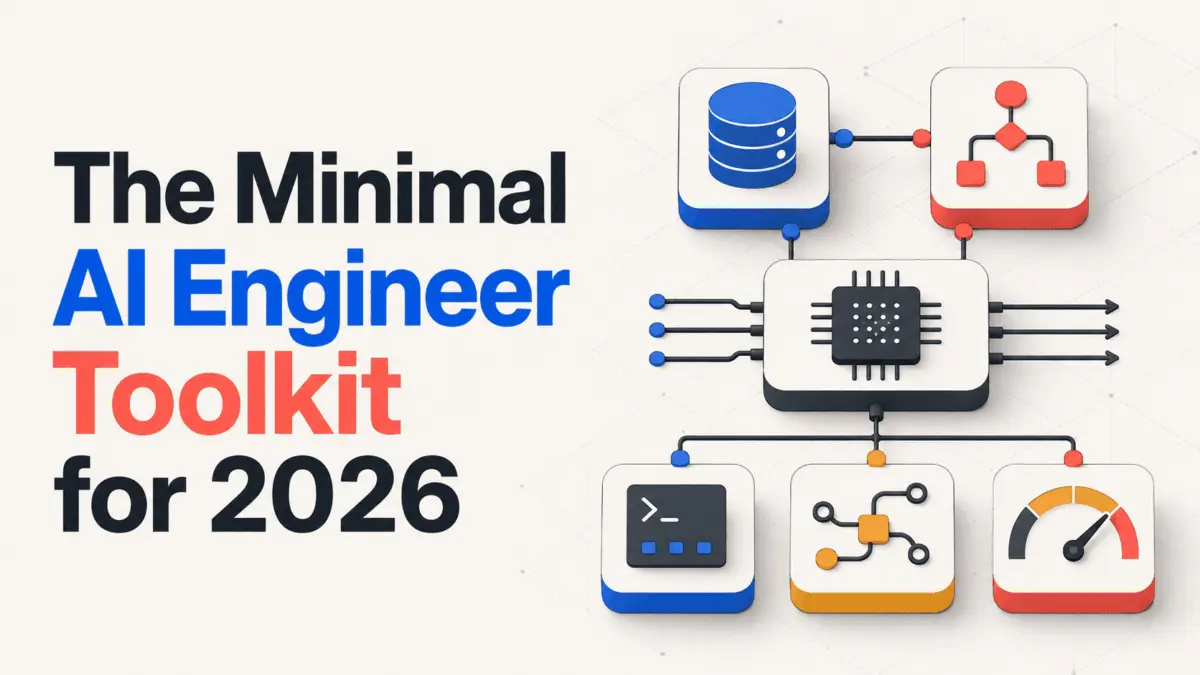
The bloated "kitchen sink" approach has been systematically replaced by a lean, standardized set of primitives. Mid-2026 demands a minimal, production-grade toolkit designed to build, evaluate, and deploy autonomous systems cleanly and efficiently. Each layer within this modern stack addresses a distinct architectural problem, combining to form a cohesive, resilient operational framework.
Detailed Chronology: The Shift from Prototyping to Production
To understand where AI engineering stands today, it is essential to trace the rapid evolution of its underlying infrastructure.
Phase 1: The Wild West of APIs and Prototypes (2023–2024)
During the initial wave of the generative AI boom, the primary goal was capability demonstration. Engineering teams prioritized speed over stability. Systems were characterized by hardcoded prompts, massive context stuffing, and ad-hoc orchestration loops written in raw Python. Every new data source or software tool required a bespoke API wrapper, leading to codebases that were notoriously difficult to debug, scale, or secure. Token costs skyrocketed because developers routed every micro-decision through expensive frontier models.
Phase 2: The Abstraction Bloat (2024–2025)
As enterprises pushed to move proofs-of-concept into production, the market was flooded with heavy, all-encompassing frameworks. These platforms promised to abstract away the complexity of LLMs entirely. However, they frequently created a "black box" problem. Developers lost visibility into exact prompt structures, token usage, and intermediate reasoning steps. When an agent failed, debugging required unwrapping layers of opaque abstraction, making these frameworks a liability for mission-critical applications.
Phase 3: The Lean, Standardized Era (2026 and Beyond)
The contemporary landscape represents a return to first principles, balanced by institutionalized engineering standards. The modern AI engineer acts less like an enthusiastic hobbyist and more like a systems architect. By adopting small language models (SLMs) for local development, utilizing open standards like the Model Context Protocol (MCP) for tool integration, and enforcing strict token-level schema validation, the industry has tamed the inherent non-determinism of generative AI.
Supporting Context & Metrics: The Core Layers of the 2026 Stack
Building reliable autonomous agents requires a disciplined approach to every layer of the application lifecycle. Below is a breakdown of the production-grade primitives defining modern AI engineering.
1. Orchestration: Graphs vs. Event Loops
Everything in an autonomous system begins with orchestration. Without reliable control over how an agent reasons, evaluates conditions, and routes tasks, the rest of the stack collapses.
- Code-First Graph Frameworks: For complex, stateful applications involving multi-turn planning and cyclical logic, developers rely on code-first graph frameworks (such as LangGraph or Burr). Instead of writing brittle
whileloops, engineers define nodes (agents or tools) and edges (conditional routing logic). State is maintained automatically, allowing systems to pause execution, request human-in-the-loop approval, and resume computation without losing context. - Visual Event-Driven Orchestration: For asynchronous workflow automation and data pipelining, visual builders (such as n8n) treat AI models as first-class citizens. Webhooks map directly to classifier agents, routing outputs to execution nodes and databases with built-in retry logic and observability.
The 2026 Rule of Thumb: Use code-first graphs for complex conversational memory and multi-turn planning; use visual orchestrators for asynchronous, event-triggered enterprise workflows.
2. The Universal Connector: Model Context Protocol (MCP)
Historically, connecting an agent to a new data source or tool required writing a custom Python wrapper, defining a JSON schema, managing API authentication, and hoping the model parsed the arguments correctly.
The widespread adoption of the Model Context Protocol (MCP) has revolutionized this workflow. Functioning similarly to how USB-C standardized hardware connections, MCP provides an open standard allowing any AI agent to interface with any data source or tool through a consistent schema. By deploying an MCP server for internal databases, Slack workspaces, or GitHub repositories, developers separate the execution environment from the reasoning engine, shifting credential management securely to the server side.
3. Local Inference and Small Language Models (SLMs)
Writing unit tests while paying cloud providers for token consumption is an obsolete practice. Modern workflows begin entirely offline.
Small language models (SLMs) under 10 billion parameters now routinely outperform the heavy frontier models of 2024 on targeted, domain-specific tasks. Local execution frameworks allow developers to iterate rapidly, run continuous integration tests locally, and achieve complete portability between local environments and cloud production instances without altering orchestration code.
4. The Evaluation Engine: CI/CD for Prompts
Probabilistic outputs cannot be verified by running a few manual queries and checking if the response "looks right." Modern deployments require rigorous statistical testing integrated directly into CI/CD pipelines using evaluation frameworks like Promptfoo, LangSmith, or Braintrust.
When a system prompt or underlying model is updated, the evaluation engine automatically executes test suites featuring hundreds of edge cases. Leveraging "LLM-as-a-Judge" methodology, secondary models score agent outputs against strict rubrics—such as verifying whether a tool was used accurately without hallucinating transaction IDs. Prompt engineering has definitively evolved from an intuitive art into a version-controlled, measurable engineering discipline.
5. Structured Output Enforcement
The days of appending desperate instructions like "Please return ONLY valid JSON. Do not include markdown formatting" to system prompts are over. The modern toolkit ensures programmatic reliability through two distinct methodologies:
- Constrained Decoding: Libraries like Outlines and vLLM Guided Decoding intercept the token generation process. By supplying a Pydantic schema, the engine restricts the model at the sampling stage, preventing it from generating invalid tokens.
- Validation-and-Retry: Tools like Instructor wrap function-calling interfaces, validating outputs post-generation against a Pydantic schema and automatically retrying with error context if validation fails.
Future Outlook: The Maturation of AI Talent
As the tooling surrounding generative AI stabilizes, the definition of senior technical talent is shifting. Knowing the highest number of third-party frameworks or experimental wrappers is no longer the primary marker of expertise.
Instead, senior AI engineers distinguish themselves by knowing precisely which layers of abstraction to strip away. The future belongs to builders who treat non-deterministic engines with deterministic rigor—leveraging clean graph orchestration, universal connectors, local SLMs, automated evaluation gates, and strict output enforcement.
As enterprise adoption accelerates throughout the remainder of the decade, organizations that abandon bloated prototyping stacks in favor of this lean, production-grade toolkit will achieve unprecedented stability, lower operational costs, and genuinely autonomous systems built to last.
Written by Vinod Chugani, an AI and data science educator specializing in agentic AI, machine learning applications, and enterprise automation workflows.
