
Executive Overview
In the modern enterprise ecosystem, customer support is no longer merely a cost center; it is a critical frontline driver of brand loyalty, consumer trust, and long-term retention. As customer expectations shift toward instant, frictionless digital interactions, organizations increasingly turn to artificial intelligence to handle the massive volume of incoming queries. However, deploying an AI support agent that is simultaneously safe, accurate, and capable of near-real-time responses remains one of the most stubborn engineering hurdles in modern software development.
Off-the-shelf chatbots and generic, out-of-the-box large language models (LLMs) frequently fall short of enterprise standards. While these foundation models possess immense general capabilities, they suffer from well-documented limitations: context degradation, high latency, unpredictable tone, and a dangerous tendency to hallucinate facts when confronted with missing data. In customer support, an AI system that gets these metrics wrong can rapidly erode consumer trust and inflict heavy financial damage. According to IBM’s 2025 Cost of a Data Breach Report, the average global cost of a security or data breach sits at a staggering $4.44 million, underscoring the urgent need for enterprise-grade safety, data governance, and architectural precision.
Recent field experience shared by data scientists—such as Alakh Sharma, an alumnus of the Indian Institute of Science, Bangalore, and Data Scientist at Talentica Software—demonstrates that relying on a single model or a naive development technique is no longer viable. Building an AI system that knows how to answer like an expert while knowing what to answer based on verified, real-time data requires a sophisticated paradigm shift. The solution does not lie in throwing more computing power or broader context windows at the problem; it demands a deliberate architectural separation of concerns. By combining Retrieval-Augmented Generation (RAG) with meticulously fine-tuned small language models (SLMs), enterprises can construct a hybrid architecture that balances factual precision, behavioral control, and lightning-fast responsiveness.
Detailed Chronology: The Evolution of Enterprise Chatbot Architecture
To understand why a hybrid AI architecture has become the gold standard for enterprise support, it is helpful to trace the chronological evolution of conversational agents and the engineering bottlenecks that led to today’s breakthroughs.
Phase 1: The Rule-Based and Early ML Era
In the early days of automated customer support, systems relied heavily on rigid decision trees, keyword matching, and hard-coded rule sets. While these bots were safe and entirely predictable—preventing any risk of AI hallucinations—they were brittle. They routinely failed when customers phrased questions colloquially, lacked context awareness, and routinely frustrated users who sought nuanced assistance.
Phase 2: The Vanilla LLM Boom
When generative AI and massive LLMs burst into the mainstream, enterprises rushed to integrate foundational models directly into their customer support pipelines. The initial hypothesis was simple: because these models had "read the internet," they should inherently understand corporate documentation, product specs, and customer troubleshooting steps.
However, engineers quickly ran into severe operational walls. Vanilla LLMs lacked access to private, proprietary enterprise data bases. When prompted with internal queries, they either admitted ignorance or, worse, synthesized plausible-sounding falsehoods (hallucinations). Furthermore, exposing raw enterprise data directly to third-party foundation models raised massive compliance, privacy, and security red flags.
Phase 3: The Naive RAG Experiment
To bridge the information gap, the industry pivoted toward Retrieval-Augmented Generation (RAG). In this setup, an external vector database stores company documents, policy manuals, and technical FAQs. When a user asks a question, a retriever searches the database for relevant snippets and injects them directly into the LLM prompt alongside the user query.
While RAG dramatically improved factual grounding, it introduced a new set of headaches. Developers discovered that simply dumping large volumes of retrieved text into a prompt did not guarantee correct answers. Models often suffered from attention dilution, missed critical details buried in the middle of long prompts, and struggled to maintain a consistent corporate voice or output format.
Phase 4: The Fine-Tuning and Hybrid Convergence
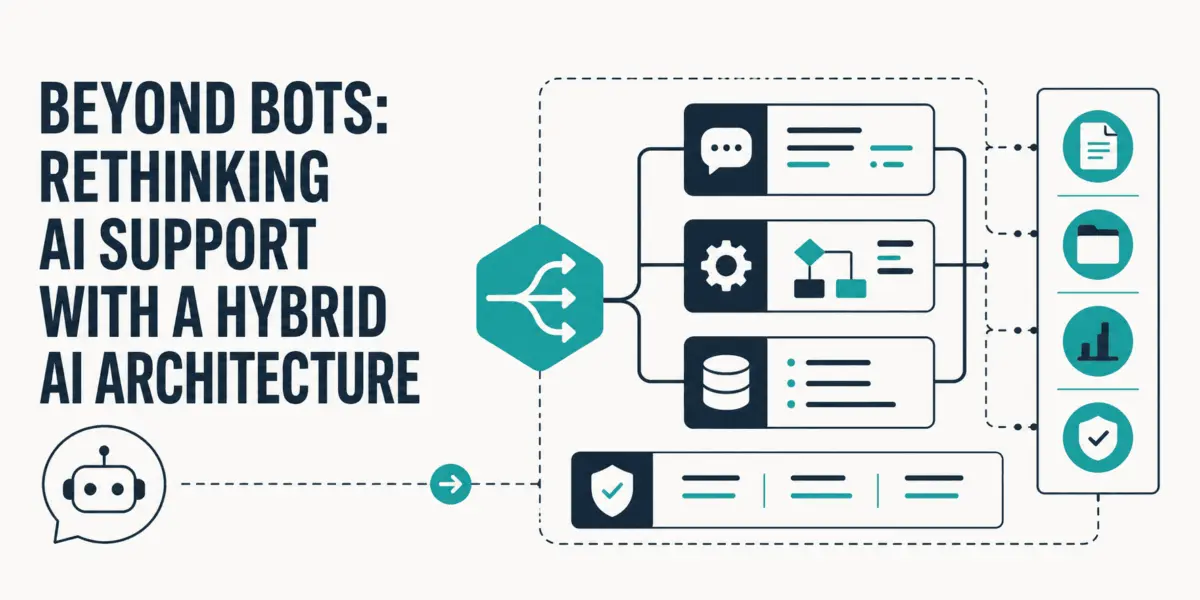
Recognizing the limitations of pure RAG and standalone fine-tuning, advanced engineering teams began experimenting with hybrid topologies. By separating the retrieval mechanism (the what) from the fine-tuned behavioral alignment (the how), developers could harness the best of both worlds. This chronological progression—from rigid rules to chaotic foundation models, and finally to controlled, hybrid systems—forms the foundation of modern enterprise AI design.
Supporting Context & Metrics: Breaking Down the Architectural Trade-offs
Designing a robust enterprise support bot requires a clear-eyed evaluation of core technical constraints. Empirical testing of various configurations reveals stark performance trade-offs across context utilization, retrieval precision, and behavioral consistency.
1. The Myth of Infinite Context and Primacy-Recency Bias
Modern LLMs routinely advertise massive context windows spanning 16K, 32K, 64K, or even 128K tokens. Sales pitches suggest that developers can simply upload entire documentation libraries directly into the prompt.
However, real-world deployment data tells a different story. Attention mechanisms in transformer-based models begin to degrade long before token limits are exhausted. When presented with massive text blocks, models frequently exhibit primacy-recency bias—paying disproportionate attention to the very beginning and the very end of a prompt while entirely ignoring critical instructions or data nested in the middle. Research highlighted in seminal studies such as Lost in the Middle: How Language Models Use Long Contexts confirms that long-context inputs frequently result in incomplete reasoning and degraded output quality.
2. Retrieval Precision Versus Performance Latency
Engineering a retrieval pipeline involves walking a delicate tightrope.
- Over-Retrieval: If the system pulls too many documents into the context window, latency spikes, compute costs escalate, and the model’s attention is diluted across irrelevant noise.
- Under-Retrieval: If the system pulls too little information, the risk of hallucination skyrockets as the model attempts to fill in the blanks using parametric memory.
The engineering challenge is achieving precision retrieval—delivering the absolute minimum sufficient context required for factual correctness without overwhelming the system or the model.
3. Quantitative Evaluation of Architectural Approaches
Field evaluations conducted during recent enterprise deployments highlight the stark performance differences between isolated techniques and a unified hybrid framework:
| Architecture Strategy | Factual Accuracy | Tone & Format Alignment | Latency & Efficiency |
|---|---|---|---|
| Pure RAG (Retrieval Only) | ~70% | Low / Variable | Moderate (Dependent on context size) |
| Fine-Tuning Only (No RAG) | ~50% | High (~90%) | High (Relies on static memory) |
| Hybrid Architecture (RAG + LoRA SLM) | ~73% | ~75% | Optimized (Small, targeted context) |
As the metrics demonstrate, relying solely on RAG yields high factual grounding but fails to control conversational tone, structure, or formatting. Conversely, fine-tuning a model alone dramatically improves tone alignment but catastrophically tanks factual accuracy when confronted with long-tail queries, new product updates, or shifting company policies.
By uniting RAG with a fine-tuned model, factual correctness rises to approximately 73%, while tone alignment reaches a stable 75%. Crucially, the fine-tuned model’s deep understanding of domain context and output structuring enables it to synthesize retrieved data far more effectively than a generic base model ever could.
Official Statements and Industry Insights
Industry practitioners and enterprise technology leaders increasingly emphasize that the future of corporate AI lies in specialization, security, and architectural modularity rather than brute-force scaling of general-purpose models.
According to Alakh Sharma, Data Scientist at Talentica Software and an alumnus of the Indian Institute of Science, Bangalore:
"The answer is not a single model or technique. It requires a broader architectural approach that separates what the model knows from how it responds, while combining learning with retrieval."
Sharma highlights the foundational division of labor that drives hybrid systems:
"Fine-tuning teaches the model how to answer, and retrieval supplies what to answer. Forcing one method to do both leads to inefficiency, instability, or high costs."
This perspective is echoed across the broader enterprise technology landscape. Organizations moving past the initial hype cycle of generative AI are discovering that proprietary data moats cannot be secured by simply plugging enterprise APIs into consumer-grade chatbots. Regulatory compliance, data privacy mandates, and consumer protection laws demand verifiable architectures where every output can be audited, grounded in verified data sources, and delivered in strict adherence to brand guidelines.
Furthermore, technical leadership points to the democratization of Small Language Models (SLMs) enhanced by parameter-efficient techniques like Low-Rank Adaptation (LoRA). By fine-tuning only a small set of adapter matrices rather than modifying an entire foundation model, companies can achieve expert-level domain adaptation while preserving the model’s general reasoning capabilities, avoiding catastrophic forgetting, and drastically curbing GPU infrastructure expenses.
Future Outlook: The Next Generation of Enterprise Support AI
Looking ahead, the landscape of AI-driven customer support is poised for rapid, maturation-focused transformation. Several emerging trends will dictate how enterprises build, scale, and govern their conversational agents over the coming years:
1. Shift Toward Modular, Agentic Workflows
Future support architectures will move beyond single-turn Q&A bots toward multi-agent, autonomous workflows. In these systems, a specialized routing agent will analyze incoming customer queries, dispatch sub-tasks to dedicated domain-specific models (e.g., technical troubleshooting vs. billing inquiries), and execute secure backend API calls to resolve issues autonomously rather than merely providing text responses.
2. Advanced Caching and Real-Time Vector Indexing
To combat latency and reduce inference costs, enterprise RAG pipelines will increasingly integrate semantic caching and dynamic, real-time vector indexing. Instead of querying massive vector stores from scratch for every repetitive support ticket, systems will instantly serve cached, validated responses for common queries while reserving intensive retrieval pipelines for complex, long-tail technical problems.
3. Heightened Focus on Guardrails and Automated Compliance
As regulatory scrutiny intensifies—particularly under frameworks like the European Union AI Act—enterprises will implement rigorous pre- and post-generation guardrail layers. These safety modules will automatically scan retrieved documents for PII (Personally Identifiable Information), filter out toxic language, and verify that model outputs strictly align with verified enterprise policy documents before a customer ever sees a response.
4. The Rise of Domain-Specific Small Language Models
The era of relying exclusively on massive, general-purpose proprietary models is giving way to tailored, enterprise-owned Small Language Models. By fine-tuning open-weight models (such as the Qwen family or similar architectures) using domain-specific expert datasets and LoRA adapters, startups and Fortune 500 enterprises alike can build high-performance, cost-effective AI moats that operate securely within private cloud environments.
Ultimately, the transformation of customer support with AI is no longer a question of if, but how. By abandoning naive prompt-stuffing in favor of disciplined, hybrid architectures that seamlessly marry retrieval precision with behavioral fine-tuning, organizations can finally deliver the holy grail of enterprise support: AI systems that are safe, accurate, brand-aligned, and lightning-fast.
