

Executive Overview
As generative artificial intelligence matures from academic research and experimental prototypes into mission-critical production environments, engineering teams are running into a stark reality: building an intelligent large language model (LLM) is only half the battle. Serving that model to real-world users with low latency, high throughput, and cost-efficient compute is an entirely different engineering hurdle.
In the lifecycle of generative AI, inference represents the phase where a trained model ingests a user’s prompt and autoregressively generates a response. Inference latency—the time delay experienced during this process—plays a defining role in user adoption and system utility. Unlike traditional web applications, where user-facing latency is typically measured in milliseconds, unoptimized LLM latency can easily stretch into multiple seconds. This delay degrades user experience, breaks conversational flows, and drives up cloud computing infrastructure costs.
At the heart of this challenge lies the dual-phase nature of LLM generation: the prefill phase, where the model processes the incoming prompt in parallel, and the decode phase, where tokens are generated sequentially. These phases produce two critical performance metrics: Time to First Token (TTFT), which dictates how quickly a user sees the initial word of a response, and Time Per Output Token (TPOT), which dictates the perceived reading speed of the ongoing generation.
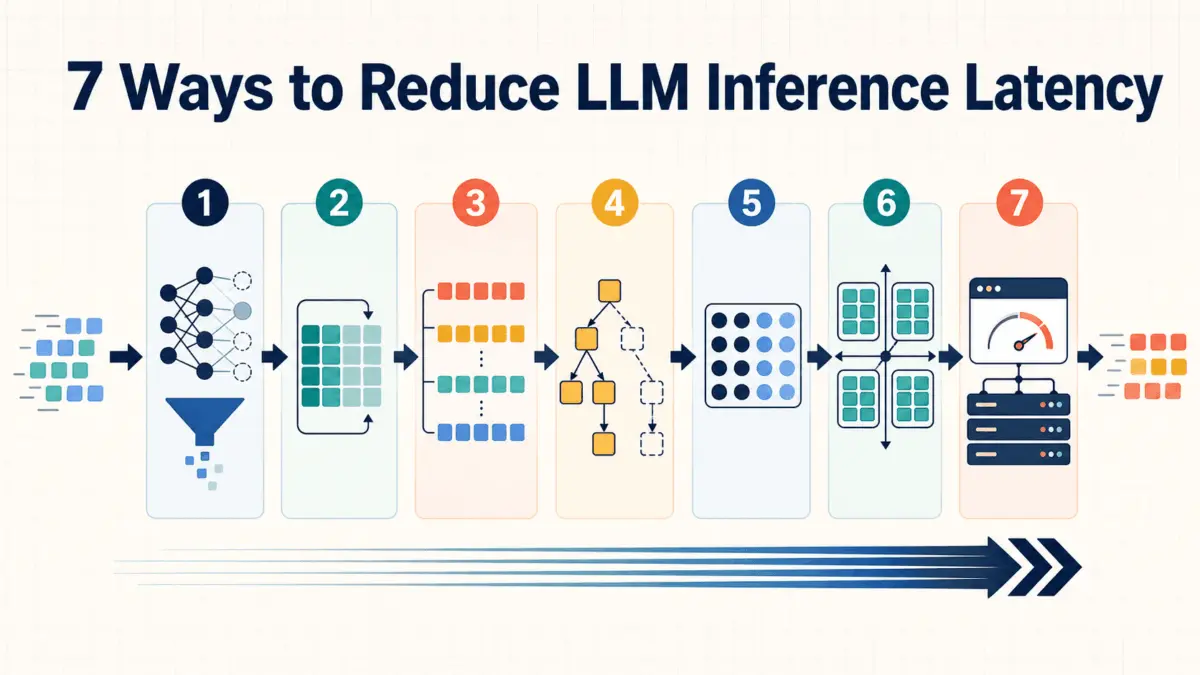
To bridge the gap between model intelligence and real-world usability, infrastructure and machine learning engineers must adopt a systematic approach to latency optimization. Below is an in-depth exploration of seven proven engineering strategies designed to dramatically reduce inference latency across modern LLM workflows.
Detailed Chronology: The Anatomy of LLM Latency and Architectural Solutions
Understanding the evolution of LLM serving requires examining how computational bottlenecks shifted from static memory bounds to complex scheduling and decoding constraints. As models grew from billions to hundreds of billions of parameters, standard deployment frameworks buckled under the weight of sequential token generation.
The industry response has evolved across seven distinct technical layers, ranging from model compression and hardware-level caching to dynamic scheduling algorithms and optimized inference engines.
[Prompt Input]
      │
      ▼
┌───────────────┐     ┌────────────────┐     ┌─────────────────┐
│ Prompt Caching│ ──> │ KV Cache Setup │ ──> │ Speculative     │
└───────────────┘     └────────────────┘     │ Decoding        │
                                             └─────────────────┘
                                                      │
                                                      ▼
┌───────────────┐     ┌────────────────┐     ┌─────────────────┐
│ Continuous    │ <── │ Model Quantiz. │ <── │ Optimized       │
│ Batching      │     │ (INT4 / INT8)  │     │ Engine (vLLM)   │
└───────────────┘     └────────────────┘     └─────────────────┘
      │
      ▼
[Output Generation]
1. Implementing Model Quantization
By default, foundation LLMs are stored in high-precision 16-bit floating-point formats, commonly known as FP16 or BF16. While this precision is vital during initial model training, it introduces severe memory bandwidth bottlenecks during inference. For example, a 70-billion-parameter model stored in FP16 requires approximately 140 gigabytes of VRAM merely to load into memory. Moving this massive volume of data across GPU memory buses for every single generated token creates a severe hardware bottleneck that directly inflates TPOT.
Quantization solves this by compressing numeric weights from 16-bit to lower-bit representations, such as 8-bit (INT8) or 4-bit (INT4) integers. A 4-bit quantized model reduces memory bandwidth requirements drastically, allowing weights to traverse the GPU memory four times faster than their FP16 counterparts.
While aggressive quantization historically introduced severe degradation in model reasoning and generation quality, modern breakthroughs—such as Activation-aware Weight Quantization (AWQ) and GPTQ—minimize accuracy loss by preserving outlier weights that carry disproportionate semantic value.
2. Utilizing Key-Value Caching
At the architectural core of modern LLMs lies the Transformer, which relies heavily on the self-attention mechanism. When a model generates token number 100, it must compute mathematical relationships—specifically the Keys and Values—between that token and all preceding tokens (1 through 99). Recalculating these matrices from scratch at every generation step introduces massive computational redundancy.
Key-Value (KV) caching eliminates this redundant work by storing the Key and Value matrices of previously processed tokens directly in VRAM. During subsequent generation steps, the model retrieves historical context straight from the cache, computing attention exclusively for the newest token.
While this dramatically lowers TPOT, it introduces a critical infrastructure trade-off: memory consumption. As conversations or generated texts grow longer, the KV cache expands dynamically, consuming vast amounts of VRAM. Balancing cache capacity against concurrent user load remains a cornerstone of production LLM system architecture.
3. Leveraging Speculative Decoding
The most stubborn obstacle in auto-regressive text generation is its inherently sequential nature: a model cannot generate token #5 until token #4 has been finalized. This strict dependency makes parallelizing token generation through traditional methods impossible.
Speculative decoding bypasses this limitation by pairing two models:
- A smaller, highly efficient draft model that generates candidate tokens at rapid speeds.
- A larger, highly accurate target model that validates those candidate tokens in a single parallel verification pass.
# Conceptual illustration of speculative decoding logic
draft_tokens = draft_model.generate(prompt, n=5)  # Generated rapidly
accepted_tokens = target_model.verify(draft_tokens) # Evaluated in parallel

if accepted_tokens:
    output_stream.extend(accepted_tokens)
In production frameworks like Hugging Face (utilizing parameters such as assistant_model), successful draft predictions allow the system to bypass sequential memory bottlenecks entirely. Under favorable conditions, this approach delivers a 2x to 3x speedup in text generation speed without sacrificing output quality.
4. Transitioning to Continuous Batching
Traditional machine learning inference servers process incoming traffic in static batches to maximize GPU utilization. If four distinct user requests arrive simultaneously, the server groups them, processes them in parallel, and returns the aggregated results.
However, LLM outputs feature highly variable lengths. If three user queries require short 50-token answers, but a fourth requires a 1,000-token essay, the users requesting shorter outputs are forced to sit idle, waiting for the longest request to finish processing.
Continuous batching (also known as iteration-level scheduling) resolves this inefficiency. Instead of waiting for an entire batch to complete before releasing resources, the inference engine injects new requests and evicts finished ones dynamically at the individual token level. The moment a short request finishes, the server returns the output immediately and slots a brand-new user request into the freed computational space, slashing wait times and boosting server throughput.
5. Pruning and Distilling Your Models
While quantization compresses existing weights, model pruning removes redundant weights entirely. Neural networks are inherently over-parameterized, meaning not every neuron or attention head contributes equally to every task. By identifying and eliminating non-essential layers, engineering teams can physically shrink the neural architecture.
Concurrently, knowledge distillation trains a smaller, hyper-optimized "student" model to replicate the behavior and outputs of a larger "teacher" model. Deploying a massive 70B-parameter model for straightforward tasks like sentiment analysis or binary classification introduces unnecessary latency and cost. Distilling those capabilities into a purpose-built 8B-parameter model can drop inference latency down to tens of milliseconds on modern hardware while maintaining the requisite domain accuracy.
6. Deploying with Optimized Inference Engines
Relying on standard library .generate() functions in raw Python environments is insufficient for enterprise-grade workloads. Standard libraries prioritize research flexibility and ease of debugging over high-throughput, low-latency production serving.
To achieve production-grade performance, engineering teams must deploy models via dedicated inference engines. Frameworks such as vLLM, Hugging Face’s Text Generation Inference (TGI), and NVIDIA’s TensorRT-LLM are engineered specifically for high-performance serving:
- vLLM introduces PagedAttention, eliminating memory fragmentation in the KV cache.
- TGI leverages Rust and Python components to maximize memory efficiency.
- TensorRT-LLM provides deep C++ and CUDA-level optimizations tailored for NVIDIA hardware.
Adopting these specialized engines routinely slashes both TTFT and TPOT with minimal disruption to existing application codebases.
7. Optimizing Context and Prompt Management
Engineering teams frequently overlook the most straightforward method for reducing TTFT: sending less redundant data to the model. In Retrieval-Augmented Generation (RAG) pipelines, developers often inject thousands of words of retrieved context into a prompt as a precautionary measure, even when the vast majority of that text is irrelevant. Every extra token in the prompt increases prefill compute time.
Targeted optimization relies on two core practices:
- Prompt compression: Utilizing lightweight natural language processing models to extract and summarize only essential sentences from vector databases before feeding them to the LLM.
- Prompt caching: Caching the prefill state of large, static system prompts (such as multi-thousand-word behavioral guidelines). When a new user connects, the inference engine skips recomputing the system prompt entirely, focusing solely on the user’s incoming query to drastically accelerate TTFT.
Supporting Context & Metrics
Evaluating the success of an optimization strategy requires robust telemetry. Production engineering teams typically monitor four core performance indicators:
| Metric | Definition | Primary Impact Factor |
|---|---|---|
| Time to First Token (TTFT) | Latency before the first generated word appears. | Prompt length, prefill compute efficiency, prompt caching. |
| Time Per Output Token (TPOT) | The speed at which subsequent tokens are generated. | Memory bandwidth, model quantization, KV caching. |
| Throughput (Tokens/Sec) | Total tokens processed and generated per second across all users. | Continuous batching, hardware acceleration, batch scheduling. |
| VRAM Utilization | Memory consumed by weights, activations, and the KV cache. | Quantization, paged attention management, model pruning. |
Future Outlook
As generative AI continues its rapid integration into enterprise software, autonomous agent frameworks, and real-time voice interfaces, the demand for ultra-low-latency inference will only intensify. Future developments will likely see deeper hardware-software co-design, where specialized AI accelerators feature native, hardware-level support for speculative decoding and dynamic context management.
Furthermore, the rise of decentralized and edge-based LLM deployment will force engineering teams to rely even more heavily on extreme quantization, distillation, and optimized runtime engines. Mastering these seven optimization approaches is no longer an optional skill for forward-thinking machine learning engineers—it is the foundational prerequisite for building scalable, cost-effective, and responsive AI applications.
About the Author
Vinod Chugani is an AI and data science educator dedicated to bridging the gap between emerging artificial intelligence technologies and practical, real-world application for working professionals. His core focus areas include agentic AI workflows, machine learning systems, and enterprise automation. Through his work as a technical mentor and instructor, Vinod has guided numerous data professionals through critical skill development and career transitions. Drawing on analytical expertise rooted in quantitative finance, his teaching methodology emphasizes hands-on execution, rigorous evaluation frameworks, and actionable strategies that professionals can implement immediately.
