

Executive Overview
The peer-review model that has sustained modern scientific discovery for centuries is buckling under the weight of its own success. Nowhere is this crisis of scale more acute than in artificial intelligence research. Driven by the efficiency of AI-assisted experimentation and writing, academic output has reached astronomical heights. At the International Conference on Machine Learning (ICML) 2026, the submission pipeline was flooded with an unprecedented 23,918 abstracts and papers, culminating in 6,352 accepted works—roughly double the volume of the previous year.
Human review capacities simply cannot scale at the same exponential rate. Conferences rely on volunteer reviewers who juggle demanding professional schedules, often leaving them with mere days—or hours—to evaluate complex mathematical proofs, massive codebases, and expansive empirical findings. As one open reviewer candidly admitted for an accepted ICML 2026 spotlight paper: "My low confidence score is because I did not check all the proofs carefully."
To test whether the modern research apparatus can survive this deluge of data, Hugging Face, alongside partners like alphaXiv, orchestrated a massive, community-driven stress test: the ICML 2026 Open Reproductions hackathon. Held from July 15 to August 2, 2026, the event leveraged the very technology accelerating the paper flood—coding agents such as Claude Code, Codex, Cursor, and Pi—to turn the tables. More than 1,200 participants deployed autonomous agents to independently reproduce, verify, or falsify roughly a third of the conference’s accepted corpus.
The results of this unprecedented audit paint a complex picture of modern AI research. While over half of the examined papers saw at least one claim successfully verified, nearly a quarter featured falsified or heavily contested findings. The experiment proved that while AI agents can process proofs, execute codebases, and run high-dimensional simulations in fractions of the time it takes a human, they are far from infallible. Ultimately, the hackathon revealed a new paradigm for academic rigor: one where human researchers transition from manual reviewers to principal investigators managing sprawling networks of artificial intelligence.
Detailed Chronology: Inside the 19-Day Reproduction Challenge
The ICML 2026 Open Reproductions challenge was structured to be as rigorous as it was expansive. Running for 19 days from July 15 to August 2, the hackathon set out to systematically verify thousands of papers through crowdsourced agentic workflows.
Phase 1: Deployment and Compute Provisioning (July 15–20)
Participants registered in teams or as individuals, bringing their own custom agent harnesses, specialized scripts, and scientific intuition. To level the playing field, organizers provided each participant with $20 in Hugging Face compute credits to launch workloads via HF Jobs.

The mechanics of the challenge were straightforward yet demanding:
- Paper Selection: Participants selected accepted papers from the ICML 2026 docket.
- Agentic Parsing: Autonomous coding agents read the PDF manuscripts, parsed equations, located or recreated accompanying code repositories, and designed verification pipelines.
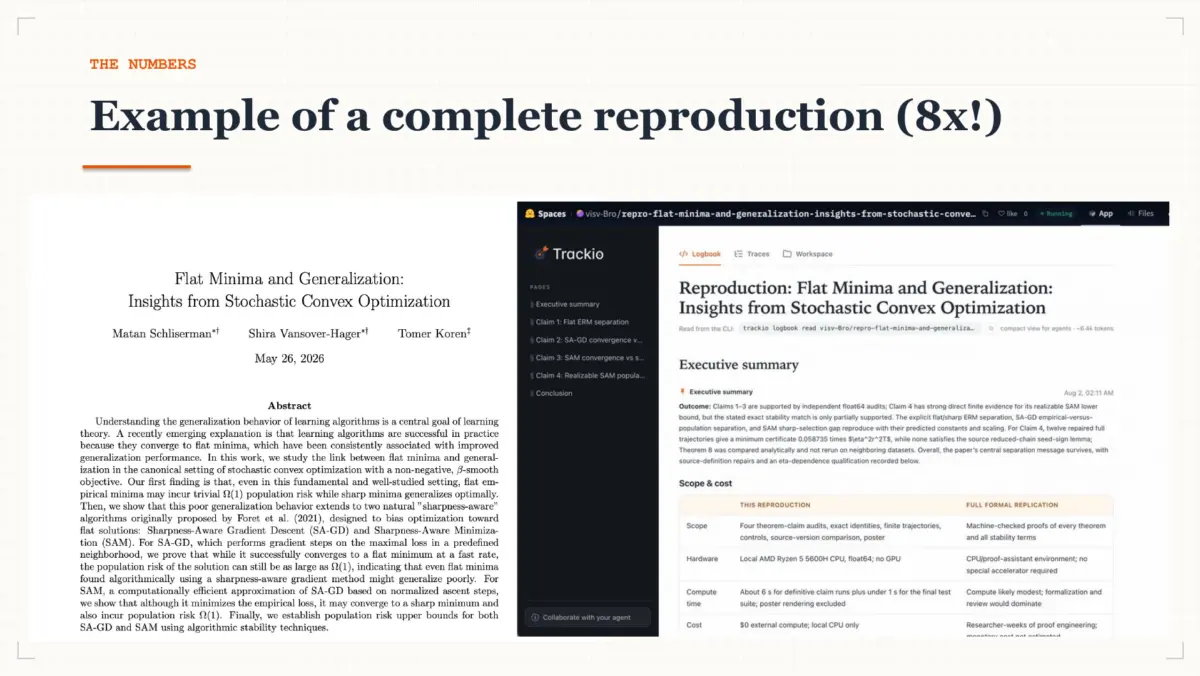
- Execution and Logging: Agents launched training runs and simulation scripts, logging every step into structured "Trackio logbooks" that recorded agent traces, computational artifacts, and interim verdicts.
Where proprietary datasets or unreleased model checkpoints made exact replication impossible, participants innovated by executing "toy reproductions"—scaling experiments down to synthetic data designed to mimic the statistical properties of the original studies. By the end of the first week, cloud jobs were spinning up in the thousands.
Phase 2: The Deluge of Verdicts (July 21–28)
As the challenge crossed its halfway mark, participants began publishing their findings en masse. The scale quickly outpaced expectations. In under three weeks, community members published a staggering 6,816 Trackio logbooks, effectively auditing 2,226 distinct papers—roughly 35% of the entire ICML 2026 conference proceedings.
Participants launched 2,962 cloud computing jobs on Hugging Face infrastructure, pushing agents to their computational limits. Yet, as the logbooks rolled in, it became clear that reproducibility is rarely a binary outcome. While many papers sailed through the verification process with clean, deterministic code and robust proofs, others sparked intense controversy. In dozens of instances, different participant teams running independent agent frameworks arrived at diametrically opposed verdicts regarding the exact same scientific claims.
Phase 3: Adversarial Re-Verification and Author Outreach (July 29–August 2)
Recognizing that automated agents can hallucinate, misinterpret metrics, or fall victim to logic traps, the hackathon organizers instituted a rigorous adversarial review process for all claimed falsifications. Organizers personally re-read the original papers, audited the community logbooks, re-derived complex mathematical proofs, and independently re-implemented disputed experiments.
Concurrently, organizers initiated contact with the authors of every paper where a definitive flaw or falsification had been confirmed. Armed with reproducible logs, agent traces, and mathematical counter-examples, they approached authors with a transparent query: Here is our evidence; do you concur, or is our analysis flawed?

The response from the academic community was overwhelmingly constructive, setting off a wave of pre-emptive corrections, GitHub patches, and forthcoming arXiv revisions before the challenge even officially closed its doors on August 2.
Supporting Context & Metrics: By the Numbers
The sheer scale of the ICML 2026 Open Reproductions challenge makes it arguably the largest open, claim-by-claim audit of a major scientific conference in history.
Conference-Wide Pressures
- 23,918: Total paper submissions received by ICML 2026, marking a near-doubling from the previous year.
- 6,352: Accepted papers at the conference, highlighting an exponential growth curve catalyzed by AI-assisted drafting and experimentation.
Hackathon Metrics
- 1,221: Community participants who brought their own coding agents and domain expertise.
- 6,816: Total Trackio logbooks published over the 19-day event.
- 2,226: Unique ICML 2026 papers audited—representing approximately 35% of the entire conference.
- 2,962: Cloud jobs executed using Hugging Face compute infrastructure.
Aggregate Claim-Level Verdicts
When organizers aggregated the claim-level verdicts across all audited papers, the distribution revealed deep insights into the current state of machine learning literature:
- 51% of Papers (1,103 papers): Had at least one central claim independently verified. Within this cohort, 266 papers achieved full reproduction (every extracted claim verified), while 632 were partially reproduced with zero falsifications found. Across these verified papers, 3,978 individual claims were confirmed via live experiments.
- 23% of Papers (496 papers): Contained at least one claim that was explicitly falsified or contested. This included 49 papers where every single claim failed verification, and 242 papers characterized by adversarial disagreement, where different reproduction teams reached opposite conclusions.
- Remainder (782 papers): Sat in a gray area, consisting of 502 papers with only toy-scale evidence due to resource constraints, and 280 papers where verification was impossible due to missing artifacts, unreleased code, or incomplete data.
Official Findings & Case Studies
When organizers and participants dug into the specific falsifications, they uncovered systemic flaws that standard peer-review pipelines—rushed and overwhelmed—frequently miss.
1. The Paging Paper and the Hidden Logarithm
Returning to the spotlight paper mentioned in the introduction—"Towards Optimal Robustness in Learning-Augmented Paging"—reviewers had previously admitted they did not check the mathematical proofs carefully. The paper claimed its algorithm achieved an additive robustness term of $H_k + O(1)$.
- The Discovery: A participant’s agentic logbook (
Auenchanters/repro-towards-optimal-robustness-in-learning-augmented-paging) tracked the additive term and found it growing empirically as $0.38 ln k$. Pinpointing the exact step where the authors’ proof broke down, organizers extended the computational sweep to $k = 1,024$ and confirmed the growth at a staggering nine-sigma certainty. The true robustness bound was proven to be $H_k + Theta(log k)$.
2. The Late-Stage Collapse in Frank-Wolfe Optimization
In "Attention’s forward pass and Frank-Wolfe," the authors proved that token particles collapse to the origin whenever the origin starts inside their convex hull.

- The Discovery: Three independent reproduction teams found mathematical and empirical counterexamples. However, the violations only appeared at late horizons ($t = 224$, $sim 3,800$, and $6,416$ steps), explaining why standard human reviews—which rely on short-horizon checks—missed the failure. Using exact rational arithmetic to eliminate floating-point ambiguities (
SabaPivot/repro-attention-frank-wolfe), the cleanest counterexample forced the authors to acknowledge the oversight on the same day the finding was published.
3. Theoretical Disconnects in Self-Distillation
The paper "Self-Distillation Enables Continual Learning" analyzed reverse Kullback-Leibler (KL) divergence across its central equations and theory sections.
- The Discovery: The community logbook (
codemaivanngu/repro-self-distillation-enables-continual-learning) revealed that the default released code—which the authors used to generate all empirical results—actually computed forward KL divergence. Furthermore, the reproduction pipeline failed to replicate the paper’s headline $+4textpp$ performance boost using the authors’ own code and data. The authors responded by uploading a clarified, corrected version to arXiv.
4. Perplexity Dilution via EOS Padding
In "Do Transformers Need Three Projections?" a participant investigation (stresearch-dev/63430) uncovered that approximately 66% of evaluated label positions consisted of End-Of-Sequence (EOS) padding tokens that naturally trained to near-zero loss. This artifact artificially deflated perplexity metrics threefold. Once corrected, the abstract’s claim of a "3.1% quality cost for 50% cache reduction" ballooned to a more realistic 9.4% performance penalty.
5. False Falsifications
Importantly, the audit also caught agentic errors. One initial logbook dramatically claimed that a paper’s novel method was "2x slower than the baseline." Upon adversarial re-verification, organizers discovered an arithmetic bug in the reproduction script: the agent had mistakenly compared per-trajectory execution time against a per-batch-of-50 execution time. When correctly normalized, the participant’s own empirical data actually validated the paper’s claimed 8x speedup.
Future Outlook: The Evolving Role of Humans in AI Research
The success and friction of the ICML 2026 Open Reproductions hackathon point directly toward a profound evolution in how scientific research will be conducted, audited, and published.
The Limits of Pure Autonomy
While coding agents like Claude Code and Codex are transformative, pure agent execution hits hard boundaries. Autonomous agents frequently became trapped in infinite local loops, misread scale-dependent behaviors (as seen in early paging paper checks that stopped before logarithmic growth became apparent), and built elaborate falsification arguments on top of simple unit mismatches. The most reliable, high-yield results during the hackathon exclusively emerged from workflows where humans actively steered the process: redirecting the agent when it chased phantoms, challenging core assumptions, or terminating doomed computational runs before compute budgets were exhausted.
Irreducibly Human Evaluation
Some forms of scientific validation remain stubbornly human. The hackathon’s human-in-the-loop winning project (KwabsHug/repro-robuq-pushing-dits-to-w1-58a2-via-robust-activation-quantization) evaluated a paper claiming stable image generation under extreme neural network quantization. While numerical metrics suggested no catastrophic collapse, determining whether the generated images were semantically usable required perceptual judgment.

To solve this, the agent built a custom review user interface, allowing the human participant to manually inspect and judge 128 image pairs. The human annotations were committed directly back into the repository, where the agent subsequently validated their internal consistency. This seamless division of labor—agents building the infrastructure and humans exercising qualitative judgment—serves as a blueprint for the future.
Managing Intelligence
Ultimately, the hackathon reframes the role of the human researcher. Just as a principal investigator (PI) in a traditional laboratory establishes an environment where graduate students can thrive—providing compute clusters, software frameworks, data access, and timely intellectual course-corrections—the most effective participants in the hackathon acted as managers of artificial intelligence.
As conference submissions continue their exponential climb driven by generative tools, the scientific community cannot rely solely on overworked, volunteer human reviewers. Instead, the future of peer review will likely mirror this hackathon: a scalable hybrid ecosystem where autonomous coding agents perform the heavy lifting of executing code, parsing proofs, and stress-testing datasets, while human scientists provide the oversight, qualitative evaluation, and strategic intuition required to keep human knowledge moving forward.
