

Executive Overview
As artificial intelligence shifts from transient chat interfaces to autonomous, long-horizon agents, software engineering faces a structural bottleneck: Large Language Models (LLMs) are fundamentally stateless. Every API call evaluates input tokens in isolation, completely devoid of innate recollection.
In the initial rush to deploy autonomous agents, engineering teams relied on a naive mitigation strategy: continuously appending entire interaction histories, tool outputs, and document drops directly into expanding context windows. While viable for brief demos, this brute-force methodology fails rapidly in enterprise environments. Over extended deployment horizons—such as six-month enterprise operational cycles—unbounded context windows induce severe latency spikes, cause cost inflation, and trigger critical cognitive degradation where models misinterpret, overlook, or conflate conflicting facts buried within megabytes of prompt text.
To build persistent, resilient AI agents capable of operating across months or years, engineering paradigms must evolve. Context windows are operational scratchpads, not durable databases.
Achieving long-term stability requires treating state and memory as distinct architectural primitives. State represents the ephemeral operational snapshot of an active task, while memory provides the durable mechanism for carrying knowledge across execution boundaries.
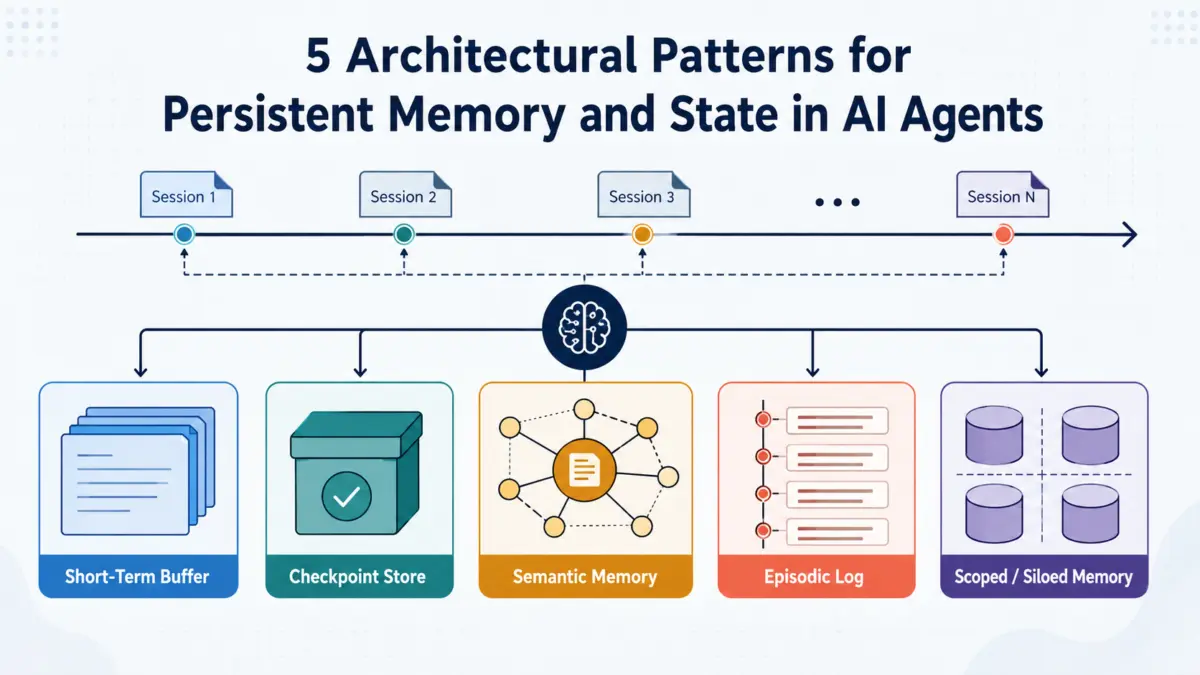
By analyzing production systems, industry standards have converged around five core architectural patterns designed to decouple state management from raw LLM reasoning:
- The In-Context Working Buffer
- Execution Checkpointing
- Semantic Memory
- Episodic Event Logs
- Multi-Scope Segregation
Detailed Chronology: The Evolution of Agentic State Management
The transition from naive context-stuffing to modern, decoupled memory architectures occurred over four distinct developmental phases as production agents confronted real-world scalability limits.
+-----------------------------------------------------------------------------------+
|                            EVOLUTIONARY TIMELINE                                  |
|                                                                                   |
|  [Phase 1] Monolithic Context Stuffing                                           |
|            └─► Raw message history dumped into prompt                             |
|  [Phase 2] Context Window Inflation & Degradation                                |
|            └─► Expanding windows (128k+) yield latency, costs, "Lost-in-Middle"  |
|  [Phase 3] Formal Separation of State & Memory                                   |
|            └─► Ephemeral operational state split from durable cross-session data  |
|  [Phase 4] Enterprise Memory Standardization                                      |
|            └─► Deployment of 5 architectural patterns with storage isolation      |
+-----------------------------------------------------------------------------------+
Phase 1: The Monolithic Context Stuffing Era
In the early days of agent framework development, developers treated the context window as a unified storage layer. Conversation transcripts, raw JSON payloads from API tools, system instructions, and external document retrievals were concatenated into a single prompt string.
While simple, this pattern suffered from immediate limitations. Systems broke down as soon as token limits were reached, requiring hard truncations that caused agents to forget original system instructions or crucial early user preferences.
Phase 2: Context Window Inflation and the Latency Crisis
Model providers responded to truncation issues by expanding context windows from 4,000 tokens to over a million. However, expanding the window exposed deeper model mechanics:
- The "Lost in the Middle" Phenomenon: Attention mechanisms naturally prioritize tokens located at the extreme beginning and end of a context window. As the context grows, accuracy for information situated in the middle degrades sharply.
- The KV Cache Paradox: To mitigate token generation latency, infrastructure providers implemented Key-Value (KV) prompt caching for identical prompt prefixes. However, dynamically inserting incoming conversation turns or raw tool outputs near the start of the prompt constantly invalidated the KV cache, causing massive latency spikes during multi-turn interactions.
- Economic Inefficiency: Repeatedly passing hundreds of thousands of tokens per turn created unsustainable API bills for enterprise workflows.
Phase 3: The Formal Separation of State and Memory
System architects began recognizing that managing agent information required formal computer science primitives. The industry established a sharp distinction between State (short-term operational context) and Memory (long-term historical knowledge).
Developers realized that memory must feed into state at task initiation, state must update dynamically during execution, and selected outputs from state must be synthesized back into durable memory upon task completion.
  +-------------------------------------------------------------------------+
  |                           THE MEMORY-STATE CYCLE                        |
  |                                                                         |
  |   +-------------------+                     +-----------------------+   |
  |   |                   |  Initializes State  |                       |   |
  |   |  Durable Memory   | ------------------► |    Execution State    |   |
  |   |  (Semantic /      |                     |  (Active Variables,   |   |
  |   |   Episodic)       | ◄------------------ |   Scratchpad, Tools)  |   |
  |   +-------------------+   Persists Select   +-----------------------+   |
  |                             State Outputs               |               |
  |                                                         | Tool Returns  |
  |                                                         v & Step Updates|
  |                                             +-----------------------+   |
  |                                             |   Dynamic State Updates   |
  |                                             +-----------------------+   |
  +-------------------------------------------------------------------------+
Phase 4: Standardization on Enterprise Design Patterns
Today, production deployments leverage structured design patterns that utilize specialized storage layers—such as relational databases, vector stores, and knowledge graphs—to decouple state and memory entirely from the core LLM inference loop.
Supporting Context & Technical Analysis: The 5 Core Architectural Patterns
+-----------------------------------------------------------------------------------+
|                        THE 5 ARCHITECTURAL PATTERNS                               |
+--------------------------+--------------------------------------------------------+
| 1. In-Context Buffer     | Short-term sliding window & background compression     |
| 2. Execution Checkpoint  | Durable database snapshots for fault tolerance & pause |
| 3. Semantic Memory       | Extracted facts & vector search across sessions        |
| 4. Episodic Logs         | Historical task trajectories (Goal -> Action -> Result)|
| 5. Multi-Scope Isolation | Tenant-level security filtering (User/Org boundaries)  |
+--------------------------+--------------------------------------------------------+
1. The In-Context Working Buffer (Short-Term Execution)
The In-Context Working Buffer manages the volatile execution state of an active session. It handles immediate tool outputs, short-term reasoning loops, and active conversational turns, functioning as the agent’s working memory scratchpad.
  +-----------------------------------------------------------------------+
  |                   IN-CONTEXT WORKING BUFFER STRUCTURE                 |
  |                                                                       |
  |  [Static System Instructions]  <--- Cached KV Prefix                  |
  |  -------------------------------------------------------------------  |
  |  [Compressed Background Summary] <--- Extracted long-term context     |
  |  -------------------------------------------------------------------  |
  |  [Sliding Window: Turn N-2]                                           |
  |  [Sliding Window: Turn N-1]                                           |
  |  [Active Turn N: Scratchpad & Tool Outputs] <--- Dynamic Updates      |
  +-----------------------------------------------------------------------+
Operational Mechanics
Instead of permitting unbounded log growth, the working buffer enforces a managed sliding window coupled with background summarization:
- Scratchpad Execution: Immediate chain-of-thought outputs and intermediate tool calls write to an active scratchpad.
- Buffer Summarization: When the active buffer crosses a predefined token threshold, an asynchronous background routine summarizes the oldest turns. This process compresses raw, verbose tool outputs into dense factual summaries, preserving core conclusions while dropping raw JSON payloads.
- Session Flush: Upon task completion, the scratchpad is completely wiped. Relevant extracted context is persisted to long-term storage, while intermediate execution clutter is permanently discarded.
Technical Tradeoffs & Edge Cases
Mid-conversation summarization fundamentally alters the text at the beginning or middle of the prompt. Rewriting this context invalidates the model provider’s KV cache, leading to unexpected latency penalties on the turn immediately following a compression cycle. Systems designers must carefully tune summarization schedules to balance context size against cache invalidation costs.
2. Execution Checkpointing (Fault Tolerance & Pausing)
Long-running agentic tasks spanning hours or days will inevitably encounter failures, including network timeouts, third-party API rate limits, or mandatory delays while awaiting human approval. Execution Checkpointing guarantees fault tolerance by serializing the agent’s complete execution graph to a persistent storage layer.
  +-----------------------------------------------------------------------+
  |                     EXECUTION CHECKPOINTING ENGINE                    |
  |                                                                       |
  |  Node A: Parse Input ──► Node B: API Call ──► [ CHECKPOINT STORE ]    |
  |                                                     │ (PostgreSQL/    |
  |                                                     │  SQLite)        |
  |                                                     v                 |
  |  Node D: Final Output ◄── Node C: Human Approval ◄──┘ (Resumes State) |
  +-----------------------------------------------------------------------+
Operational Mechanics
Modern agent frameworks model workflows as directed graphs composed of state nodes and transition edges. After an individual node completes its execution:
- State Serialization: The execution framework captures a snapshot of current system variables, history logs, tool states, and the exact position in the execution graph.
- Durable Persistence: This state payload is written to an ACID-compliant transactional database, such as PostgreSQL or SQLite.
- State Recovery: If a node crashes or pauses for human-in-the-loop validation, the agent halts without retaining active memory or compute handles. Upon resumption, the engine loads the latest checkpoint and continues execution seamlessly from the last completed node.
Technical Tradeoffs & Edge Cases
Checkpoint resumption does not automatically confer exactly-once execution semantics. If an agent fails mid-execution while performing a side-effecting action (e.g., dispatching an email or executing a database write), resuming from the prior checkpoint may re-trigger that same action.
To prevent duplicate actions, all tool calls executed by checkpointed nodes must be designed to be strictly idempotent.
Furthermore, non-serializable objects—such as open network sockets, active database connections, or streaming file handles—cannot be saved in state structures and must be explicitly re-initialized upon recovery.
3. Semantic Memory (Cross-Session Knowledge)
Semantic Memory provides durable, cross-session storage of facts, user preferences, technical specifications, and domain-specific knowledge, enabling an agent to maintain consistent operational awareness across independent interactions.
  +-----------------------------------------------------------------------+
  |                     SEMANTIC MEMORY PIPELINE                          |
  |                                                                       |
  |  User Input: "We migrated our database from Postgres to Snowflake."   |
  |                                 │                                     |
  |                                 v                                     |
  |                   [ Asynchronous Extraction ]                         |
  |                                 │                                     |
  |                                 v                                     |
  |             [ Vector Database / Knowledge Graph Store ]               |
  |             ├── Fact: DB = Snowflake (Metadata: Fresh)                |
  |             └── Fact: DB = Postgres  (Metadata: Superseded/Deprecated)|
  |                                 │                                     |
  |                                 v                                     |
  |  Query Time Filter: Fetch highest recency score ──► Inject to Prompt  |
  +-----------------------------------------------------------------------+
Operational Mechanics
Semantic information is decoupled from session transcripts and managed through dynamic vector stores and knowledge graphs:
- Asynchronous Fact Extraction: An offline language model evaluates conversational turns to extract core facts, attributes, and user preferences into structured JSON records.
- Vector Indexing & Graph Linking: Extracted facts are transformed into vector embeddings and saved with rich operational metadata (e.g., timestamps, source tags, confidence metrics). Where relationship modeling is critical, facts are structured as nodes and edges within a knowledge graph.
- Dynamic Prompt Injection: Prior to processing a user query, the system executes a semantic search across the vector store, retrieving high-relevance facts and injecting them into the dynamic system prompt.
Critical Vulnerabilities & Architectural Considerations
- Stale Fact Management: If a user states in March, "Our database is PostgreSQL," and in July states, "We migrated to Snowflake," naive vector search will often retrieve both entries as highly relevant. Semantic memory architectures must implement strict fact invalidation routines, employing recency-weighted scoring, clear supersession logic, or explicit Time-To-Live (TTL) field updates.
- Credential Isolation: Credentials, tokens, and API keys must never be written to semantic memory stores. If a secret is stored as a retrievable vector embedding, simple prompt injection attacks or unexpected vector retrievals can surface raw credentials in public responses. Secrets must remain strictly managed within dedicated secrets hardware (e.g., HashiCorp Vault), leaving the agent with non-sensitive credential handles.
- Data Provenance & Supply Chain Injection: Ingesting untrusted third-party inputs (such as scraped websites or processed emails) directly into semantic memory risks persistent memory poisoning. Without robust provenance tagging that tracks the origin and authorization level of every ingested fact, malicious inputs can permanently skew agent behaviors across future sessions.
4. Episodic Event Logs (Historical Reflection)
While semantic memory captures what an agent knows, Episodic Memory records what an agent did. It functions as a structured chronological record of past executions, allowing the system to analyze prior execution trajectories and learn from previous mistakes.
  +-----------------------------------------------------------------------+
  |                    EPISODIC EVENT LOG STRUCTURE                       |
  |                                                                       |
  |  Episode Entry #1042                                                  |
  |  ├── Goal: Execute automated SQL migration schema update.             |
  |  ├── Plan: Run direct ALTER TABLE command via tool.                   |
  |  ├── Tool Execution: Query failed (Syntax Error at line 4).           |
  |  └── Outcome: Failure. Reflection: Requires explicit table qualification.|
  |                                                                       |
  |  Future Execution Check: Query past errors for "SQL migration"        |
  |  └── Surface Episode #1042 trace to prevent repeated syntax error.    |
  +-----------------------------------------------------------------------+
Operational Mechanics
When a complex task finishes, a background process formats the execution trace into an episodic record containing four fundamental fields:
$$textEpisodic Entry = textGoal, textPlan, textTool Executions, textFinal Outcome$$
When a new task is initiated:
- Similarity Retrieval: The agent executes a semantic search against the episodic log using the active goal as the query payload.
- Reflection Injection: If past execution failures exist for similar tasks, the framework retrieves the historical failure context and injects it into the prompt as a negative constraint (e.g., "When executing this task previously, approach X failed with error Y. Avoid approach X.").
Technical Tradeoffs & Edge Cases
Retrieved episodic logs operate purely as advisory context rather than deterministic program constraints; the model may still choose to ignore historical recommendations.
Additionally, system developers must safeguard against trajectory poisoning. If an agent fails a step due to a transient environmental issue (such as a temporary network drop), logging that event as a fundamental strategy failure will incorrectly instruct the agent to avoid valid execution paths in future runs.
5. Multi-Scope Segregation (Enterprise Privacy & Compliance)
In enterprise multi-tenant applications, long-term memory must be rigidly partitioned. Information learned from User A within Organization X must never be accessible to User B within Organization Y.
  +-----------------------------------------------------------------------+
  |                   MULTI-SCOPE ISOLATION ARCHITECTURE                  |
  |                                                                       |
  |   Incoming Agent Request (Auth Token Context: Org_42, User_109)      |
  |                                 │                                     |
  |                                 v                                     |
  |   +---------------------------------------------------------------+   |
  |   |                  HARD STORAGE BOUNDARY LAYER                  |   |
  |   |                                                               |   |
  |   |   [Org_42 Namespace / Postgres Row-Level Security (RLS)]      |   |
  |   |   ├── User_109 Scope  <── MATCH: Access Granted               |   |
  |   |   └── User_205 Scope  <── NO MATCH: Hard Filter               |   |
  |   |                                                               |   |
  |   |   [Org_99 Namespace]  <── BLOCKED AT STORAGE LAYER            |   |
  |   +---------------------------------------------------------------+   |
  +-----------------------------------------------------------------------+
Operational Mechanics
Every memory write operation enforces strict context metadata tags based on identity verification:
$$textMemory Record implies textorg_id, textuser_id, textsession_id$$
Retrievals execute mandatory dynamic filtering rooted directly in verified authentication context:
- Storage-Layer Isolation: Security isolation should be managed directly at the storage infrastructure layer (e.g., PostgreSQL Row-Level Security (RLS) or dedicated per-tenant vector database namespaces).
- Failsafe Architecture: Relying solely on application-level filtering (e.g., appending a
WHERE user_id = Xclause in dynamic application code) introduces structural risks. A bug in application code can cause queries to fail open, exposing cross-tenant data. Enforcing isolation at the database layer ensures that invalid queries fail closed by default.
Regulatory Compliance & Right to Erasure
Enterprise data regulations (such as GDPR and CCPA) enforce strict "Right to be Forgotten" mandates. In a decoupled memory ecosystem, fulfilling a deletion request requires more than simply clearing raw database records.
Compliance pipelines must deterministically purge all derived vector embeddings, offline context summaries, and extracted semantic facts tied to that user identity across all underlying vector stores, cache tiers, and knowledge graph structures.
Technical Comparison Matrix
| Architectural Pattern | Primary Horizon | Storage Layer | Primary Risk / Challenge | Key Mitigating Strategy |
|---|---|---|---|---|
| 1. In-Context Buffer | Intra-session | Memory / Prompt | KV Cache invalidation & high token latency | Scheduled compression & static prefix preservation |
| 2. Execution Checkpoint | Intra-task | RDBMS (Postgres, SQLite) | Non-idempotent side effects during recovery | Idempotent tool design & graph-based state nodes |
| 3. Semantic Memory | Cross-session | Vector DBs / Graph DBs | Stale fact conflicts & credential leaks | TTL decay, recency weighting & external secrets managers |
| 4. Episodic Logs | Historical / Long-term | Document Store / Vector DB | Trajectory poisoning from transient failures | Environment error filtering & strategy validation |
| 5. Multi-Scope Isolation | System-wide / Governance | RLS-enabled Databases | Application-level leaks & compliance breaches | Storage-layer enforcement (RLS) & unified purge pipelines |
Official Statements & Industry Perspectives
Practical Insights from Production Deployments
"The industry spent two years attempting to solve agent reliability by expanding context windows from 4K to 1M tokens. What we realized in production is that context windows are volatile scratchpads. If you don’t build deterministic storage layers outside the model, your agent will inevitably degrade over extended deployments."
— Senior AI Systems Architect, Enterprise SaaS Platform
Security & Privacy Audits
"We frequently observe engineering teams writing raw user interaction traces directly into vector databases for long-term semantic retrieval. When malicious prompt injections occur, those vector stores get queried, and the payload reinjects itself back into administrative execution steps. Memory systems must maintain structural isolation levels equal to enterprise relational databases."
— Lead Security Auditor, AI Infrastructure Group
Infrastructure Engineering Consensus
"The primary bottleneck in multi-turn agent systems today isn’t pure reasoning capability—it’s cache invalidation dynamics. Indiscriminate prompt rewriting at turn N destroys the KV cache for turn N+1, forcing full re-computation of massive prompts. Intelligent context management is fundamentally an operational latency optimization problem."
— Principal Engineer, Infrastructure Optimization
Future Outlook: Operating Memory at Scale
As autonomous AI deployments extend from multi-day tasks to multi-year continuous operations, managing storage scale becomes a core challenge. Unmanaged semantic and episodic memory stores inevitably suffer from factual bloat, redundant data points, and context pollution, leading to performance degradation and elevated storage costs.
  +-----------------------------------------------------------------------+
  |                   THE FUTURE: MEMORY GC & COMPACTION                  |
  |                                                                       |
  |  [ Raw Memory Stores ] ──► (Continuous Ingestion)                     |
  |                                  │                                    |
  |                                  v                                    |
  |  [ Background Garbage Collector & Compaction Process ]                |
  |  ├── 1. Deduplication (Merge identical facts)                         |
  |  ├── 2. Temporal Decay (Prune expired TTL records)                    |
  |  └── 3. Abstraction Compression (Cluster episodes into rules)        |
  |                                  │                                    |
  |                                  v                                    |
  |  [ Optimized High-Density Knowledge Base ] ──► (Faster Retrieval)    |
  +-----------------------------------------------------------------------+
To maintain long-term stability, agent architectures will increasingly rely on automated background maintenance routines inspired by classical systems engineering:
Memory Garbage Collection & Compaction
Future storage platforms will run background garbage collection tasks to manage memory lifecycle routines:
- Deduplication Engine: Merging semantically equivalent facts into single authoritative records.
- Temporal Decay Mechanics: Applying exponential decay functions to historical context, automatically downgrading or archiving unreferenced memories over time.
- Episodic Compression: Aggregating thousands of execution traces into generalized procedural guidelines, distilling raw event streams into actionable rules.
Deterministic State Machine Integration
The separation between deterministic code execution and probabilistic language modeling will continue to narrow. Next-generation frameworks will rely on deterministic state engines (such as Temporal or LangGraph) to strictly govern execution flow, using LLMs exclusively for discrete reasoning operations within individual graph nodes.
Standardized Memory Protocols
Just as SQL established a standardized interface for relational database queries, the industry is moving toward standard operational interfaces for agent memory access. Unified abstraction layers will manage semantic retrieval, identity context scoping, and execution checkpointing through standardized middleware protocols.
Conclusion
Building resilient, production-ready AI agents requires setting aside the assumption that larger context windows eliminate the need for traditional software engineering. Unbounded context windows lead to latency spikes, degraded model recall, security vulnerabilities, and uncontrolled operational costs.
Long-term agent stability demands a fundamental shift in perspective: the context window is an execution scratchpad, not a database.
By decoupling state from memory—and implementing structured design patterns across working buffers, execution checkpoints, semantic knowledge stores, episodic event logs, and isolated multi-tenant boundaries—engineers can build AI systems that operate reliably, learn continuously, and maintain strict data integrity over long-term enterprise deployments.
