

Executive Overview
The landscape of enterprise artificial intelligence has crossed a definitive threshold. For years, the commercial narrative was dominated by conversational chatbots and generative text models—reactive systems that sat dormant until a human supplied a prompt, synthesized an answer, and waited for further instruction. Today, that paradigm has been thoroughly upended.
As enterprises move deeper into production cycles, the focus has shifted definitively toward Agentic AI. Unlike their conversational predecessors, autonomous AI agents possess the capacity to plan, reason, execute, and self-correct across multi-step workflows. They interface directly with external software tools, relational databases, enterprise resource planning (ERP) systems, and application programming interfaces (APIs) with minimal to zero human oversight.
Whether these systems are dynamically routing global supply chains around unexpected geopolitical choke points, authoring and deploying production-ready code repositories, or parsing millions of micro-transactions to intercept sophisticated financial fraud, they are no longer mere digital assistants. They are autonomous actors executing core business workflows.
According to recent enterprise metrics, early adopters of agentic architectures are capturing monumental productivity gains. By relegating high-volume, repetitive execution layers to autonomous loops, organizations are shifting human capital away from mechanical tasks and into roles defined by strategic oversight, architectural design, and cross-functional governance. This comprehensive report investigates the five foundational sectors experiencing this transformation, analyzes the technological shifts driving adoption, and outlines practical frameworks for engineers and business leaders looking to deploy these systems.
Detailed Chronology: From Static Prompts to Autonomous Execution
To understand the current state of agentic AI, it is necessary to examine the rapid evolutionary arc that brought the enterprise software ecosystem to this juncture.
Phase 1: The Rule-Based and Retrieval Era (Pre-2023)
For decades, business automation relied on rigid, deterministic rules engines and keyword-matching decision trees. Customer service was handled by chat widgets that frequently trapped users in endless loops of canned responses. In software development, automation was restricted to basic Continuous Integration/Continuous Deployment (CI/CD) pipelines that could flag a syntax error but possessed zero contextual understanding of why the error occurred.
Phase 2: The Generative Boom and Chatbot Saturation (2023–2024)
The widespread release of Large Language Models (LLMs) sparked a gold rush of conversational interfaces. Enterprises scrambled to wrap proprietary data around foundational models using Retrieval-Augmented Generation (RAG). While this solved the hallucination and data-freshness problems of early models, it left a glaring operational bottleneck: the human-in-the-loop requirement. Every single action—whether generating a report, updating a CRM record, or modifying a block of code—still required a human user to copy, paste, review, and execute.
Phase 3: The Emergence of Tool-Use and Reasoning Loops (2025)
The introduction of advanced reasoning frameworks (such as ReAct—Reasoning and Acting) allowed LLMs to do more than just predict the next token. Models were suddenly able to ingest a complex goal, break it down into sequential sub-tasks, select appropriate tools (like a web scraper, a calculator, or a database query tool), execute the tool, observe the output, and iteratively correct their course if the output revealed an error.
Phase 4: Enterprise Production and Multi-Agent Collaboration (2026 and Beyond)
Today, agentic AI has moved out of research sandboxes and into mission-critical corporate environments. Modern deployments utilize Multi-Agent Systems (MAS), where specialized agents—each fine-tuned or prompted for specific sub-domains—collaborate, negotiate, and execute complex workflows asynchronously. The human workforce has largely graduated from execution to supervision, managing fleets of digital workers that operate around the clock.
Supporting Context & Metrics: The Business Case for Agents
The economic viability of agentic AI rests on its ability to collapse latency and overhead across high-friction operational layers. Traditional software automation required heavy, upfront, deterministic programming for every conceivable edge case. Agentic systems, by contrast, leverage probabilistic reasoning paired with deterministic tool guardrails, allowing them to handle the ambiguity inherent in real-world business environments.
- Reduction in Average Handle Time (AHT): Customer service organizations deploying multi-step autonomous agents have reported AHT drops exceeding 60%, as agents execute backend system updates simultaneously across multiple platforms during a single customer interaction.
- Engineering Velocity: In software development cycles, engineering teams utilizing agent-driven testing and deployment report a 40% decrease in time-to-PR (Pull Request) resolution for standard backlog tickets.
- Fraud Detection Accuracy: Financial institutions utilizing contextual agentic investigations have seen false-positive rates plunge by up to 50%, freeing compliance officers from endless manual reviews of innocuous transactions.
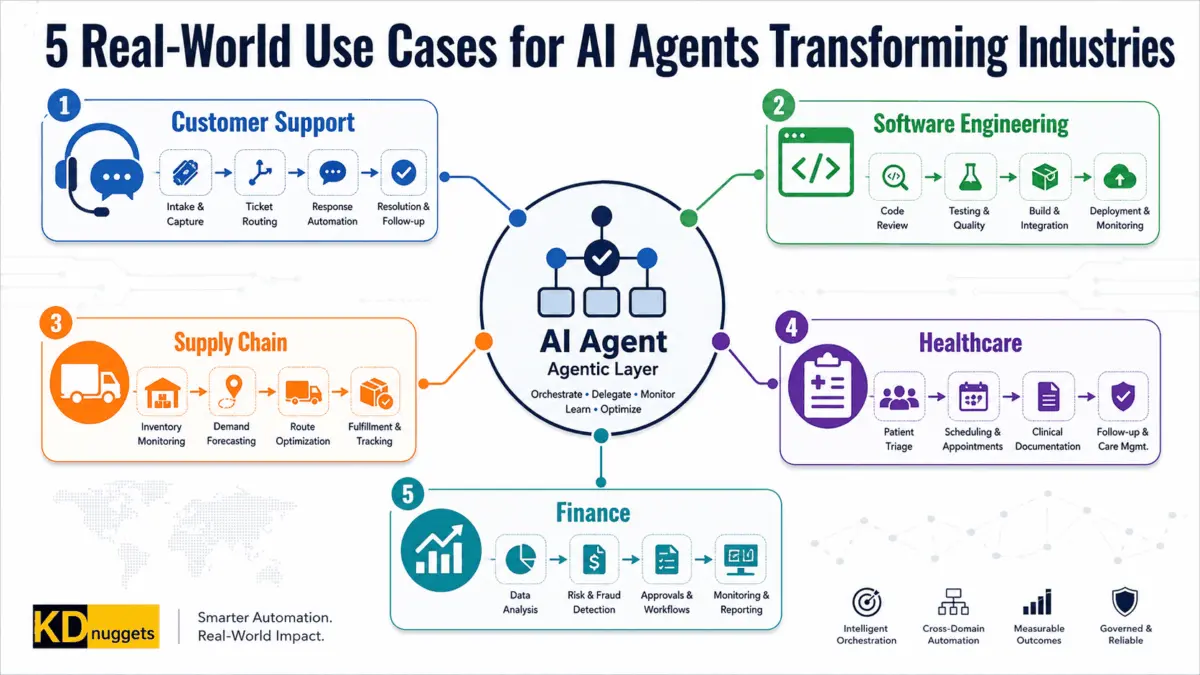
Five Real-World Use Cases Transforming Global Industries
+-----------------------------------------------------------------+
|                    AGENTIC AI WORKFLOW ENGINE                   |
|                                                                 |
|  [ Goal / Input ] ---> [ Planning & Reasoning Loop ]            |
|                               |                                 |
|                               v                                 |
|         +---------------------------------------------+         |
|         | Tool Selection & Execution:                 |         |
|         | - CRM / ERP APIs   - SQL Databases          |         |
|         | - External Feeds   - Code Repositories      |         |
|         +---------------------------------------------+         |
|                               |                                 |
|                               v                                 |
|              [ Evaluation & Self-Correction ]                   |
|                               |                                 |
|         +---------------------+---------------------+           |
|         |                                           |           |
|         v (Success)                                 v (Error)   |
|   [ Output / Action ]                      [ Re-plan & Retry ]  |
+-----------------------------------------------------------------+
1. Automating End-to-End Customer Support and Triage
Customer service can no longer rely on rigid, rule-based chatbots that frustrate users with dead-end prompts. Modern consumer expectations demand rapid, omnichannel resolutions across email, live chat, voice, and social networks.
Today’s AI support agents integrate deeply into Customer Relationship Management (CRM) platforms, handling intricate, multi-step workflows autonomously. If a customer requests a refund, updates a shipping address, and reschedules a delivery across three separate touchpoints, an agent maintains persistent cross-channel context. It authenticates the user, checks inventory databases, executes the financial transaction via payment APIs, and updates the internal ticketing system—all without human intervention.
- The Operational Shift: Human agents are liberated from repetitive lookups, form-filling, and password resets, pivoting instead toward emotionally nuanced, high-value relationship management.
- Implementation Resource: Developers can explore the LangChain Documentation to learn how to wire language models securely to external ticketing tools, identity providers, and enterprise CRM APIs.
2. Accelerating Software Engineering and Testing
Software development lifecycles are undergoing a structural evolution with the rise of autonomous coding agents. Moving far beyond simple inline autocompletion, these systems can ingest a high-level GitHub issue, search a sprawling legacy codebase, design the required feature, write production-ready code, execute local unit tests, debug failing assertions, and submit a fully documented pull request.
- Key Capabilities:
- Autonomous codebase navigation via semantic search and abstract syntax tree (AST) parsing.
- Automated test-driven development (TDD) loop execution.
- Context-aware refactoring that respects architectural guidelines.
- The Operational Shift: Software engineers are spending less time writing boilerplate code and triaging minor bugs, shifting their focus upward toward system architecture, security hardening, and complex code reviews.
- Implementation Resource: Review SWE-agent to observe how open-source autonomous agents resolve real-world software engineering issues directly within live GitHub repositories.
3. Orchestrating Adaptive Supply Chains
Global supply chains are chronically vulnerable to external disruptions—ranging from sudden port congestion and extreme weather events to geopolitical trade embargoes and raw material shortages. Logistics enterprises now deploy multi-agent systems that continuously ingest real-time global data feeds (weather radars, shipping manifests, customs data).
The moment a disruption is flagged, a network of autonomous logistics agents recalculates delivery routes, negotiates spot-rate contracts with alternative carriers, updates inventory forecasts, and notifies downstream warehouses—compressing a crisis-management response that once took human teams days of frantic coordination down to mere minutes.
- The Operational Shift: Supply chain management transforms from reactive firefighting to predictive, algorithmic optimization.
- Implementation Resource: Examine Multi-Agent Reinforcement Learning (MARL) papers and concepts via the Berkeley AI Research (BAIR) Lab to understand how distinct agents coordinate, negotiate, and optimize distributed logistical networks.
4. Streamlining Clinical Triage and Healthcare Workflows
Clinician burnout is an urgent systemic crisis driven largely by administrative overhead. Extensive industry studies demonstrate that physicians frequently spend as much time on electronic health record (EHR) documentation and paperwork as they do interacting directly with patients.
AI agents are increasingly deployed to securely ingest unstructured clinical notes, manage patient scheduling, coordinate diagnostic lab orders, and handle complex insurance pre-authorization workflows. By acting as an intelligent administrative buffer, these agents return precious hours to healthcare providers.
- Key Capabilities:
- HIPAA-compliant parsing and structuring of clinical notes.
- Automated prior-authorization generation and submission to insurance payers.
- Intelligent multi-variable patient scheduling and resource allocation.
- Implementation Resource: Review enterprise frameworks such as Kore.ai Healthcare Solutions to understand how enterprise systems maintain strict regulatory compliance while executing complex clinical workflows.
5. Scaling Anti-Money Laundering and Fraud Detection
Financial institutions operate in an unceasing arms race against sophisticated financial criminals. Traditional rule-based fraud detection engines generate massive volumes of false positives, drowning compliance teams in noise and occasionally allowing genuinely sophisticated illicit transactions to slip through undetected.
Modern banks deploy autonomous financial agents capable of conducting deep, contextual investigations into flagged activities. These agents can traverse transaction ledgers, analyze corporate registry databases, cross-reference sanctions lists, and evaluate behavioral patterns to produce comprehensive risk reports with unprecedented accuracy.
- Key Capabilities:
- Autonomous graph traversal of transaction networks to identify layering and structuring.
- Dynamic risk-scoring backed by synthesized investigative summaries.
- Reduced false-positive overhead for human compliance officers.
- Implementation Resource: Explore courses such as DeepLearning.AI’s AI for Finance programs to study how machine learning models are designed for anomaly detection and risk assessment within highly regulated financial environments.
Official Statements & Industry Perspectives
Industry leaders and technology pioneers have been vocal about the profound implications of this architectural shift:
"We are no longer building software that merely processes human instructions. We are constructing digital colleagues that can ingest broad objectives, reason through obstacles, and execute complex execution paths across our entire software stack."
— Enterprise AI Systems Architect"The competitive advantage in the enterprise no longer belongs to the company with the most data, but to the organization that can successfully orchestrate autonomous agents to turn that data into immediate, error-free operational action."
— Director of Global Technology Strategy
Future Outlook
The transition from generative AI chatbots to fully autonomous agentic workflows marks the exact moment when enterprise technology evolved from answering questions to actively executing labor. Across customer support, software engineering, supply chain logistics, healthcare administration, and financial compliance, a unified pattern is clear: agents absorb the high-volume, time-sensitive execution layers of business, while human workers ascend into roles defined by strategic governance, ethical oversight, and systemic exception handling.
This division of labor is no longer a speculative prediction; it is actively running in production environments across the global economy. Wherever a high-volume, repetitive operational layer sits between human intent and structural execution, an agentic framework is primed to take over.
Organizations that successfully bridge the gap between foundational data infrastructure and agentic orchestration will define the competitive landscape of the next decade. Those that remain tethered to manual human execution loops risk falling behind an inexorable wave of autonomous velocity.
About the Author
Vinod Chugani is an established AI and data science educator dedicated to bridging the chasm between bleeding-edge artificial intelligence research and practical, production-ready enterprise applications. His core areas of expertise include agentic AI architectures, machine learning deployment, and complex workflow automation.
Through his extensive work as a technical mentor, instructor, and quantitative finance practitioner, Vinod has guided hundreds of data professionals through critical skill development and career transitions. His pedagogical philosophy centers on actionable frameworks, rigorous system design, and immediate professional applicability. Connect with Vinod on LinkedIn.
