
Executive Overview
The global labor market is currently experiencing an unprecedented paradigm shift, driven almost exclusively by the meteoric rise of artificial intelligence and machine learning. From boardrooms in Silicon Valley to research laboratories in academic institutions, the demand for talent that can harness the power of AI has reached a fever pitch. Yet, beneath the surface of soaring salaries, ubiquitous recruitment campaigns, and breathless media coverage lies a profound and pervasive confusion.
For many aspiring professionals, the journey into artificial intelligence begins with a paralyzing question: Where do I actually start?
All too often, motivated learners dive headfirst into the ecosystem without a clear map, reading job descriptions that conflate machine learning engineers, research scientists, and data strategists. They assume these titles are interchangeable variations of the same daily routine. They are not. This fundamental misconception frequently misguides job seekers into chasing the wrong skill sets for the wrong roles, resulting in squandered capital, frustrated ambitions, and months—sometimes years—of wasted time.
Drawing from over three years of intensive technical mentoring, spanning more than one thousand individual sessions with data science students and career-switchers, a stark reality emerges: Artificial Intelligence is not a monolithic profession. Rather, it is a sprawling, multidisciplinary universe that encompasses rigorous mathematical research, scalable software engineering, and strategic, human-centric problem-solving. Each of these distinct sectors rewards a fundamentally different starting point, cognitive profile, and educational background.
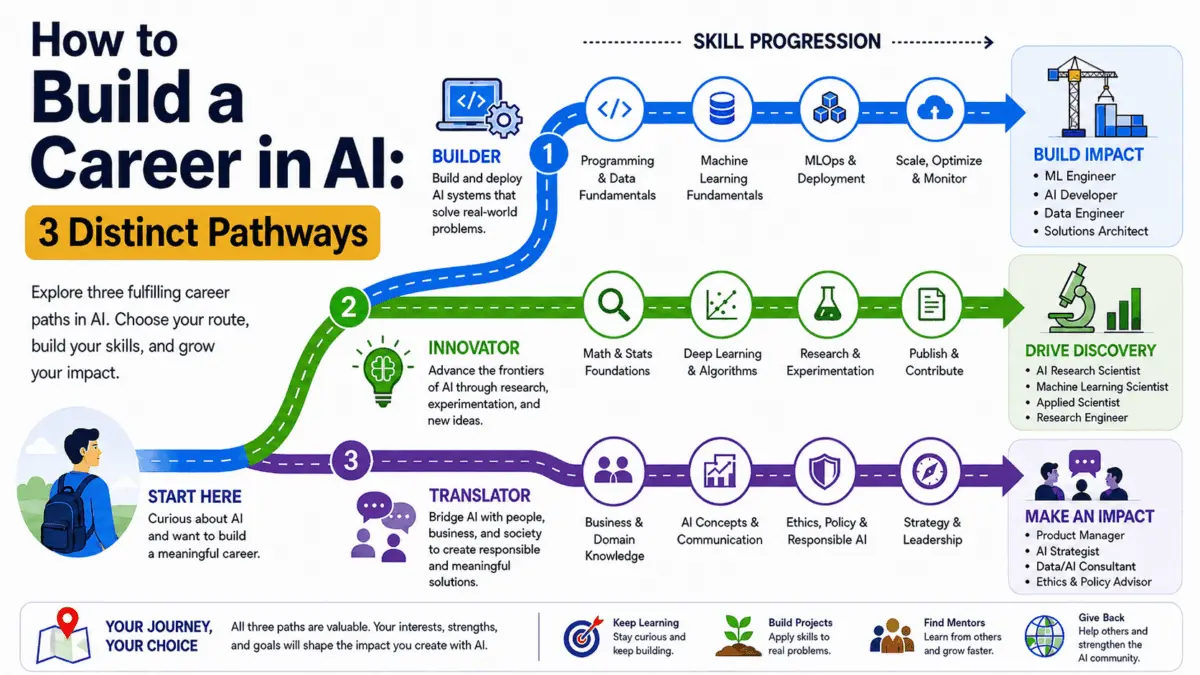
This comprehensive report deconstructs the AI employment landscape into three distinct, viable career pathways: The Builder, The Innovator, and The Translator. By examining the nuances of each orientation, identifying the critical traps that ensnare newcomers, and providing a comparative analytical framework, this article serves as an authoritative guide to locating your unique professional trajectory within the AI revolution.
Detailed Chronology: The Evolution of AI Roles and the Rise of the Specialization Era
To understand why the modern AI job market is so bewildering, one must trace the rapid evolution of the technology sector over the past decade.
Phase One: The Academic Monopoly (Pre-2015)
In the early days of modern deep learning breakthroughs—typified by successes in computer vision and convolutional neural networks—artificial intelligence was almost exclusively the domain of academia and elite corporate research labs (such as Google Brain and DeepMind). The roles were clear-cut: you were either a theoretical researcher inventing novel network architectures or a computer scientist implementing academic papers. The barrier to entry was astronomically high, requiring advanced graduate degrees in computer science, mathematics, or physics.
Phase Two: The Open-Source Democratization (2015–2022)
The landscape shifted dramatically with the open-sourcing of foundational frameworks like TensorFlow and PyTorch, alongside the proliferation of accessible cloud computing. Suddenly, machine learning was no longer locked inside university ivory towers. Software developers began bolting predictive models onto traditional web and mobile architectures. This era gave birth to the modern "Data Scientist" and "Machine Learning Engineer" hybrid roles, where professionals were expected to know a little bit of everything: data wrangling, statistical modeling, software development, and deployment.
Phase Three: The Generative AI Splintering (2023–Present)
The launch of Large Language Models (LLMs) and generative multimodal systems shattered the illusion of the "generalist AI practitioner." The field grew too vast for any single human to master entirely. Today, we witness a clear and necessary specialization splintering.
- Infrastructure and Scale (The Builder): As models grew to billions of parameters, the industry realized that training a model is only 10% of the battle; running it reliably, securely, and cost-effectively at scale is where 90% of the engineering challenges lie.
- Cutting-Edge R&D (The Innovator): With architectures constantly evolving, advanced research labs required specialists capable of pushing the mathematical boundaries of transformer models, diffusion processes, and reinforcement learning.
- Application and Strategy (The Translator): Organizations quickly discovered that deploying raw AI models without domain-specific strategy, ethical oversight, and product-market fit led to catastrophic failures. This realized the urgent need for professionals who could translate technological capabilities into concrete business value.
Recognizing this chronological maturation is crucial for anyone entering the field today. Attempting to master all three domains simultaneously is a recipe for professional stagnation. Sustainable success requires identifying your core competency and aligning your trajectory with one of the three established pathways.
Supporting Context & Metrics: Deconstructing the Three Pathways
To make an informed career decision, prospective AI professionals must look beyond flashy job titles and examine the underlying mechanics, day-to-day responsibilities, and common pitfalls associated with each pathway.
+-----------------------------------------------------------------------------------+
|                        THE THREE AI CAREER PATHWAYS                               |
+---------------------------+---------------------------+---------------------------+
|      THE BUILDER          |      THE INNOVATOR        |      THE TRANSLATOR       |
|  (Engineering & Scale)    |   (Research & Science)    | (Product, Strategy, Ethics)|
+---------------------------+---------------------------+---------------------------+
| • Focus: Systems & Code   | • Focus: Math & Theory    | • Focus: Domain & Value   |
| • Skill: Python, PyTorch  | • Skill: Linear Algebra   | • Skill: UX, Product Sense|
| • Trap: Ignoring MLOps    | • Trap: Romanticizing Math| • Trap: Inferiority Complex|
+---------------------------+---------------------------+---------------------------+
Pathway 1: The Builder (Engineering and Deployment)
The Builder is the foundational engine of applied artificial intelligence. Builders take working models, experimental code, and research prototypes and transform them into robust, reliable systems that operate seamlessly at enterprise scale.
- The Core Work: This pathway centers on writing clean, modular code, orchestrating complex data pipelines, managing API integrations, and maintaining system stability when millions of users depend on uninterrupted uptime.
- Who It’s For: Individuals who revel in logical puzzles, system architecture, and experiencing the immediate, tangible gratification of shipping software that works.
- Common Misconceptions: A pervasive myth suggests that Builders must invent novel mathematical algorithms. In reality, the vast majority of Builders rarely write raw neural network architectures from scratch; instead, they leverage pre-existing libraries (such as
scikit-learnorPyTorch) and focus heavily on software engineering best practices. - The Pitfall: Many aspiring engineers focus exclusively on model accuracy metrics during training while completely ignoring production realities. A classic mentoring case involved a candidate who boasted stellar benchmark accuracy on a local machine but had never practiced model versioning, monitored data drift, or constructed a data validation layer. He was shocked to discover that interviews for Builder roles tested engineering rigor far more heavily than modeling wizardry.
- Recommended Starting Arsenal: Master Python, core data science libraries (
scikit-learn,PyTorch), and gain proficiency in at least one major cloud platform (AWS, GCP, or Azure) alongside modern MLOps tooling.
Pathway 2: The Innovator (Research and Science)
If the Builder is tasked with making existing systems work reliably in production, the Innovator lives at the jagged frontier of human knowledge, pushing the boundaries of what artificial intelligence can achieve.
- The Core Work: Innovators work on foundational research—inventing novel architectures, improving optimization algorithms, reducing computational bottlenecks, and publishing findings at top-tier conferences (like NeurIPS, ICML, and CVPR).
- Who It’s For: Individuals with an intense passion for advanced mathematics, theoretical puzzles, and operating comfortably amidst high degrees of uncertainty. This path is deeply grounded in linear algebra, multivariable calculus, probability theory, and convex optimization.
- Common Misconceptions: Unlike the Builder path—where a strong programming background can serve as a sufficient springboard—the Innovator path has a remarkably steep, uncompromising entry barrier. A frequent mistake is romanticizing research roles purely out of intellectual fascination without objectively auditing one’s mathematical foundation.
- The Pitfall: Aspiring researchers often jump straight into fine-tuning large language models without understanding the underlying gradient descent dynamics or loss landscapes. Fascination with the results of AI is not a substitute for the grueling discipline required to derive its mechanics. This pathway typically demands formal graduate study (Master’s or Ph.D.) or an intensive research fellowship within an advanced laboratory.
- Recommended Starting Arsenal: Build uncompromising fluency in advanced mathematics, followed by rigorous foundational coursework such as the DeepLearning.AI Machine Learning Specialization and the practical experimentation frameworks offered by fast.ai.
Pathway 3: The Translator (Product, Strategy, and Ethics)
Often overlooked in technical discourse, the Translator is arguably the most critical—and most widely accessible—orientation in the modern AI ecosystem. Translators serve as the vital bridge connecting raw technological capability with organizational necessity.
- The Core Work: Translators do not typically write production-grade code. Instead, they possess high technical literacy: they understand how AI works, where it fails, what regulatory and ethical risks it carries, and how it can be marshaled to solve specific business or societal problems.
- Who It’s For: Professionals with backgrounds in business strategy, product management, law, design, user experience, healthcare, or specialized domain fields who want to direct how AI is deployed.
- Common Misconceptions: There is an unfortunate cultural bias in the tech industry that places a higher social status on writing code than on designing products or setting strategy. Students frequently absorb this bias, viewing non-coding roles as a "consolation prize." This is entirely false. Knowing which problems AI can actually solve—and avoiding costly implementations of AI where a simple spreadsheet would suffice—is where true enterprise value is unlocked.
- The Pitfall: Underestimating the value of domain expertise. For example, a clinician transitioning into the tech sector might initially chase machine learning engineering roles purely for compensation figures, viewing her medical background as irrelevant. In truth, her deep clinical intuition and understanding of patient workflows represent an irreplaceable competitive edge that a freshly graduated computer science major simply cannot replicate.
- Recommended Starting Arsenal: Cultivate robust product sense, user experience frameworks, and practical fluency with modern generative tools through programs like the Hugging Face LLM Course.
Comparative Analytical Framework
To crystallize these distinctions, the following matrix evaluates the three pathways across key professional dimensions:
| Dimension | Pathway 1: The Builder | Pathway 2: The Innovator | Pathway 3: The Translator |
|---|---|---|---|
| Core Motivation | Building scalable, reliable systems and shipping code. | Solving open mathematical problems and pushing technical boundaries. | Bridging human needs with technological capabilities; driving strategy. |
| Typical Academic Background | Computer Science, Software Engineering, Information Systems. | Graduate study in Mathematics, Statistics, Physics, or CS. | Business administration, law, design, or specialized domain fields. |
| Primary Technical Focus | Python, PyTorch, Cloud Infrastructure, APIs, MLOps. | Linear algebra, probability, optimization theory, research papers. | Product sense, UX design, prompt engineering, domain workflows. |
| Tolerance for Ambiguity | Moderate (focused on engineering standards and bug fixing). | Extremely High (dealing with unproven research hypotheses). | High (navigating organizational politics and shifting market needs). |
| Primary Risk | Neglecting software engineering rigor in favor of modeling. | Underestimating the rigorous mathematical entry barrier. | Falling victim to industry bias that undervalues strategic roles. |
Official Industry Insights & Expert Perspectives
Industry leaders, technical mentors, and workforce analysts increasingly emphasize that the era of the "generic AI generalist" has officially drawn to a close.
Vinod Chugani, an esteemed AI and data science educator and technical mentor who has guided hundreds of professionals through career transitions, notes a recurring pattern in professional development:
"Across more than a thousand mentoring sessions, the single most consistent mistake I witness is professionals picking an AI career path simply because it sounds prestigious or boasts high average salaries, rather than evaluating where their actual strengths lie. AI content online tends to showcase the glamorous destination while completely obscuring the grueling route. Consequently, people work backward into learning plans without honestly auditing their starting point."
Chugani stresses that attempting to force oneself into a mismatched archetype leads to professional burnout:
"You can build the engine, design the fuel, or steer the car. Pick one, and commit to it long enough to achieve genuine mastery. Your career choice matters far less for how impressive it sounds at a dinner party and far more for how precisely it aligns with your authentic background and long-term ambitions."
Furthermore, enterprise hiring managers consistently report that job candidates who can clearly articulate which of these three pillars they inhabit stand out immediately in a sea of generic resume templates. Organizations are no longer looking for people who claim to "know AI"; they are looking for Builders who can scale pipelines, Innovators who can optimize models, and Translators who can ensure those models actually solve real-world problems.
Future Outlook: The Next Decade of AI Talent Development
As artificial intelligence continues to permeate every corner of the global economy, the maturation of the job market will accelerate. Several key trends will define the next decade of AI talent development:
- The Rise of Low-Code/No-Code AI Integration: As foundational models become increasingly commoditized and user interfaces grow more intuitive, the demand for basic wrapper-building will decline. Builders will be expected to focus on deep systems integration, security, and edge computing, while Translators will leverage natural language interfaces to prototype solutions without writing traditional code.
- Specialized Ethics and Governance Roles: With the proliferation of deepfakes, algorithmic bias, and regulatory scrutiny (such as the European Union Artificial Intelligence Act), the Translator pathway will see an explosive surge in specialized roles focused on AI governance, legal compliance, and human-in-the-loop validation.
- The Interdisciplinary Edge: The most successful AI professionals of the 2030s will not be pure purists, but hybrid thinkers. A Builder with a background in biology, an Innovator with a grounding in philosophy, or a Translator with deep clinical expertise will outpace generalized tech workers every single time.
Conclusion
Entering the artificial intelligence industry does not require you to become a carbon-copy of a fictional, omnicompetent "AI expert." The ecosystem is far too vast, complex, and dynamic for any single human to master all of its facets.
Whether your calling lies in engineering robust data pipelines as a Builder, formulating novel mathematical optimization techniques as an Innovator, or guiding organizational strategy and ethical deployment as a Translator, success is entirely contingent upon self-awareness and deliberate alignment. Stop chasing the illusion of the average AI professional. Audit your strengths, select your pathway with intention, and commit to the rigorous, sustained practice required to build a truly remarkable career.
