

Executive Overview
Imagine gently sliding your fingertip across the surface of a standard U.S. penny. Without looking, your nervous system instantly processes a rich array of topographic details: the sharp, raised ridges of the letters and numbers, the distinct, bearded profile of Abraham Lincoln, or—if flipped to the reverse—the fluted, architectural columns of the Lincoln Memorial.
Replicating this deceptively simple human capability in artificial systems has long been one of robotics’ most formidable grand challenges. Traditionally, conferring a sense of touch to a robotic appendage requires densely packing arrays of pressure, force, and shear sensors into tight spatial constraints. This approach invariably runs into engineering bottlenecks, including complex wiring, high computational latency, and severe limitations in spatial resolution.
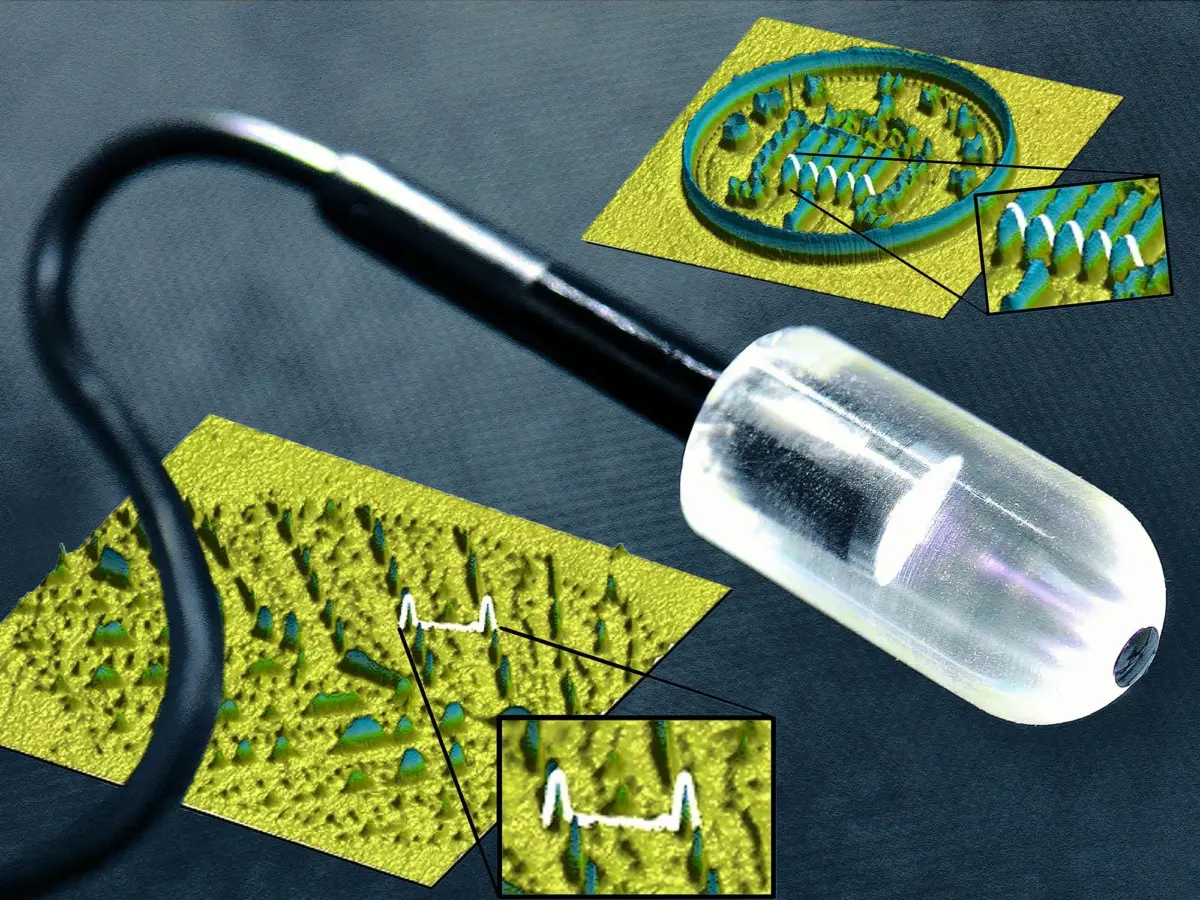
Now, an international collaboration of European scientists has unveiled a radically different paradigm: a robotic fingertip equipped with an unusual, colorful synthetic skin that delivers high-resolution tactile sensing in real time. Developed by researchers across Queen Mary University of London, the University of Florence, the University of Trieste, and the University of Trento, this novel sensor maps surface topology, strain, and contact pressure not through electronic grids, but through the shifting physics of light and color.
By utilizing a "mechanochromic" material structured as a Bragg reflector, the team’s robotic finger translates physical deformation directly into distinct visible light wavelengths. When the fingertip presses against an object, the underlying layers stretch, shifting the reflected color from red (minimal deformation) through the spectrum to green and blue (maximum deformation). Captured by an internal camera and processed with zero computational latency at a remarkable 100-micrometer resolution, this colorful approach offers an intriguing new frontier for robotic manipulation, prosthetics, and even minimally invasive surgical tools.
Detailed Chronology: From Laser Optics to Mechanochromic Skin
The genesis of this breakthrough skin traces back to a serendipitous cross-disciplinary crossover led by Giacomo Sasso, a postdoctoral research associate working in the lab of Professor Federico Carpi at Queen Mary University of London.
The Spark of Inspiration
Sasso was originally focused on advanced optics research when he stumbled upon a landmark paper published in the prestigious journal Nature. The paper detailed the properties of a novel mechanochromic material—a substance capable of altering its optical characteristics in response to mechanical force. Recognizing its potential, Sasso set out to adapt the material for tactile applications, successfully recreating and modifying the substance within his laboratory in less than a week.
Fabrication and the Bragg Reflector
Following the precise protocols outlined in the Nature study, Sasso engineered the core of the sensor using a light-sensitive film.
- Laser Exposure: The film was exposed to a 5-megawatt, 635-nanometer (red) laser beam for a duration of seven minutes.
- Interference Pattern: This exposure generated a precise optical interference pattern that induced the polymer to polymerize in alternating densities.
- Refractive Layers: The resulting structure—known as a Bragg reflector—features microscopic layers with varying refractive indices designed to reflect specific wavelengths of light.
When an external force deforms the reflector, these microscopic layers stretch and become thinner. Consequently, the physical change alters the wavelength of the light they reflect, creating a direct visual translation of mechanical stress.
Integration into the Robotic Fingertip
With the optical material proven, Sasso and his colleagues designed a functional robotic fingertip to house it. The architecture of the sensor is carefully layered:
- Outer Shield: A durable outer layer of black-colored silicone protects the internal components and increases optical contrast.
- The Reflector: Sandpooled just beneath the outer shell sits the Bragg reflector film.
- The Core: A transparent, fingertip-shaped silicone core houses a miniature camera and an embedded LED light source.
The LED shines light outward through the clear polymer matrix. When an object deforms the fingertip, the Bragg reflector bounces the light back toward the internal camera. The camera captures the resulting color shift—red for light touches, graduating to green and blue for heavier pressures—and instantly translates these optical changes into high-resolution topological maps.
Supporting Context & Metrics: Solving the Spatial and Computational Equations
To fully appreciate the significance of the European team’s design, one must examine the persistent trade-offs that have historically constrained artificial tactile sensing.
The Spatial Constraint Dilemma
Human skin relies on a dense network of specialized mechanoreceptors that feed sensory data—texture, vibration, thermal gradients, and pressure—continuously to the brain. Translating this capability to a robot requires solving a severe spatial puzzle. A robotic fingertip offers limited internal volume. Cramming dozens or hundreds of discrete electronic sensors (taxels) into that space introduces massive wiring complexity, signal cross-talk, and mechanical fragility.
Overcoming Taxel Limitations
Most existing tactile sensors rely on discrete taxels, measuring force vectors at isolated points across a grid. This approach yields coarse topological maps that struggle to capture fine-grained surface features.
By contrast, Carpi’s team embedded the sensing capability directly into the material level. As Sasso explains, the camera acts as a high-performance electronic translator, converting the continuous physical behavior of the material directly into digital signals without the need for complex, spatially distributed arrays of point-sensors.
Technical Performance Metrics
Through careful iterative design—including utilizing a rigid internal camera housing to maximize local deformation and a black silicone exterior to sharpen optical contrast—the team achieved striking performance metrics:
- Spatial Resolution: 100 micrometers, enabling the detection of minute surface variations.
- Latency: Zero computational latency, as the optical-to-digital translation occurs instantaneously via direct visual processing.
- Validation Range: Successfully generated high-fidelity topological maps of diverse test subjects, including a human fingertip, a U.S. penny, and a delicate plant leaf.
Official Statements and Industry Perspectives
The robotics community has taken swift notice of the colorful new sensor, offering both high praise for its innovative approach and pragmatic caution regarding its path to commercialization.
Praise from the Robotics Sector
Rich Walker, director of Shadow Robot—the United Kingdom’s longest-running robotics firm, renowned for its advanced robotic hands—did not mince words when evaluating the technology.
"To be honest, when they showed us this, we thought it was, and pardon my French, [expletive] cool, because it’s a distinctly different approach," Walker recalled.
Walker emphasized that because roboticists still lack a definitive consensus on the ideal tactile sensor architecture, exploring novel modalities like optical mechanochromism expands the industry’s design toolkit in vital ways.
Concerns Regarding Durability and Wear
While acknowledging the elegance of the vision-based approach, other industry leaders point out the rigorous hurdles that await the technology outside the controlled environment of a laboratory. Michael Wang, co-founder and chief scientist at Daimon Robotics—a firm that specializes in vision-based robotic systems—highlighted the perennial challenge of soft material durability.
"The practical and useful benefits, especially in the context of robot hands, remain to be tested and validated," Wang noted. He explained that repeated physical interactions inevitably cause soft silicones to erode or degrade, which can distort the fidelity of the underlying sensor signals over time. "Especially if you have electronics embedded into the material layer itself, that becomes a very challenging engineering problem. And I haven’t seen [many] good soft electronics materials that really can undergo long periods of usage."
Addressing the Wear-and-Tear Challenge
The research team is well aware of these engineering hurdles. Sasso points out a critical design advantage in their specific architecture: because the delicate Bragg reflector film is not in direct contact with external objects—shielded instead by the outer silicone layer—it is largely protected from abrasive wear. Furthermore, Federico Carpi notes that the outer silicone shell can be fortified with advanced chemical coatings to significantly extend its operational lifespan under heavy industrial or commercial use.
Future Outlook: Beyond Flat Surfaces and into the Operating Room
With the foundational physics validated and initial laboratory benchmarks cleared, the research collective is actively plotting the next phase of development.
Commercial Engagements and Real-World Integration
Discussions are currently underway with private sector companies interested in licensing or co-developing the sensor technology for commercial deployment. The primary objective for these near-term partnerships will be transitioning the fingertip from standalone bench tests to fully integrated multi-fingered robotic hands operating in dynamic, unstructured environments.
Expanding Beyond Flat Geometries
A key technical limitation of the current prototype is its efficacy primarily against flat or gently curved surfaces. To broaden its utility, the team is working on algorithmic and structural enhancements that will allow the sensor to accurately map complex, three-dimensional, and non-planar geometries.
Medical and Surgical Applications
Should the team successfully adapt the sensor for complex 3D contours, the implications extend far beyond industrial manufacturing and warehouse automation. Carpi envisions a transformative role for the technology in the medical field, particularly within advanced surgical instrumentation.
By leveraging high-resolution color-mapped touch feedback, specialized surgical tools could provide clinicians with precise, real-time contact mapping of internal tissues, organs, and delicate vascular structures during minimally invasive procedures.
As robotics continues its relentless march toward human-level dexterity, innovations that rethink the very nature of artificial perception—turning physical touch into a vibrant, high-definition spectrum of color—prove that the future of machine touch may well be illuminated from within.
