

Executive Overview
The rapid proliferation of open-source Large Language Models (LLMs)—ranging from massive architectures like gpt-oss-120b and the gargantuan Kimi-K3 with its 2.8 trillion parameters—has triggered a paradigm shift in artificial intelligence deployment. While these cutting-edge models exhibit unprecedented reasoning, linguistic comprehension, and long-context capabilities, their operational footprint remains prohibitively expensive. For instance, deploying a model like Kimi-K3 requires roughly 3 terabytes of video RAM (VRAM) simply to load its weights into memory. Consequently, the machine learning community has increasingly turned to model compression and knowledge distillation as an indispensable pathway to democratizing high-performance AI.
Knowledge distillation—the process of training a smaller, more efficient "student" model to replicate the outputs and behavior of a larger, more powerful "teacher" model—has long been standard practice. Industry leaders have successfully leveraged this technique to release compact variants, such as Nvidia’s Nemotron 3 Puzzle 75B and Multiverse Computing’s Hypernova 60B. However, traditional distillation pipelines have hit a formidable economic and infrastructural wall. The computational bottleneck has never been the concept itself, but rather the immense VRAM and compute overhead required to execute the distillation step.
To address this critical industry bottleneck, researchers at Multiverse Computing have released a groundbreaking research paper titled "Efficient Knowledge Distillation for LLMs: Offline Top-K Logits and a Fused Chunked KL Loss" (arXiv:2608.03796). By introducing two fundamental systems-level innovations—offline top-$K$ logit caching and a fused, memory-efficient Kullback-Leibler (KL) divergence loss—the research team has slashed VRAM consumption by orders of magnitude. These breakthroughs make long-context training and model recovery feasible on a single enterprise GPU, fundamentally altering the economics of LLM development and enabling agile, large-scale experimentation without requiring multi-node supercomputing clusters.

Detailed Chronology: The Evolution of LLM Distillation and the Memory Wall
To appreciate the significance of Multiverse Computing’s latest contribution, it is essential to trace the operational evolution of model compression techniques within the machine learning landscape.
The Era of Online Distillation and Its Constraints
Historically, the prevailing methodology for model compression has relied on online distillation. In this setup, both the teacher and student models are loaded into GPU memory simultaneously during every single training iteration.
At each forward pass, the teacher model evaluates the training corpus to generate a comprehensive probability distribution across its entire vocabulary. The student model then processes the same tokens and is optimized via the Kullback-Leibler (KL) divergence loss function to minimize the divergence between its predictions and those of the teacher.

While mathematically expressive, online distillation extracts a punishing toll on hardware infrastructure:
- Dual Model Overhead: Maintaining two fully active models in VRAM simultaneously consumes massive memory bandwidth and capacity.
- Redundant Computation: The teacher model must repeatedly execute full forward passes across identical training epochs, despite its internal parameters remaining completely frozen throughout the distillation run.
- Exploding Tensor Dimensions: The output probability tensor scale factor grows exponentially with vocabulary size and sequence length.
The Breaking Point: Scaling to Long Context Windows
As modern LLMs transitioned from standard 2K or 4K token contexts to ultra-long horizons of 32K, 64K, and even 256K tokens, the online distillation paradigm completely buckled under its own weight.
Consider a concrete industrial baseline: the gpt-oss-120b model features an expansive vocabulary of 201,088 tokens. When processing a sequence length of 32,768 tokens at a modest batch size of 4, the teacher-probability tensor alone—formatted in standard bfloat16 precision (4 × 201,088 × 32,768)—demands roughly 50 gigabytes of VRAM for just a single tensor.

When factoring in model gradients, intermediate activations, optimizer states, and the dual-model architecture, a single online distillation training iteration easily spikes to a staggering 250GB of VRAM. This resource requirement far exceeds the physical limits of even the most advanced single-GPU accelerators available today, such as the NVIDIA H200 (141GB) or the B200, forcing engineering teams to stitch together complex tensor-parallelism strategies across sprawling multi-node GPU clusters.
Supporting Context & Metrics: The Two-Pronged Systems Breakthrough
Multiverse Computing’s research circumvents this infrastructural barrier by decoupling the teacher evaluation phase from the student optimization phase and fundamentally reengineering how the KL-divergence loss is computed.
+---------------------------------------------------------------------------------+
|                       TRADITIONAL ONLINE DISTILLATION                           |
|  [ Teacher Model (Loaded) ] <---> [ Student Model (Loaded) ]                    |
|  * Peak VRAM: ~250GB (Spikes beyond single-GPU limits at 32K context)           |
+---------------------------------------------------------------------------------+
                                       VS.
+---------------------------------------------------------------------------------+
|                     MULTIVERSE COMPUTING OFFLINE ARCHITECTURE                   |
|  [ Teacher Model (Executed Once) ] ---> [ Top-K Logit Cache ]                   |
|                                                  |                              |
|                                                  v                              |
|                                        [ Student Model ]                        |
|                                        [ Fused Chunked KL Loss ]                |
|  * Peak VRAM: ~58GB to 128GB (Enables long-context training on a single H200)   |
+---------------------------------------------------------------------------------+
1. Offline Distillation via Top-$K$ Logit Caching
The first major architectural pivot shifts the workflow from real-time online evaluation to an offline caching pipeline.

Instead of forcing the massive teacher model to recompute its output distributions at every single training step, Multiverse Computing’s framework executes the teacher model once across the target dataset. For every token position, the system extracts and caches only the top-100 most likely tokens along with their associated logit values.
Once this lightweight cache is established:
- The teacher model is completely purged from GPU memory during the student training phase.
- The student model trains exclusively against the cached top-$K$ probability distributions.
- Because the teacher’s behavior remains static throughout the compression run, the identical cache can be endlessly reused across multiple hyperparameter ablations, architectural tweaks, and experimental iterations without any performance degradation.
2. The Fused, Chunked KL Loss Engine
Even with cached logits, computing the standard KL-divergence loss over massive vocabularies and long sequence lengths remains notoriously memory-intensive.

Conceptually, computing a dense KL loss requires constructing a massive comparison grid: one axis represents every single entry in the model’s vocabulary (100K+ words), while the other axis represents every token position across the sequence length. Standard machine learning libraries like PyTorch or NVIDIA Megatron-Bridge construct this entire vocabulary-by-sequence matrix in memory before calculating a single scalar loss value.
To eradicate this memory spike, Multiverse Computing developed a fused, chunked KL-divergence loss function. Rather than materializing the complete grid all at once, the algorithm processes the data in discrete, manageable slices:
- It builds, evaluates, and immediately discards individual chunks of the comparison matrix sequentially.
- Memory utilization remains strictly bounded to the size of a single chunk, preventing the runaway VRAM spikes characteristic of dense implementations.
- A custom backward-pass projection ensures mathematical equivalence with traditional dense KL loss while circumventing memory fragmentation.
Empirical Performance Benchmarks
To validate these innovations, the researchers conducted a series of rigorous benchmarks using Llama 3.1 8B Instruct as the teacher model and a compact 3.2B Llama variant as the student model at an 8K token context on a single NVIDIA H200 GPU.

| Method (8K context, single H200) | Peak Memory | Iteration Time | Throughput |
|---|---|---|---|
| Online distillation | 102.8 GB | 25.9 s | 237 TFLOP/s |
| Offline, dense KL | 78.3 GB | 18.5 s | 331 TFLOP/s |
| Offline, forward-chunked KL | 61.8 GB | 18.4 s | 335 TFLOP/s |
| Offline, fused chunked KL | 58.3 GB | 20.2 s | 304 TFLOP/s |
Crucially, the resulting training loss curves overlap almost perfectly across all four methodologies. This empirical proof confirms that offline distillation utilizing top-100 cached logits incurs zero fidelity loss compared to computationally heavy online distillation setups.
Scaling to Ultra-Long Context Horizons
While the performance gains at an 8K context are substantial, the true disruptive advantage of the fused chunked loss materializes as context lengths expand:
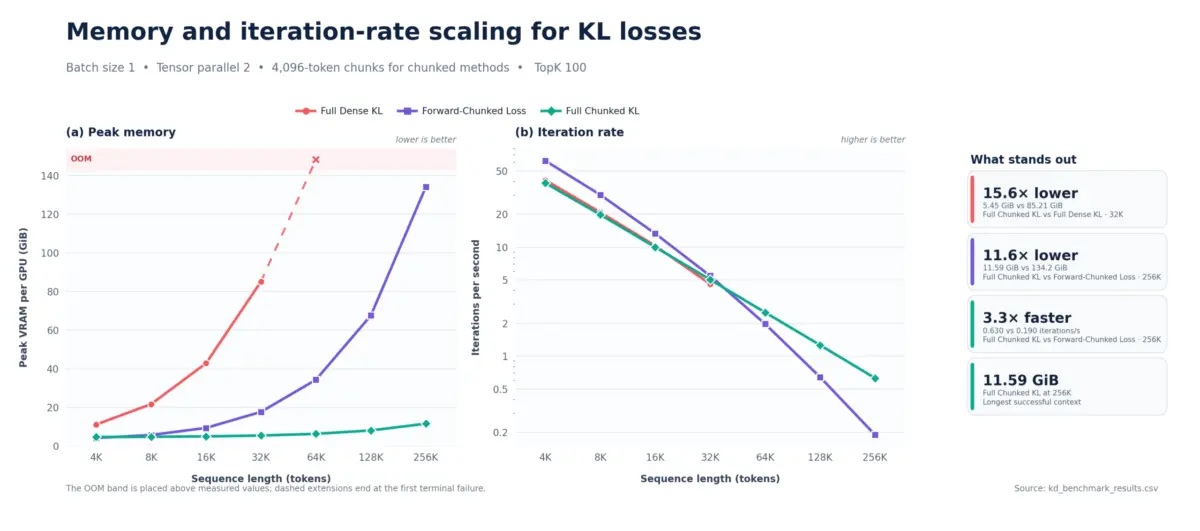
- At 32K tokens: Peak memory consumption plummets from 85.2 GiB (using dense loss) down to a meager 5.45 GiB with the fully chunked implementation—representing a staggering 15.6× reduction in VRAM. Furthermore, dense loss implementations experience outright out-of-memory (OOM) failures on standard hardware configurations at 64K tokens and beyond.
- At 256K tokens: The fully chunked loss consumes just 11.6 GiB compared to 134.2 GiB for alternative chunked variants, while executing approximately 3.3× faster per iteration.
- Real-World Impact: When distilling a GPT-OSS 20B model at a 32,768-token context, the memory liberated by the fused chunked loss allowed engineering workflows to scale down infrastructure requirements from four dedicated GPU nodes to a single node, cutting step times from 57.0 seconds down to 12.23 seconds (a 5× speedup) and elevating per-GPU throughput from 74.2 to 345.7 TFLOP/s.
Official Statements & Industry Implications
The implications of this research extend far beyond academic optimization; they address a major economic hurdle in commercial artificial intelligence development.

Industry analysts and machine learning engineers have long noted that the cost of fine-tuning and compressing frontier-class foundation models has acted as an effective barrier to entry, reserving custom model distillation exclusively for well-funded hyperscalers and elite research institutions. By reducing hardware dependency from multi-node supercomputing clusters down to single-GPU workstations, Multiverse Computing’s open-source release democratizes advanced model compression.
To foster community adoption and collaborative validation, Multiverse Computing has open-sourced the complete implementation of their chunked-loss engine via GitHub:
- GitHub Repository: CompactifAI/Full-Chunked-KL-Loss
- Research Paper: arXiv:2608.03796
By making the code freely accessible, the company aims to empower enterprise developers, academic researchers, and mid-sized AI labs to build highly specialized, compressed, long-context models without incurring punishing cloud infrastructure expenditures.

Future Outlook: The Next Frontier in Model Compression
The successful deployment of Multiverse Computing’s 3.2B student model—distilled from the Llama 3.1 8B Instruct teacher—demonstrates the viability of this methodology. Evaluated across standard industry benchmarks, the resulting compact student successfully retained the vast majority of the teacher’s accuracy across core language understanding tasks:
- BoolQ & HellaSwag: Near-identical task recovery compared to the full-sized teacher.
- MMLU (Massive Multitask Language Understanding): Maintained a performance delta within nine points while operating at less than half the parameter count.
Where the Field is Headed
As the AI industry confronts rising energy costs, hardware supply constraints, and the insatiable demand for extended context windows (ranging into millions of tokens), the techniques pioneered in this research point the way forward:
- Edge and On-Premises AI Deployment: With VRAM requirements reduced to single-GPU thresholds, enterprises can now distill proprietary foundation models locally, ensuring strict data privacy and regulatory compliance without leaking sensitive operational data to external cloud providers.
- Dynamic Caching Ecosystems: Future iterations of offline distillation pipelines will likely integrate automated, hardware-aware caching layers that seamlessly interface with quantized model formats (such as NVFP4 and INT4 quantization frameworks).
- Continuous "Healing" Loops: Beyond initial model compression, the efficiency gains enabled by the fused chunked loss make continuous model "healing"—the iterative correction of hallucination vectors and catastrophic forgetting in deployed models—economically viable as a routine operational maintenance cycle.
Multiverse Computing’s ongoing research under its CompactifAI initiative signals a broader transition in AI engineering: shifting away from brute-force scaling laws toward mathematically elegant, resource-efficient systems design. As these tools mature, the ability to tailor, compress, and deploy state-of-the-art language models will transition from an elite luxury into a standard, agile component of every modern software engineering stack.
