

Executive Overview
The landscape of high-performance artificial intelligence is fundamentally tethered to the efficiency of its underlying computational execution. While massive foundation models command mainstream headlines, the actual speed, memory consumption, and economic viability of these systems are dictated by custom hardware-level code—commonly known as kernels. Historically, packaging, distributing, and consuming custom kernels has been an arduous, fragmented, and notoriously insecure enterprise. Developers have had to grapple with conflicting compilation toolchains, platform-specific binaries, and opaque native code execution paths that made integrating optimized routines into Python-based ML frameworks a perilous gamble.
Addressing this systemic bottleneck, Hugging Face has rolled out a comprehensive, ground-up redesign of its Kernels project. Originally introduced as a proof-of-concept for standardizing custom hardware acceleration, the newly revamped ecosystem establishes a first-class repository type on the Hub, implements state-of-the-art cryptographic security and provenance tracking, refines command-line interfaces (CLIs), and introduces ground-breaking native support for agentic AI development.
This major milestone transforms how developers share optimized workloads across diverse accelerators, operating systems, and backend frameworks. By treating kernels as native citizens of the Hub alongside datasets and models, Hugging Face is bridging the gap between low-level hardware optimization and accessible machine learning deployment. This report explores the core architectural shifts, advanced security measures, developer ergonomics, and future trajectories defining this pivotal release.
Detailed Chronology: From Concept to Ecosystem Standard
The journey toward a unified kernel distribution framework began with initial explorations into streamlining GPU kernel deployment. Developers faced a stark reality: writing a high-speed CUDA, ROCm, or Metal kernel was only half the battle. Distributing it safely and reliably to end-users without requiring complex compilation environments on target machines was an unsolved industry-wide challenge.
Phase 1: The Initial Vision (From Zero to GPU)
In the initial conceptualization phase, the Hugging Face team introduced the core architecture of the Kernels project. The objective was straightforward yet ambitious: create a frictionless, secure, and Hub-friendly standard for packaging custom machine learning primitives. However, early prototypes revealed significant friction points. Utilities between the runtime loading library (kernels) and the build-time orchestration tool (kernel-builder) were heavily intertwined, creating a convoluted mental model for developers. Furthermore, the security implications of executing unverified native code inside high-privilege Python runtimes demanded a total architectural rethink.
Phase 2: The Architectural Redesign
Over the subsequent months, the core development team embarked on a relentless overhaul of the codebase. The project was nearly completely redesigned to decouple build-time logic from runtime execution.
- Separation of Concerns: The runtime library (
kernels) was stripped of all compilation utilities, refactoring it strictly into an agile loading and preparation utility. Conversely,kernel-builderwas isolated into a specialized compilation engine. - First-Class Hub Integration: The Hub introduced a dedicated repository classification explicitly for kernels. Users could finally inspect metadata regarding supported accelerators, operating system constraints, and backend versions directly within a centralized web UI.
- Robust Reproducibility: To combat the inherent trust deficit of running native binaries, the team integrated Nix for hermetic evaluation and strict sandboxed builds, embedding Git SHA1 provenance markers directly into compiled artifacts.
Phase 3: Hardening Security and Expanding Ecosystem Horizons
With the infrastructure foundation stabilized, the focus shifted toward enterprise-grade security and modern developer workflows. This era birthed the concept of "trusted publishers," cryptographic code signing via Sigstore’s cosign, and streamlined integrations designed specifically for autonomous agentic workflows. Today, the project stands as a mature, production-ready framework capable of supporting advanced hardware acceleration across the global AI ecosystem.
Supporting Context & Metrics: Architecture and Security Mechanics
To fully appreciate the scope of the recent updates, one must examine the technical mechanisms driving the revamped Kernels ecosystem. The engineering choices made by the Hugging Face team reflect a deep understanding of modern software supply chain vulnerabilities and hardware heterogeneity.
1. The "Kernel" Repository Type and Discovery
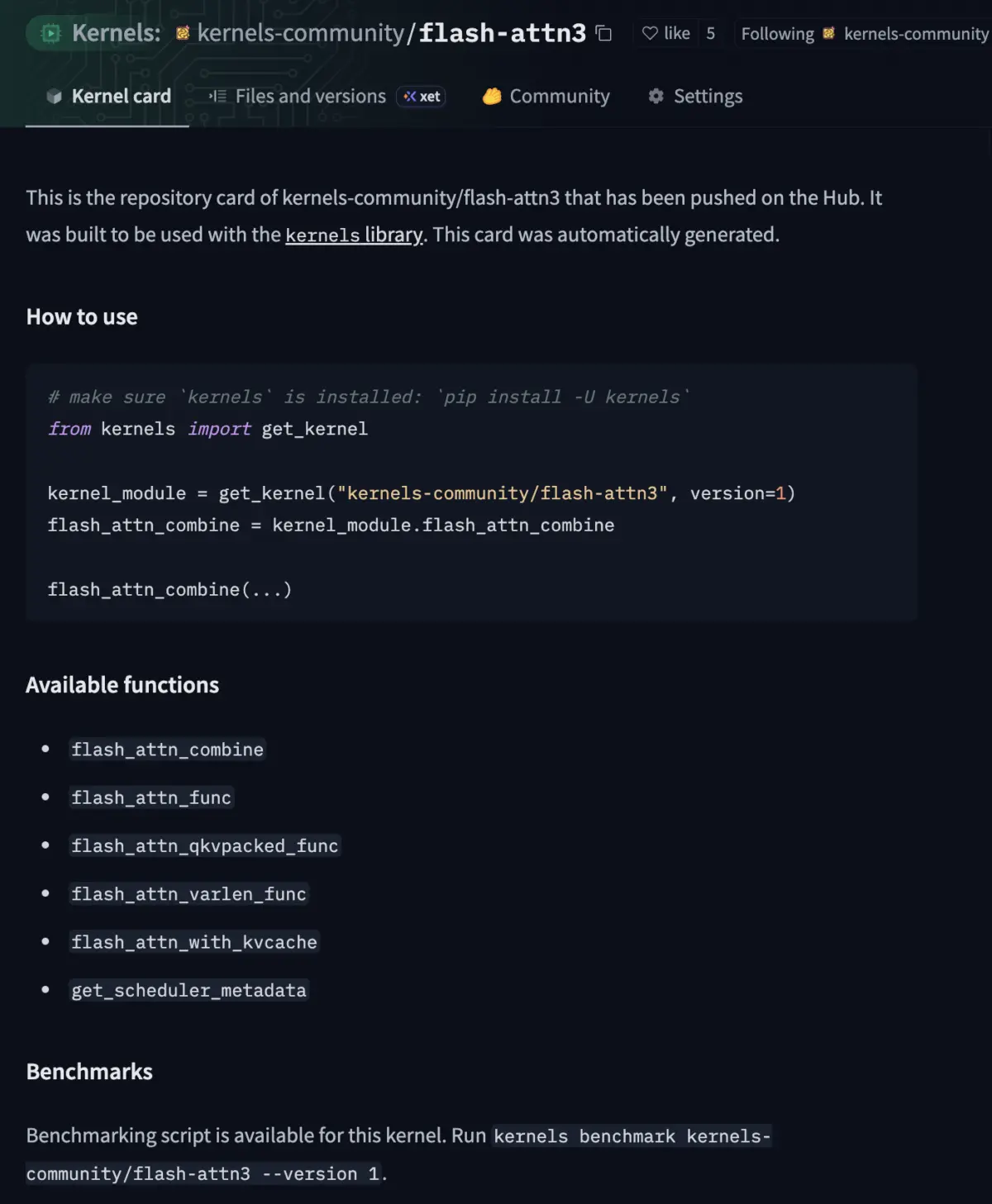
The introduction of the kernel repository type on the Hub fundamentally changes how performance engineers publish work and how practitioners discover it. Navigating to https://huggingface.co/kernels presents an intuitive registry where users can examine specific hardware compatibility matrices. For instance, browsing a high-performance primitive like kernels-community/flash-attn3 immediately exposes supported backend versions, target operating systems, and accelerator families.

┌─────────────────────────────────────────────────────────────┐
│                     Hugging Face Hub                        │
│  ┌──────────────────┐  ┌─────────────────┐  ┌────────────┐  │
│  │   Models (Repo)  │  │ Datasets (Repo) │  │ Kernels    │  │
│  └──────────────────┘  └─────────────────/  └────────────┘  │
│                                                     │       │
│                                           Metadata Matrix   │
│                                           - Accelerators    │
│                                           - OS Support      │
│                                           - Backends        │
└─────────────────────────────────────────────────────────────┘
By elevating kernels to first-class citizens, the ecosystem benefits from cross-pollination. Metrics and trends regarding model architectures can now be directly correlated with the specific custom operators accelerating them, enhancing discoverability and performance benchmarking.
2. Multi-Layered Defense: Trusted Publishers and Code Signing
Because custom kernels execute native compiled code within the same memory space and privilege level as the host Python process, a compromised or malicious package represents a critical security risk. The Kernels project implements a defense-in-depth strategy:
-
Default Restriction to Trusted Publishers: To prevent supply chain attacks via typosquatting or malicious uploads, the
kernelspackage enforces a strict policy: by default, it will only load kernels authored by verified, trusted organizations. Unverified sources require explicit user opt-in via thetrust_remote_code=Trueparameter:from kernels import get_kernel # Explicit opt-in required for non-trusted community publishers kernel_module = get_kernel( "Atlas-Inference/gdn", version=1, trust_remote_code=True ) - Cryptographic Code Signing: Going a step further than publisher verification, Hugging Face has integrated Sigstore’s
cosign. Developers sign kernel packages using ephemeral private keys bound to authenticated GitHub Actions workflows. Even if an attacker compromises a developer’s Hub credentials, they cannot forge a valid signature without access to the private signing context. While signature verification tools (kernels verify-signature) are currently available for developer audit, runtime signature enforcement is being rolled out methodically following community testing.
3. Solving the manylinux_2_28 and libstdc++ Conundrum
A major technical hurdle in distributing compiled binaries across diverse Linux distributions revolves around ABI compatibility. Historically, kernel-builder targeted manylinux_2_28 by compiling with a modern GCC toolchain and statically linking libstdc++ to avoid runtime dependencies on older system libraries.
However, this approach introduced insidious segmentation faults and data corruption. When modern C++ features (such as standard regular expressions) trigger global initialization routines, the coexistence of a dynamically linked libstdc++ (loaded by frameworks like PyTorch) and a statically linked libstdc++ (embedded in the custom kernel) causes severe memory conflicts.
The engineering team resolved this by refactoring builds to link libstdc++ dynamically while strictly adhering to the official manylinux_2_28 compilation toolchain. This ensures uncompromised compatibility with legacy system environments without triggering global initialization memory corruption.
Official Statements and Developer Insights
The philosophy guiding the Kernels project centers on empowerment, transparency, and frictionless collaboration. In technical briefings accompanying the release, project maintainers emphasized that the intersection of low-level systems programming and high-level machine learning must be guarded by robust structural guarantees.
"Our goal with the Kernels project is to bridge the chasm between extreme hardware optimization and everyday machine learning usability," notes the core engineering documentation. "We want kernel developers to have absolute confidence in their distribution pipelines, and model practitioners to consume custom hardware primitives with the same safety and simplicity as downloading a tokenizer configuration."
The transition toward clean architectural boundaries has also fundamentally empowered automated tooling. By separating the build mechanics of kernel-builder from the consumption semantics of kernels, the development team inadvertently laid the bedrock for the next frontier in AI engineering: Agentic Kernel Development.

Future Outlook: The Foundation for Agentic Kernel Development
Perhaps the most forward-looking aspect of the revamped Kernels project is its explicit accommodation of AI agents designed to write, test, and optimize hardware code autonomously.
Agentic kernel development—where large language models or specialized reinforcement learning agents scaffold, compile, benchmark, and iteratively refine custom operators—is rapidly transitioning from academic curiosity to industrial necessity. However, agents require rigid guardrails, predictable directory layouts, and programmatic interfaces to function effectively.
[ AI Agent / LLM ]
       │
       ▼ (Scaffolding & Code Generation)
[ kernel-builder CLI (Agent-Optimized) ]
       │
       ▼ (Hermetic Nix Build)
[ Compiled Kernel Artifact ]
       │
       ▼ (HF Jobs Integration)
[ Automated Hardware Benchmarking Suite ]
       │
       ▼ (Performance Feedback Loop)
[ Iterative Optimization ]
The Kernels ecosystem addresses these requirements through several key provisions:
- Agent-Optimized CLI Design: The command-line interfaces for
kernel-builderfeature non-intuitive-free, programmatic outputs that language models can easily parse, interpret, and react to. - Backend-Specific Skills: Specialized documentation and skill templates guide agents through the idiosyncratic toolchains, compilation flags, and performance traps associated with different hardware backends (CUDA, ROCm, Metal, etc.).
- Automated Benchmarking via HF Jobs: Generating a syntactically correct kernel is insufficient; it must demonstrate quantifiable speedups against established baselines. Through tight integration with Hugging Face Jobs and GitHub Actions, agents can automatically deploy generated kernels across diverse target accelerators, harvest benchmark metrics, and feed performance data back into their optimization loops.
Practical Ecosystem Utility: Inspection and Compatibility
For human developers and automated agents alike, runtime environment interrogation is crucial. The revamped API provides precise diagnostic tooling to verify system compatibility before execution:
from kernels import get_kernel_variants, VariantAccepted, has_kernel

# Quick boolean check for system compatibility
is_supported = has_kernel("kernels-community/activation", version=1)
print(f"Kernel supported on current hardware: is_supported")

# Detailed variant inspection and rejection reasoning
for decision in get_kernel_variants("kernels-community/activation", version=1):
  variant_name = decision.variant.variant_str
  if isinstance(decision, VariantAccepted):
    print(f"  [PASS] variant_name: compatible")
  else:
    print(f"  [FAIL] variant_name: rejected -> decision.reason")
This level of granular feedback ensures that deployment pipelines fail fast and informatively, saving countless hours of debugging in multi-node, heterogeneous production clusters.
Conclusion
The comprehensive redesign of the Hugging Face Kernels project represents a watershed moment for custom machine learning infrastructure. By establishing a dedicated repository standard on the Hub, hardening the supply chain with Nix reproducibility, trusted publishers, and cryptographic signing, and architecting an environment tailor-made for agentic code generation, Hugging Face has removed the historical barriers that kept low-level hardware optimization locked behind ivory towers.
As machine learning models push the absolute limits of compute efficiency, the ability to rapidly, safely, and securely deploy custom kernels will define the leaders in the AI space. The revamped Kernels ecosystem provides the exact scaffolding required for this next era of high-performance intelligence—inviting developers, researchers, and autonomous agents alike to contribute to an increasingly open, robust, and lightning-fast AI future.
