

Executive Overview: The Concurrency Challenge in Multi-Agent AI Systems
Orchestrating a standalone Artificial Intelligence agent to process a prompt, query a database, and return a structured response is a straightforward software engineering task. However, transitioning from single-agent prototypes to enterprise-grade, multi-agent systems operating concurrently presents significant architectural challenges. Modern enterprise workflows increasingly rely on autonomous agent "swarms"—networks of specialized LLM-powered units executing sub-tasks such as web scraping, document synthesis, code generation, and external API invocation simultaneously.
When orchestrating a fleet of agents concurrently, developers face serious synchronization and execution challenges. Unregulated concurrency can lead to deadlocked event loops, cascading API rate-limit errors (HTTP 429), memory exhaustion, and runaway token expenses.
Python’s asyncio framework serves as the standard library foundation for handling asynchronous I/O and concurrent operations. However, choosing the wrong asynchronous pattern can introduce subtle, hard-to-reproduce failure modes that remain dormant during local development but trigger critical outages under production workloads.
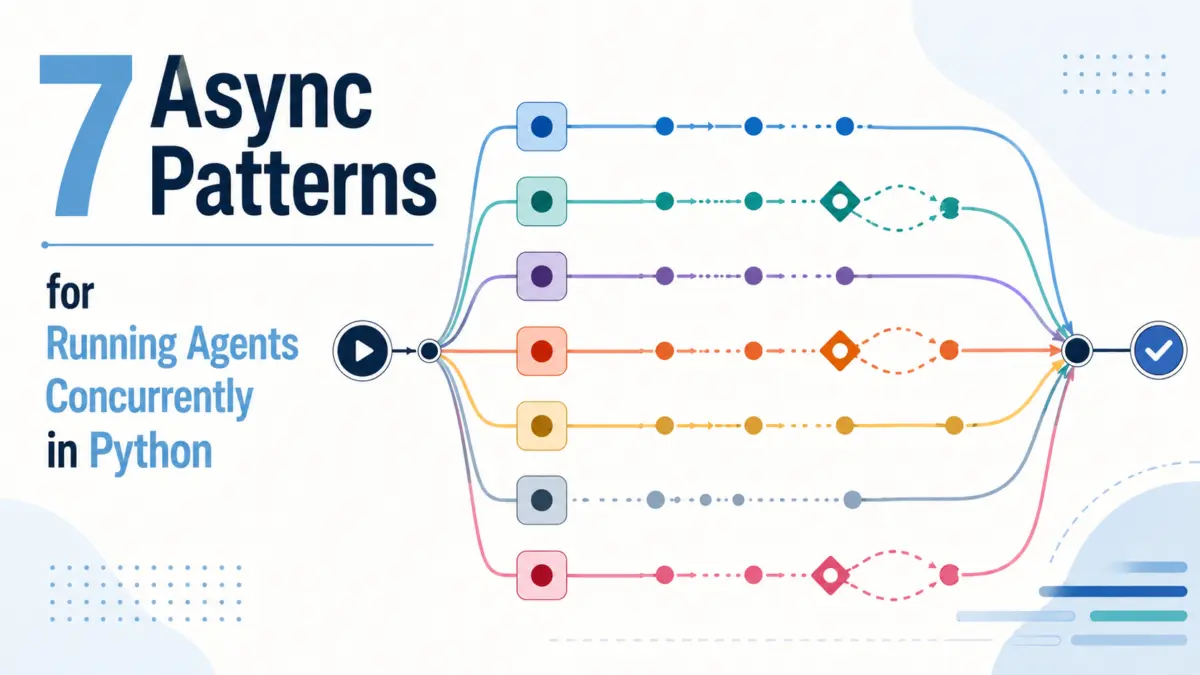
This comprehensive technical analysis examines seven core asynchronous patterns for concurrent agent execution, breaking down their operational mechanics, real-world utility, and the hidden production risks engineering teams must mitigate.
Architectural Deep Dive: Seven Async Patterns and Production Pitfalls
                   +---------------------------------------+
                   |       Orchestration Controller        |
                   +---------------------------------------+
                                       |
     +-----------------+---------------+---------------+-----------------+
     |                 |                               |                 |
[1. Fire & Forget] [2. Scatter-Gather]             [4. Producer-Consumer] [7. Pipeline Chaining]
     |                 |                               |                 |
 Background Task    Parallel Agents              Async Queue Buffer     Stage A -> Stage B
 (Context Flush)  (Data Aggregation)             (Dynamic Workload)    (Sequential Stream)
                       |                               |
              [3. Supervised TaskGroup]          [5. Semaphores]
              (Structured Concurrency)          (Rate-Limit Control)
                                                       |
                                             [6. Speculative Execution]
                                             (First Completed Wins)
1. Fire and Forget (Detached Background Execution)
Operational Mechanics
The "Fire and Forget" pattern involves spawning an asynchronous agent task using asyncio.create_task() and immediately continuing execution along the primary execution path without awaiting the task’s completion or capturing its return value directly.
# Conceptual Architecture: Fire and Forget
task = asyncio.create_task(background_agent_log_flush(session_context))
# Main execution path proceeds immediately without awaiting 'task'
Optimal Use Cases
This pattern is ideal for non-blocking secondary operations whose outcomes do not impact downstream decision-making. Examples include pushing telemetry logs, writing agent memory buffers to vector databases, or triggering asynchronous cleanup routines.
Production Pitfalls & Engineering Mitigation
- Silent Failure Modes: By default, unhandled exceptions in detached background tasks do not bubble up to the main thread; they are silently swallowed by the event loop, surfacing only as late warning logs upon garbage collection.
- Garbage Collection Dropping: In Python runtime versions prior to explicit reference retention strategies, strong references to running tasks must be maintained in a set. Otherwise, the garbage collector may purge an active background coroutine mid-execution.
- Mitigation: Implement explicit error-handling wrappers or attach explicit exception callbacks using
task.add_done_callback()to report background agent failures to monitoring platforms like Sentry or Datadog.
2. Strict Scatter-Gather (asyncio.gather)
Operational Mechanics
The Scatter-Gather pattern fans out requests from a central orchestrator agent to multiple concurrent worker agents simultaneously. The runtime halts downstream execution until every worker task in the cluster returns, aggregating all results into an ordered list corresponding to launch order.
# Conceptual Architecture: Scatter-Gather
results = await asyncio.gather(
    agent_alpha.fetch(),
    agent_beta.fetch(),
    agent_gamma.fetch(),
    return_exceptions=True
)
Optimal Use Cases
This pattern is best suited for parallel data aggregation workflows where an ensemble of agents must simultaneously query independent information sources—such as market data feeds, internal document stores, and external search engines—before a downstream synthesizer agent generates a unified response.
Production Pitfalls & Engineering Mitigation
- Straggler Latency Bottlenecks: The overall performance of a scatter-gather operation is dictated by the slowest individual agent. A single lagging API call delays the entire payload.
- Default Fail-Fast Cancellation: By default, if one task in
asyncio.gather()raises an unhandled exception, the entire operation halts, potentially invalidating successful responses from peer agents. - Mitigation: Always invoke
asyncio.gather(*tasks, return_exceptions=True). This ensures individual worker failures are captured as exception objects within the returned list rather than aborting the entire collection process.
3. Supervised Task Groups (asyncio.TaskGroup)
Operational Mechanics
Introduced in Python 3.11, asyncio.TaskGroup brings formal structured concurrency to the language. Using an asynchronous context manager, the lifecycle of every child agent spawned within the block is tied directly to the parent scope.
# Conceptual Architecture: TaskGroup (Python 3.11+)
async with asyncio.TaskGroup() as tg:
    task1 = tg.create_task(agent_researcher.run(query_a))
    task2 = tg.create_task(agent_coder.run(query_b))
# Execution halts here until all tasks complete or one fails
Optimal Use Cases
TaskGroup is the modern standard for execution blocks where a set of sub-agents must run concurrently, but strict lifecycle boundaries are required. If the parent workflow fails or is cancelled, all child agents are systematically cleaned up.
Production Pitfalls & Engineering Mitigation
- Aggressive Cascading Cancellations: If a single sub-agent raises an unhandled exception (e.g., an HTTP 429 rate-limit error), the
TaskGroupimmediately cancels all remaining sibling tasks inside the scope and raises anExceptionGroup. - Mitigation: Implement localized retry loops (e.g., using libraries like
tenacity) inside the individual agent coroutines. Ensure transient networking issues or rate limits are resolved locally before an exception escapes to theTaskGroupboundary.
4. Producer-Consumer Decoupling via Queues (asyncio.Queue)
Operational Mechanics
This pattern decouples task creation from task execution using an intermediate asynchronous queue (asyncio.Queue). Producer agents continuously discover or generate tasks and enqueue them, while a dedicated pool of consumer agents processes items from the queue asynchronously.
# Conceptual Architecture: Producer-Consumer
queue = asyncio.Queue(maxsize=100)
# Producer agent pushes: await queue.put(work_item)
# Consumer agents pull:  work_item = await queue.get()
Optimal Use Cases
Essential for asynchronous web crawling, recursive autonomous research, and dynamic task expansion workflows where the total volume of work cannot be calculated in advance.
Production Pitfalls & Engineering Mitigation
- Unbounded Queue Memory Exhaustion: Using an unbounded queue (
asyncio.Queue()) can lead to out-of-memory (OOM) crashes if producers generate tasks faster than consumers can process them. - Mitigation: Enforce backpressure by establishing a strict maximum capacity (
maxsize=N). When the queue fills up, producer agents automatically suspend execution atawait queue.put()until consumer agents free up capacity.
5. Backpressure and Resource Throttling via Semaphores (asyncio.Semaphore)
Operational Mechanics
An asynchronous semaphore limits the number of agents allowed to access a protected resource concurrently. Agents attempt to acquire a lock permit before execution; if all permits are checked out, subsequent agents wait in an asynchronous queue.
# Conceptual Architecture: Semaphore Limit
sem = asyncio.Semaphore(10) # Max 10 concurrent requests

async def throttled_agent_call(agent, payload):
    async with sem:
        return await agent.process(payload)
Optimal Use Cases
Critical for protecting database connection pools, internal microservices, and third-party APIs that enforce hard concurrent connection limits.
Production Pitfalls & Engineering Mitigation
- Connection vs. Token Rate Limit Mismatch: Semaphores limit concurrent HTTP connections, not total LLM tokens per minute (TPM).
- The Rate-Limit Trap: Limiting execution to 5 concurrent agent connections can still trigger API rate-limit errors if those 5 agents send massive context windows that exceed provider TPM thresholds.
Semaphore Guard: [ Max 5 Concurrent HTTP Connections ]
 ├── Connection 1: Agent A ( Prompt: 200 Tokens  ) -> PASS
 ├── Connection 2: Agent B ( Prompt: 50k Tokens  ) -> PASS
 ├── Connection 3: Agent C ( Prompt: 100k Tokens ) -> PASS (Alert: TPM Capacity Exceeded!)
└── Connection 6: Agent F -> HELD IN QUEUE BY SEMAPHORE- Mitigation: Pair
asyncio.Semaphorewith token-bucket rate limiters that track token throughput alongside raw connection counts.
6. Speculative Execution & Race Conditions ("First Completed Wins")
Operational Mechanics
Speculative execution launches multiple agents concurrently toward a single objective. The orchestrator monitors execution using primitives like asyncio.wait(..., return_when=asyncio.FIRST_COMPLETED) and accepts the first successful response, cancelling all remaining agents.
# Conceptual Architecture: Speculative Execution
done, pending = await asyncio.wait(
    [agent_fast.run(), agent_smart.run()],
    return_when=asyncio.FIRST_COMPLETED
)
for task in pending:
    task.cancel() # Cancel losing agents
Optimal Use Cases
Ideal for latency-critical applications where systems race a fast, lightweight model (e.g., Llama 3 8B) against a larger, slower model (e.g., Claude 3.5 Sonnet or GPT-4o), accepting whichever returns valid output within an acceptable time window.
Production Pitfalls & Engineering Mitigation
- Ghost Token Costs: Cancelling a Python task terminates the local network connection, but it does not stop inference on the LLM provider’s backend. The provider continues processing the prompt, charging your account for tokens generated by cancelled agents.
- Mitigation: Avoid using speculative execution for large generation tasks. Restrict this pattern to low-token classification tasks or deployments running on self-hosted model infrastructure where inference requests can be explicitly terminated via cancellation endpoints.
7. Asynchronous Pipeline Chaining
Operational Mechanics
Pipeline chaining creates sequential execution pipelines where specialized agents pass outputs directly to subsequent stages as inputs.
[Agent A: Fetch Raw Data] ---> [Agent B: Clean Context] ---> [Agent C: Reasoning Engine]# Conceptual Architecture: Pipeline Chaining
raw_data = await agent_extractor.run(target_url)
clean_text = await agent_cleaner.run(raw_data)
final_eval = await agent_evaluator.run(clean_text)Optimal Use Cases
Standard architecture for multi-stage Retrieval-Augmented Generation (RAG) applications, automated software development pipelines, and multi-step analytical reasoning workflows.
Production Pitfalls & Engineering Mitigation
- Observability Degredation & Fault Attribution: As data flows through multiple agents, identifying the root cause of a failure becomes difficult. An error in the final stage is often caused by subtle data corruption in an earlier stage.
- Mitigation: Inject trace contexts, correlation IDs, and runtime type validations (e.g., Pydantic schemas) into data payloads passed between pipeline stages.
Comparative Architectural Matrix
| Pattern | Primary Use Case | Core Structural Primitive | Latency Profile | Primary Failure Mode | Recommended Mitigation |
|---|---|---|---|---|---|
| 1. Fire & Forget | Background side-effects, telemetry | asyncio.create_task() |
Non-blocking | Exceptions swallowed silently; GC task loss | Attach callbacks (add_done_callback) & retain references |
| 2. Scatter-Gather | Parallel source querying & aggregation | asyncio.gather() |
Constrained by slowest task | Single straggler stalls workflow | Pass return_exceptions=True |
| 3. Task Groups | Bound lifecycle agent clusters | asyncio.TaskGroup() |
Bounded block | Cascading cancellations across siblings | Implement localized retries inside coroutines |
| 4. Queue-Based | Variable producer-consumer workloads | asyncio.Queue() |
Dynamic decoupling | Unbounded queue causing OOM errors | Set explicit maximum queue sizes (maxsize) |
| 5. Semaphores | Strict API connection concurrency limits | asyncio.Semaphore() |
Queued lock | Exhausting token limits despite low connections | Pair with token-aware throttling algorithms |
| 6. Speculative | Latency-critical redundant execution | asyncio.wait(FIRST_COMPLETED) |
Fastest-response wins | Phantom billings from backend processing | Use only for small prompts or self-hosted models |
| 7. Pipelines | Multi-step sequential reasoning | Asynchronous linear execution | Cumulative linear | Difficult to trace error provenance | Inject correlation IDs & validate data schemas |
Supporting Context, Performance Metrics, and Event Loop Physics
Understanding Python concurrency requires recognizing the operational limits of the asyncio event loop. asyncio achieves high performance through single-threaded cooperative multitasking. The event loop registers non-blocking I/O file descriptors and yields control whenever an operational yield point (an await statement) is encountered.
       Event Loop Thread Execution Timeline
┌──────────────────────────┬──────────────────────┬──────────────────────────┐
│ Non-Blocking Network I/O │ CPU-Bound Parsing    │ Non-Blocking Network I/O │
│   (Yields to Loop: OK)   │ (BLOCKS LOOP: BAD!)  │   (Resumes Execution)    │
└──────────────────────────┴──────────────────────┴──────────────────────────┘
                           ▲                      ▲
                           │                      │
                   Event Loop Stalls      Heartbeats Missed
                   Requests Timeout       System Cascades
The CPU-Bound Event Loop Starvation Fallacy
A common mistake in agent design is confusing asynchronous I/O with parallelism. While network requests to model providers yield control to the event loop, post-processing calculations do not.
Synchronous operations executed directly inside an agent coroutine interrupt the event loop:
- Complex JSON schema validation
- Heavy local tokenization (e.g.,
tiktokencalculations over large contexts) - Vector math calculations (e.g., cosine similarity using
numpy) - Local regex parsing of large context blocks
When an agent executes a CPU-bound operation synchronously, the entire event loop freezes. While the loop is blocked, concurrent background tasks cannot process incoming network packets, health-check heartbeats miss their response windows, and server connections time out across the system.
Mitigating Event Loop Starvation
To prevent heavy computations from blocking the event loop, offload CPU-bound processing to worker threads or secondary processes using asyncio.to_thread() or concurrent.futures.ProcessPoolExecutor:
# BAD: Blocks the asyncio event loop during token processing
def process_agent_response(huge_payload: dict):
    # Heavy CPU-bound JSON parsing, token counting, vector distance math
    return parsed_results

# Inside agent coroutine:
results = process_agent_response(payload) # Stalls ALL concurrent agents!

# GOOD: Offloads heavy computation to a worker thread
results = await asyncio.to_thread(process_agent_response, payload)
Enterprise Perspectives and Governance Frameworks
As multi-agent deployments move into enterprise operations, engineering managers and platform architects are updating their development frameworks. Industry experience reveals consistent operational requirements across production deployments:
"The primary operational risk in multi-agent orchestration isn’t underlying model quality—it’s ungoverned I/O concurrency," notes a principal platform engineer at an enterprise AI integration firm. "Teams build prototypes that run five agents simultaneously using raw
asyncio.gather(). In production under real-world traffic, a single API delay causes memory usage to spike, rate limits to trigger, and the entire system to crash. Building structured concurrency and backpressure into the system architecture from day one is essential."
Enterprise deployments require comprehensive observability frameworks built around three main requirements:
- Distributed Tracing Standards: Every multi-agent interaction should inject standard OpenTelemetry headers into the request payload context. This enables tracing a transaction’s entire journey across multi-stage agent workflows.
- Defensive Isolation: Failure in an auxiliary agent (e.g., an automated summary generator) must not collapse primary transactional pathways (e.g., executing an automated database update).
- Adaptive Rate-Limiting: Systems must dynamically scale back concurrency limits based on HTTP header feedback (
retry-after,x-ratelimit-remaining) provided by API endpoints.
Future Outlook: The Evolution of Autonomous Agent Infrastructures
The landscape of asynchronous agent execution is evolving rapidly. Key architectural shifts shaping the next generation of agent infrastructure include:
- Native Async Runtime Integration: Orchestration frameworks like LangChain, LlamaIndex, and AutoGen are shifting from synchronous wrappers toward native, async-first runtimes. Developers are moving away from dynamic code execution in favor of structured concurrency primitives.
- Hybrid Local-Cloud Runtimes: Next-generation orchestrators dynamically route tasks across local light models (executed on edge accelerators) and larger cloud APIs. Managing these hybrid systems requires sophisticated async orchestration patterns to balance latency, cost, and capacity.
- Protocol Standardizations: Protocols like the Model Context Protocol (MCP) are establishing standardized, asynchronous interfaces for agent-tool interaction. This standard reduces custom integration glue code and establishes predictable concurrency models across multi-agent environments.
Final Takeaway for System Architects
Mastering asynchronous Python concurrency is a fundamental requirement for building scalable, reliable multi-agent systems. Simple abstractions work fine for local prototypes, but production systems demand explicit lifecycle management, proactive backpressure, and isolated failure domains. System architects must choose patterns carefully, respect the operational constraints of the asyncio event loop, and design every agent network with robust error handling and telemetry from the start.
