

Executive Overview
The landscape of open-weight artificial intelligence has undergone a fundamental paradigm shift. What began as an era dominated by text-generation chatbots running on cloud infrastructure has evolved into a ecosystem of locally deployed, agentic language models. Central to this transformation is tool calling (also known as function calling)—a architectural capability that transitions a large language model (LLM) from a passive text generator into an active control unit capable of executing external code, querying local databases, and interacting with operating system APIs without sending data over the public internet.
When executed locally, tool calling addresses two of the enterprise’s most persistent challenges in AI adoption: strict data privacy and reliance on low-latency execution. However, implementing tool calling locally without cloud-side orchestration presents significant technical hurdles. The local model must accurately parse complex JSON schemas, determine whether a tool is required, emit syntactically flawless function invocation payloads, and cleanly digest the returned output—all while operating within the memory constraints of consumer or workstation hardware.
This comparative analysis evaluates how three leading open-weight model families address local tool calling: Google DeepMind’s Gemma 4, Meta’s Llama 3, and Mistral AI’s Mistral series. By evaluating their architectural designs, historical release trajectories, schema adherence, and operational requirements, this report provides data practitioners and infrastructure engineers with a comprehensive guide for selecting the optimal model family for air-gapped agentic workflows.
Detailed Chronology: The Architectural Evolution of Local Function Calling
To understand the current state of local tool calling, one must examine how the underlying open-weight architectures evolved from basic completion models to function-aware agents.
+---------------------------------------------------------------------------------------------------+
| CHRONOLOGICAL EVOLUTION OF OPEN-WEIGHT TOOL CALLING                                              |
+---------------------------------------------------------------------------------------------------+
| 2023 Sept  : Mistral 7B releases; establishes high parameter-efficiency standards.                |
| 2024 April : Meta releases Llama 3 (8B/70B); introduces early structured output fine-tuning.      |
| 2024 July  : Meta releases Llama 3.1 (inc. 405B); standardizes native JSON tool calling.          |
| 2024 Late  : Mistral 0.3 updates rollout native function calling specs; vLLM templates emerge.     |
| 2026 March : Mistral Small 4 launches; integrates MoE reasoning, vision, and tool-use (119B/6B).|
| 2026 April : Google DeepMind releases Gemma 4 (E2B, E4B, 26B A4B, 31B) with native agentic mode. |
| 2026 June  : Gemma 4 12B Unified bridges edge and server deployments.                              |
+---------------------------------------------------------------------------------------------------+
Phase 1: Unstructured Generation and Guided Parsing (2023)
In late 2023, local models lacked native tool-calling capabilities. When Mistral AI launched its initial Mistral 7B model in September 2023—founded by former DeepMind researcher Arthur Mensch and Meta AI alumni Guillaume Lample and Timothée Lacroix—it disrupted the open-source landscape by outperforming models twice its size on standard benchmarks. However, executing function calls required host applications to rely on complex system prompts, regular expression parsing, or external sampling constraints (such as JSON grammars) to extract function arguments from raw output text.
Phase 2: Native JSON Invocation and Parameter Scaling (2024)
The landscape changed significantly in 2024 with Meta’s release of Llama 3 and its subsequent update, Llama 3.1. Recognizing that post-training prompt engineering was insufficient for reliable tool execution, Meta explicitly fine-tuned the Llama 3.1 collection (spanning 8B, 70B, and the massive 405B parameter model) to natively recognize tool definitions. Rather than treating JSON definitions as standard text, Llama 3.1 was trained to emit structured JSON responses matching precise call signatures.
Concurrent with Llama 3.1, Mistral AI introduced Mistral 0.3, embedding function calling into its core chat formats. Later in the Llama 3 lifecycle, Meta introduced Llama 3.2, which experimented with "pythonic" function calling for its edge-tier 1B and 3B models, substituting JSON blocks with raw Python function invocation syntax.
Phase 3: Multimodal Agentic Paradigms and MoE Efficiency (2026)
By early 2026, tool calling transitioned from a fine-tuning add-on to a foundational architectural requirement:
- March 2026: Mistral AI released Mistral Small 4, unifying reasoning, vision, and tool calling into a single 119-billion total parameter Mixture-of-Experts (MoE) architecture that routes approximately 6 billion active parameters per token.
- April 2, 2026: Google DeepMind launched Gemma 4, built directly from the infrastructure supporting their proprietary Gemini models. Gemma 4 debuted as a natively multimodal, native tool-calling architecture across four sizes: E2B, E4B, 26B A4B (MoE), and 31B.
- June 2026: Google DeepMind expanded the family with the Gemma 4 12B Unified model, specifically engineered to optimize tool calling and reasoning for mid-tier local deployments.
Supporting Context & Technical Metrics
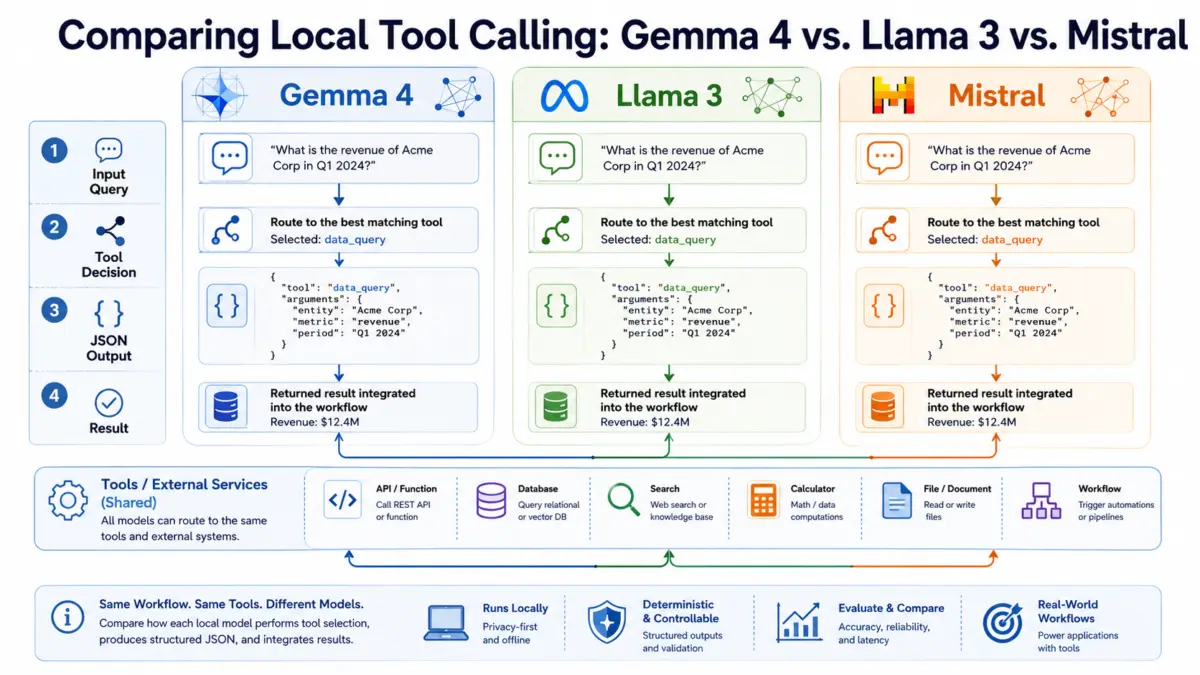
The operational viability of a local tool-calling model depends on three key vectors: structural execution mechanics, architectural design, and hardware resource footprint.
                      +---------------------------------------+
                      | User Prompt / Application Request     |
                      +---------------------------------------+
                                          |
                                          v
                      +---------------------------------------+
                      | Local LLM (Gemma 4 / Llama 3 / Mistral)|
                      | - Parses input & registered JSON schemas|
                      +---------------------------------------+
                                          |
                        +-----------------+-----------------+
                        |                                   |
           (Tool Call Required)                   (Direct Text Answer)
                        |                                   |
                        v                                   v
+-----------------------------------------------+ +-------------------+
| Emit JSON Payload:  "name": ..., "args": ... | | Standard Text    |
+-----------------------------------------------+ | Response Output   |
                        |                         +-------------------+
                        v
+-----------------------------------------------+
| Host System Executes Local Tool / API / Script |
+-----------------------------------------------+
                        |
                        v
+-----------------------------------------------+
| Result Fed Back into LLM Context Window        |
+-----------------------------------------------+
                        |
                        v
+-----------------------------------------------+
| Final Synthesized Output Generated for User   |
+-----------------------------------------------+
1. Structural Execution Mechanics
Across all three model families, local function calling adheres to a deterministic loop:
- Tool Registration: The client application presents available tools formatted as JSON schemas detailing names, parameters, data types, and required inputs within the context window.
- Decision & Payload Emission: The model evaluates the query against the registered tools. If external execution is required, it yields a payload identifying the chosen function and its structured parameters.
- Local Execution: The host runtime (e.g., Python runtime, local shell, database engine) executes the function call offline.
- Result Incorporation: The output of the executed function is formatted back into the context history, enabling the model to construct a finalized, natural-language response.
2. Deep Dive Model Breakdown
Google DeepMind Gemma 4
- Architectural Blueprint: Multimodal native baseline (text, image, audio, video). Blends dense architectures with sparse MoE setups across its variant matrix.
- Context Capacity: Up to 256,000 tokens on medium/large variants.
- Tool Calling Mechanism: Features native tool calling and system prompt routing. Incorporates a configurable thinking mode, allowing developers to allocate variable compute budgets to intermediate reasoning steps prior to emitting a function payload.
- Licensing Model: Permissive Apache 2.0 license.
Meta Llama 3 (3.1 / 3.2 / 3.3 Series)
- Architectural Blueprint: Pure text dense architecture across main releases (with specialized vision branches in 3.2).
- Context Capacity: Standardized to 128,000 tokens across 3.1 and subsequent releases.
- Tool Calling Mechanism: JSON-based schema adherence natively fine-tuned into post-training datasets. Small variants (8B) perform well on single-tool queries but exhibit non-deterministic behavior on highly ambiguous multi-tool definitions; 70B and 405B variants maintain high precision across multi-step chains.
- Licensing Model: Llama 3 Community License (Commercial use allowed under 700M monthly active users; subject to competitive re-training restrictions).
Mistral AI (Mistral 7B / Mistral Small 4)
- Architectural Blueprint: Sparse Mixture-of-Experts (MoE) optimizations coupled with compact dense variants.
- Context Capacity: 32,000 to 128,000 tokens depending on variant.
- Tool Calling Mechanism: Introduced natively in v0.3. Refined in Mistral Small 4 by unifying reasoning, vision, and tool execution. Relies on structured parallel system prompts within runtimes like vLLM to prevent hallucination in multi-tool configurations.
- Licensing Model: Open-weight releases under Apache 2.0; enterprise tier available via proprietary commercial licenses.
Comparative Metric & Feature Matrix
| Feature / Metric | Google DeepMind Gemma 4 | Meta Llama 3 (3.1+) | Mistral AI (Small 4 / Series) |
|---|---|---|---|
| Primary Open License | Apache 2.0 | Llama 3 Community License | Apache 2.0 (Open Releases) |
| Max Native Context | 256K Tokens | 128K Tokens | 128K Tokens |
| Native Tool Calling | First-class native feature | Native (Post-training) | Native (v0.3 & Small 4) |
| Architectural Mix | Dense & MoE Variants | Dense (Text) / Vision | Sparse MoE Heavy |
| Reasoning Control | Configurable Thinking Mode | Fixed System Prompts | Integrated MoE Routing |
| Multi-Tool Scalability | High (Edge to Server variants) | Variable (8B medium / 70B+ high) | High (MoE parameter efficiency) |
| Primary Deployment Tools | Ollama, LM Studio, vLLM | Ollama, LM Studio, vLLM | Ollama, vLLM, La Plateforme |
Hardware Footprint & Deployment Specifications
Running local tool-calling workflows requires balancing parameter quantization against system VRAM/RAM capacity. Below is an overview of resource requirements across model sizes:
+--------------------------------------------------------------------------------------------------+
| LOCAL HARDWARE RESOURCE ALLOCATION PROFILE                                                       |
+--------------------------------------------------------------------------------------------------+
| Model Class          | Min RAM / VRAM (INT4 Quant) | Rec. VRAM (FP16 / Native) | Target Hardware     |
+----------------------+-----------------------------+---------------------------+-----------------+
| Edge (2B - 4B)       | 3 GB - 6 GB                 | 8 GB                      | Laptops / Mobile|
| Mid-Tier (8B - 12B)  | 8 GB - 12 GB                | 16 GB - 24 GB             | Consumer GPUs   |
| Workstation (26B-70B)| 24 GB - 48 GB               | 80 GB - 144 GB (Multi-GPU)| Dual Workstation|
| MoE (Mistral Small 4)| 64 GB Unified / VRAM        | 120+ GB                   | Mac Studio / GPU|
+--------------------------------------------------------------------------------------------------+-
Edge-Tier Models (Gemma 4 E2B/E4B, Llama 3.2 1B/3B):
- Target Hardware: Ultra-light local systems, Apple Silicon laptops, embedded edge devices.
- Requirements: 3 GB – 6 GB VRAM under 4-bit quantization (Q4_K_M).
- Tool Precision: Capable of single-stage tool calling (e.g., pulling local system time, reading a single file signature).
-
Mid-Tier Models (Gemma 4 12B Unified, Llama 3.1 8B, Mistral 7B v0.3):
- Target Hardware: Single consumer GPUs (Nvidia RTX 3090/4090 with 24GB VRAM, Apple M-series chips with 16GB+ Unified Memory).
- Requirements: 8 GB – 12 GB VRAM for quantized execution; 16 GB – 24 GB for unquantized precision.
- Tool Precision: Handles moderate schema ambiguity; suitable for localized database queries, structured JSON extraction, and basic API routing.
-
Enterprise Workstation Tier (Gemma 4 26B/31B, Llama 3.1 70B, Mistral Small 4):
- Target Hardware: Multi-GPU workstations (e.g., 2x RTX 4090s, Nvidia A100/H100 nodes, Apple Mac Studio 64GB/128GB).
- Requirements: 24 GB – 80+ GB dependent on quantization depth. MoE architectures like Mistral Small 4 require significant system memory to store the 119B total static weight matrix, but generate tokens rapidly by utilizing only ~6B parameters per token.
- Tool Precision: High precision on complex nested JSON schemas, parallel tool calls (calling multiple functions in a single turn), and continuous multi-turn agent execution loops.
Official Statements & Ecosystem Perspectives
The ongoing evolution of local tool calling reflects distinct strategic philosophies across the major AI labs and open-source infrastructure maintainers:
Google DeepMind Perspective
In documentation detailing the release of Gemma 4, Google DeepMind emphasized the necessity of embedding agentic behavior into the base model architecture rather than relying exclusively on post-training prompts:
"With Gemma 4, our architectural objective was to deliver structured execution as a baseline native capability across all scale points. By combining system prompt handling, configurable reasoning budgets via thinking modes, and embedded function parsing, we provide developers with an enterprise-ready foundation that operates reliably on air-gapped devices."
Meta AI Perspective
Engineering teams behind Meta’s Llama project highlighted community ubiquity and standardization as the key drivers behind Llama 3.1’s functional upgrades:
"Expanding open access to advanced intelligence requires making models operational within existing software ecosystems. By natively supporting structured JSON function outputs across our entire parameter matrix—from 8B up to 405B—Llama 3 shifted open-source development from conversational prototypes to functional systems integrated with external APIs."
Mistral AI Perspective
Discussing the architectural decisions leading to Mistral Small 4 and their deployment strategy, Mistral AI’s leadership reiterated their commitment to compute efficiency and developer autonomy:
"High-performance tool calling should not necessitate massive operational costs or restrictive cloud environments. Through sparse Mixture-of-Experts design, models like Mistral Small 4 provide enterprise workflows with reasoning, vision, and precise function calling while keeping active compute overhead low enough for accessible hardware deployment."
Open-Source Maintainer Insights (Ollama & vLLM Ecosystems)
Maintainers within the open-source inference tooling space note that native model support has substantially reduced execution failure rates:
"Before native function calling fine-tunes were common in models like Llama 3.1, Gemma 4, and Mistral 0.3, nearly 30% of local tool-execution requests failed due to JSON syntax errors or structural hallucinations. Native alignment, paired with inference runtimes that natively parse structured tool schemas, has reduced baseline execution failure rates close to zero in production environments."
Future Outlook: The Next Phase of On-Device Autonomous Workflows
The trajectory of local tool calling suggests several emerging trends for developers and enterprise architects:
+-----------------------------------------------------------------------------------+
| EMERGING PARADIGMS IN LOCAL AGENTIC WORKFLOWS                                     |
+-----------------------------------------------------------------------------------+
| 1. Multimodal Tool Execution                                                      |
|    - Models digest visual/audio context directly to execute external code.        |
|                                                                                   |
| 2. Dynamic Local Micro-Agents                                                     |
|    - Specialized sub-4B models routed via high-capacity MoE supervisors.           |
|                                                                                   |
| 3. Completely Air-Gapped Enterprise Integration                                   |
|    - Zero external network dependencies for database, file, and OS manipulation.  |
|                                                                                   |
| 4. Context Window Expansion & Memory Persistence                                  |
|    - 256K+ context windows retain long execution traces across complex workflows. |
+-----------------------------------------------------------------------------------+
1. Multimodal Tool Execution
As demonstrated by Gemma 4 and Mistral Small 4, tool calling is no longer restricted to text input. Models can now digest visual frames (e.g., user interface screenshots, engineering schematics, industrial camera feeds), identify required software actions, and construct function payloads to modify local system parameters accordingly.
2. Multi-Agent Local Orchestration
The capability to run efficient models locally is enabling local multi-agent systems. Rather than relying on a single dense model to manage an entire workflow, developers are using orchestration engines to deploy smaller models (such as Gemma 4 E4B) as dedicated function callers, supervised by larger models (Llama 3.1 70B or Mistral Small 4) for higher-level planning.
3. Native Zero-Cloud Enterprise Automation
Enterprise adoption of local tool calling is accelerating in highly regulated sectors—including health care, financial services, and defense software—where transmitting sensitive internal data to third-party endpoints is prohibited. Local models capable of reliable JSON emission allow organizations to build air-gapped agents capable of operating on internal databases and document repositories.
Final Assessment & Strategic Selection Matrix
When selecting an open-weight model family for local tool calling, choice depends primarily on deployment constraints:
- Choose Google DeepMind Gemma 4 when building applications that require native multimodal processing, configurable reasoning controls, deep context handling (256K), or deployments targeting edge-to-server hardware under an Apache 2.0 license.
- Choose Meta Llama 3 when leveraging established agentic frameworks (e.g., LangChain, LlamaIndex), prioritizing extensive ecosystem integration, or deploying at scale on high-VRAM hardware.
- Choose Mistral AI (Mistral / Small 4) when seeking high compute efficiency, native Mixture-of-Experts routing, and optimal balance between static parameter size and dynamic inference speed on mid-to-high-end workstation hardware.
