

Executive Overview
At the Hot Chips conference, Intel provided a highly anticipated, deep technical look at its next-generation data center processors: the Xeon 7 family, codenamed "Diamond Rapids." Slated for a commercial market debut in 2027, Diamond Rapids represents a massive evolution in Intel’s enterprise silicon strategy. Packing up to 256 Performance-cores (P-cores) and a staggering 1.28 GB of last-level cache (LLC), this upcoming processor range is explicitly designed to command leadership in modern hyper-scale data centers, artificial intelligence infrastructure, and demanding agentic workloads.
Diamond Rapids pulls together years of corporate R&D, combining Intel’s enhanced 18A-P process node, universal chiplet interconnects (UCIe-S), advanced AVX 10.2 vector extensions, Intel Advanced Performance Extensions (APX), and a completely restructured internal layout. By shifting compute tiles to the perimeter of the die and centralizing memory and I/O subsystems, Intel is signaling a departure from legacy topologies, adopting a design philosophy akin to AMD’s successful EPYC layout to optimize thermal management and signal integrity.
As the enterprise landscape transitions rapidly to accommodate the surging demands of generative AI, high-performance computing (HPC), and massive cloud environments, Diamond Rapids serves as a critical litmus test for Intel’s manufacturing resurgence and process technology roadmap.
Detailed Chronology & Architectural Breakthroughs
The architectural journey of Diamond Rapids began taking shape publicly when Intel first teased the processor family earlier this year. However, the comprehensive disclosure at Hot Chips 2026 has brought structural clarity to how Intel plans to execute its vision for the late-decade data center.
The Compute Building Block (CBB) Paradigm
While Intel has opted to hold back specific microarchitectural details regarding the new Panther Cove core architecture—saving those disclosures for a later technical deep dive—the company laid bare the physical construction of the Diamond Rapids SoC.
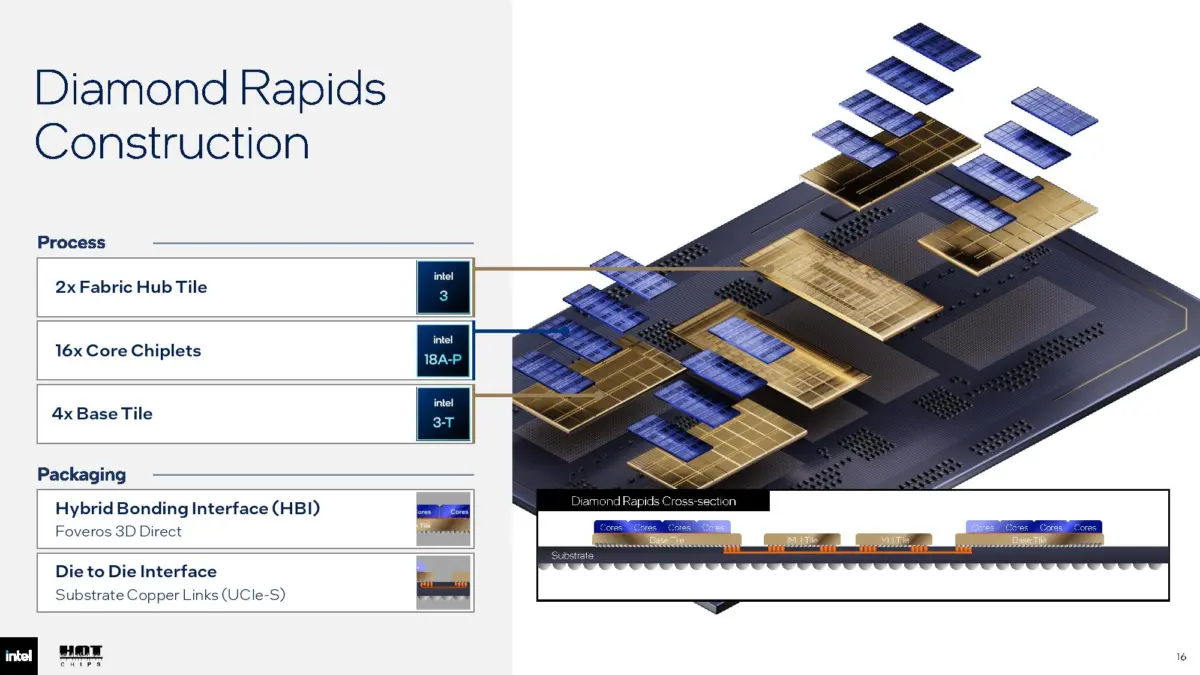
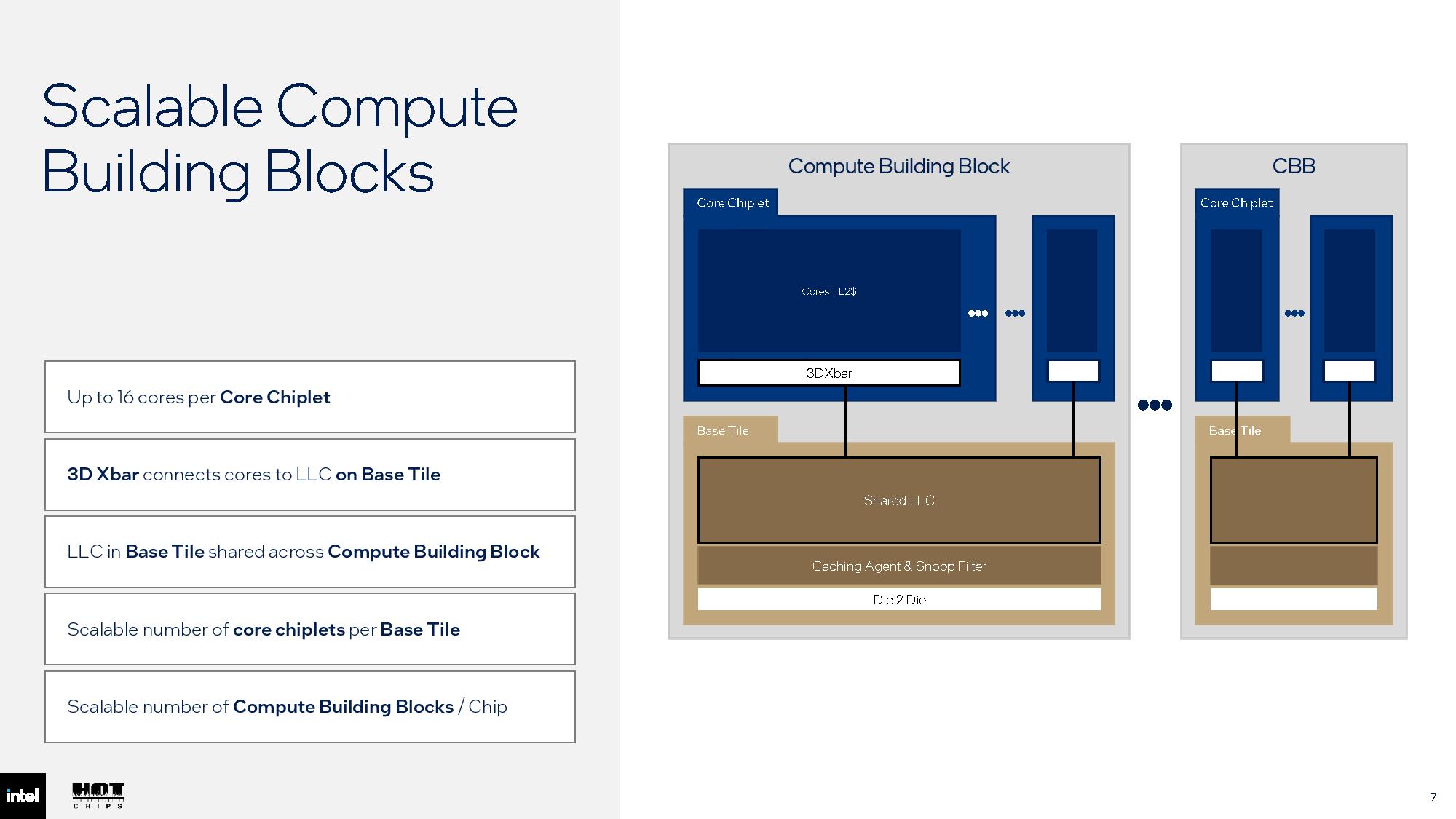
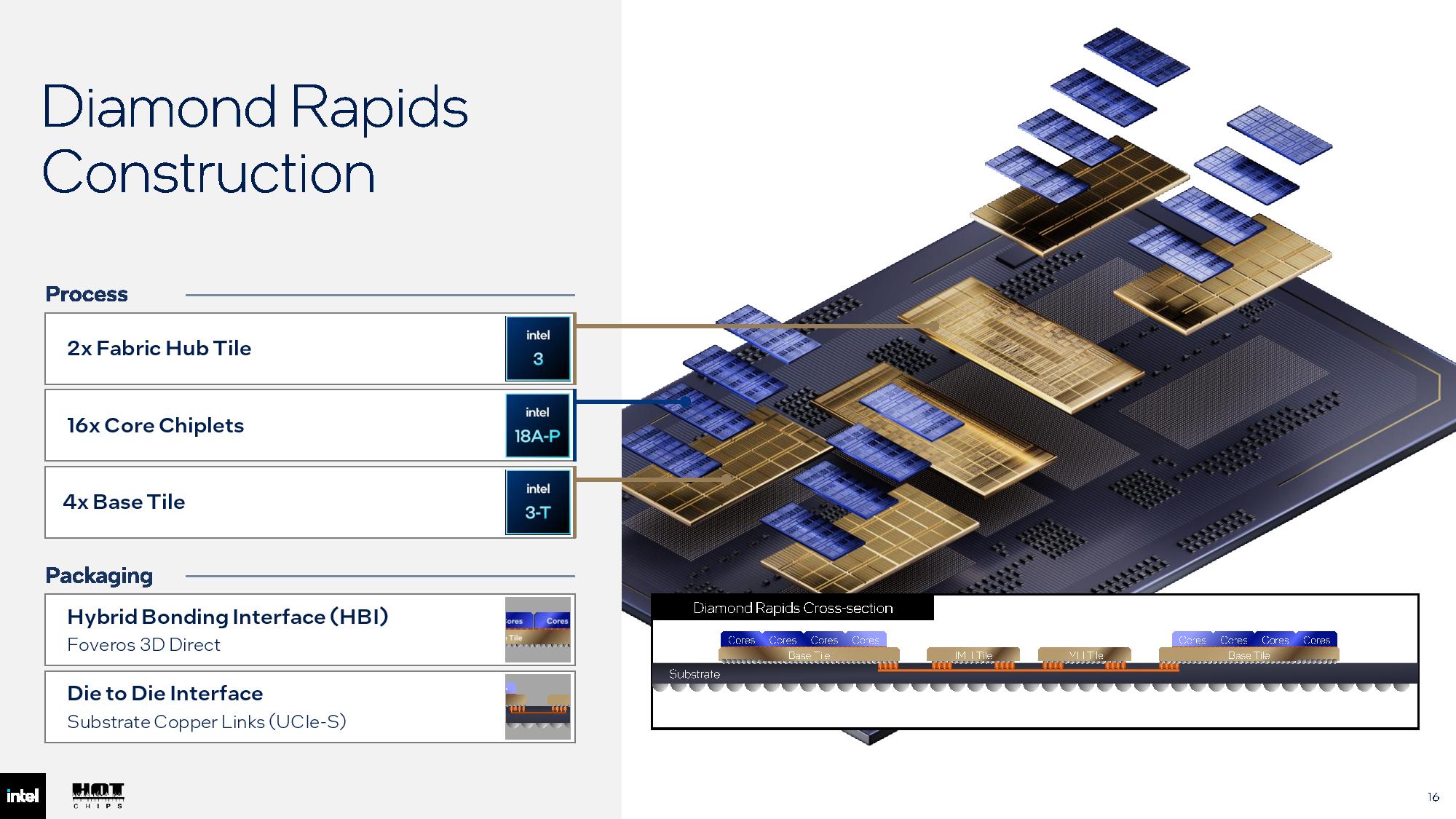
The chip is organized around Compute Building Blocks (CBBs). Within these CBBs lie individual core chiplets stacked vertically atop a base tile via Intel’s advanced Foveros Direct 3D packaging technology—a technique previously showcased in the Xeon 6+ "Clearwater Forest" processors.
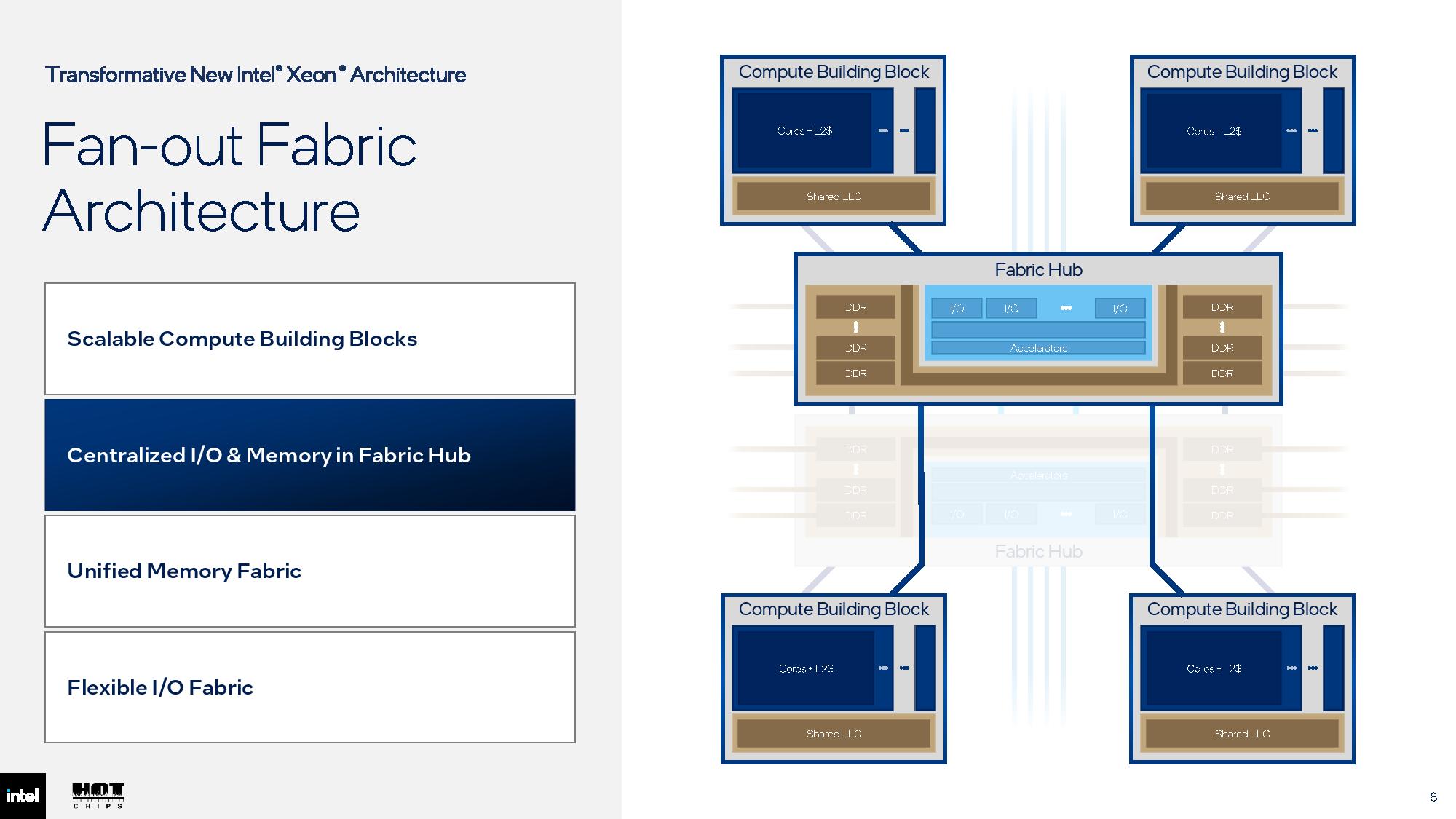
- Core Distribution: Each core chiplet accommodates up to 16 P-cores with private L2 caches. Up to four of these chiplets reside within a single CBB.
- Cache Architecture: The cores connect to the underlying base tile utilizing a 3D Xbar routing architecture, granting them shared access to a massive global L3 cache system.
- Global SoC Layout: A complete Diamond Rapids processor integrates four base tiles (built on the Intel 3-T node), two centralized fabric hub tiles (built on the Intel 3 node), and 16 core chiplets manufactured on the bleeding-edge Intel 18A-P process.
Flipped Layout: Centralizing I/O and Memory
One of the most profound architectural departures in Diamond Rapids is its physical layout. Compared to its predecessor, Granite Rapids, Intel has inverted the floorplan entirely.
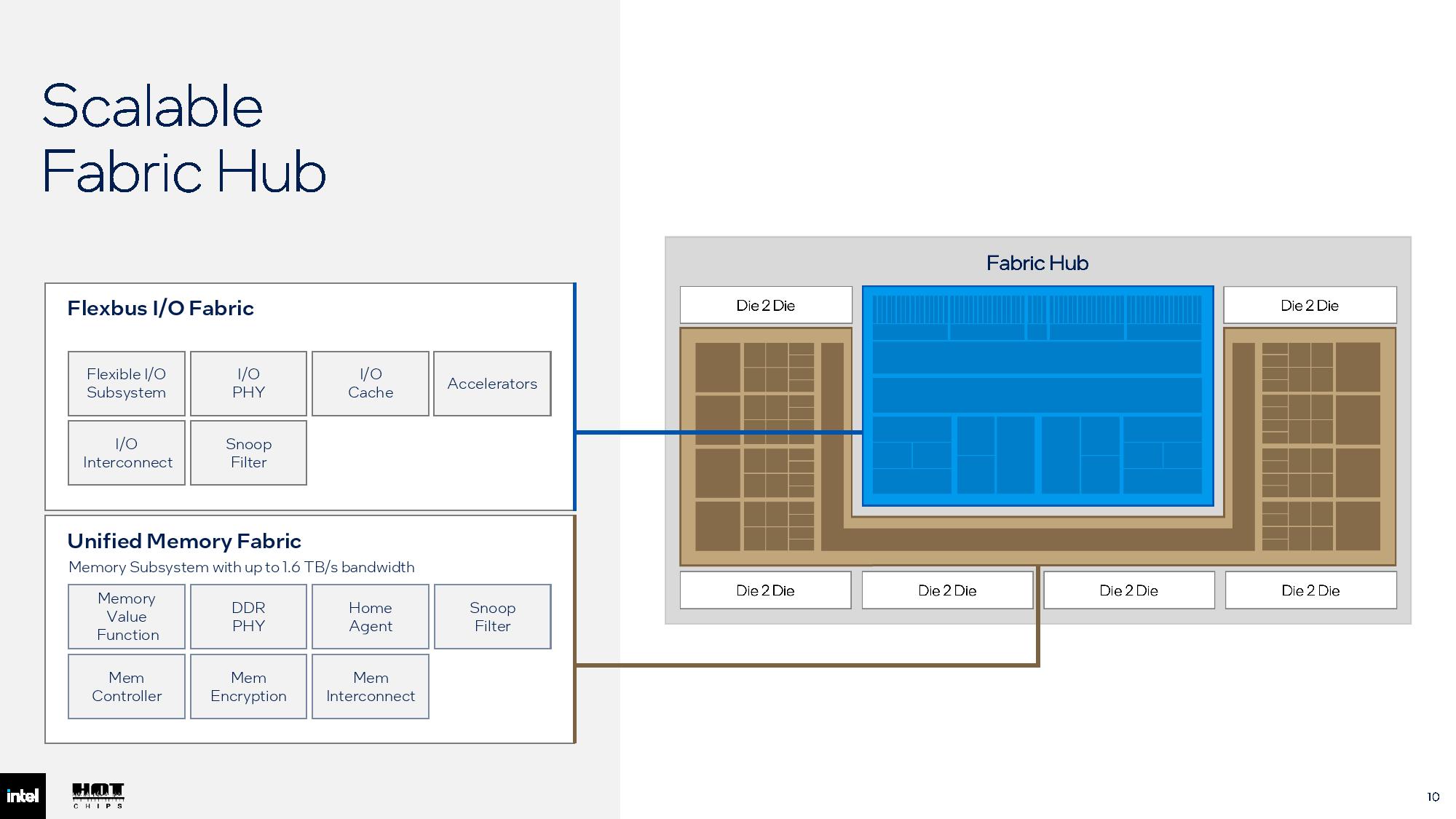
In Granite Rapids-AP, the high-performance and high-heat compute cores resided primarily in the center of the package, occasionally creating localized thermal hotspots. Diamond Rapids pushes the compute tiles out to the perimeter edges of the package, while concentrating the memory controllers, accelerators, and I/O hardware squarely in the center across two dedicated fabric hub tiles.
This inverted approach yields two immediate engineering advantages:
- Thermal Optimization: By distributing the hottest, highest-clocked compute elements along the outer edges, heat dissipation is far more uniform, and the risk of acute central thermal throttling is vastly minimized.
- Symmetric Routing: Every Compute Building Block is linked to both central fabric hubs, ensuring predictable, low-latency communication paths across the entire multi-chiplet assembly.
Supporting Context & Metrics: Memory, Interconnects, and Instruction Sets
Diamond Rapids is engineered not just for raw core counts, but to eliminate memory bottlenecks and modernize the underlying x86 software ecosystem.
Memory Subsystem and High-Speed Bandwidth
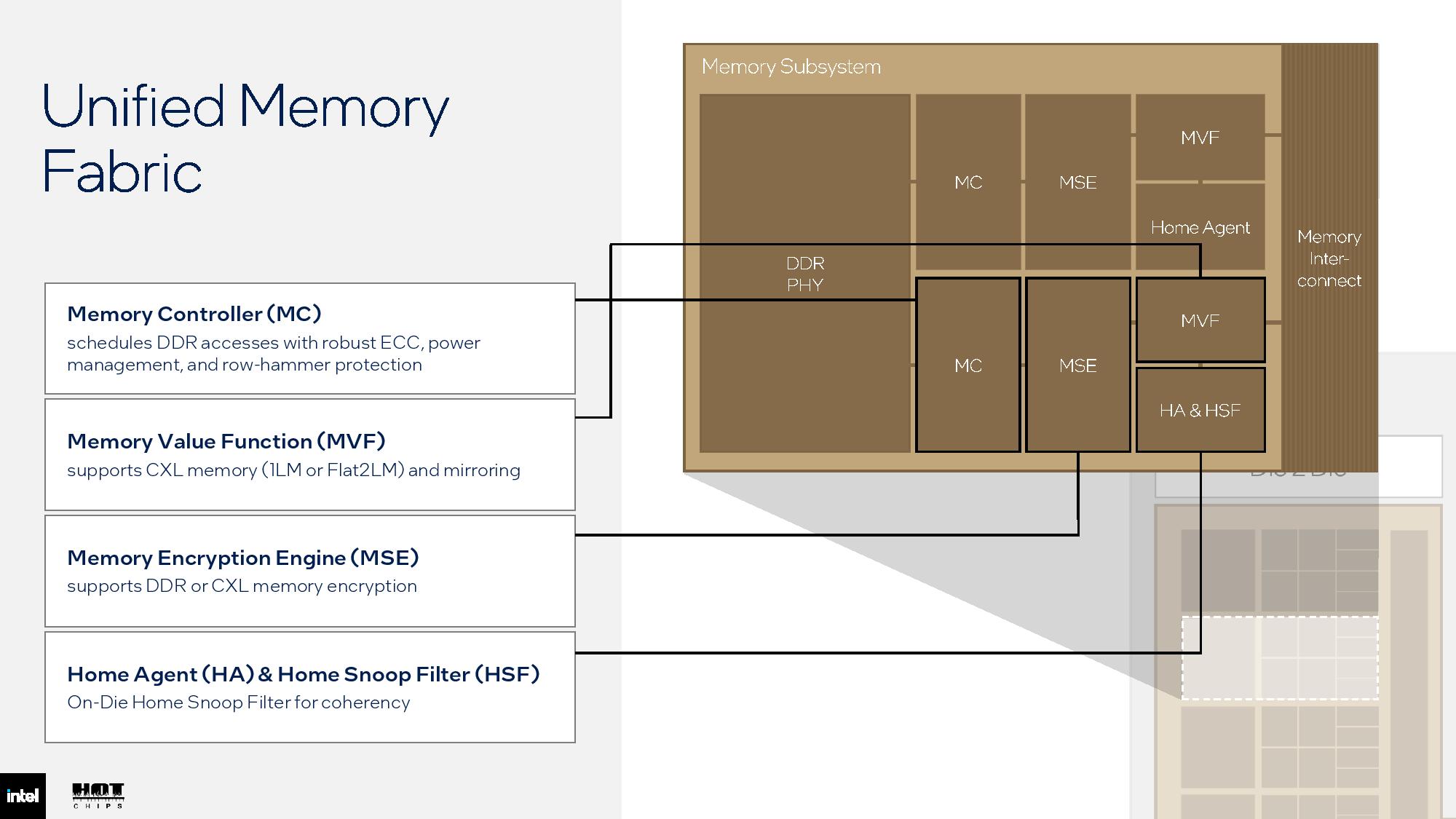
Enterprise workloads demand extreme memory bandwidth to feed hundreds of hungry cores. Diamond Rapids addresses this by scaling up to a 16-channel memory subsystem (surpassing the 12-channel ceiling seen on Granite Rapids).
- Supported Standards: The platform natively supports high-speed DDR5 operating up to 8,000 MT/s and blistering MRDIMMs scaling up to 12,800 MT/s.
- On-Die Snoop Filter: Integrated directly into the memory fabric, Intel has embedded an on-die snoop filter. By moving this cache-coherency directory away from the memory itself and directly onto the CPU, background directory storage and coherency management tasks are offloaded from system RAM, streamlining overall transaction efficiency.
Interconnect Strategy: UCIe-S over EMIB
An unexpected design choice in Diamond Rapids is the omission of Intel’s proprietary Embedded Multi-die Interconnect Bridge (EMIB) for linking the fabric hubs to the CBBs. Instead, Intel opted for standard UCIe-S (Universal Chiplet Interconnect Express – Standard) connections via copper in the substrate.
When queried about why they bypassed advanced packaging techniques like UCIe-A in favor of UCIe-S, Intel engineers explained that the decision came down to distance and latency uniformity. UCIe-A architectures can introduce multi-hop latency penalties across long distances on massive server packages, whereas UCIe-S delivers uniform, low-latency access across the entire chip surface.
I/O and Accelerator Integration
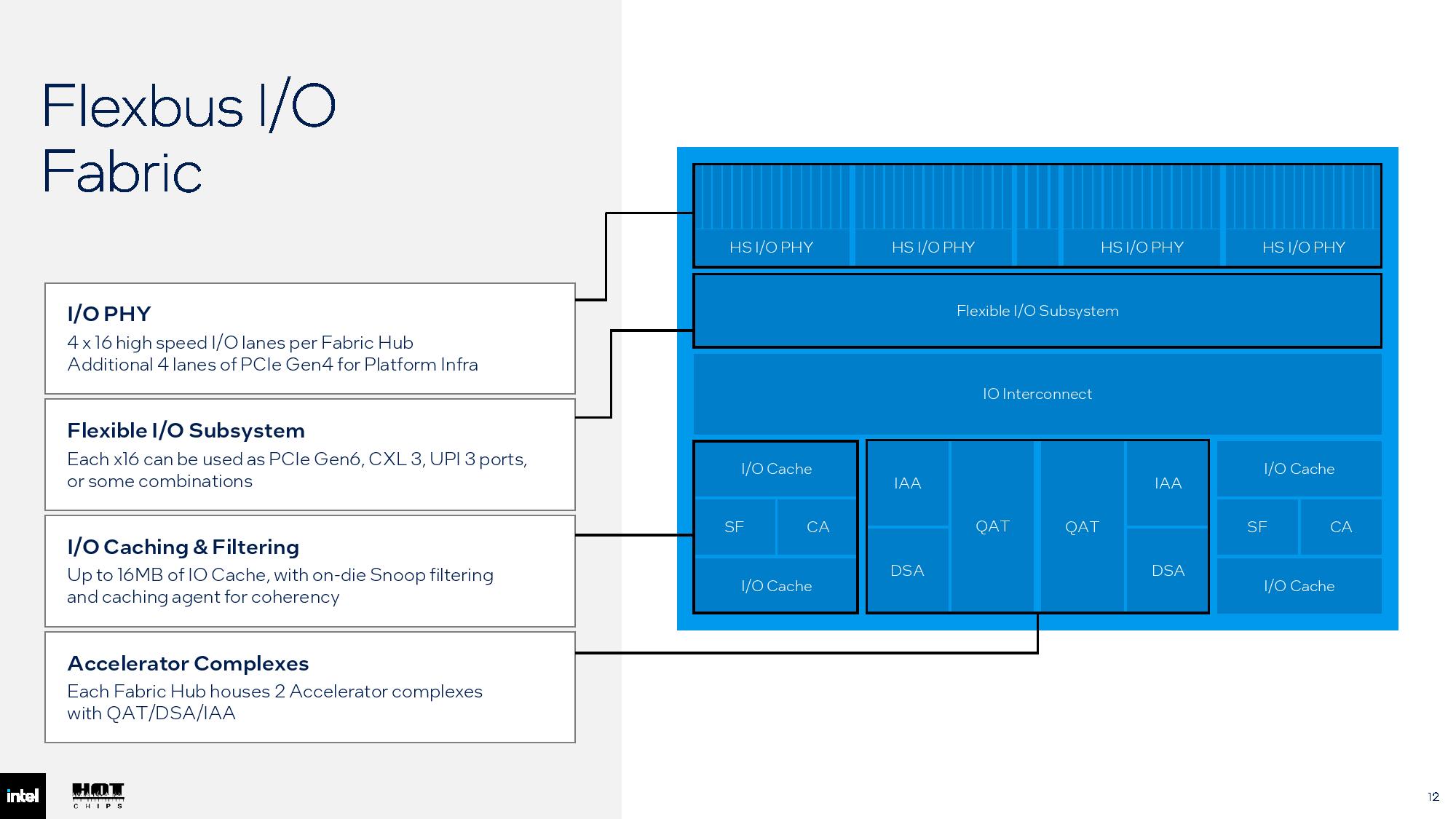
The flexible I/O subsystem on Diamond Rapids is built for massive data throughput, providing:
- Up to 128 lanes of PCIe 6.0, CXL 3.0, and UPI 3 connectivity.
- An additional eight PCIe 4.0 lanes (four per CPU) dedicated to baseline platform management.
- Dedicated on-chip hardware accelerator complexes, including Intel QuickAssist Technology (QAT) for cryptographic acceleration and In-Memory Analytics Accelerator (IAA) engines.
Modernizing x86: AVX 10.2 and APX
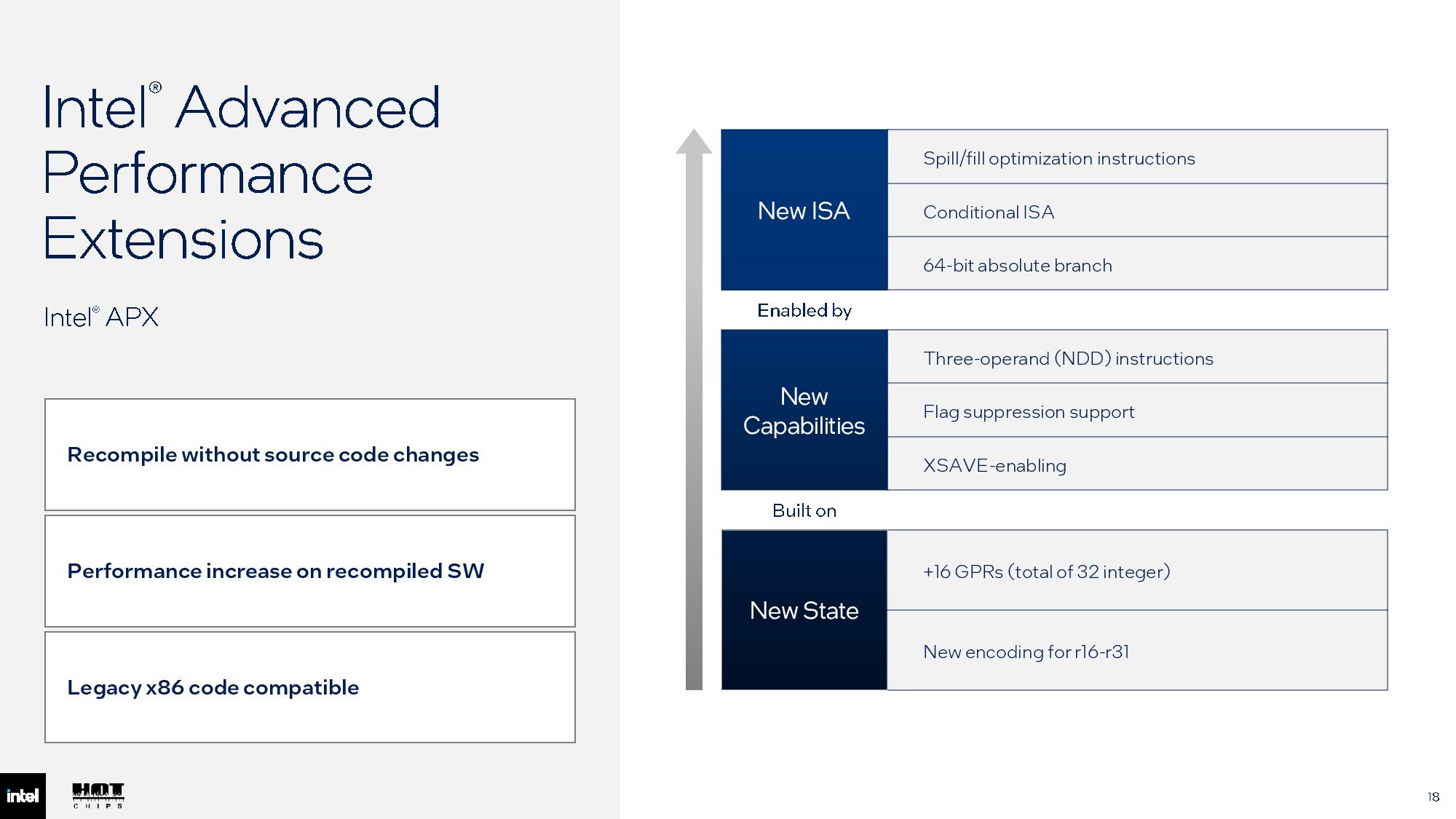
Diamond Rapids marks a pivotal milestone for instruction set architecture (ISA) evolution by introducing native support for AVX 10.2 and Intel Advanced Performance Extensions (APX).
- AVX 10.2: Unlike AVX 10.1—which served as a transitional step restricted primarily to P-cores—AVX 10.2 establishes converged 256-bit vector operations capable of executing seamlessly across both P-cores and E-cores, while fully preserving legacy 512-bit vector execution paths.
- Intel APX: APX doubles the general-purpose register count from 16 to 32. According to Intel benchmarks, this modernization requires 10% fewer load operations and 20% fewer store operations in memory, while introducing advanced conditional load and store instructions. Crucially, software can extract performance gains from APX simply by being recompiled, requiring zero source code modifications and ensuring absolute backward compatibility.
Official Statements & Industry Positioning
While Intel’s presentation at Hot Chips 2026 was heavy on silicon schematics and architectural philosophy, company executives emphasized that Diamond Rapids is positioned as a direct answer to the hyper-scale explosion of agentic AI workflows and dense cloud virtualization.
The deployment of the 18A-P process node—which Intel confirmed entered risk production earlier this year—is central to the company’s foundry narrative. Intel claims the 18A-P process yields a 9% performance improvement at peak power, or delivers 18% lower power consumption under iso-performance conditions compared to the baseline 18A node.
Industry analysts note that while Intel experienced notable execution delays and competitive friction during the Granite Rapids era, Diamond Rapids adopts many successful structural principles pioneered by competitors—such as AMD’s EPYC memory and I/O centralization—while injecting proprietary Intel innovations like Foveros Direct 3D packaging and advanced x86 extensions (APX).
Future Outlook
Looking past the horizon of Diamond Rapids, Intel’s server roadmap is already branching out. While the company continues to refine its efficiency-focused and core-dense strategies (such as Clearwater Forest), roadmap indicators confirm that generations following Diamond Rapids will reintroduce simultaneous multithreading (SMT) to Intel’s mainstream Xeon offerings.
For 2027, however, Diamond Rapids stands as Intel’s flagship bid for data center supremacy. By uniting 256 high-performance Panther Cove-derived cores, 1.28 GB of cache, an ultra-fast 16-channel DDR5/MRDIMM memory subsystem, and a modernized x86 instruction set built on the 18A-P node, Intel is laying down an aggressive marker. Whether this complex, multi-tile architectural gamble can successfully recapture dominant market share from entrenched enterprise competitors will depend heavily on execution as production ramps toward the 2027 launch window.
