

By You Xiaoying
Special Dispatch from Shanghai, China
Executive Overview
On the outskirts of Shanghai, amidst a bustling public holiday, a new kind of amusement park attraction is capturing the public imagination. At the Intelligent Manufacturing & Robotics Global Co-Innovation Center, thousands of curious families, tech enthusiasts, and children have gathered not for roller coasters or traditional games, but for a glimpse into the future of consumer robotics. Here, miniature robotic dogs perform awkward handstands, bipedal humanoids execute precision martial arts sequences, and children cheer wildly as remote-controlled mechanical combatants duke it out in a water-bead arena.
This vibrant weekend carnival is far more than a localized novelty; it is a vivid micro-cosm of a massive, state-backed industrial push. Across China, humanoid and specialized robots are rapidly transitioning from sterile laboratory environments and industrial assembly lines into the public sphere. Driven by a national strategy termed “embodied AI”—the integration of artificial intelligence into physical, moving systems—China is aggressively working to normalize robotics in everyday life.
While Western markets and robotics firms continue to grapple with high production costs, balance physics, safety concerns, and deep-seated skepticism regarding the practical utility of human-shaped machines, Chinese manufacturers are surging ahead. Accounting for nearly 90% of the more than 13,000 two-armed, two-legged robots delivered globally last year, China’s industrial ecosystem is unmatched. By pairing aggressive manufacturing scaling with immersive public relations campaigns—such as this Shanghai carnival, bipedal marathons in Beijing, and autonomous performers in shopping malls—the nation is methodically priming its populace for an automated tomorrow.
Detailed Chronology: A Day Inside the Shanghai Robotics Showcase
Morning: The Arrival and the Retail Frenzy
The atmosphere outside the sprawling R&D hub in suburban Shanghai is reminiscent of a theme park on opening day. Families spill out of sedans and public transit, drawn by word-of-mouth excitement and holiday promotions. Inside the gates, the commercial appetite for consumer robotics is immediately apparent.
Near the entrance, an 11-year-old boy shouts in triumph: "Look, it is trying to do a handstand!" He is clutching a newly purchased mini robotic dog—a holiday gift bought moments prior at one of the center’s pop-up retail booths. He repeatedly commands the mechanical quadruped to flip, eager to show off his acquisition to passing families. This scene is replicated across the venue, where retail kiosks do brisk business selling everything from programmable toy bots to modular robotic kits.
Midday: Interactive Demonstrations and Mechanical Combat
As the morning sun climbs, the focus shifts from retail acquisition to technical demonstration. The innovation hub itself is a massive industrial powerhouse housing over 100 specialized firms dedicated to researching, developing, manufacturing, and marketing robotic hardware. While many of these companies design utilitarian machines meant for heavy industrial lifting, sewage pipe inspection, or hazardous waste handling, today’s programming is decidedly audience-centric.
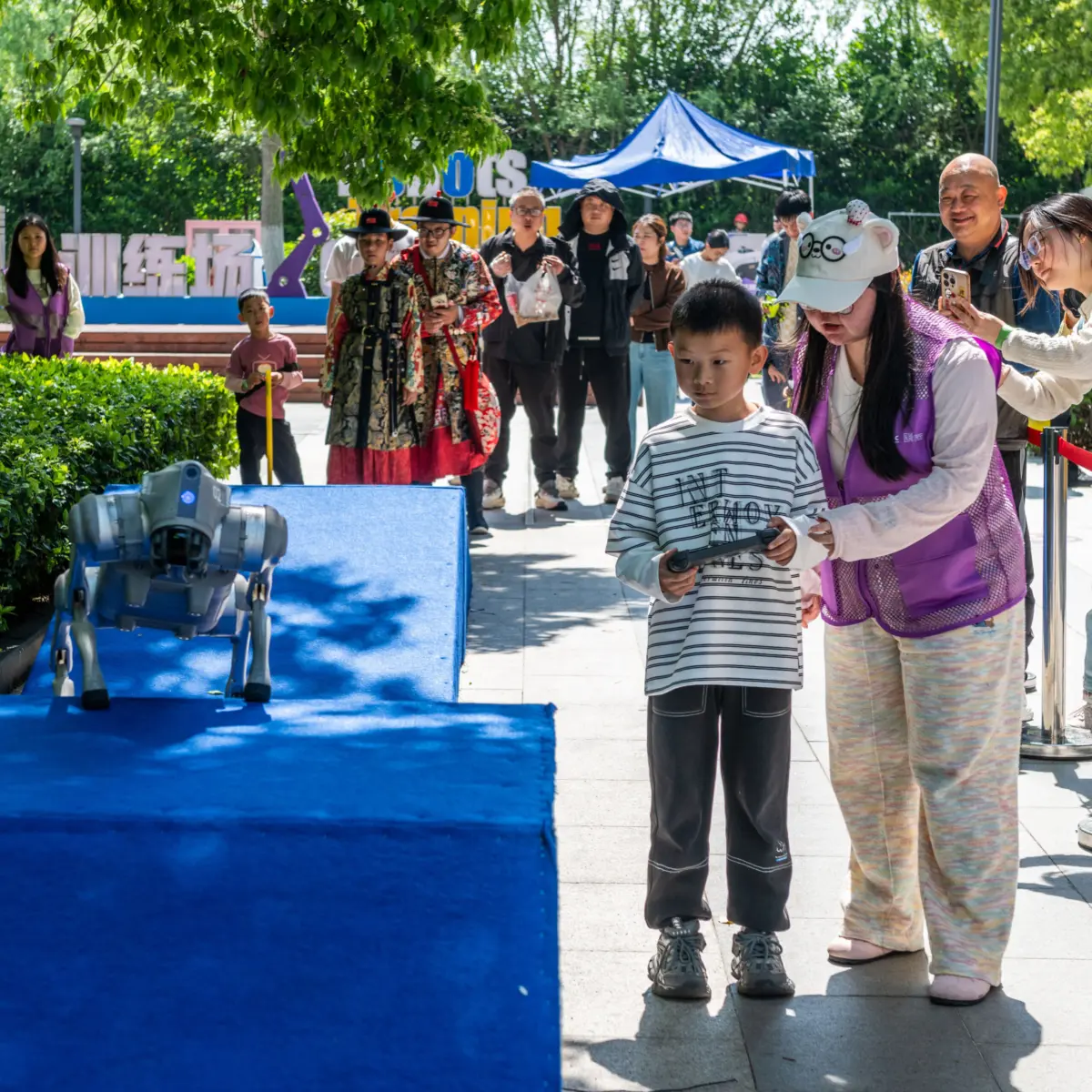
A few meters away from the bustling retail queues, two youthful technical staffers crouch beside a flight of concrete stairs, patiently teaching children how to program a quadrupedal robot to ascend step-by-step. The kids tap commands into ruggedized tablets, watching with rapt attention as the four-legged machine adjusts its gait to conquer the vertical incline.

Farther down the concourse, the mood shifts from educational to competitive. A dense crowd surrounds a temporary ring where a tense battle is underway. Two remote-controlled combat robots are aggressively maneuvering, firing volleys of water beads at one another as boys and girls chant encouragement from the sidelines. After a frantic three-minute skirmish, a supervising staffer steps in to declare the duel a diplomatic draw, prompting good-natured groans from the young spectators.
Afternoon: Humanoid Utility and the Quest for Domestic Freedom
While the quadrupedal dogs and combat bots provide high-energy thrills, the true heavyweights of the exhibition are the humanoid systems. Prominent robotics firms have set up interactive stations designed to demonstrate how bipedal and dual-armed machines will soon integrate into human society.
At the booth for DexForce, a prominent player in the perception-and-action space, product manager Yang Duan watches over a humanoid robot expertly brewing pour-over coffee. "These machines can free people from physical work and mundane chores," Duan explains, highlighting the fundamental pitch of the embodied AI movement.
A few booths down, the limitations—and ambitions—of current robotic dexterity are on full display. A pair of high-precision robotic arms struggles methodically with a basket of mixed laundry, attempting to fold a stubborn T-shirt. While the movements are occasionally hesitant, the underlying machine-learning models are continuously adapting to fabric deformities in real time.
Late Afternoon: Cultural Performances and the Grand Finale
The climax of the day takes place inside the festival’s cavernous main tent. The space is packed to capacity, buzzing with anticipation.
When the house lights dim, the crowd erupts. On stage, a humanoid robot adorned with traditional theatrical garb executes a complex martial arts sequence known as "drunken boxing," swaying and pivoting with uncanny balance. Just as the applause dies down, a second humanoid launches into a flawless front flip, drawing gasps from the audience. Along the edges of the stage, a coordinated squad of small robotic lions—nodding their mechanical heads and blinking LED eyes—wait patiently for their turn in the spotlight.
The audience is completely captivated. A collective chant rises from the bleachers, echoing off the canvas roof: "More, more, more!"
Supporting Context & Metrics: The Anatomy of China’s Robotics Boom
To understand why a robot carnival in Shanghai can draw such massive crowds and enthusiastic engagement, one must examine the broader macroeconomic and structural shifts occurring across China’s technology sector.

The Power of "Embodied AI"
For decades, artificial intelligence existed primarily as software—algorithms running on remote servers, processing text, imagery, and code. "Embodied AI" represents the critical bridge from the digital to the physical world. By embedding advanced neural networks, computer vision, and spatial awareness into physical hardware, machines are no longer just processing data; they are interacting directly with the physical environment.
This concept was formally cemented as a pillar of national economic policy in China’s latest five-year plan, released by the National Development and Reform Commission (NDRC). The policy mandates aggressive state support, tax incentives, and infrastructural backing for domestic robotics firms, transforming what was once a niche academic field into a critical national priority.
Global Market Dominance
The fruits of this state-corporate alignment are already starkly visible in global supply chains and shipping data. According to industry analyses, nearly 90% of the more than 13,000 two-armed, two-legged humanoid robots delivered globally last year were manufactured in China.
While Western robotics pioneers like Boston Dynamics or Tesla (with its Optimus project) command significant media attention, Chinese manufacturers are out-scaling them by leveraging mature consumer electronics supply chains, lower component costs, and rapid prototyping ecosystems centered around hubs like Shenzhen and Shanghai.
| Metric / Indicator | Data Point | Context |
|---|---|---|
| Global Humanoid Shipments | ~13,000+ units (prior year) | Total global deliveries of two-armed, two-legged robots. |
| Chinese Market Share | ~90% | Proportion of global humanoid shipments manufactured in China. |
| Ecosystem Concentration | 100+ firms | Companies housed within the single Shanghai innovation center visited. |
| Public Deployment Venues | Multiple major cities | Includes shopping malls, tourist attractions, and municipal marathons (e.g., Beijing bipedal half-marathons). |
Overcoming Global Skepticism
Despite the bullish momentum in China, the global robotics community remains divided on the viability and form factor of humanoid machines. Critics and skeptical roboticists in the West frequently point to several stubborn engineering hurdles:
- The Balance and Weight Problem: Keeping a bipedal robot upright requires massive computational power, heavy actuators, and sophisticated gyroscopic stabilization, making them inherently dangerous should they suffer a power failure or software glitch near humans.
- Prohibitive Costs: Premium humanoids remain astronomically expensive to manufacture, limiting their market penetration to elite research institutions and heavily capitalized industrial facilities.
- Power Consumption: Short battery lives severely restrict the operational windows of bipedal machines, often requiring tethered power supplies or frequent recharging breaks.
- Form Factor Debate: Many engineers argue that humanoids are an inefficient shape for utilitarian tasks, contending that wheeled bases, quadrupedal frames, or task-specific manipulators are far more practical than imitating human anatomy.
Chinese firms, however, are tackling these criticisms through a deliberate strategy of mass public exposure and iterative field testing. By deploying humanoids into high-traffic retail environments, tourist attractions, and even athletic events—such as bipedal robots running half-marathons in Beijing—companies are gathering invaluable real-world data while simultaneously defusing public apprehension.
Official Statements and Industry Perspectives
The philosophy driving China’s public-facing robotics push is rooted in the belief that societal acceptance is just as important as technical capability.
Yang Duan, Product Manager at DexForce:

"Humanoid robots are no longer just science fiction or abstract engineering experiments. By bringing them out of the lab and into spaces like this carnival, we allow people to touch them, interact with them, and understand their potential. These machines are designed to free people from physical work and mundane chores, but to achieve that integration, the public has to trust them."
Anonymous Industry Analyst (Shanghai Robotics Symposium):
"The Western approach tends to treat humanoids as hyper-exclusive technological marvels that must be perfect before the public ever sees them. The Chinese approach is iterative and populist. By normalizing their presence in shopping malls, marathons, and carnivals, companies are building a cultural acceptance and consumer demand loop that western firms simply do not have."
Future Outlook: What Lies Ahead for Embodied AI?
As the sun sets over the Intelligent Manufacturing & Robotics Global Co-Innovation Center, packing crates are assembled, and exhausted staff members power down the martial arts humanoids and coffee-brewing robotic arms. Yet, the energy generated throughout the day lingers.
The trajectory for China’s robotics industry over the next five years points toward deeper commercialization and wider societal integration. Several key trends are expected to define the immediate future:
- Consumerization of Robotics: Following the runaway success of robotic vacuum cleaners and automated lawnmowers, the next wave will likely see semi-autonomous domestic assistants enter middle-class households, starting with specialized quadrupeds and graduating to simplified dual-armed tabletop units.
- Standardization and Cost Reduction: As domestic supply chains scale production, component costs for actuators, sensors, and lightweight carbon-fiber frames are projected to plummet, bringing consumer-grade humanoids closer to price parity with high-end appliances.
- Regulatory and Safety Frameworks: As bipedal robots increasingly share physical spaces with pedestrians in shopping malls and public squares, municipal governments will face mounting pressure to establish clear regulatory frameworks governing autonomous movement, liability, and data privacy.
- The Global Export Wave: Having successfully saturated domestic markets and refined their hardware through aggressive public testing campaigns, Chinese robotics firms are poised to aggressively target international markets, potentially upending Western legacy industrial automation landscapes.
For the children who spent their holiday cheering for drunken-boxing humanoids and chasing mini robotic dogs, the future is not an intimidating dystopia of automated displacement. It is a noisy, colorful carnival—and they cannot wait for the show to start again.
