
Executive Overview
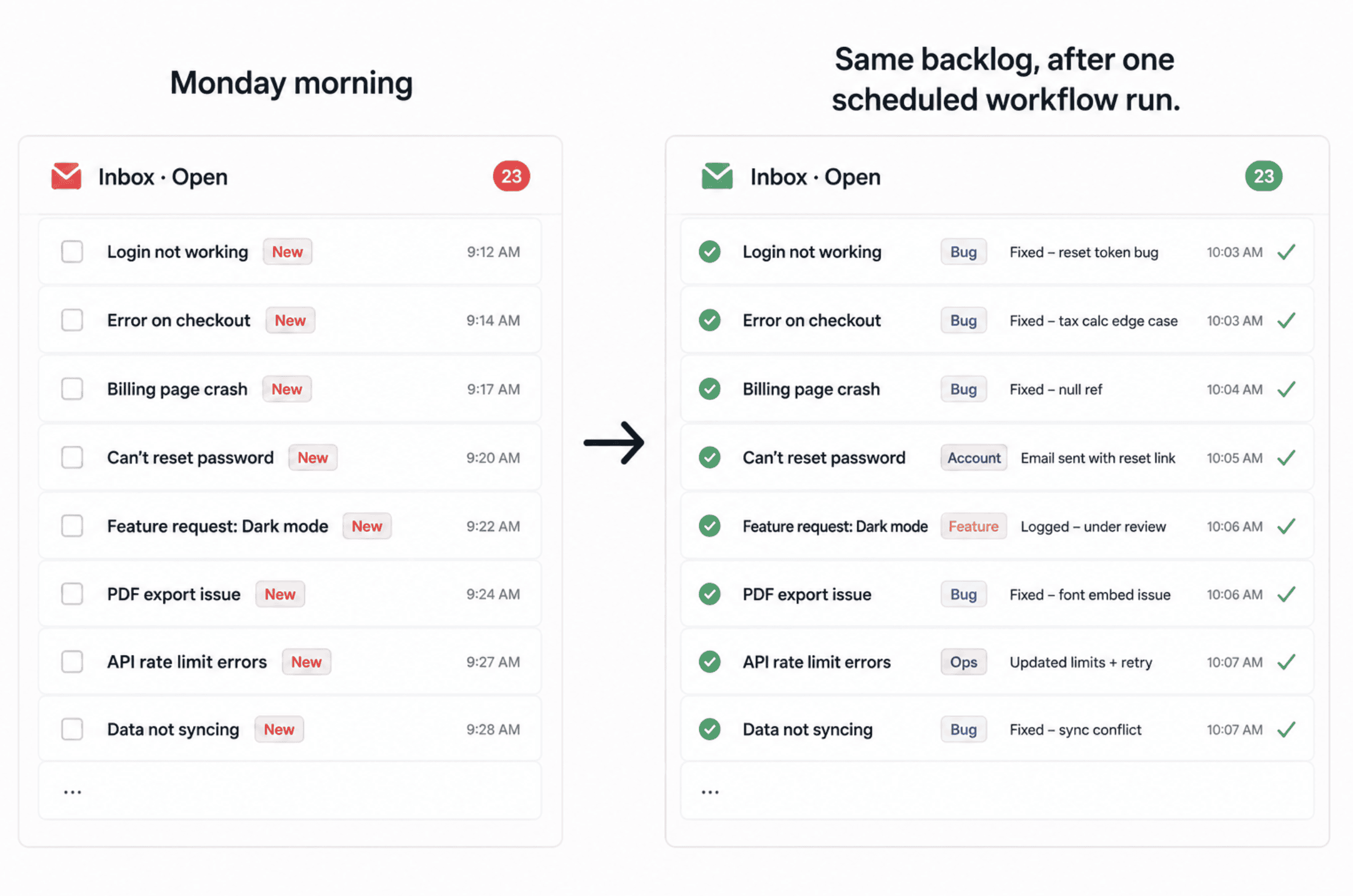
It is 9:00 AM on a Monday, and forty-three new issues are sitting unread in the repository backlog. Some are legitimate, high-severity bugs; others are duplicate feature requests; a handful are merely users venting about a misplaced typo. The engineer assigned to triage duty this week faces an arduous ritual: spending the first two hours of their morning reading, labeling, and responding to every notification before they can even touch the work they originally planned to build.
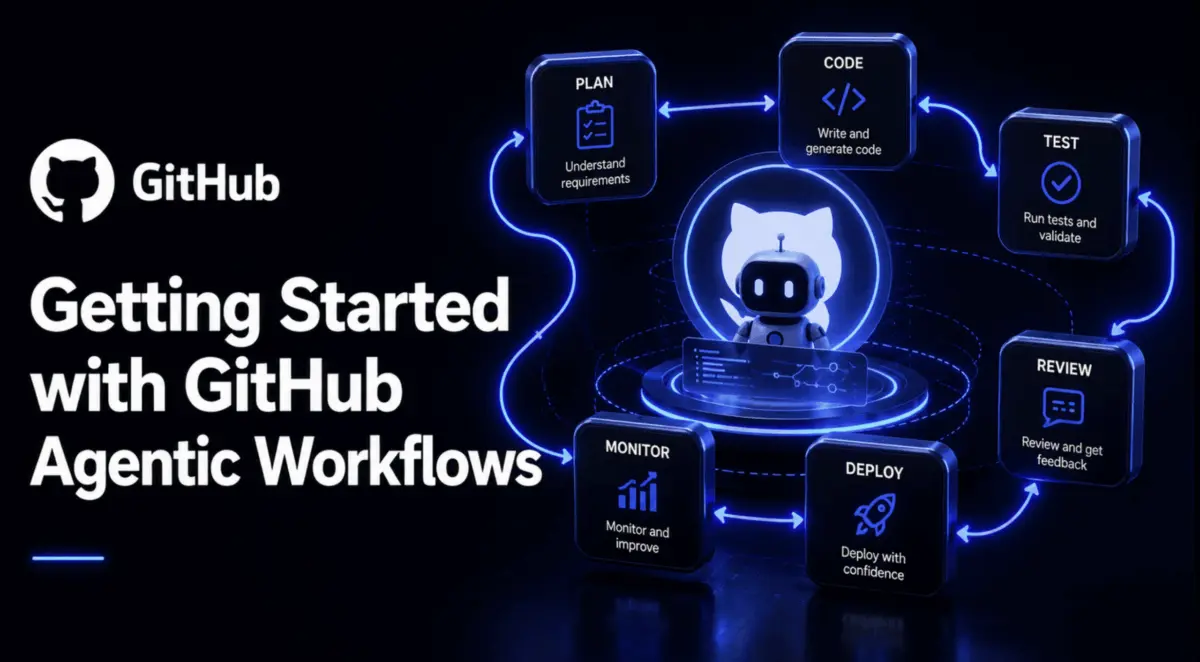
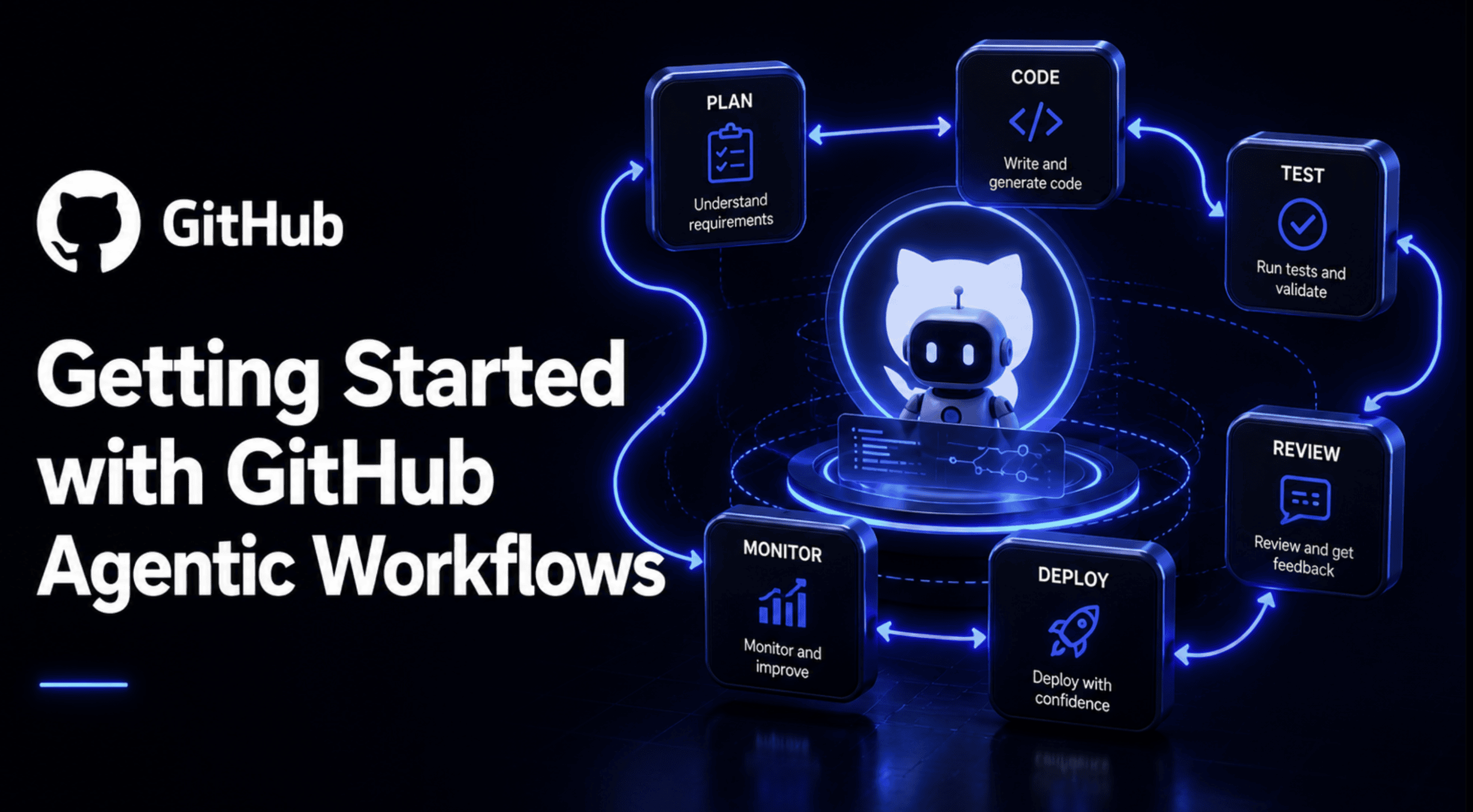
This is the exact operational friction that GitHub aims to eliminate with its latest architectural leap. On June 11, 2026, GitHub officially transitioned Agentic Workflows into public preview, empowering any repository to run autonomous coding agents directly inside GitHub Actions. Moving far beyond simplistic code completion or chat sidebars, this feature introduces scheduled or event-triggered agents capable of reading an entire pull request, analyzing a week’s worth of commits, or parsing a sprawling backlog—and executing structured, reasoning-heavy tasks based on those insights.
Developed in collaboration with GitHub Next and Microsoft Research, Agentic Workflows serves as the execution engine for a broader paradigm GitHub terms Continuous AI. Rather than prompting an LLM reactively when an engineer sits at a keyboard, Continuous AI bakes systemic intelligence directly into the software lifecycle. However, as organizations race to automate their DevOps pipelines, the true narrative is not merely the introduction of natural-language automation; it is the robust, five-layer security model designed to neutralize prompt injection and maintain strict trust boundaries in environments where untrusted code meets autonomous execution.
Detailed Chronology: From Concept to Public Preview
The journey toward native agentic workflows did not happen overnight; it represents the culmination of years of iterative development within GitHub’s experimental labs.
The Evolution of AI in CI/CD
To understand the significance of the June 2026 release, one must trace the progression of GitHub’s developer tooling. GitHub Copilot revolutionized how code is written at the line and function level, while subsequent cloud coding agents allowed developers to manually assign complex tasks to an isolated environment. Yet, these tools relied entirely on human initiation.
By late 2025 and early 2026, engineering teams began experimenting with primitive, custom-built scripts that tried to hook LLMs into GitHub Actions. These early prototypes were brittle, required cumbersome personal access tokens (PATs), and lacked standardized security guardrails, exposing repositories to severe prompt injection vulnerabilities via malicious issue descriptions or pull request comments.
The Technical Preview and the June 11, 2026 Release
Recognizing the demand for secure, native automation, GitHub launched a technical preview in February 2026. Early iterations required developers to manually generate fine-grained PATs with specific Copilot Request permissions and embed them as repository secrets.
Just four months later, on June 11, 2026, GitHub streamlined this architecture dramatically with the public preview release. Crucially, this update eliminated the need for personal access tokens entirely when utilizing enterprise-backed AI engines. Concurrently, GitHub introduced the gh-aw command-line interface (CLI) tool, transforming natural-language Markdown files into secure, executable GitHub Actions lock files (.lock.yml). This ensured that agentic workflows did not rely on a separate, unvetted runtime, but instead leveraged existing runner infrastructure, branch protections, and enterprise compliance policies.
Supporting Context, Architecture, & Core Metrics
Strip away the marketing terminology, and the mechanical foundation of Agentic Workflows is elegantly straightforward. An engineer writes a Markdown file residing in .github/workflows/. The file’s YAML frontmatter outlines the triggers, permissions, AI engine, and safe outputs, while the body contains plain-English instructions detailing the agent’s responsibilities.
---
description: Classify new issues, apply labels, and post a short response
on:
  issues:
    types: [opened]

permissions:
  contents: read
  issues: read

network: defaults

tools:
  github:
    toolsets: [issues]

safe-outputs:
  add-label:
    max: 3
  add-comment:
    max: 1
---

# Issue Triage Agent
When a new issue is opened, read its title, body, and code snippets...
The CLI tool, gh-aw, compiles this Markdown file into standard, executable YAML.
Core Platform Metrics & Capabilities
| Metric / Feature | Specification |
|---|---|
| Supported AI Engines | 4 built-in (GitHub Copilot, Anthropic Claude, OpenAI Codex, Google Gemini) + custom engine support |
| Security Layers | 5 distinct layers (read-only token, zero secrets policy, network firewall, safe outputs contract, threat detection) |
| Documented Design Patterns | 18+ established archetypes (IssueOps, ChatOps, DailyOps, BatchOps, etc.) |
| Supported Event Triggers | 10+ standard GitHub events (issues, pull_request, push, schedule, discussion, label) |
| Safe Output Types | 8+ restricted write actions (create-issue, create-pull-request, add-comment, add-label, etc.) |
| CLI Installation | One-line command: gh extension install github/gh-aw |
The Five-Layer Security Model
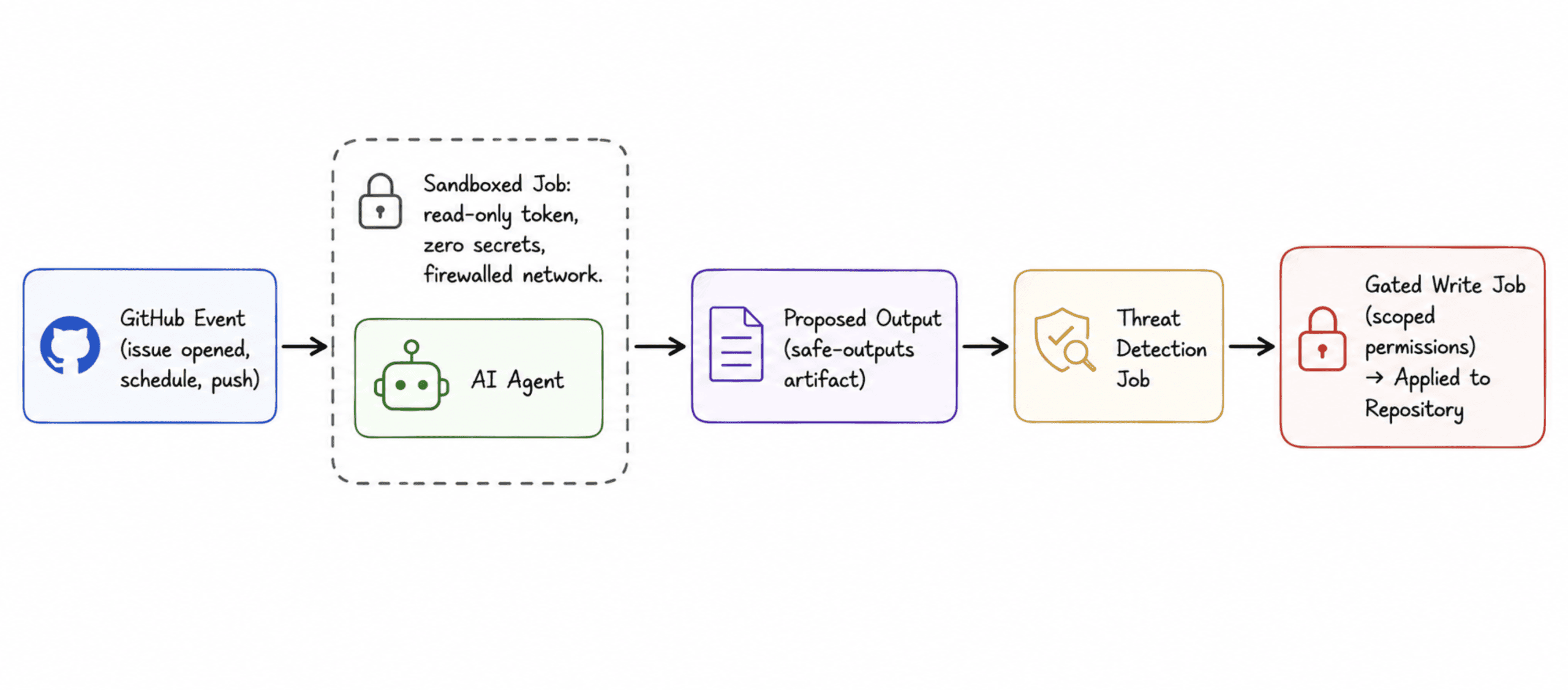
The most critical aspect of Agentic Workflows is its defense-in-depth security posture. Because LLMs are inherently susceptible to prompt injection via untrusted repository content (such as a malicious payload hidden in a public issue comment), GitHub engineered a five-tier security framework:
- Read-Only Tokens: Default execution scopes restrict agents from modifying repository contents unless explicitly authorized.
- Zero Secrets by Default: Workflows do not automatically inherit sensitive environment variables or third-party API keys.
- Network Firewall: Outbound container traffic is restricted to a tight default allowlist, preventing unauthorized exfiltration of data.
- Safe Outputs Contract: Agents cannot arbitrarily write code or modify files; they must request actions through tightly controlled, rate-limited channels (e.g., a maximum of one comment and three labels per run).
- Threat Detection: Runtime monitoring catches anomalous behavior mid-execution.
Official Statements and Enterprise Adoption
Enterprise validation for Agentic Workflows has been swift, driven by engineering organizations eager to reclaim sprint hours lost to repetitive maintenance tasks.
According to the official GitHub changelog, Carvana reported that the platform’s flexibility and built-in controls provided their engineering organization with the confidence to deploy agentic workflows across highly complex, multi-repository architectures.
Similarly, Marks & Spencer highlighted a major cultural and productivity shift. Their developers were routinely losing valuable development hours to mundane chores—such as dependency maintenance, vulnerability remediation, and initial issue triage. By adopting a shared, centralized catalog of reusable agentic workflows, different engineering teams across the enterprise could leverage standardized automation without reinventing the wheel for every new service.
Furthermore, industry feedback collected by platforms like Hud.io crystallized the ultimate engineering thesis behind the feature: getting an AI agent to generate a pull request was never the true technical bottleneck. The real challenge has always been establishing enough institutional trust in the output to safely merge it into production. GitHub’s strict isolation and safe-output boundaries directly address this trust deficit.
Future Outlook: The Next Era of Software Development
As GitHub Agentic Workflows continues its public preview phase, the developer tooling landscape is undergoing a profound structural shift. We are moving away from an era where automation is strictly deterministic—where every action requires rigid, hand-written conditional scripts—toward a future where qualitative judgment can be safely embedded into software pipelines.
Remaining Challenges
Despite its rapid ascent, the platform still exhibits growing pains. Debugging opaque LLM classifications remains heavily reliant on traditional GitHub Actions logs rather than granular, step-by-step reasoning traces. Additionally, enterprise financial governance lacks real-time, per-workflow token cost attribution, making it difficult for engineering directors to forecast token consumption across hundreds of active repositories. Finally, the two-file compilation requirement (.md source paired with .lock.yml) points toward an interim architecture that will likely be absorbed natively into the core GitHub platform in future updates.
Conclusion: The Convergence of Rules and Judgment
The true legacy of GitHub Agentic Workflows will not be that "AI writes YAML configuration files," but rather that development teams can finally encode nuanced human judgment into their continuous integration pipelines. A traditional Action can enforce strict rules, but an agentic workflow can evaluate context, weigh competing priorities, and execute complex, multi-step administrative burdens autonomously.
For teams stepping into this ecosystem for the first time, starting with automated issue triage provides an ideal sandbox. It demonstrates immediate value, operates within tight safety boundaries, and builds organizational confidence. As these workflows mature from public preview into enterprise-grade standards, they promise to redefine the very definition of developer productivity—allowing engineers to focus less on managing backlogs and more on building extraordinary software.
