

Executive Overview
For decades, the Python ecosystem has suffered from an open secret: its packaging and dependency management landscape is notoriously fractured. Developers embarking on a new project have long faced a paradox of choice, navigating an intricate labyrinth of disjointed tools just to get a basic script running. Installing packages required pip, while isolating dependencies demanded venv or virtualenv. Reproducible environments for production meant wrestling with pip-tools or Poetry, and managing multiple runtime versions called for pyenv.
The cognitive overhead of stitching these tools together has historically drained productivity. Developers frequently found themselves installing packages globally by accident due to forgotten virtual environment activations, or waiting minutes for complex machine learning dependency graphs to resolve.
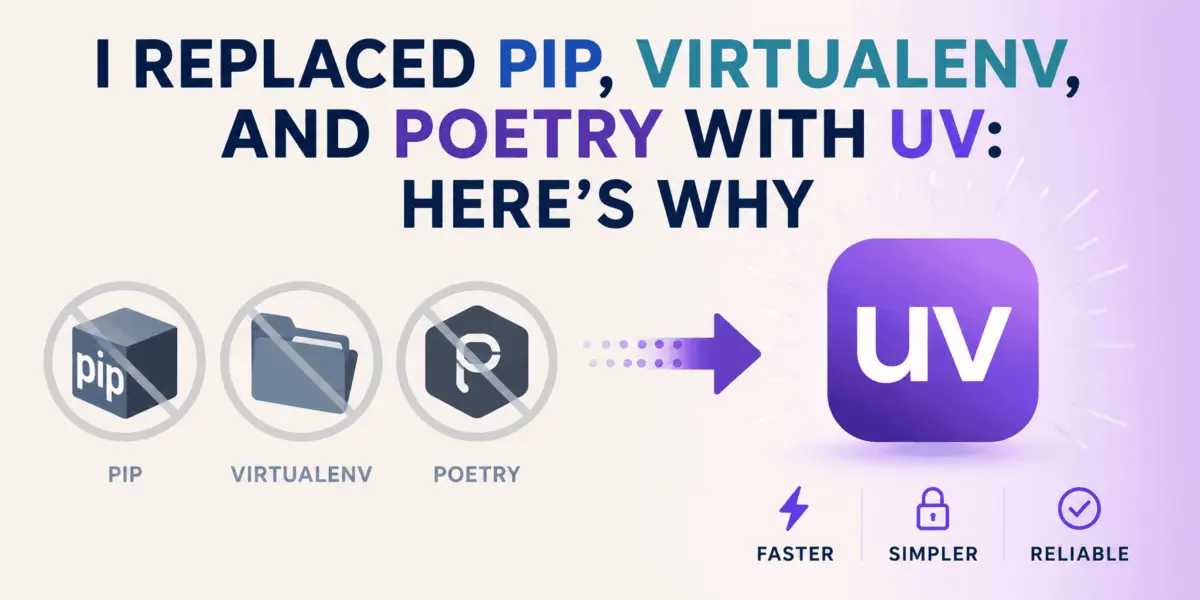
Enter uv, an ultra-fast Python package and project manager developed by Astral—the same high-performance engineering team behind Ruff. Written in memory-safe, systems-level Rust, uv has emerged as a disruptive force by collapsing this sprawling toolchain into a single, cohesive, drop-in utility. Promising speeds up to 10 to 100 times faster than traditional pip, uv is not merely an incremental speed upgrade; it represents a philosophical shift toward a unified, deterministic, and frictionless developer experience.
This report examines the structural inefficiencies of legacy Python workflows, evaluates uv’s architectural advantages, and analyzes its strategic impact on software engineering, data science, and AI development pipelines.
Detailed Chronology: The Evolution of Python Packaging and the Rise of Astral
To understand the disruptive significance of uv, one must trace the historical evolution of Python’s packaging ecosystem.
- The Early Era (2008–2014): Python’s default package installer,
pip, revolutionized how developers consumed third-party libraries from the Python Package Index (PyPI). However,pipwas designed for global installation, leading to "dependency hell" where two projects required conflicting versions of the same library. - The Isolation Era (2014–2018): To solve global pollution, the community rallied around
virtualenvand eventually standardized around the built-invenvmodule. While environments became isolated, workflows grew tedious. Developers had to manually create directories, activate shells via operating-system-specific scripts (bin/activatevs.ScriptsActivate.ps1), and manually track dependencies inrequirements.txtusingpip freeze. - The Modern Project Management Era (2018–2023): As applications scaled, tools like Poetry, Flit, and Hatch emerged to handle packaging, publishing, and dependency lock files (
poetry.lock) in a declarative format (pyproject.toml). While powerful, these tools often introduced heavy abstractions and slow resolution times. Meanwhile, enterprise and data science pipelines leaned heavily on Conda for binary package management. - The Rust Revolution (2023–Present): Recognizing that Python packaging bottlenecks stemmed from interpreted languages handling massive I/O and graph resolution tasks, Astral set out to rebuild foundational tooling in Rust. Following the explosive success of the
Rufflinter, Astral launcheduvto unify package installation, virtual environment creation, Python version management, and script execution under a single lightning-fast binary.
Supporting Context & Metrics: Deconstructing the Bottlenecks
The friction of traditional Python toolchains manifests in both developer frustration and quantifiable computational overhead.
The Cost of Fragmentation
In a conventional data science or machine learning workflow, initializing a project with heavy dependencies—such as transformers, torch, scikit-learn, and streamlit—involves a multi-step ritual:
- Initialize a virtual environment (
python -m venv .venv). - Activate the environment (
source .venv/bin/activate). - Install packages via
pip install(watchingpipsequentially parse metadata, download wheels, and resolve dependency trees). - Freeze dependencies (
pip freeze > requirements.txt). - Repeat or alter steps when switching to enterprise managers like Poetry or Conda.
This fragmentation introduces human error. Forgetting to activate a virtual environment results in accidental global installations, polluting the system interpreter and breaking reproducible builds. Furthermore, standard dependency resolution algorithms in pip can stall significantly when confronted with complex, deeply nested constraints common in modern AI stacks.
The uv Advantage
By leveraging Rust’s concurrency primitives, aggressive caching strategies, and global hard-linking mechanisms, uv fundamentally alters these performance metrics:

- Speed: Benchmarks published by Astral indicate that
uvinstalls packages up to 10–100x faster thanpip, drastically accelerating CI/CD pipelines and local environment bootstrapping. - Storage Efficiency: Instead of duplicating wheel files across multiple project environments,
uvutilizes a global cache with copy-on-write or hard-linking capabilities, saving gigabytes of local disk space. - Unified Interface:
uvsupports a complete drop-in replacement API for standard commands (uv pip install), alongside a high-level project management layer (uv init,uv add,uv run,uv sync) modeled after modern package managers in other ecosystems (such as Cargo for Rust or Bun/Node for JavaScript).
Official Statements and Architectural Philosophy
Astral’s core design philosophy for uv centers on eliminating unnecessary context switching without forcing an all-or-nothing migration path. According to the project’s documentation and developer communications:
"Why use three or four different tools when a single, heavily optimized utility can handle environment isolation, dependency resolution, lock file generation, and tool execution?"
Rather than demanding that engineering teams rewrite legacy repositories overnight, uv was architected for incremental adoption. Developers can utilize uv strictly as a drop-in acceleration layer for existing requirements.txt workflows using uv pip install, before gradually transitioning to native pyproject.toml project management via uv init and uv add.
Furthermore, uv introduces the uvx execution model—functioning similarly to npx in the Node.js ecosystem. Developers can run command-line interface (CLI) tools wrapped in isolated, ephemeral environments without polluting their global system state or manually provisioning dedicated virtual environments. For example, executing a linting or formatting utility transiently becomes a single, self-contained command.
Future Outlook: Where Does Python Packaging Go From Here?
As uv gains widespread adoption across enterprise engineering teams, open-source maintainers, and individual developers, its trajectory signals a broader consolidation within the Python toolchain.
The Developer Experience Paradigm
The era of assembling a bespoke Python toolchain from disparate third-party packages is drawing to a close. Developers increasingly expect out-of-the-box speed, deterministic lock files, and zero-friction environment management. By bridging the gap between low-level script execution and high-level project orchestration, uv sets a new baseline for developer expectations.
Ecosystem Nuances and Caveats
Despite its impressive velocity, the transition away from legacy tools is non-linear across different domains:
- Data Science & HPC: While
uvhandles pure Python and compiled wheel dependencies brilliantly, Conda retains a stronghold in high-performance computing (HPC) and data science environments requiring non-Python binary dependencies (such as CUDA toolkits, Fortran libraries, or complex C++ bindings). - AI Tooling & LLM Agents: For "vibe coders" and automated AI coding assistants trained heavily on historical web data, traditional
pip,venv, andrequirements.txtinstructions remain dominant. Prompt engineering frameworks must gradually adapt to reference modern tools likeuvto prevent LLMs from generating outdated boilerplate.
Conclusion
Python’s historic weakness—its fragmented packaging ecosystem—is rapidly becoming a solved problem. By injecting systems-level performance and unified project management into a single Rust-powered binary, uv has transformed Python development from an exercise in environmental administration back into what it was always meant to be: an enjoyable, expressive medium for building powerful software. For developers willing to modernize their workflows, uv offers an immediate, measurable leap forward in productivity, cleanliness, and speed.
