

Executive Overview
The landscape of global robotics is undergoing a profound structural evolution, shifting away from theoretical laboratory prototypes toward ruggedized, real-world deployments. This transformation was vividly illustrated this weekend as IEEE Spectrum published its flagship weekly showcase, Video Friday, capturing a sweeping array of technological milestones. At the forefront of this week’s developments is the highly anticipated DARPA Lift Challenge, an ongoing initiative pushing the absolute boundaries of heavy-lift unmanned aerial vehicle (UAV) engineering.
Simultaneously, the broader robotics ecosystem is accelerating across multiple domains. NASA is preparing its next-generation SkyFall helicopters for Martian subsurface exploration, relying on innovative fabric-based antenna systems to hunt for frozen water. In terrestrial automation, companies like Flexiv, Generalist, Generative Bionics, and ROBOTIS are redefining dexterity, low-level actuator learning, and humanoid aesthetics. Furthermore, cutting-edge academic research from institutions such as the General Robotics Lab is introducing novel passive aeroacoustic frameworks, allowing UAVs to navigate autonomously using sound alone.
This comprehensive report examines the technical achievements, strategic implications, and industrial trajectories highlighted in this week’s global robotics showcase. Through an exhaustive breakdown of the DARPA Lift Challenge, space exploration mechanics, and AI-driven hardware adaptations, we explore how these advancements are laying the groundwork for the next generation of autonomous systems.
Detailed Chronology & Technical Breakdown
1. The DARPA Lift Challenge: Pushing Aerial Heavy-Lift to Unprecedented Extremes
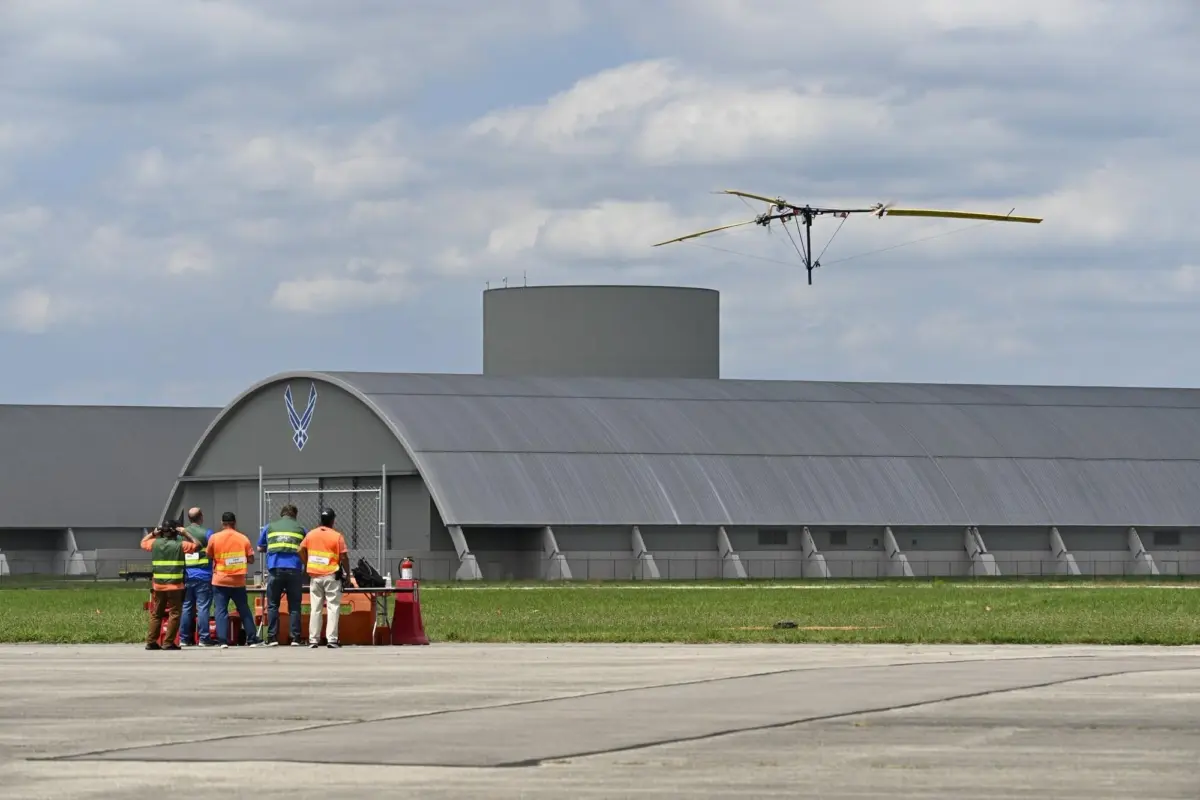
The centerpiece of this week’s robotics community is the DARPA Lift Challenge, a high-stakes competition taking place through the weekend. Designed to unearth radical innovations in vertical takeoff and landing (VTOL) heavy-lift capabilities, the event has showcased an array of unconventional and bizarrely engineered drone designs.
DARPA (Defense Advanced Research Projects Agency) has historically utilized challenge-based frameworks to bypass conventional engineering paradigms, and the Lift Challenge is no exception. Traditional heavy-lift rotary aircraft rely on conventional helicopter architectures—characterized by massive central rotors, complex swashplates, and substantial mechanical overhead. However, the prototypes featured in the DARPA competition deviate wildly from these blueprints.
Footage and full-event livestreams released by DARPA reveal unconventional configurations, including multi-rotor arrays with distributed electric propulsion, hybrid thrust-vectoring systems, and asymmetrical chassis built explicitly for extreme payload capacity. For engineers and roboticists, the challenge highlights a critical industry-wide pivot: moving away from scaled-up consumer drone architectures toward heavy-payload industrial and tactical platforms capable of moving multi-ton supplies without traditional runway infrastructure.
2. NASA’s SkyFall Mission: Sub-Surface Martian Water Detection
Beyond terrestrial heavy-lift applications, aerospace robotics continues to push the boundaries of interplanetary exploration. NASA’s upcoming SkyFall Mars helicopter mission represents a significant leap forward in extraterrestrial reconnaissance.
When the SkyFall rotorcraft touches down on the Martian surface, its primary objective will be to locate and map deposits of subsurface frozen water—an indispensable resource for future crewed missions, propellant production, and life-support systems. To achieve this, the helicopter must deploy ground-penetrating radar (GPR).
However, integrating GPR onto a lightweight Martian drone presents severe engineering hurdles. Antennas traditionally used for ground-penetrating radar are rigid, heavy, and structurally demanding. To solve this, NASA engineers developed a flexible, fabric-based antenna that extends downward from the aircraft during flight. The crucial innovation lies in its aerodynamic and mechanical compliance: the fabric antenna hangs below the rotorcraft to collect radar data without interfering with flight dynamics, yet it possesses the flexibility required to avoid snapping, tangling, or destabilizing the craft during turbulent Martian landings.
3. Advanced End-Effectors and Kinematic Versatility: Flexiv and Generative Bionics
In industrial and service robotics, dexterity remains a primary bottleneck. Traditional robotic hands have long labored under the assumption that human-mimetic, five-fingered anthropomorphic designs are the ultimate standard. However, advanced robotics firms are beginning to question this dogma.
- Flexiv’s Grav Product Line: Highlighting alternative end-effectors, Flexiv’s recent demonstrations pose a fundamental design question: Why replicate a standard five-fingered human hand when task-specific, superior geometries can achieve higher operational efficiency? By optimizing grip configurations, tactile feedback loops, and force-torque compliance, Flexiv’s hardware demonstrates that specialized end-effectors frequently outperform generalized humanoids in high-precision industrial scenarios.
- Generative Bionics: On the humanoid front, the industry is increasingly emphasizing visual and mechanical polish. Generative Bionics showcased a humanoid platform that stands as one of the most aesthetically refined systems currently in development. Beyond outward appearance, the integration of seamless casing, fluid joint actuation, and balanced weight distribution signals that humanoid robots are transitioning from clumsy laboratory experiments into commercially viable, human-centric form factors.
4. Low-Level Adaptability: Generalist’s GEN-1 and NIST Benchmarks
Software adaptability is advancing in tandem with hardware refinement. Generalist has announced significant performance gains in its GEN-1 system architecture, focusing on how robots learn to adapt to new actuators and novel hardware configurations at the lowest level.
According to Generalist’s technical disclosures, the firm has achieved 10x to 20x performance gains on internal foundational benchmarks. This low-level adaptability translates directly into high-precision operational capabilities, such as the autonomous disassembly of complex components from a NIST (National Institute of Standards and Technology) evaluation board. By allowing neural networks to dynamically adjust to hardware friction, backlash, and varying actuator responses without extensive manual recalibration, Generalist is addressing one of the most persistent bottlenecks in robotic deployment.
5. Tactile Navigation and Aeroacoustic Perception
Navigating complex or GPS-denied environments requires sophisticated sensor suites. Two distinct projects featured this week underscore innovative approaches to spatial awareness and physical interaction:
- Tac-Nav: Focusing on assistive robotics, the Tac-Nav project demonstrates how robots can be precisely controlled and guided through direct human touch. By prioritizing tactile feedback over traditional visual interfaces or voice commands, Tac-Nav introduces an intuitive control paradigm for assistive and collaborative robotic systems.
- SonicFly (General Robotics Lab): In the realm of aerial autonomy, the General Robotics Lab introduced SonicFly, a passive aeroacoustic perception framework. SonicFly allows a secondary unmanned aerial vehicle (UAV) to estimate the position of, track, and precisely follow a leader UAV using exclusively the leader’s intrinsic flight sound. By eliminating the need for heavy LIDAR, complex computer vision pipelines, or active radio telemetry, SonicFly demonstrates how acoustic sensors can provide lightweight, resilient navigation capabilities in congested airspace.
Supporting Context & Operational Metrics
To fully contextualize the velocity of current robotics development, it is helpful to examine the operational metrics and underlying technological drivers defining the sector:
| Technology Domain | Primary Project / Firm | Key Technological Metric / Innovation | Strategic Objective |
|---|---|---|---|
| Heavy-Lift UAVs | DARPA Lift Challenge | Radical VTOL and multi-rotor structural designs | Extreme payload mobility without runway dependence |
| Interplanetary Flight | NASA SkyFall | Flexible, fabric-based ground-penetrating radar antenna | Subsurface water mapping on Mars |
| Industrial Dexterity | Flexiv (Grav) | Specialized non-anthropomorphic end-effectors | Superior task-specific force application |
| Low-Level AI | Generalist (GEN-1) | 10x–20x gains in actuator adaptation benchmarks | High-precision component disassembly (NIST boards) |
| Acoustic Autonomy | General Robotics Lab (SonicFly) | Passive aeroacoustic leader-follower UAV tracking | GPS-denied, vision-independent drone swarm navigation |
The convergence of these metrics highlights a maturing industry. While funding and public attention often gravitate toward flashy humanoid announcements, the underlying engineering momentum is occurring at the component level—specifically in materials science (fabric antennas), acoustic sensing, and low-level neural adaptation.
Official Statements & Industry Insights
The release of this week’s robotics compilation underscores a broader philosophical shift within the research community. Speaking on the integration of low-level adaptable intelligence, software architects at Generalist noted:
"We’ve improved how GEN-1 learns to adapt to new actuators and new robots at the lowest level, with up to 10-20x gains on internal benchmarks. This significantly boosts performance on high-precision tasks like disassembling parts from a NIST board."
Similarly, academic teams pushing the boundaries of drone perception emphasize the necessity of multimodal, non-visual sensor integration. The General Robotics Lab outlined the mechanics of their SonicFly framework:
"We present SonicFly, a passive aeroacoustic perception framework that enables one unmanned aerial vehicle (UAV) to estimate and follow another using only the leader’s intrinsic flight sound."
These statements reflect a growing consensus: the future of robotics lies in systemic redundancy, cross-domain adaptability, and the decoupling of robotic systems from heavy, power-hungry primary sensors through clever mechanical and algorithmic design.
Future Outlook & Upcoming Industry Milestones
As the robotics community looks beyond the immediate weekend events, the global calendar is filling rapidly with critical academic and industrial summits. Organizations, engineers, and investors are already preparing for major convenings over the coming months:
- Actuate 2026 (18–19 August 2026, San Francisco): Expected to showcase the latest commercial software deployments, orchestration platforms, and developer toolkits for operational robotics.
- Humanoids Summit Seoul (22–23 September 2026, Seoul): A premier gathering focusing entirely on the mechanical engineering, bipedal locomotion, and commercialization trajectories of humanoid robotic platforms.
- IROS 2026 (27 September–1 October 2026, Pittsburgh): The International Conference on Intelligent Robots and Systems will bring together thousands of researchers to debate foundational breakthroughs in machine learning, sensor fusion, and autonomous control.
Conclusion
The developments captured in this week’s robotics review—from DARPA’s unorthodox heavy-lift drones and NASA’s fabric-antenna Mars copters to Generalist’s hardware-agnostic AI and SonicFly’s acoustic tracking—demonstrate an ecosystem operating at peak velocity. As these technologies transition from controlled testbeds into real-world and interplanetary deployment, the boundary between science fiction and operational reality continues to dissolve.
