

Executive Overview
For years, the journey of taking a state-of-the-art machine learning model from a public repository to a production-ready enterprise environment has been fraught with administrative and logistical friction. Developers and machine learning engineers operating at the bleeding edge of artificial intelligence have long faced a disjointed pipeline. Discovering a groundbreaking foundation model (FM) on a community hub like Hugging Face was often exhilarating, but translating that discovery into hands-on experimentation meant navigating a labyrinth of manual infrastructure setup.
Enterprises had to manually log into cloud consoles, spin up development domains, manually provision and wire up complex AWS Identity and Access Management (IAM) roles, configure security boundaries, and troubleshoot cryptic GPU quota limits before writing a single line of fine-tuning code. This context-switching stifled developer velocity, delaying the path from creative inspiration to enterprise deployment.
Today, that paradigm shifts fundamentally. In a landmark development for the open-source and cloud computing ecosystems, Hugging Face and Amazon Web Services have announced a powerful, native deep-link integration between Hugging Face and Amazon SageMaker AI. This one-click capability allows developers to transition seamlessly from model discovery to active experimentation and deployment within SageMaker Studio.
By eliminating manual domain configuration, automatically applying pre-configured managed IAM policies, and embedding real-time GPU quota visibility directly into the user interface, this integration bridges the long-standing divide between public model repositories and private, secure cloud environments. For enterprise organizations looking to leverage open-weight models with total architectural control, this release marks a monumental leap forward in developer experience and operational efficiency.
Detailed Chronology: From Friction to Fluidity
The genesis of this integration stems from a continuous feedback loop between cloud architects, enterprise AI teams, and platform engineers. To understand the significance of the current launch, one must look at the evolutionary steps required to bring open-source foundation models into secure cloud workspaces.
The Era of Manual Handshakes
Historically, if a machine learning engineer identified a promising open-weight large language model (LLM) or vision transformer on Hugging Face, executing a fine-tuning job inside Amazon SageMaker required an exhaustive multi-step choreography:

- Model Evaluation: The engineer would read model cards, review evaluation benchmarks, and copy model weights or repository identifiers.
- Console Navigation: They would then open a separate browser tab, navigate to the AWS Management Console, and access Amazon SageMaker AI.
- Infrastructure Provisioning: Creating or configuring a SageMaker Domain was required, often demanding deep familiarity with Virtual Private Clouds (VPCs), subnets, and security groups.
- IAM Configuration: Engineers frequently spent hours drafting custom IAM policies to ensure the domain could access S3 buckets, pull Hugging Face tokens, and execute training jobs without violating corporate security compliance.
- Quota Checks: Trying to launch a training job only to discover that the account lacked sufficient G5 or G6 GPU quotas meant jumping over to the Service Quotas console, submitting a limit increase request, and waiting for approval.
This fragmented workflow could consume days of engineering time—not in building AI solutions, but in administrative plumbing.
The Streamlined Pipeline: How the Integration Operates
The newly released deep-link architecture re-architects this journey into an intuitive, frictionless sequence:
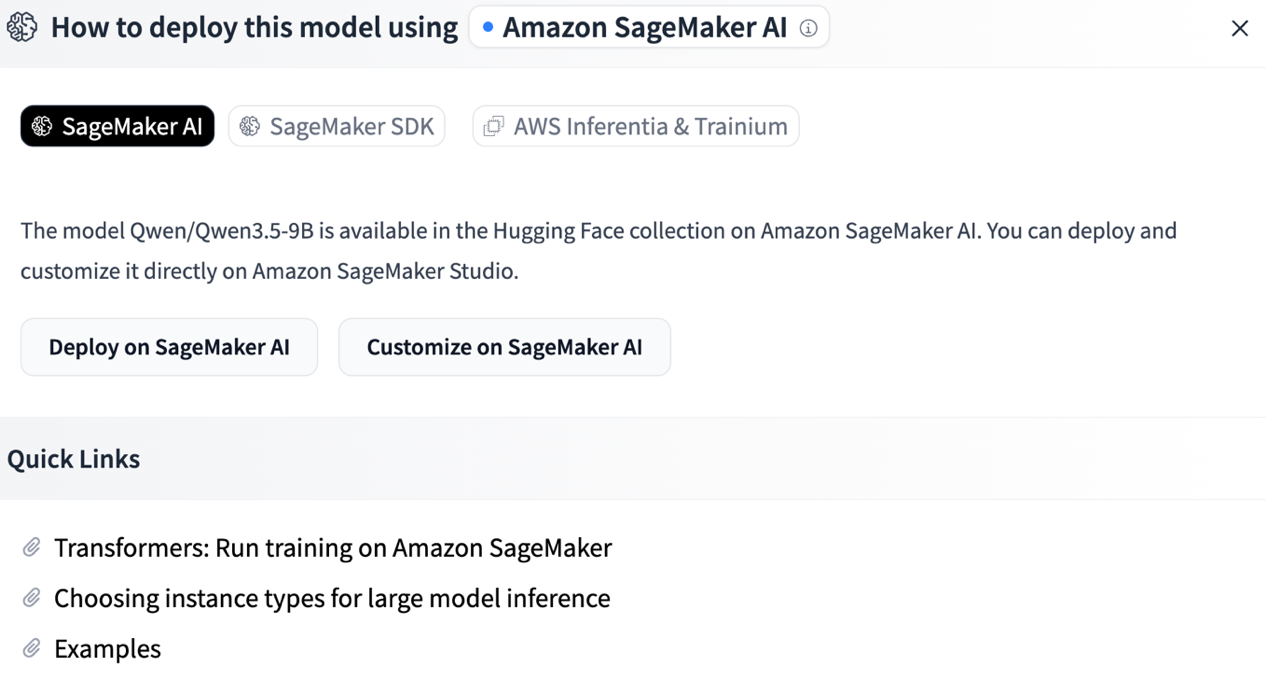
- Step 1: Direct Discovery and Intent Selection — When browsing supported models on Hugging Face, users click the "Deploy" dropdown menu and select "Amazon SageMaker AI." This surfaces two distinct, action-oriented pathways: "Customize on SageMaker AI" and "Deploy on SageMaker AI."
- Step 2: Instant Authentication and Context Hand-off — Selecting either pathway immediately triggers a secure sign-in protocol to the AWS Management Console (which passes seamlessly if an active session already exists). Behind the scenes, SageMaker AI instantly provisions or connects to a Studio environment, dynamically carrying over the complete model context, repository path, and architectural metadata.
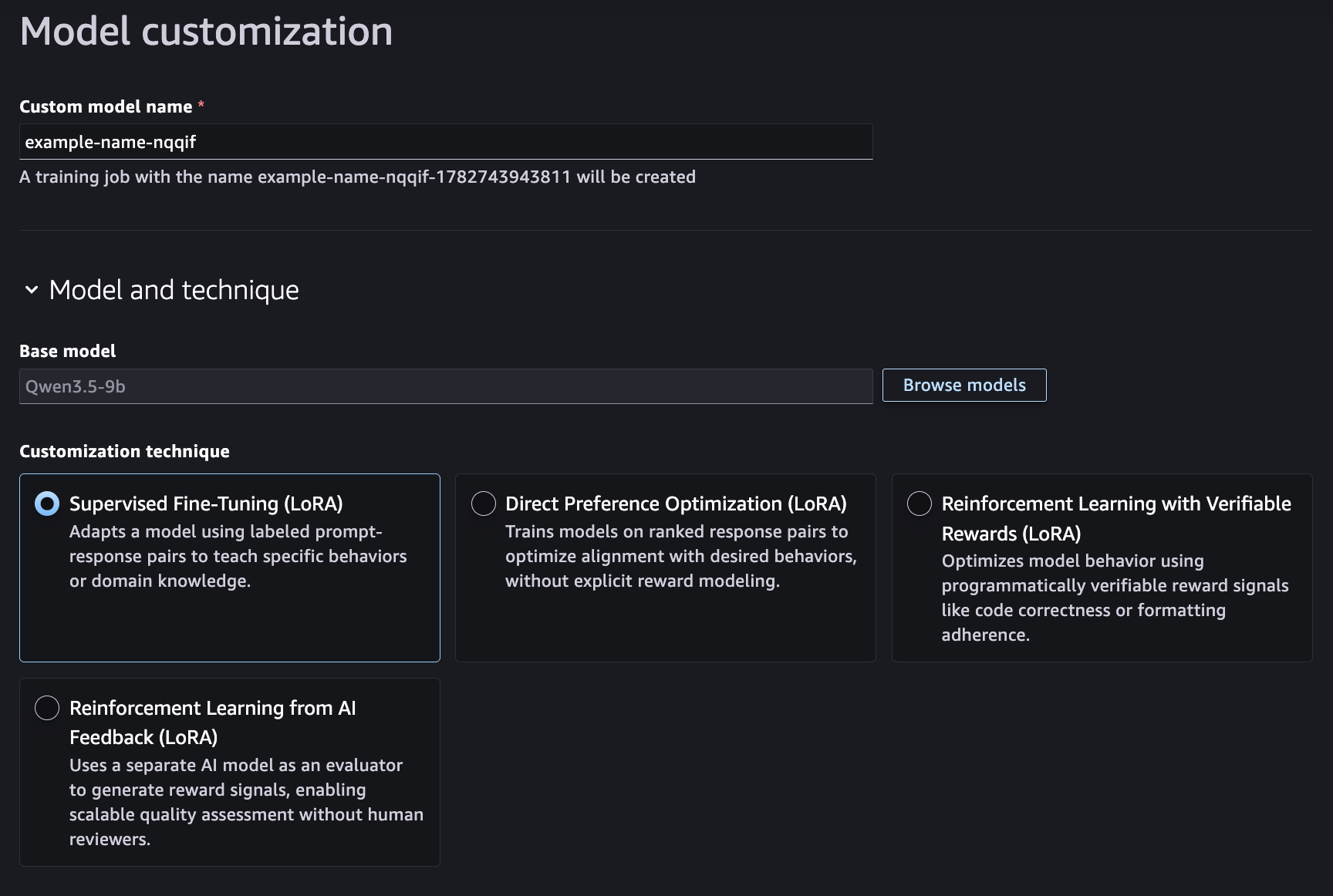
- Step 3: Direct Landing in Studio Workflows — Rather than landing on a generic dashboard, the developer is placed directly inside the specialized SageMaker Studio page—either the Model Customization interface pre-loaded with the chosen model or the Endpoint Deployment canvas.
- Step 4: Immediate Validation and Testing — With infrastructure, permissions, and model weights aligned, engineers can configure hyperparameters, submit fine-tuning routines, or deploy endpoints and execute immediate inference testing via Studio’s built-in testing interfaces.
Supporting Context & Metrics: The Mechanics Behind the Integration
Underpinning this seamless user experience are three major technical capabilities engineered directly into the AWS and Hugging Face infrastructure. These features solve core bottlenecks that have historically plagued enterprise machine learning workflows.
1. Intelligent Deep-Linking Architecture
The foundational pillar of the release is a robust URI-based deep-linking schema. When a developer selects a model action on Hugging Face, the URL payload transmits essential metadata—such as the model repository ID, task type, and framework dependencies—directly into the AWS console launch parameters. This ensures zero data loss during context transition, removing any requirement for manual copy-pasting of model identifiers or artifact paths.
2. Pre-Configured Permissions via AmazonSageMakerModelCustomizationCoreAccess
Perhaps the most significant operational upgrade for enterprise security teams is the introduction of a new managed policy: AmazonSageMakerModelCustomizationCoreAccess.
Configuring permissions for advanced machine learning workflows—such as Supervised Fine-Tuning (SFT), Direct Preference Optimization (DPO), Reinforcement Learning with Verifiable Rewards (RLVR), and Reinforcement Learning from AI feedback (RLAIF)—previously required granular IAM crafting. The new managed policy automates this securely, granting just-enough-access permissions for serverless and cluster-based model customization jobs while supporting deployment pathways to both SageMaker AI and Amazon Bedrock endpoints. For organizations governed by strict compliance frameworks, this standardized policy ensures security teams retain strict guardrails without burdening developers with manual role management.
3. Real-Time GPU Quota Visibility
Resource contention is a constant battleground in generative AI development. Waiting until the final step of a configuration wizard to discover that an AWS account lacks the necessary GPU quota for instance types like g5 or g6 introduces frustrating operational delays.
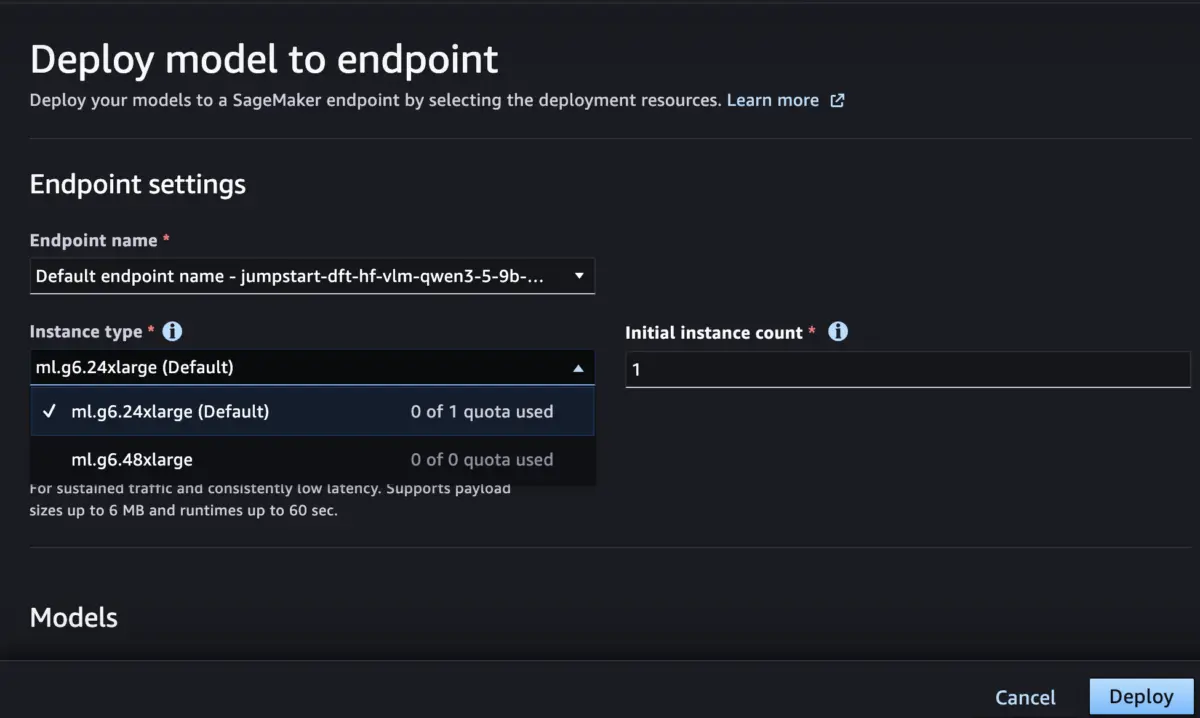
The updated SageMaker Studio UI integrates real-time quota visibility directly into the instance selection dropdown. Engineers can view their account limits at a glance during the deployment or training setup phase. If an instance type exceeds current quotas, the interface provides a direct, contextual redirect to the Service Quotas console, streamlining the exception-handling process and cutting down cycle times for infrastructure scaling.
Official Statements: Industry Leaders Weigh In
The convergence of open-weights flexibility and enterprise-grade cloud control has drawn high praise from across the artificial intelligence sector. Industry pioneers emphasize that this integration represents a philosophical as well as technical victory for the open-source community.
Mark McQuade, Founder and CEO of Arcee AI, captured the essence of the shift in a statement highlighting the empowerment of enterprise developers:
"At Arcee, we build open models so developers and enterprises can actually own what they run: inspect the weights, post-train on their own data, and deploy on their own terms. This integration takes that promise the last mile. Going from an open model on Hugging Face straight into SageMaker Studio in a single click, then fine-tuning or deploying it inside your own AWS environment with nothing to wire up, is the kind of experience open models have been missing. Open weights you own, running in the cloud you control. That is exactly the combination our customers have been asking for."
Analysts note that as enterprises increasingly demand data sovereignty and model ownership—moving away from black-box APIs toward customizable open-weights models—tooling that reduces the operational overhead of private cloud hosting becomes a critical market differentiator. By removing the friction between public discovery and private deployment, AWS and Hugging Face are effectively lowering the barrier to entry for proprietary open-source AI adoption.
Future Outlook: The Next Wave of Collaborative AI Infrastructure
The launch of the Hugging Face and Amazon SageMaker AI deep-link integration is not merely a quality-of-life update; it signals a broader trajectory for how cloud service providers and open-source ecosystems will interact in the future.
The Convergence of Managed Services and Open Repositories
As foundation models proliferate at an exponential rate, the competitive advantage will no longer belong solely to those who build the largest models, but to those who can operationalize them the fastest. The traditional boundaries dividing public model hubs and proprietary enterprise clouds are steadily dissolving. We can anticipate future iterations of this partnership to expand into deeper automated benchmarking, automated cost-estimation pre-checks before fine-tuning begins, and tighter integrations with model evaluation harnesses.
Implications for Enterprise AI Strategy
For enterprise chief technology officers and heads of artificial intelligence, this development validates a hybrid strategy: leveraging the rapid pace of open-source innovation found on platforms like Hugging Face while maintaining the uncompromising security, data governance, and scalability of Amazon SageMaker AI and Amazon Bedrock.
As teams spend less time wrestling with IAM policies, network configurations, and quota dashboards, engineering hours can be redirected toward what truly matters: curating domain-specific training data, optimizing model performance, and delivering tangible business value. The one-click bridge between Hugging Face and SageMaker Studio sets a new benchmark for developer velocity in the generative AI era—proving that openness and enterprise control can finally coexist without compromise.
