

Executive Overview
Voice has rapidly ascended to become one of artificial intelligence’s primary interfaces. Across customer support hotlines, healthcare diagnostics, educational platforms, entertainment software, and personal productivity assistants, spoken natural language is swiftly replacing text-based typing as the default mode of human-computer interaction. Over the past few years, the underlying architecture of voice models has improved at a staggering pace. Word error rates (WER) continue to plummet, latency has been driven down to conversational speeds, and many established legacy benchmarks are rapidly approaching saturation.
Yet, anyone who frequently interacts with modern voice AI experiences a persistent, nagging disconnect. Something still feels fundamentally "off."
Current voice models frequently suffer from identity drift—sounding like entirely different individuals over the course of a single conversation—while failing to register human hesitation, uncertainty, or subtext. They routinely stumble when forced to process heavy regional accents, background acoustic noise, or emotionally charged speech. These critical shortcomings are deceptively easy to miss in conventional benchmarks that fixate almost exclusively on latency and word error rates. In day-to-day life, users do not care merely if a system can transcribe words; they care deeply about whether a voice system can truly listen, respond appropriately, and maintain natural, reliable human interactions in unpredictable environments.
To address this widening chasm between laboratory performance and real-world utility, researchers have introduced Real World VoiceEQ—a comprehensive new evaluation framework designed to assess the human quality of voice interaction. Evaluating over 40 leading proprietary and open-source models across more than 15 key evaluation dimensions and 60 distinct metrics, this benchmark reveals that while voice AI has learned how to speak, it still has a remarkably long way to go before it learns how to truly listen.
Detailed Chronology: The Evolution and Awakening of Voice Evaluation
The trajectory of speech technology over the past decade can be segmented into distinct phases of technical achievement, followed by inevitable reckoning regarding human-machine interaction.
Phase 1: The Transcription Era (2015–2020)
For years, the progress of voice AI was dictated by Automatic Speech Recognition (ASR) metrics. The primary holy grail was lowering the Word Error Rate. Researchers treated speech as text-in-disguise. Success meant converting acoustic signals into characters with maximum mathematical accuracy. During this period, text-to-speech (TTS) systems focused on intelligibility rather than expressive cadence, resulting in robotic, monotonous outputs that worked fine for basic command-and-control operations but failed completely in sustained social dialogue.
Phase 2: The Latency and Speed Rush (2021–2023)
As large language models (LLMs) exploded in capability, the bottleneck shifted from mere transcription to end-to-end conversational speed. The industry obsessed over reducing conversational latency—ensuring models could respond within milliseconds to mimic human turn-taking dynamics. While models became blazing fast, they remained brittle. They relied on brittle, modular pipelines: turning speech to text, passing it to an LLM, and turning text back into speech. This segmented approach systematically stripped out the rich emotional metadata encoded in human voices.
Phase 3: The Speech-to-Speech Pivot and the Reality Check (2024–Present)
The current era is defined by native Speech-to-Speech (S2S) models designed to process audio directly without intermediate text translations. However, as these models hit the market, developers discovered that standard benchmarks were no longer fit for purpose. Legacy metrics could not explain why a model with a stellar leaderboard score felt jarringly unnatural during a complex, emotionally nuanced customer service call.
Recognizing this blind spot, a massive data collection and evaluation initiative was mobilized. Researchers aggregated over one million individual human ratings across diverse demographics, speaking styles, and acoustic environments. This monumental effort culminated in the deployment of Kairos, a flexible, voice-native evaluation platform designed to capture the qualitative nuances of human speech. This infrastructure allowed the industry to finally map out the true capabilities—and systemic failures—of modern conversational agents.

Supporting Context & Metrics: Inside the Real World VoiceEQ Framework
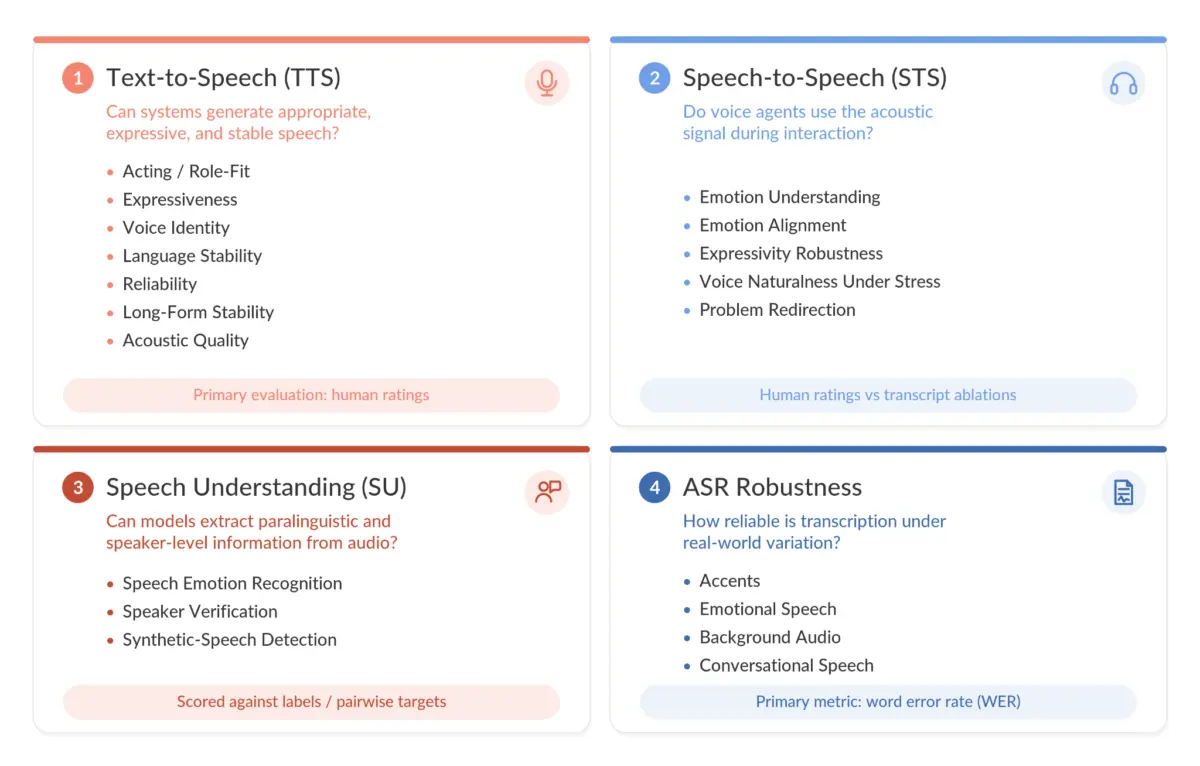
The Real World VoiceEQ benchmark represents one of the largest human-evaluated studies of voice AI conducted to date, incorporating 785,000 Text-to-Speech ratings and 48,000 Speech-to-Speech ratings. Rather than relying on simple automated checks, the framework assesses whether voice systems can recognize, produce, and respond to the critical acoustic information that standard text transcripts routinely leave out.
The benchmark spans four distinct components, each packed with rigorous sub-metrics:
+---------------------------------------------------------------------------------+
|                         REAL WORLD VOICEEQ FRAMEWORK                            |
+-------------------------+-----------------------+-------------------------------+
|  1. Text-to-Speech      |  2. Speech-to-Speech  |  3. Speech Understanding      |
|     (785,000 ratings)   |     (48,000 ratings)  |                               |
+-------------------------+-----------------------+-------------------------------+
|  4. ASR Robustness      |  (Evaluates 40+ models across 15+ dimensions & 60+ metrics)   |
+-------------------------+-------------------------------------------------------+- Text-to-Speech (TTS): Assesses prosody, emotional expression, natural pacing, identity retention, and pronunciation across complex domains.
- Speech-to-Speech (S2S): Measures how effectively a model processes incoming audio cues and responds in kind without losing conversational flow or emotional attunement.
- Speech Understanding: Evaluates the model’s capacity to extract intent, hesitation, and context directly from acoustic signals rather than sanitized transcripts.
- ASR Robustness: Tests how transcription and comprehension hold up under duress—such as heavy background noise, music-backed audio, overlapping speakers, and varied accents.
Key Findings from the Data
- Specialization Over Generalization: The era of a single, undisputed "best" voice model is officially over. The data reveals that progress in voice AI is fracturing into hyper-specialized tracks. Systems optimized for repeating complex alphanumeric data (such as bank account numbers, pharmaceutical names, or booking reference numbers) frequently struggle to produce emotionally resonant, fluid speech. Conversely, models that sound remarkably theatrical and natural often falter on precision-oriented, factual tasks. In TTS evaluations, not a single system configuration ranked in the top five across all eight evaluated capability groups.
- The Listening Deficit: Speech-to-Speech models exhibited the widest performance variance of any category. Crucially, the evaluation proved that having technical access to audio does not guarantee that an agent actually utilizes paralinguistic data. Many systems remained fundamentally transcript-driven. They registered the words spoken while remaining completely blind to tone, volume, pacing, emphasis, and hesitation. For example, consider a banking agent reviewing a suspicious transaction. A confident "Yes" versus a hesitant, drawn-out "…yes…" carry wildly disparate implications—yet many contemporary models treat the acoustic difference as irrelevant noise.
- The Illusion of Legacy Benchmarks: Traditional evaluation metrics are actively inflating expectations. Models that score near-zero word error rates in pristine laboratory conditions experience massive performance degradation in the wild. When subjected to noise-backed speech, transcription error rates were measured at roughly four times higher than on music-backed speech. Single aggregate scores routinely mask these severe localized failure modes.
- The Limits of Automated Evaluation: While Large Language Models (LLMs) have revolutionized text model evaluation, the study cautions against blindly trusting Speech-Language Models (SLMs) to judge voice outputs. When researchers compared SLM evaluators against trained human raters, agreement was highest on objective, verifiable tasks (like pronunciation accuracy). However, agreement plummeted on subjective judgments—such as whether a voice matched an appropriate acting persona, maintained emotional consistency, or correctly interpreted subtle social subtext. Automated auditors remain a helpful tool, but human perception is still irreplaceable.
Official Statements and Expert Insights
Industry leaders and researchers behind the Real World VoiceEQ initiative emphasize that the paradigm of synthetic speech evaluation must undergo a fundamental structural overhaul.
"For decades, speech AI has advanced by optimizing against quantitative metrics on standardized benchmarks—from WER for transcription accuracy to objective perceptual metrics like PESQ and DNSMOS for speech quality," notes the research collective behind the framework.
"As voice rapidly becomes one of AI’s defining interfaces, speed and technical accuracy alone will no longer determine which systems succeed. The models people ultimately choose will be those that can understand, express, and respond like humans—not just under ideal benchmark conditions, but across the immense complexity of real-world conversation."
Enterprise developers are increasingly waking up to the reality that laboratory benchmarks do not translate into customer satisfaction. By utilizing flexible evaluation infrastructures like Kairos, engineering teams can finally move beyond aggregate leaderboards to diagnose granular failure modes—such as why an AI support agent sounds reassuring during a simple billing inquiry, but inappropriately cheerful or robotic when handling a frustrated customer complaint.
Future Outlook: The Road Ahead for Conversational AI
The unveiling of benchmarks like Real World VoiceEQ signals a maturity milestone for the voice AI industry. The low-hanging fruit—reducing basic latency and minimizing transcription errors—has largely been picked. The next frontier requires solving the messy, deeply human elements of communication.
Over the coming years, we can expect several major shifts in how voice models are developed and deployed:
- Context-Aware Architectures: Future voice models will move away from transcript-reliant processing. They will be natively trained to decode micro-hesitations, vocal tremors, emotional resonance, and spatial audio cues as first-class citizens of the neural network.
- Tailored Enterprise Evaluation: Rather than relying on generic public leaderboards, enterprises deploying voice agents in high-stakes fields—such as mental health counseling, emergency dispatch, and financial advisory—will adopt custom human-in-the-loop evaluation pipelines to continuously monitor emotional alignment and safety.
- Closing the Benchmark Gap: As the industry embraces multi-dimensional, human-grounded evaluation metrics, the artificial inflation of model capabilities will decline. Developers will be forced to build systems that are not only fast and accurate, but genuinely empathetic and robust against real-world chaos.
Ultimately, the measure of voice AI’s success will no longer be how closely it approximates a pristine text document. It will be determined by its ability to navigate the unspoken nuances of human emotion, establishing a truly seamless and authentic bridge between people and machines.
