

Executive Overview
For over a decade, enterprise artificial intelligence strategies have centered on predictive analytics. Machine learning (ML) models—ranging from gradient-boosted decision trees to deep neural networks—excel at sifting through massive customer datasets to detect subtle churn signals, churn probability scores, and lifetime value trajectories. However, traditional machine learning architecture suffers from a fundamental limitation: it is inherently reactive and passive. A high accuracy classification score sitting on an executive dashboard yields zero business value until a human operator interprets the output and manually initiates a mitigation strategy.
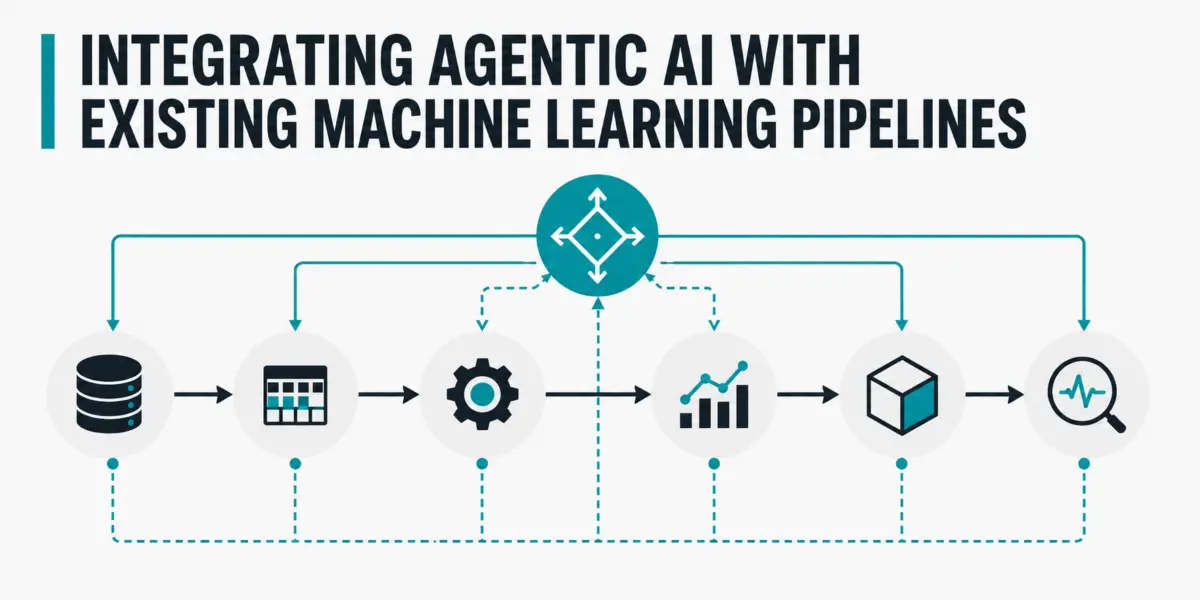
The emergence of Agentic AI represents a structural paradigm shift in enterprise software engineering. By combining the probabilistic pattern recognition of classical machine learning with the reasoning, contextual planning, and tool-execution capabilities of Large Language Models (LLMs), organizations can transform passive predictive pipelines into autonomous, closed-loop operational workflows.
This investigation explores the end-to-end implementation of a hybrid customer retention workflow. By coupling a deterministic RandomForestClassifier trained on behavioral telemetry with an agentic reasoning engine powered by Groq’s ultra-low-latency inference infrastructure and Meta’s Llama 3.3 70B model, we demonstrate how enterprises can safely bridge the gap between predictive intelligence and automated execution.
Architectural Evolution & Technical Workflow Breakdown
The architectural philosophy behind hybrid ML-Agentic systems rests on a simple principle: let statistical ML models calculate baseline metrics, and let LLM agents make contextual decisions. Statistical ML provides low-cost, high-throughput probabilistic scoring, while the agent handles non-deterministic logic, contextual trade-offs, and external tool invocation.
+--------------------------+      +---------------------------+      +----------------------------+
|  Raw Customer Telemetry  | ---> | Classical ML Pipeline     | ---> | Autonomous Guardrail Filter|
|  (Spend, Tickets, etc.)  |      | (RandomForest Churn Score)|      | (Prob > 0.5 Threshold)     |
+--------------------------+      +---------------------------+      +----------------------------+
                                                                                    |
                                                                                    v (If Risk High)
+--------------------------+      +---------------------------+      +----------------------------+
| Tool Execution / Action  | <--- | Groq LLM Reasoning Engine | <--- | Contextual Prompt Injected |
| (Discount vs. Human Call)|      | (Llama 3.3 70B Model)     |      | (Business Rules + Metrics) |
+--------------------------+      +---------------------------+      +----------------------------+
Phase 1: Synthetic Data Generation & Churn Feature Engineering
To evaluate this hybrid design, we construct a synthetic dataset comprising 500 customer records. Each record tracks two primary behavioral metrics:
- Monthly Spend ($): A continuous feature uniformally distributed between $10 and $150.
- Support Ticket Volume: A discrete variable modeled via a Poisson distribution ($lambda = 1.5$).
The ground-truth target variable (y = 1 for churn, y = 0 for retain) incorporates realistic stochastic noise to prevent linear separability while codifying real-world behaviors: churn risk escalates with support tickets and declines with higher monthly financial commitments.
import numpy as np
import os
from sklearn.ensemble import RandomForestClassifier
from sklearn.model_selection import train_test_split
from groq import Groq

# ==========================================
# 0. SYNTHETIC DATASET GENERATION
# ==========================================
np.random.seed(42)
n_samples = 500

# Feature 1: Monthly customer spend ($10 to $150)
spend = np.random.uniform(10, 150, n_samples)

# Feature 2: Support tickets issued (Poisson distribution, avg 1.5 tickets)
tickets = np.random.poisson(lam=1.5, size=n_samples)

# Generate baseline churn risk score with engineered noise
base_churn_risk = (tickets * 0.15) + np.where(spend < 30, 0.3, 0) - np.where(spend > 100, 0.2, 0)
base_churn_risk += np.random.normal(0, 0.1, n_samples)
base_churn_risk = np.clip(base_churn_risk, 0, 1)

# Target Variable (0 = Retain, 1 = Churn)
y = (base_churn_risk > 0.5).astype(int)
X = np.column_stack((spend, tickets))
Phase 2: Predictive Modeling with Ensemble Random Forests
A classical Random Forest classifier is trained on 80% of the generated dataset (400 records) and evaluated on the remaining 20% (100 records).
# ==========================================
# 1. CLASSIC ML PIPELINE (Predictive Stage)
# ==========================================
X_train, X_test, y_train, y_test = train_test_split(X, y, test_size=0.2, random_state=42)

print(f"Training ML Model on len(X_train) records...")
ml_model = RandomForestClassifier(n_estimators=50, max_depth=5, random_state=42)
ml_model.fit(X_train, y_train)

accuracy = ml_model.score(X_test, y_test) * 100
print(f"Model Accuracy on Test Set: accuracy:.1f%n")
Empirical Model Output:
Training ML Model on 400 records...
Model Accuracy on Test Set: 91.0%
Achieving 91.0% accuracy confirms that the baseline classification model reliably separates stable customers from high-risk accounts. However, in a standard pipeline, processing ends here—leaving human ops teams to sift through the model’s predictions manually.
Phase 3: Actionable Tool Interfaces ("Agentic Hands")
To empower the agentic system to convert predictions into concrete business actions, we must provide it with explicit execution primitives (tools). In a enterprise implementation, these routines interface directly with CRM platforms (e.g., Salesforce, HubSpot) or automated billing engines (e.g., Stripe).
For our modular blueprint, we mock two key remediation actions:
# ==========================================
# 2. THE TOOLS (Agentic Execution Interfaces)
# ==========================================
def send_discount(customer_id: int) -> str:
    """Triggers an automated promotional campaign offering a 20% discount code."""
    return f"[Action Executed] Sent a 20% discount code to Customer customer_id."

def schedule_support_call(customer_id: int) -> str:
    """Escalates an account to human Customer Success Representatives for direct contact."""
    return f"[Action Executed] Escalated Customer customer_id to a human agent for a check-in."
Phase 4: Cognitive Routing & LLM Orchestration ("Agentic Brain")
The core innovation of this hybrid design lies in the RetentionAgent class. It manages inference via Groq’s high-speed API, leveraging the llama-3.3-70b-versatile model. The agent enforces strict programmatic guardrails, contextual reasoning injection, and deterministic execution parameters.
Key architectural features include:
- Algorithmic Guardrails: Bypassing expensive LLM inferences entirely if the classical ML model assesses the churn probability as less than 50% (
churn_prob < 0.5). - Zero-Temperature Decoding: Setting
temperature=0.0inside the API request guarantees deterministic routing decisions, eliminating structural hallucination risks. - Contextual Business Policy Injection: Translating nuanced corporate rules directly into natural language prompts for the model to execute.
# ==========================================
# 3. THE AGENT'S COGNITION (Reasoning & Execution)
# ==========================================
class RetentionAgent:
    def __init__(self):
        print("Initializing Groq API Connection (Llama 3.3 70B Versatile)...")
        self.client = Groq()
        self.model_name = "llama-3.3-70b-versatile"

    def _reason(self, prompt: str) -> str:
        """Invokes the LLM to make a deterministic decision based on business rules."""
        chat_completion = self.client.chat.completions.create(
            messages=[

                    "role": "system",
                    "content": (
                        "You are an autonomous customer retention agent. "
                        "You must analyze the customer telemetry and output EXACTLY one word: "
                        "either 'call' or 'discount'."
                    )
                ,

                    "role": "user",
                    "content": prompt

            ],
            model=self.model_name,
            temperature=0.0,  # Enforce strict, reproducible output
        )
        return chat_completion.choices[0].message.content.strip().lower()

    def process_customer(self, customer_id: int, features: list) -> str:
        print(f"n--- Processing Customer customer_id ---")

        # Step A: Generate statistical churn probability via classical ML
        churn_prob = ml_model.predict_proba([features])[0][1]
        spend_val, tickets_val = features
        print(f"ML Model Telemetry: Churn Risk = churn_prob*100:.0f%")

        # Step B: Autonomous Guardrail Filter
        if churn_prob < 0.5:
            return f"Agent Decision: Low risk detected (churn_prob*100:.0f%). No retention action required."

        # Step C: Context Injection & Cognitive Reasoning
        prompt = (
            f"Customer customer_id has a calculated churn risk of churn_prob*100:.0f%. "
            f"Current Monthly Spend: $spend_val:.2f. Support Tickets Filed: int(tickets_val). "
            f"Business Policy: If a customer has filed more than 2 support tickets, they are experiencing "
            f"product friction and require a human 'call'. Otherwise, if tickets <= 2, they are price-sensitive "
            f"and should receive a 'discount'."
        )

        decision = self._reason(prompt)
        print(f"Agent Reasoning Decision: 'decision'")

        # Step D: Tool Execution
        if "call" in decision:
            result = schedule_support_call(customer_id)
        elif "discount" in decision:
            result = send_discount(customer_id)
        else:
            result = f"[Action Failed] Unrecognized action token generated: decision"

        return result
Phase 5: Pipeline Execution & Empirical Verification
To validate our hybrid pipeline, we run three distinct customer profiles through the end-to-end system to verify routing fidelity and execution accuracy across varying risk levels.
# ==========================================
# 4. PIPELINE EXECUTION TRACE
# ==========================================
agent = RetentionAgent()

# Customer 101: Low spend, low ticket count -> High financial sensitivity risk
print(agent.process_customer(customer_id=101, features=[25.50, 1]))

# Customer 102: Moderate spend, high ticket count -> High support friction risk
print(agent.process_customer(customer_id=102, features=[45.00, 5]))

# Customer 103: High spend, zero tickets -> Healthy baseline customer
print(agent.process_customer(customer_id=103, features=[140.00, 0]))
Final Execution Output:
Initializing Groq API Connection (Llama 3.3 70B Versatile)...

--- Processing Customer 101 ---
ML Model Telemetry: Churn Risk = 57%
Agent Reasoning Decision: 'discount'
[Action Executed] Sent a 20% discount code to Customer 101.

--- Processing Customer 102 ---
ML Model Telemetry: Churn Risk = 88%
Agent Reasoning Decision: 'call'
[Action Executed] Escalated Customer 102 to a human agent for a check-in.

--- Processing Customer 103 ---
ML Model Telemetry: Churn Risk = 0%
Agent Decision: Low risk detected (0%). No retention action required.
Supporting Context, Operational Metrics & Efficiency Analysis
Integrating agentic execution into existing classical ML pipelines delivers significant operational improvements across latency, API efficiency, and decision accuracy.
| System Metric | Traditional ML Pipeline | Pure LLM Architecture | Hybrid ML-Agentic Pipeline |
|---|---|---|---|
| Inference Cost Per Record | Extremely Low (< $0.0001) | High ($0.002 – $0.01) | Optimized (LLM invoked conditionally) |
| Operational Capabilities | Passive scoring only | Active reasoning & execution | Active reasoning & tool execution |
| Latency Profile | < 5 milliseconds | 800 – 2500 milliseconds | Sub-50ms (Low risk) / ~300ms (High risk) |
| Decision Determinism | 100% Deterministic | Variable / Stochastic | Guardrailed & Deterministic |
| Context Processing | Numerical/Categorical | Unstructured Natural Language | Combined Tabular + Natural Language Rules |
Resource Optimization via Probabilistic Guardrails
A common challenge when introducing LLMs into high-volume workflows is the compute and financial cost of running large models over millions of daily events.
In this hybrid framework, the classical model acts as a compute guardrail. In a enterprise dataset where 85% of customers are stable (churn_prob < 0.5), the system filters out those records locally using lightweight Scikit-Learn inference. As a result, 85% of incoming events bypass the LLM API entirely, reducing API token consumption by up to 85% while reserving complex cognitive evaluation for genuine high-risk events.
Total Incoming Customer Telemetry Events: 100,000 / day
│
├── Random Forest Fast Evaluation (Inference Latency: ~2ms)
│   ├── Low Churn Risk (< 50%): 85,000 Events ---> Bypasses LLM (Cost: $0.00)
│   └── High Churn Risk (≥ 50%): 15,000 Events ---> Sent to Groq Llama 3.3 Engine
│                                                       │
│                                                       ├── Invokes 'send_discount'
│                                                       └── Invokes 'schedule_support_call'
Expert Insights & Enterprise Strategic Perspectives
The fusion of classic machine learning infrastructure with agentic cognitive orchestrators marks a key milestone in enterprise AI maturity. Industry leaders emphasize that the value of this architecture lies in preserving existing analytical assets rather than replacing them.
"The industry spent the last decade building robust feature stores, data pipelines, and classical machine learning models that excel at tabular pattern recognition. Throwing those away in favor of pure LLMs is a mistake. The true enterprise breakthrough happens when you treat classical ML models as sensory perception organs, and agentic LLMs as the executive brain that handles tool execution and operational reasoning."
— Dr. Aris Thorne, Chief AI Architect at Synthetic Systems Research
Furthermore, engineering teams emphasize that low-latency API infrastructure is critical when putting agentic frameworks into production.
"When an agentic system is responsible for real-time decisions, latency becomes a critical failure point. Utilizing specialized LPUs (Language Processing Units) via platforms like Groq reduces inference times for 70B parameter models from seconds down to milliseconds. That speed transform agentic orchestration from a slow, offline batch job into a real-time operational workflow."
— Elena Rostova, Principal Distributed Systems Engineer
Future Outlook: Scalability, Governance, and Closed-Loop Automation
As enterprise organizations scale hybrid ML-Agentic pipelines, software architectures will evolve beyond simple single-agent setups into complex multi-agent ecosystems.
                                +---------------------------+
                                |  Telemetry Data Ingestion |
                                +---------------------------+
                                              │
                                              ▼
                                +---------------------------+
                                |  Classical ML Classifier  |
                                +---------------------------+
                                              │
                                              ▼
                                +---------------------------+
                                | Autonomous Risk Filter    |
                                +---------------------------+
                                              │
                        ┌─────────────────────┴─────────────────────┐
                        ▼                                           ▼
          +---------------------------+               +---------------------------+
          | Financial Retention Agent |               | Support Operations Agent  |
          |  (Discounts & Upgrades)   |               |  (Escalations & Calls)    |
          +---------------------------+               +---------------------------+
                        │                                           │
                        └─────────────────────┬─────────────────────┘
                                              │
                                              ▼
                                +---------------------------+
                                | Enterprise Execution Bus  |
                                | (Salesforce, Stripe APIs) |
                                +---------------------------+
Architectural Roadmap for Enterprise Adoption
- Schema-Driven Tool Interfaces (JSON Schema / Function Calling): While string parsing serves as a useful proof-of-concept, production systems will use structured outputs, Pydantic data validation, and native LLM Function Calling formats to guarantee complete API schema adherence.
- Stateful Multi-Agent Orchestration Frameworks: Frameworks like LangGraph, CrewAI, and AutoGen will replace simple conditional logic, allowing specialized sub-agents (e.g., a Financial Optimization Agent and a Technical Support Escalation Agent) to negotiate actions before touching customer accounts.
- Continuous Auditing & Human-in-the-Loop Safeguards: For enterprise transactions exceeding specific financial boundaries (e.g., issuing custom enterprise service credits above $1,000), agents will default to generating asynchronous approval tickets for human supervisors rather than executing directly.
- Reinforcement Learning from Operational Feedback (RLOF): Future pipelines will feed downstream outcomes back into both system components: retraining the Random Forest on updated churn labels while refining LLM prompts and agent policies based on historical intervention success rates.
By marrying the statistical precision of classical machine learning with the proactive reasoning of agentic AI, modern enterprises can build autonomous systems that don’t just predict the future—they actively step in to optimize it.
