

Executive Overview
The landscape of surgical robotics is undergoing a profound paradigm shift. For decades, the field has been constrained by the physical realities of teleoperation and the immense hurdles associated with training vision-language-action (VLA) policies. Physical robotic platforms—such as advanced teleoperated surgical systems—are exceptionally capital-intensive to acquire and operate, iterative experimentation is notoriously slow to reproduce, and the margin for error is razor-thin. A single miscalculated movement or hardware failure can result in catastrophic damage to sensitive surgical instruments, high-cost hardware, or delicate biological materials.
To mitigate these risks, researchers have long relied on conventional physics-based simulators. However, modeling the complex, chaotic visual physics of the human operating theater remains a formidable computational challenge. Simulating deformable biological tissues, fluid dynamics, fine instrument-tissue interactions, specular highlights on wet organs, moving sutures, flying needles, surgical smoke, and unpredictable occlusions pushes traditional rendering pipelines to their absolute limits.
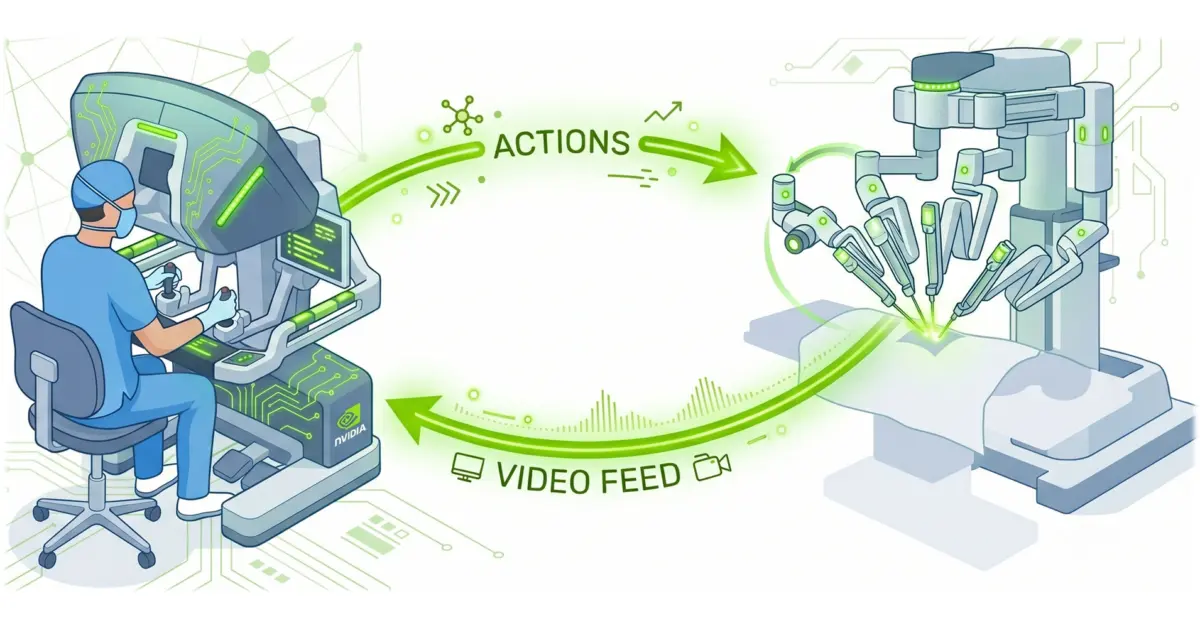
Enter Cosmos-H-Dreams, NVIDIA’s groundbreaking real-time, action-conditioned generative simulator designed specifically for surgical robotics. Building upon the foundational capabilities of the earlier Cosmos-H-Surgical-Simulator, Cosmos-H-Dreams distills massive world foundation models into a highly efficient, causal, few-step student model. Served via FlashDreams—NVIDIA’s specialized streaming-inference library—the system operates seamlessly on a single NVIDIA RTX PRO 6000 GPU. The result is an interactive, closed-loop surgical environment capable of rendering photorealistic, action-responsive surgical video at an astonishing ~160 frames per second.
This comprehensive report examines the technological breakthroughs underpinning Cosmos-H-Dreams, exploring its architectural evolution from static world models to real-time interactive simulators, the advanced distillation techniques used to make streaming inference possible, its cross-platform industry integrations, and the broader implications for the future of surgical Physical AI.
Detailed Chronology: From Static Surgical World Models to Interactive Simulators
The journey toward real-time generative surgical simulation represents a multi-stage evolution in artificial intelligence, computer vision, and high-performance computing.
The Foundation: Cosmos-H-Surgical-Simulator
The precursor to today’s breakthrough was the release of the Cosmos-H-Surgical-Simulator, an action-conditioned world foundation model built upon NVIDIA’s Cosmos-Predict2.5-2B architecture and post-trained on the expansive Open-H-Embodiment dataset. Given an initial surgical context frame alongside a planned sequence of robot actions (such as a future robot trajectory), the system was engineered to generate prospective video predicting the visual consequences of those actions.
While transformative for offline policy evaluation and synthetic data generation, the original Cosmos-H-Surgical-Simulator was constrained by inference latency. It operated more akin to a batch video generation engine than an interactive simulation environment. Researchers could feed a recorded or policy-generated trajectory into the model and inspect the resulting rollout without risking physical hardware, but closed-loop, human-in-the-loop interaction remained elusive.
The Breakthrough: Cosmos-H-Dreams
Recognizing the necessity for instantaneous feedback loops in robotic policy training, NVIDIA developed Cosmos-H-Dreams. By taking the multi-embodiment surgical priors learned by its predecessor and specializing them for specific hardware setups—such as the da Vinci Research Kit (dVRK) tabletop suturing environment—engineers successfully distilled the architecture into a causal student model.
Crucially, Cosmos-H-Dreams has already proven its cross-platform versatility. Through strategic collaborations with industry leaders such as CMR Surgical and Cambridge Consultants, NVIDIA successfully integrated the simulator with the Versius surgeon controller, proving that the generative engine can scale beyond academic research platforms to commercial-grade surgical master consoles.
Technical Architecture & Distillation Methodology
Transforming a massive, bidirectional video generation model into a real-time, streaming simulator required solving a critical engineering paradox: how to preserve hyper-realistic surgical physics and dynamics while drastically reducing the computational overhead of image generation.
[Teacher Model (Bidirectional)]
       │
       ▼ (Cached Trajectories & Progressive Temporal Horizon: 12 -> 72 frames)
[Causal Warmup Phase]
       │
       ▼ (Causal Attention & Streaming KV Cache)
[Self-Forcing Distillation]
       │ (Rolls forward using own outputs to prevent drift)
       ▼
[FlashDreams Inference Engine (~160 FPS on Single NVIDIA RTX PRO 6000)]
1. The Surgical Teacher and Progressive Horizon Training
The optimization pipeline begins with a bidirectional teacher model initialized from the Cosmos-H-Surgical-Simulator Open-H checkpoint. This model relies on a unified 44-dimensional action representation. For the dVRK tabletop model, dual-arm dVRK actions—encompassing relative end-effector translation, rotation, and gripper state—are mapped directly into this standardized vector space.
To ensure the simulator can evaluate flawed policies rather than just idealized surgical maneuvers, the teacher was fine-tuned on a diverse mixture of the Johns Hopkins University (JHU) dVRK tabletop dataset. This dataset includes not only successful expert demonstrations but also critical failure cases and out-of-distribution episodes:
- Needle drops and misaligned throws
- Unsuccessful or tangled knot ties
- Instrument slips and unexpected tissue deformation
To maintain structural and temporal stability across extended execution horizons, NVIDIA implemented a progressive training strategy. Training commenced on a short 12-frame temporal horizon, iteratively scaling up to 72 frames. At each milestone, the warmed-up model was initialized using pretrained weights from the previous phase.
2. Causal Warmup
Autoregressive streaming requires causal attention mechanics, ensuring that the model predicts future frames solely based on past observations and current actions, without peeking ahead into the future. To achieve this, the teacher’s denoising trajectories were precomputed and cached. A causal student model was then initialized from the teacher and trained to imitate these cached trajectories, mastering causal attention and streaming key/value (KV) caching before learning from its own dynamically generated history.
3. Self-Forcing Distillation
A persistent pitfall in autoregressive generative modeling is the "exposure bias" or distribution shift: during training, models typically ingest clean, ground-truth historical context, whereas during real-world deployment, they must condition their outputs on their own imperfect past predictions. Small visual or kinematic errors compound over time, leading to rapid model degradation during long rollouts.
Cosmos-H-Dreams circumvents this via self-forcing distillation. During training, the student model rolls forward autoregressively using its own generated context. Distribution-matching supervision from the frozen teacher continuously guides these self-generated rollouts back toward authentic surgical video distributions. This rigorous process prepares the student to handle the exact error margins it will encounter during live, interactive inference. Consequently, the model requires as few as two denoising steps per latent frame, achieving lightning-fast inference without sacrificing fidelity.
Supporting Context & Performance Metrics
The architectural triumph of Cosmos-H-Dreams is amplified by FlashDreams, NVIDIA’s proprietary accelerated inference library built explicitly for autoregressive world and video models.
Performance Breakdown
- Inference Engine Optimization: FlashDreams integrates advanced optimizations including streaming KV caching, CUDA Graph capturing, and comprehensive model compilation.
- Throughput Leap: While standard Cosmos-H-Surgical-Simulator inference hovers around a sluggish 10 frames per second (FPS), FlashDreams propels the distilled Cosmos-H-Dreams model to an interactive ~160 frames per second.
- Hardware Footprint: This massive computational leap is achieved entirely on a single NVIDIA RTX PRO 6000 GPU, democratizing access for research laboratories that lack access to multi-node enterprise server clusters.
Multi-Modal Human-Machine Interfaces
Generation is only valuable if it is interactive. Cosmos-H-Dreams bridges the gap between digital simulation and physical interaction via robust client integrations:
- Web Browser Client: Transmits keyboard commands and receives real-time rendered frames via WebRTC protocols.
- Meta Quest Client: Maps tracked VR controller movements directly into robotic control commands while streaming the synthesized surgical scene via WebXR.
- Policy-in-the-Loop: Can be directly wired to autonomous or learned reinforcement-learning surgical policies, exchanging simulated observations and predicted actions in an airtight, closed loop.
- Extensibility: For research teams working with proprietary hardware, NVIDIA provides comprehensive recipes and tutorials for teacher fine-tuned training and self-forcing distillation via its public repositories.
Official Statements and Industry Perspective
Industry leaders and engineering pioneers have lauded the release of Cosmos-H-Dreams as a watershed moment for medical robotics and Physical AI.
"Moving surgical robotics from rigid, pre-programmed automation to adaptive, vision-language-action policies has always been bottle-necked by our ability to safely train and evaluate models," noted computer vision researchers tracking the release. "By harnessing world foundation models that learn directly from synchronized kinematics and video, we are bypassing the impossible task of manually coding every biological variable in the human body."
The collaborative integration with CMR Surgical and Cambridge Consultants further highlights the commercial appetite for generative simulation. By coupling generative AI with established master controllers like the Versius platform, medical device developers can test edge-case scenarios—such as unexpected tissue tearing or sudden instrument occlusions—long before clinical trials or physical prototype manufacturing begin.
Future Outlook: Toward Closed-Loop Surgical Physical AI
The deployment of Cosmos-H-Dreams opens an expansive new frontier for medical technology. By establishing environments learned from real robot data that are responsive enough for humans and algorithms to inhabit, the medical robotics community stands on the precipice of several transformative advancements:
- Richer Validation Benchmarks: Future development will move beyond visual realism toward rigorous functional metrics, including tool-tip reach and pose accuracy, gripper-cycle fidelity, idle stability against drift, counterfactual action diversity, and strict correlation between simulated and real-world policy outcomes.
- Active Policy Training Partners: Real-time world models will serve as active co-pilots in robotic learning, generating rare, high-risk failure states on demand to harden imitation and reinforcement learning agents against catastrophic operating room errors.
- Advanced Downstream Applications: While explicitly designated as a research and development platform—rather than an autonomous diagnostic system or direct surgical controller—the underlying technology lays the groundwork for latency-aware telesurgery (where world models compensate for network lag to maintain smooth visual feeds), interactive pre-operative procedure rehearsal, and real-time intraoperative decision support.
As temporal stability, model fidelity, and hardware efficiency continue their upward trajectory, generative simulation is poised to unify surgeon education, synthetic data pipelines, policy training, and rigorous safety evaluation within a single, shared Physical AI ecosystem.
Get Started Today
Researchers, developers, and robotics engineers can explore the models, datasets, and runtime environments powering Cosmos-H-Dreams through NVIDIA’s open-source repositories:
- Explore the base models and datasets on the NVIDIA Hugging Face Organization.
- Access the real-time inference engine via the FlashDreams GitHub Repository.
- Review the interactive simulator codebase at Cosmos-H-Dreams on GitHub.
- Follow the step-by-step custom embodiment tutorial in the NVIDIA-Medtech Documentation.
