As artificial intelligence transitions from conversational chatbots to fully autonomous agentic systems, enterprise engineering teams face a fundamental engineering hurdle: the context window bottleneck. While foundational large language models (LLMs) continue to demonstrate remarkable reasoning capabilities, their performance degrades when deployed in long-running, multi-turn, or stateful production environments. Agents frequently re-ask resolved questions, contradict previously established operational parameters, or fail to pull critical institutional documentation into their immediate scope of reasoning.
At the core of this operational breakdown is a persistent design flaw: the conflation of retrieval and memory.
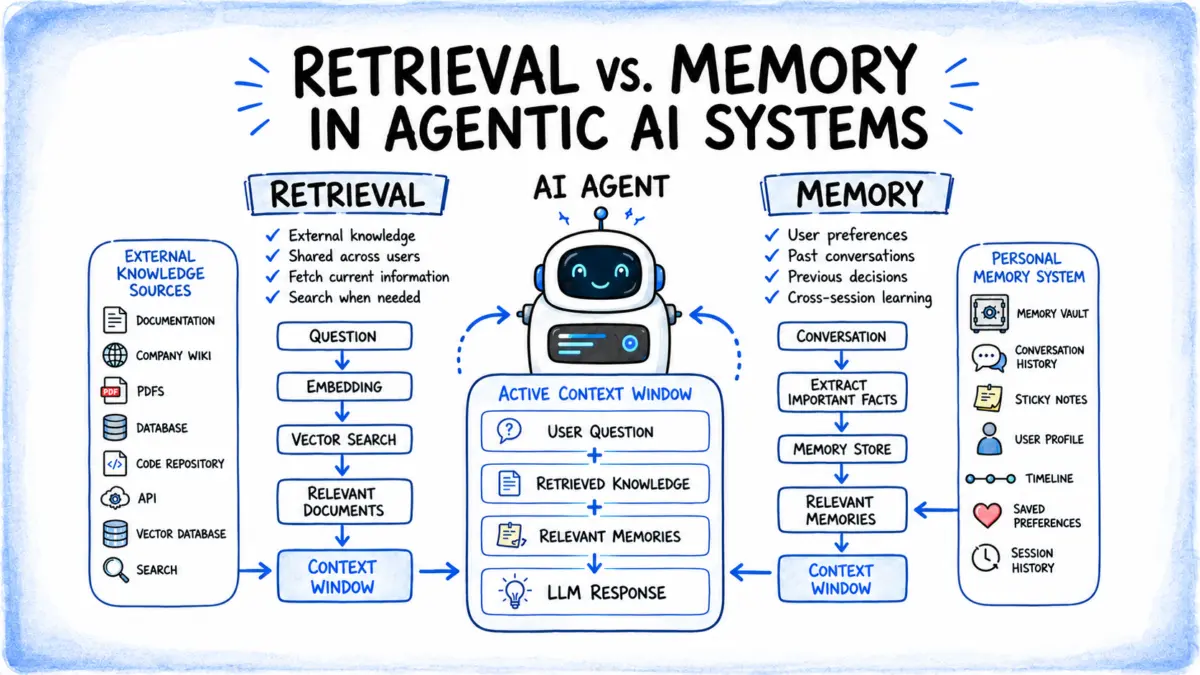
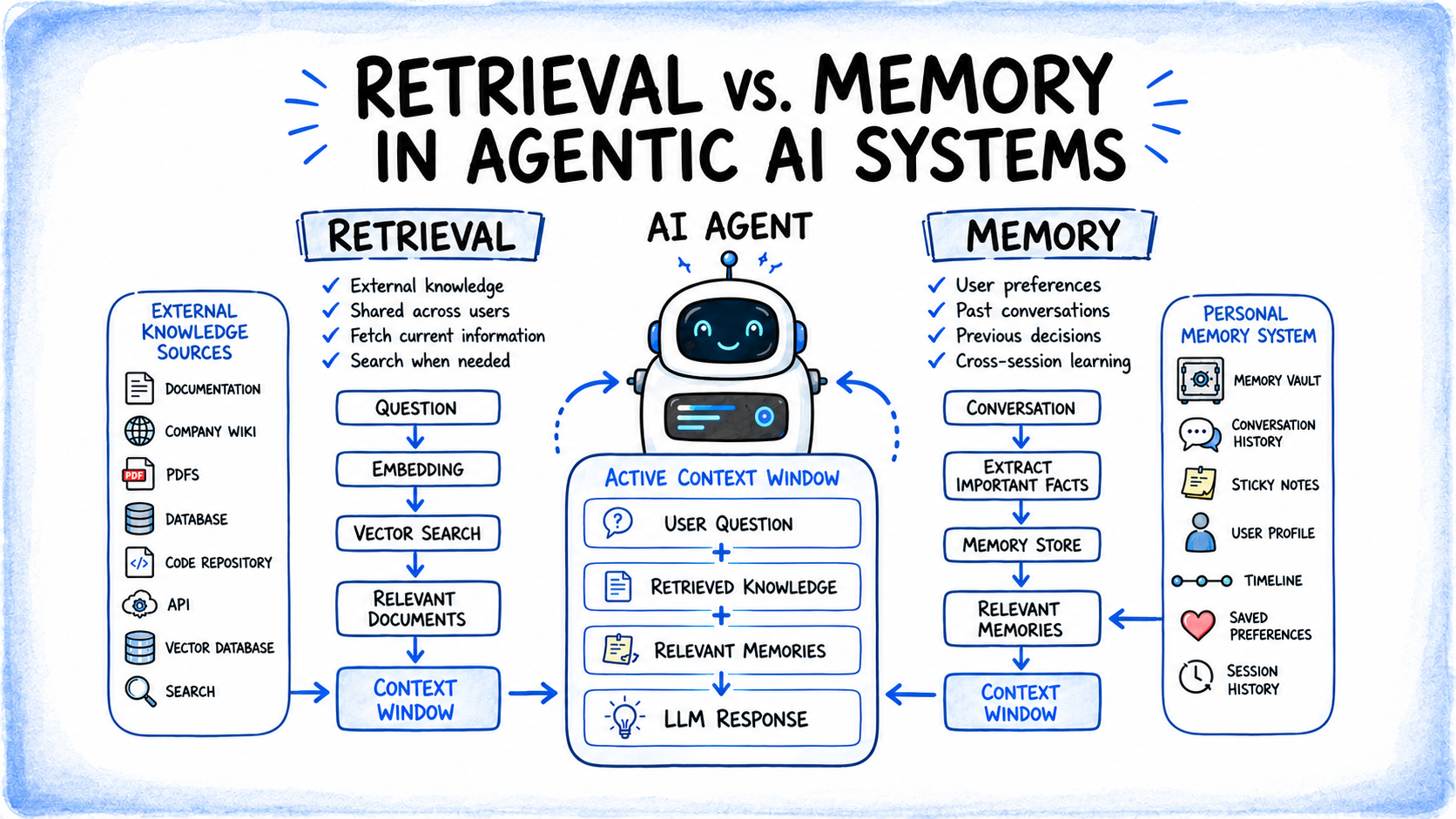
While both mechanisms leverage vector databases, embeddings, and context-engineering methodologies to bypass physical LLM token constraints, they solve fundamentally different problems. Retrieval serves as an agent’s access window to external, static domain knowledge that the model was never trained on and should not persistently carry in its active context—such as API documentation, codebase repositories, and corporate knowledge bases. Memory, by contrast, serves as the agent’s internal, dynamic record of experience—persisting state, user preferences, operational decisions, and historical interaction paths across execution sessions.
Building resilient, enterprise-grade AI agents requires moving beyond single-index architectures toward unified dual-engine systems. Without robust retrieval, an agent lacks grounding in external operational facts; without structured memory, an agent operates as an amnesiac, re-deriving basic conclusions and failing to personalize execution pathways. This article provides an authoritative analysis of the architectural distinctions, technical trade-offs, and operational strategies required to synthesize retrieval and memory into a cohesive, high-performance agentic state management system.
Detailed Chronology: The Architectural Evolution of Agent State
The transition from static text generation to stateful agentic workflows has passed through four distinct architectural eras, driven by the limitations of transformer context processing:
+-----------------------------------------------------------------------------------+
| ERA 1: The In-Context Epoch (2022-2023)                                           |
| - Hardcoded prompts, 4k-8k token limits, stateless single-turn paradigms           |
+-----------------------------------------------------------------------------------+
                                         |
                                         v
+-----------------------------------------------------------------------------------+
| ERA 2: The Naive RAG Explosion (2023)                                             |
| - External vector stores, chunking & semantic search for unstructured documents  |
| - Fatal flaw: Treated conversational history as static documents                  |
+-----------------------------------------------------------------------------------+
                                         |
                                         v
+-----------------------------------------------------------------------------------+
| ERA 3: The Extended Window Delusion (2023-2024)                                    |
| - 128k to 2M token context windows                                                |
| - Reality: Quadratic compute cost, latency spikes, "lost in the middle" degradation |
+-----------------------------------------------------------------------------------+
                                         |
                                         v
+-----------------------------------------------------------------------------------+
| ERA 4: Dual-Engine Context Architecture (Present)                                 |
| - Bifurcated state management: External static RAG vs. Dynamic personal memory     |
| - Background extraction, semantic consolidation, automated context pruning        |
+-----------------------------------------------------------------------------------+
Era 1: The In-Context Epoch (2022–2023)
Early autonomous agent frameworks relied entirely on zero-shot or few-shot prompts constrained within context windows of 4,000 to 8,000 tokens. System architects attempted to pack system rules, immediate conversational turns, and operational instructions into a single context payload. Agents operating in this paradigm suffered from rapid amnesia, reaching token limits within a handful of execution steps and forcing hard truncations that stripped away critical operational parameters.
Era 2: The Naive RAG Explosion (2023)
To overcome context limits, the industry rapidly adopted Retrieval-Augmented Generation (RAG). By chunking external documentation into dense vector embeddings and storing them in dedicated stores, systems could retrieve context-relevant snippets on demand. However, early engineering teams attempted to treat all information—including dynamic user dialogue and system state—as a homogeneous document corpus. This approach failed because semantic similarity search struggled to distinguish between historical facts, temporary scratchpad reasoning, and updated system parameters.
Era 3: The Extended Window Delusion (2023–2024)
The arrival of extended context windows spanning 128,000 to over 2 million tokens prompted a temporary shift away from managed context infrastructure. Many developers stuffed raw interaction logs, database dumps, and multi-file codebases directly into the prompt payload.
This approach proved economically and operationally unsustainable in production:
Quadratic Attention Cost: Processing massive context windows significantly increased inferencing latency and token costs.
Attention Degradation: LLMs suffered from "lost-in-the-middle" phenomena, failing to reliably retrieve and execute instructions buried inside bloated context buffers.
Era 4: The Dual-Engine Context Architecture (Present)
Today’s enterprise architectures recognize that context window management is an exercise in optimization. Context engineering has matured into a precise discipline, treating the context window as a scarce, real-time working space. Modern agent frameworks separate external domain knowledge (Retrieval) from experiential history (Memory), using automated background consolidation services, episodic graph databases, and dynamic context pruning.
Supporting Context & Technical Metrics: Retrieval vs. Memory
To construct an efficient system architecture, software engineers must analyze how Retrieval and Memory diverge across structural, operational, and financial dimensions.
                  +----------------------------------------------+
                  |            AGENT CONTEXT ENGINE              |
                  +----------------------------------------------+
                                         |
                   +---------------------+---------------------+
                   |                                           |
                   v                                           v
    +------------------------------+            +------------------------------+
    |       RETRIEVAL ENGINE       |            |        MEMORY ENGINE         |
    |   (External Knowledge)       |            |      (Agent State & History) |
    +------------------------------+            +------------------------------+
    | - Shared Global Corpus       |            | - User/Session/Task Specific |
    | - Static / Scheduled Index   |            | - Dynamic Extraction & Writes|
    | - Document & API Knowledge   |            | - Episodic & Semantic Facts  |
    +------------------------------+            +------------------------------+
                   |                                           |
                   +---------------------+---------------------+
                                         |
                                         v
                  +----------------------------------------------+
                  |         OPTIMIZED CONTEXT PROMPT            |
                  | [System Persona + Working Memory + RAG Docs] |
                  +----------------------------------------------+
Decoding Retrieval: The External Knowledge Engine
Retrieval engines provide answer paths to the fundamental query: "What does the broader enterprise or domain know about this issue that is not present in the model’s base weights or active context?"
Corpus Scope: Shared universally across users, sessions, and agents. Multiple users querying product support documentation hit the same retrieval index.
Pipeline Infrastructure: Unstructured documents, API definitions, and database schemas are chunked, embedded via dense or sparse models, and loaded into vector database indices or hybrid BM25/vector search engines.
Mutation Rhythm: Read-heavy and static. Index updates occur asynchronously on scheduled build pipelines or explicit documentation deployment triggers.
Decoding Memory: The Agent Experience Engine
Memory engines provide answer paths to the query: "What has this specific agent learned, decided, or executed across past interactions that must govern present behavior?"
Memory is further subdivided into two functional operational operational tiers:
Short-Term (Working) Memory: The immediate operational state, active context scratchpad, tool call outputs, and multi-turn message queues for the current session.
Long-Term Memory: Persistent information extracted across multiple sessions. This includes:
Episodic Memory: Chronological logs of specific past actions, multi-step execution graphs, and outcomes.
Semantic Memory: Extracted preferences, persistent user facts, mental models, and recurring operational constraints.
Architectural Matrix: Retrieval vs. Memory
Technical Dimension
Retrieval Architecture
Memory Architecture
Primary Data Source
External enterprise corpora, raw source code, static documentation, legacy datastores.
Query-time vector embedding and database lookup costs; static storage pricing.
Continuous background LLM extraction costs; complex index traversal compute.
Concrete Production Walkthrough: The Customer Support Agent
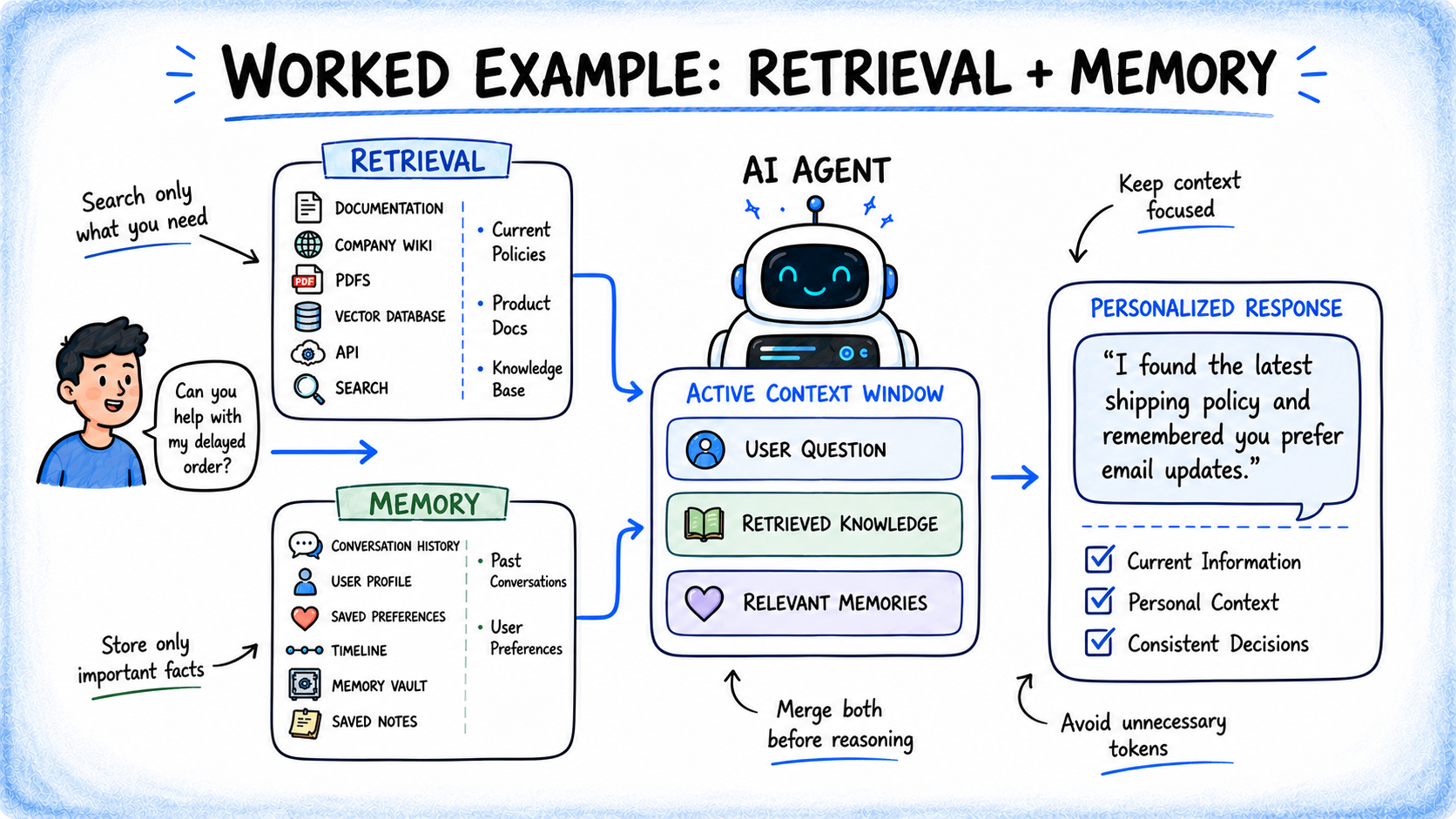
To see this distinction in practice, consider an autonomous customer support agent handling an e-commerce order issue:
[User Message: "My shipment is late. I need a resolution."]
                           |
                           v
              +--------------------------+
              | Agent Orchestration Core |
              +--------------------------+
                           |
             +-------------+-------------+
             |                           |
             v                           v
  +--------------------+       +--------------------+
  | Query Memory Store |       | Query Retrieval    |
  | (User History)     |       | (Corporate Policy) |
  +--------------------+       +--------------------+
             |                           |
             v                           v
  [Result: User prefers email  [Result: Shipping policy
   follow-ups; resolved last    v2.4 specifies partial
   delay via partial refund]    refund for >3-day delay]
             |                           |
             +-------------+-------------+
                           |
                           v
              +--------------------------+
              | Synthesis in Context     |
              | Window & Action Decision |
              +--------------------------+
Memory Query: The agent queries its Memory Store using the customer ID. It retrieves episodic facts: the user encountered a similar delay three weeks ago, explicitly requested email-only updates, and accepted a 15% partial refund.
Retrieval Query: The agent queries its Retrieval Index (RAG pipeline) using the query parameters shipping_delay_policy_2026. It fetches the current, globally applicable corporate operational policy updated last month.
Context Synthesis: The agent merges these inputs into its active reasoning window:
Retrieved Memory: User-specific history and communication preferences (Personal operational fact).
Execution: The agent issues an automated partial refund that complies with global policies while aligning with the customer’s historical interaction model.
Official Statements & Industry Perspectives
The operational separation between retrieval and memory has emerged as a core architectural best practice among leading AI research labs and enterprise infrastructure engineers.
In its authoritative guidance on context engineering, Anthropic’s Engineering Team emphasized the necessity of treating the context window as an active workspace rather than an unstructured datastore:
"Context engineering is the discipline of maximizing the utility of every single token passed to the model. Stuffed contexts introduce noise, degrade attention metrics, and drastically increase latency. High-performing agent architectures treat the prompt window as dynamic working RAM, pulling static facts from vector search engines and state facts from structured memory stores only when required by the immediate agent goal."
Similarly, technical architects at IBM’s AI Division underscored the operational vulnerabilities of failing to properly isolate memory frameworks from retrieval mechanisms:
"When systems confuse retrieval with memory, agent reliability collapses. A classical RAG pipeline cannot tell you if a user changed their mind mid-conversation, nor can it track state across long-running asynchronous workflows. Conversely, memory engines lack the scale and transactional guarantees required to house gigabytes of technical documentation. Isolating these subsystems into dedicated read and write paths is mandatory for production reliability."
Engineering practitioners building on Google Cloud’s Agent System Architecture frameworks have reached similar conclusions regarding governance and compliance:
"From a compliance and security baseline, memory and retrieval must be handled via distinct access controls. Retrieval engines generally point to shared corporate repositories protected by enterprise Access Control Lists (ACLs). Memory stores, however, hold sensitive user history, stateful preferences, and potentially Personally Identifiable Information (PII). Conflating the two creates significant privacy and data-leakage risks."
Future Outlook: The Convergence toward Unified Cognitive Architectures
As LLMs continue to decrease token costs and increase processing speeds, the boundary mechanisms managing context will grow increasingly sophisticated. The next iteration of agent state management will move toward Unified Cognitive Architectures built around three primary design patterns:
1. Hybrid Query Orchestrators
Future agent frameworks will replace manual decisions about where to search with multi-tiered context routers. A single unified agent prompt will query a Context Router, which will dynamically route requests to external search engines, RAG pipelines, user memory graphs, or transactional SQL databases in parallel. The engine will merge and re-rank these results before writing them into the context window.
To manage memory growth without incurring high token costs during active user interactions, enterprise agent architectures are adopting background offline consolidation loops. Similar to biological sleep consolidation, these asynchronous pipelines review raw interaction logs off-peak, resolve conflicting statements, prune expired preferences, and update persistent Knowledge Graphs. This ensures that the online agent queries clean, compact semantic state records during active execution.
3. Dynamic Context Budgets and Token Tiering
Instead of static prompt boundaries, context managers will operate on adaptive token budgets allocated dynamically based on task risk and execution complexity:
High-Precision Tasks (e.g., automated code refactoring, legal analysis) will dedicate up to 80% of their token budget to deep external RAG retrieval chunks.
High-Personalization Tasks (e.g., executive assistants, adaptive learning tutors) will invert that allocation, prioritizing deep semantic user state and dynamic episodic history.
By treating Retrieval as a global, read-heavy reference system and Memory as a hyper-personalized, stateful execution engine, systems developers can overcome LLM context limitations. This architectural separation unlocks scalable, stateful, and contextually aware autonomous agents capable of operating across extended enterprise workflows.