

Executive Overview
When a faulty software or firmware update transforms an expensive piece of hardware into a useless electronic paperweight, the fundamental question of accountability immediately takes center stage. Who bears the financial and operational burden when a manufacturer’s own update bricks a consumer device?
While modular computing pioneers like Framework have previously set a consumer-friendly precedent by unequivocally stepping up to offer free repairs for company-induced system failures, computing giant Lenovo has found itself under intense public scrutiny regarding its handling of a similar crisis.
Weeks after early adopters and gaming enthusiasts began flooding online forums with terrifying reports of dead handheld gaming PCs and steep, nearly $300 repair bills, Lenovo has officially broken its silence. The company acknowledges that certain iterations of its popular Legion Go handheld devices are encountering critical display and boot failures following the installation of BIOS version V42 (N3CN42WW).
However, Lenovo’s initial response—instructing users to hold down power buttons and contact customer service, alongside ambiguous forum statements regarding out-of-warranty repairs—has left many consumers unsatisfied. This developing crisis underscores a critical vulnerability in modern consumer electronics: the delicate trust between hardware manufacturers and their user bases when automated quality control fails, and the pressing need for standardized, transparent policies concerning software-induced hardware failures.
Detailed Chronology: From Silent Launch to Community Outcry
The unfolding controversy surrounding the Lenovo Legion Go and BIOS update V42 did not erupt overnight. Instead, it followed a trajectory familiar to modern tech crises: isolated user complaints bubbling up on niche subreddits, followed by a sudden cascade of panic, corporate opacity, and finally, defensive maneuvers by the manufacturer.
The Groundswell on Reddit
The timeline of the crisis traces back through several weeks of escalating frustration within the online gaming community. Owners of the original Lenovo Legion Go 8APU1 began turning to online communities such as the r/LegionGo subreddit to share alarming experiences. Users reported black screens, unresponsive systems, and boot loops immediately following attempts to update their firmware.
By mid-to-late February, the tone on these forums shifted from troubleshooting queries to financial distress. One prominent Reddit thread detailed a jaw-dropping repair estimate approaching $300 for a device rendered inoperable through no fault of the user, other than installing a firmware patch sourced directly from the manufacturer’s support channels. As additional reports accumulated—highlighting persistent black screens, failed power cycles, and high-cost repair quotes—the community realized this was not an isolated incident, but a systemic software defect affecting a subset of units in the wild.
Lenovo’s Stealth Rollback and Official Response
For weeks, Lenovo remained largely quiet as community alarm grew. During this window, the controversial BIOS update V42 (N3CN42WW)—which had been manually downloadable from Lenovo’s support portal for roughly two months—was quietly scrubbed from the website. Crucially, the update had never been broadly distributed via automated channels like Windows Update or the proprietary Legion Space utility, meaning users had to intentionally seek out and download the file.
When Lenovo finally addressed the public, it did so through a corporate statement provided to industry media outlets. Jeff Witt, Lenovo’s communications director, confirmed the company’s awareness of the issue:
"Lenovo is aware that some Legion Go devices may experience a blank screen during installation of BIOS version V42. BIOS V42 was not distributed through Windows Update or Legion Space, and Lenovo has removed the update from its support website while we continue our validation work. Users who have successfully completed the V42 update should not need to take further action at this time."
The company’s initial troubleshooting advice for affected users was remarkably simple, albeit frustratingly sparse for those dealing with genuinely bricked hardware: press and hold the power button for approximately 10 seconds, wait about a minute, and attempt to power the device back on. If that failed, customers were directed to contact Lenovo Support.

Supporting Context & Metrics: Hardware Vulnerability and Reproducibility
To fully understand the scope and nature of the Legion Go BIOS V42 crisis, it is essential to examine the technical variables at play. Not every Legion Go in existence was vulnerable to the bug, and the erratic nature of the failure has presented unique diagnostic challenges for Lenovo’s engineering teams.
Device Eligibility and Isolation
The vulnerability was strictly limited to the original Legion Go 8APU1 models. Later iterations, such as the Legion Go S or the anticipated Legion Go 2, were unaffected. Furthermore, because Lenovo pulled the update from its public support ecosystem after approximately two months of availability, the exposure window was theoretically restricted to enthusiasts who actively sought out manual BIOS updates rather than waiting for automated pushes.
The Russian Roulette of Firmware Updates
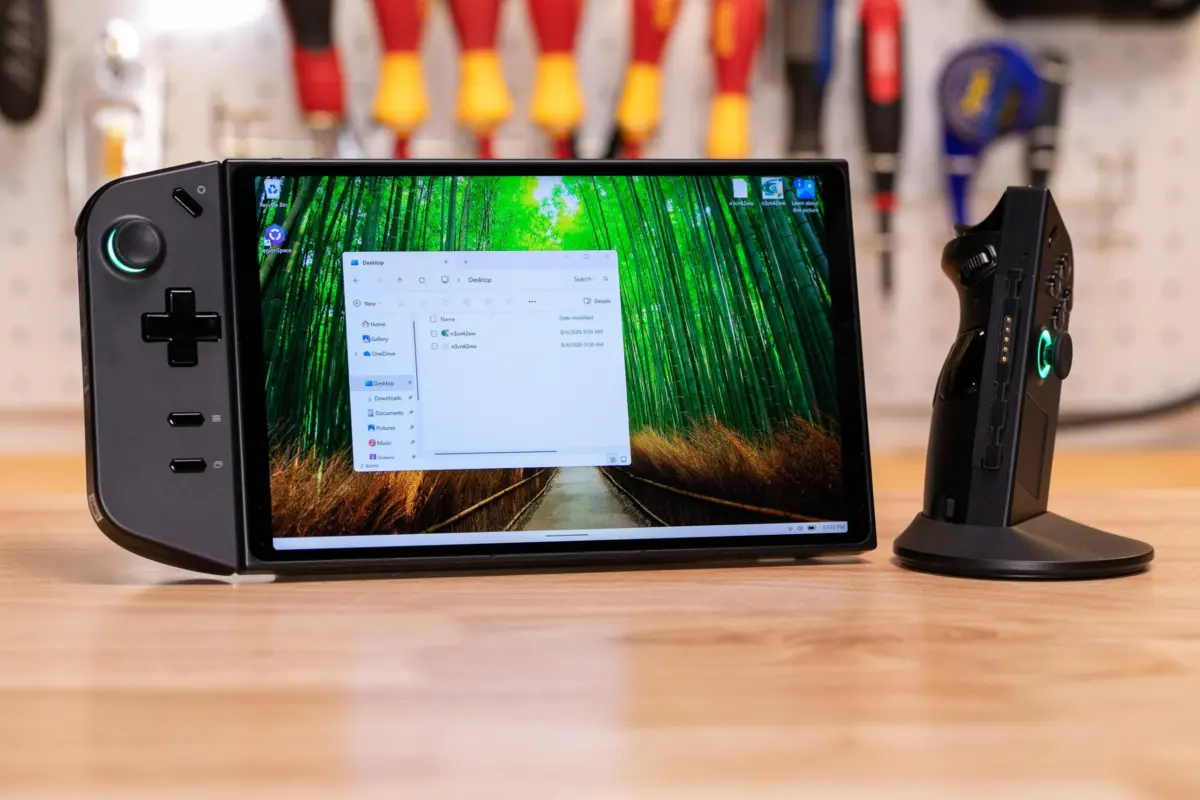
Interestingly, testing conducted by tech reviewers demonstrated that the update did not universally brick every targeted device. For instance, testing performed on a review unit of the original Legion Go revealed that installing the "forbidden" BIOS V42 resulted in a nerve-wracking six-minute sequence of black screens, progress bars, and stern warnings. Ultimately, however, the device successfully booted into Windows, fully restored gaming functionality, and even introduced welcome quality-of-life improvements—such as allowing users to log into Windows using a PIN entered directly via the gamepad controls, a feature that had been broken immediately prior to the update.
Hardware Inconsistencies and Regional Discrepancies
The erratic manifestation of the bug points toward a classic manufacturing variance problem. According to statements allegedly leaked by a Lenovo employee on official support forums—an account associated with the username "Daniel_Legion"—engineering teams in Europe were able to successfully reproduce the blank-screen bricking issue on three out of three test devices. Conversely, other regional teams were entirely unable to replicate the bug in controlled environments.
Daniel_Legion explained the diagnostic hurdle to the community:
"As such, the issue is most likely related to specific components used on mainboards in certain batch or batches, or the issue needs to have specific circumstances to manifest."
This revelation suggests that a specific hardware revision or component supplier variation within a distinct manufacturing run of the Legion Go mainboards reacts catastrophically to the V42 microcode, while other identical-looking units sail through the update without issue.
Official Statements and Policy Ambiguity
The corporate communication surrounding the Legion Go crisis has exposed a rift between rigid standard operating procedures and consumer expectations of fairness.
When Lenovo released its official statement through Jeff Witt, it focused heavily on containment: removing the file, advising basic power cycles, and funneling users into standard support pipelines. Crucially, the official statement omitted any explicit commitment regarding financial liability, leaving open the terrifying possibility that out-of-warranty users—or those whose regional consumer protection laws are weak—might be billed for repairs necessitated by a manufacturer-authored file.
The Forum Contradiction
Adding to the confusion was the appearance of "Daniel_Legion" on the Lenovo support forums. While attempting to calm restless users, this representative stated that units under warranty should be repaired free of charge, and added regarding out-of-warranty devices: "it should be repaired free of charge, but please check local laws."
For consumer advocates and affected owners, this statement is far from reassuring. Relying on the phrase "local laws" implies that Lenovo’s willingness to fix a software-induced hardware failure is dictated purely by legal obligation rather than corporate responsibility or goodwill.

As technology journalists and consumer advocates have pointed out, asking customers to navigate jurisdictional legal frameworks just to secure a repair for a device destroyed by an official manufacturer update is an unacceptable customer service posture. At the time of reporting, follow-up inquiries have been submitted to Lenovo corporate communications to clarify whether Daniel_Legion’s statements represent official company policy and whether the company will unconditionally extend warranty coverage to encompass all BIOS-bricked Legion Go units.
Comparative Industry Standards: Framework vs. Lenovo
The Lenovo Legion Go controversy gains sharper relief when compared directly against how competing hardware companies handle similar software catastrophes.
The Framework Precedent
In stark contrast to Lenovo’s cautious, legally hedged approach, modular computing company Framework established a gold standard for accountability during its own firmware crises. When a software update for Framework’s AMD 7040-series laptops (specifically BIOS 320) inadvertently turned user computers into useless bricks, the company did not hesitate or hide behind warranty clauses. Framework publicly acknowledged the mistake, streamlined the recovery process, and made it abundantly clear that fixes and hardware replacements resulting from the bad update would be entirely free of charge, regardless of warranty status.
The Ethical Imperative for Tech Giants
The philosophical divide between these two approaches highlights a growing crisis of corporate ethics in the consumer tech space. Modern devices—whether they are modular laptops, handheld gaming PCs, smartphones, or smart home appliances—rely entirely on continuous firmware updates to maintain security, optimize performance, and unlock advertised features.
When a company releases a corrupted or insufficiently validated BIOS update, the failure originates entirely within the manufacturer’s quality assurance pipeline. Forcing an end-user to pay hundreds of dollars to resurrect a device that was operating perfectly until it ingested an official manufacturer patch is functionally equivalent to an automotive manufacturer installing a defective recall part and sending the customer a bill for the engine rebuild.
Industry analysts argue that tech giants must adopt a zero-liability policy for end-users when it comes to official firmware updates. If a company distributes a file that bricks hardware, the moral and financial obligation to restore that device to working order—shipping costs, parts, and labor included—must rest squarely on the manufacturer’s shoulders, irrespective of arbitrary warranty expiration dates.
Future Outlook: What Next for Legion Go Owners?
As the dust begins to settle around the Legion Go BIOS V42 fiasco, several critical questions remain unanswered for the community and for Lenovo’s leadership.
-
Will Lenovo Issue a Blanket Repair Policy?
Consumers are waiting for an unambiguous, globally binding statement from Lenovo clarifying that all units bricked by BIOS V42 will be repaired or replaced entirely free of charge, regardless of warranty status. Vague forum hints relying on "local laws" will not suffice in maintaining consumer trust in Lenovo’s gaming ecosystem. -
Improved Quality Assurance and Validation Protocols:
The fact that BIOS V42 slipped past internal checks—only to be validated successfully by some regional teams while catastrophically bricking others—highlights deep-seated issues in Lenovo’s supply chain traceability and firmware testing pipelines. Moving forward, the company must institute rigorous cross-batch testing to ensure that hardware variations do not result in catastrophic software failures. -
Transparent Communication Channels:
The weeks of silence from Lenovo while Reddit threads accumulated horror stories damaged the brand’s relationship with its most dedicated advocates. Establishing rapid-response channels and transparent acknowledgment of known bugs will be vital as Lenovo continues to develop and market handheld gaming hardware.
Ultimately, the Lenovo Legion Go BIOS controversy serves as a cautionary tale for the entire consumer technology industry. In an era where devices are increasingly defined by the software running inside them, hardware manufacturers can no longer afford to treat firmware updates as minor housekeeping tasks. Accountability must match complexity—and when a company breaks a user’s computer, fixing it shouldn’t cost the customer a dime.
