

Executive Overview
For years, the trajectory of artificial intelligence seemed immutable: bigger was inherently better. The industry standard dictated that developers route software applications through centralized cloud APIs, implicitly accepting latency overheads, unpredictable scaling costs, and significant data exposure risks as the unalterable cost of doing business. Enterprises and independent builders alike traded autonomy for capability, tethering their applications to remote infrastructure managed by a handful of tech giants.
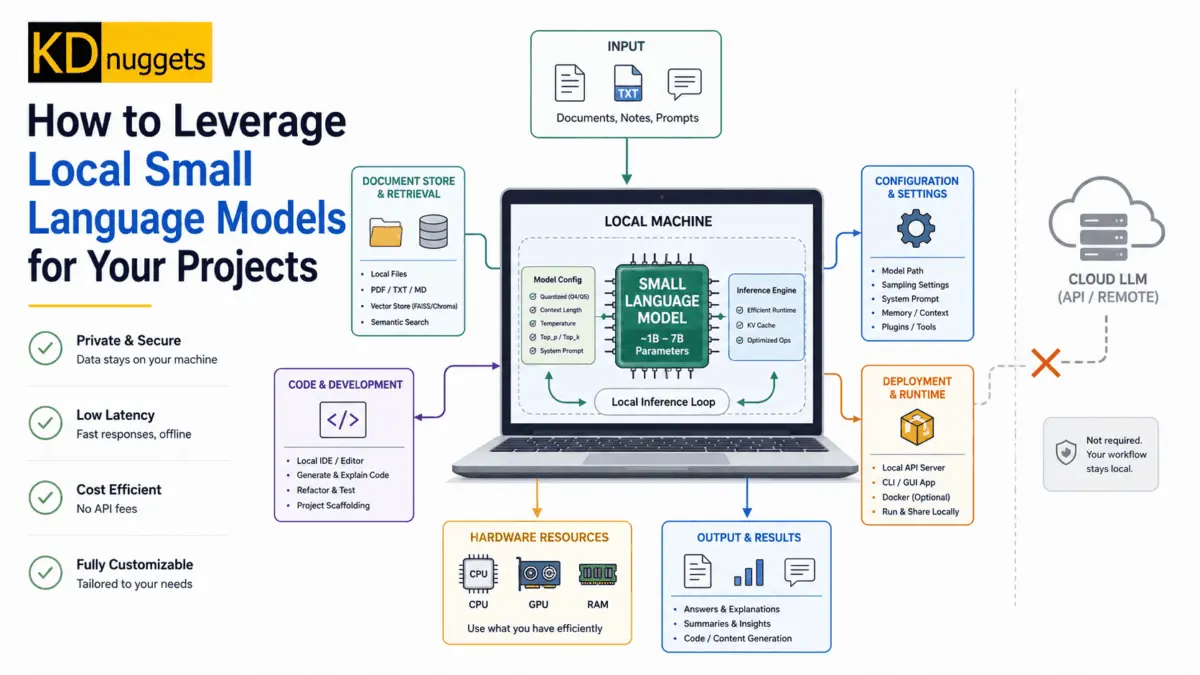
Today, that foundational assumption has dissolved. A quiet revolution in open-weight architecture has catalyzed the maturation of Small Language Models (SLMs). Typically operating in the range of 1 billion to 13 billion parameters, these compact architectures pack a disproportionate computational punch. Capable of running locally on a standard consumer-grade laptop or a single desktop GPU, modern SLMs deliver lightning-fast inference, eliminate external API dependencies, slash operational costs to zero beyond initial hardware, and—most importantly—grant organizations absolute, uncompromised control over their data.
This comprehensive briefing explores the operational framework of deploying local SLMs. From hardware optimization and model selection using tools like Ollama to advanced agentic workflows and rigorous quality evaluation, we examine how developers are reclaiming their infrastructure and building production-grade AI solutions closer to the metal.
Detailed Chronology: From Cloud Monopolies to Local Autonomy
The evolution of generative AI can be segmented into distinct waves, each shifting the paradigm of where and how intelligence is executed.
Phase 1: The Cloud-First Era (2020–2023)
Following the breakthrough of transformer-based architectures, the immediate focus was raw scale. Models expanded from millions to hundreds of billions of parameters, demanding data centers packed with high-end accelerators. Developers had no choice but to rely on proprietary cloud endpoints. While this democratized access to raw intelligence, it introduced massive structural friction:
- Latency Penalties: Every user interaction required a round-trip network request to a remote server.
- Cost Volatility: Token-based pricing models made prototyping expensive and high-volume scaling economically prohibitive for many organizations.
- Data Compliance Nightmares: Transmitting proprietary code, personal identifiable information (PII), and sensitive corporate documents to third-party servers created severe legal and security vulnerabilities.
Phase 2: The Emergence of Open-Weight Open-Source (Late 2023–2024)
The release of open-weight families—such as Meta’s LLaMA series and Mistral AI’s foundational models—marked the first major fracture in the cloud monopoly. For the first time, sophisticated weights were made available to the public. However, early deployments still demanded heavy server-grade infrastructure, limiting local execution to well-resourced engineering teams.
Phase 3: The SLM Maturation and Edge Deployment Boom (2025–Present)
We have now entered the era of hyper-efficient localization. Through aggressive quantization techniques (such as GGUF formatting), pruning, and optimized distillation, models sized between 1B and 13B parameters have achieved performance parity with older generation large-scale models. Paired with lightweight local runtimes like Ollama, developers can spin up tailored, highly specialized language models on edge devices in seconds. The default engineering mindset has inverted: rather than defaulting to the cloud, developers now ask, "Can this run locally?"
Supporting Context & Metrics: The Anatomy of Local SLM Deployment
To successfully integrate local SLMs into a production architecture, engineers must understand the underlying economics, hardware dynamics, and operational trade-offs.
The Core Pillars of Local SLM Advantages
-
Privacy and Absolute Data Control
When an inference loop executes entirely on a local machine, data remains strictly within the local environment. Prompts, enterprise documents, and generated outputs never traverse a public network or touch third-party servers. For sectors bound by rigorous data governance frameworks—such as healthcare (HIPAA), finance, and legal services—this completely eliminates compliance friction. -
Cost Predictability
Cloud APIs charge per token, creating a variable overhead that scales directly with user engagement. Local models incur a fixed hardware acquisition cost followed by zero marginal cost per token. This enables unrestricted experimentation, stress-testing, and large-scale automated data processing pipelines without fear of budget overruns. -
Unprecedented Low Latency
By removing network round-trips entirely, local inference delivers instantaneous response times. For real-time applications—such as interactive code completion, conversational agents, or assistive UI elements—this creates a fluid, organic user experience that feels natively integrated into the host operating system.
Hardware Realities and Constraints
While local SLMs are remarkably efficient, they are bound by hardware laws. Understanding the interplay between model parameters, quantization, and memory architecture is vital:
- 1B to 3B Parameter Models: Ideal for ultra-lightweight edge devices, mobile environments, and basic classification tasks. These models can run smoothly on almost any modern laptop with 8 GB of RAM.
- 7B Parameter Models: The undisputed sweet spot of the current ecosystem. They strike an optimal balance between reasoning capability and hardware demands, running comfortably on consumer GPUs with 8 GB of VRAM (or unified Mac Apple Silicon memory) using 4-bit quantization (Q4).
- 13B Parameter Models: Represent the upper threshold for single-GPU consumer hardware, offering advanced instruction-following and coding capabilities at the cost of higher memory consumption.
Navigating the Ecosystem: Tools, Configuration, and Architecture
Transitioning from cloud dependence to local infrastructure requires a deliberate stack of tools designed to streamline deployment and optimization.
Orchestration with Ollama
Running and managing local weights once required complex Python scripts and direct interaction with low-level C++ libraries (such as llama.cpp). Ollama has effectively standardized local model execution across macOS, Linux, and Windows.
By providing a clean command-line interface, Ollama handles automated model downloading, GPU offloading, and local REST API hosting out of the box (defaulting to port 11434). This makes local models instantly compatible with mainstream orchestration frameworks like LangChain and LlamaIndex. Furthermore, engineers are not restricted to Ollama’s curated registry; GGUF-format weights can be pulled directly from Hugging Face, opening access to community fine-tunes and specialized vertical variants.
Fine-Tuning Behavior via Modelfiles
Deploying raw models is rarely sufficient for production use cases. Ollama utilizes Modelfiles—conceptually analogous to Dockerfiles—to govern model behavior. Through a Modelfile, developers can configure:
- System Prompts: Defining exact behavioral boundaries, personas, and domain expertise.
- Context Windows: Balancing memory footprint against the need to ingest long-form text or documentation.
- Temperature & Sampling Parameters: Tuning determinism (low values like
0.2for code generation and data extraction) versus creativity (higher values like0.8for brainstorming).
Advanced Architectural Patterns
-
Retrieval-Augmented Generation (RAG) Pipelines:
Local SLMs excel at the synthesis phase of RAG systems. By coupling a local model with a local vector database, enterprises can build secure, offline document-assistance tools that parse proprietary PDFs, internal wikis, and legal briefs without a single byte leaving the corporate network. -
Agentic Multi-Agent Workflows:
Rather than relying on a single monolithic model to handle complex multi-step tasks, modern agentic architecture delegates sub-tasks to small, hyper-specialized SLMs. Because these agents are lightweight, multi-agent loops execute rapidly and operate completely offline.
Future Outlook: The Horizon of Edge Intelligence
As the small language model ecosystem continues its rapid ascent, several distinct trends are shaping the future of AI engineering:
- Architectural Efficiency Gains: Research into state-space models (such as Mamba architectures) and advanced quantization techniques suggests that future SLMs will deliver higher reasoning performance at even lower memory footprints.
- Ubiquitous On-Device Integration: Operating systems are increasingly shipping with native SLM runtimes embedded at the kernel level. Developers will soon build applications that assume local intelligence as a baseline system utility, much like a database driver or graphics library.
- Democratization of Custom Fine-Tuning: Fine-tuning a 3B or 7B model on custom domain data is transitioning from an academic specialty to an accessible, consumer-hardware workflow using Low-Rank Adaptation (LoRA).
Final Thoughts
The narrative that artificial intelligence requires massive, centralized data centers is rapidly fading. The rise of production-grade Small Language Models, paired with accessible tooling like Ollama and flexible deployment paradigms, has permanently altered the engineering landscape.
Organizations no longer need to compromise their privacy, budget predictability, or user experience to leverage state-of-the-art natural language processing. By carefully matching model parameters to hardware constraints, optimizing system prompts, and architecting robust local pipelines, developers can build responsive, secure, and sovereign AI applications tailored precisely to their operational needs. The future of AI is not locked away in a remote cloud; it is running locally on the device in front of you.
