

Executive Overview
The intersection of robotics, machine learning, and cloud infrastructure has historically been plagued by data friction. For years, the paradigm of training robotic policies has followed a cumbersome, disjointed ritual: collect demonstrations in the physical world or simulation, package them into massive monolithic files, push them to a version-controlled repository, download those hundreds of gigabytes onto a GPU-accelerated cluster, train a model, and finally, manually serialize and deploy the resulting checkpoint back to hardware.
Run this loop once, and it is a technical victory. Run it continuously—gathering episodes throughout the day, retraining models overnight, and pushing fresh weights to robotic arms—and the systemic inefficiencies quickly compound. Network egress fees mount, storage systems choke on duplicated files, and idle GPUs sit waiting for massive downloads to complete.
Enter Strands Robots, an open-source SDK from AWS released under the Apache 2.0 license. Designed to abstract the complexities of hardware embodiments, simulation environments, and the rapidly growing LeRobot ecosystem into unified agent tools, Strands Robots introduces a seamless, end-to-end streaming data loop. By leveraging Hugging Face Storage Buckets backed by Xet content-defined chunking and native dataset streaming, the framework transforms how robotic data moves.
This article explores the inner workings of the Strands Robots streaming data loop. We will dissect how a single agentic workflow bridges the gap between hardware demonstration recording, byte-level efficient cloud storage, GPU-accelerated streaming training, and seamless edge deployment—all while maintaining the standard LeRobot on-disk format from end to end.
Detailed Chronology & Architecture of the Data Loop
To understand the power of the Strands Robots architecture, one must trace the lifecycle of a single robotic demonstration. The data loop is broken down into four distinct yet interconnected stages: Recording, Storing, Training, and Deploying. Each stage feeds directly into the next, creating a continuous cycle powered by a unified backend and abstract interface.
Stage 1: Natural Language Demonstration Recording
The journey begins at the edge—either in a simulation environment or on physical hardware such as a SO-100 or SO-101 robotic arm. Utilizing the Strands Robots factory pattern, a single Robot() abstraction manages embodiments ranging from articulated arms to humanoids, mobile bases, and dexterous hands.
Through natural language prompts interpreted by an autonomous agent, the system handles scene setup, camera configurations, policy execution, and recording parameters. For instance, an agent can be tasked with creating a simulation world, spawning a robotic arm and a red cube, initiating a recording session at 30 frames per second, and executing a policy for a set number of steps.

from strands import Agent
from strands_robots import Robot, sync_dataset_to_bucket

sim = Robot("so100")                 # mode="sim" by default
agent = Agent(tools=[sim])

agent(
    "Create a world with the so100 robot, add a red cube and a front camera, "
    "start recording (repo_id='local/cube_pick', root='/tmp/cube_pick', fps=30, "
    "overwrite=True, task='pick up the red cube'), run the mock policy for "
    "60 steps, then stop recording."
)
The data is saved locally in the standard LeRobot dataset format, comprising Parquet shards for joint states and actions alongside MP4 shards for camera observations. Crucially, rather than immediately forcing this data into a traditional, versioned Git-LFS repository (where every append triggers heavy commits), the recording is seamlessly synchronized into a mutable Hugging Face Storage Bucket via a straightforward utility call:
sync_dataset_to_bucket("/tmp/cube_pick", "my-org/robot-fave")Stage 2: Byte-Level Deduplication via Xet
In a heavy robotic data collection campaign, redundancy is the enemy of efficiency. Pointing fixed cameras at a workspace for eight hours means recording thousands of episodes that share identical backgrounds, static lighting, and stationary chassis configurations. In traditional version-controlled repositories, modifying a single frame in a multi-gigabyte video shard forces the re-upload of the entire file.
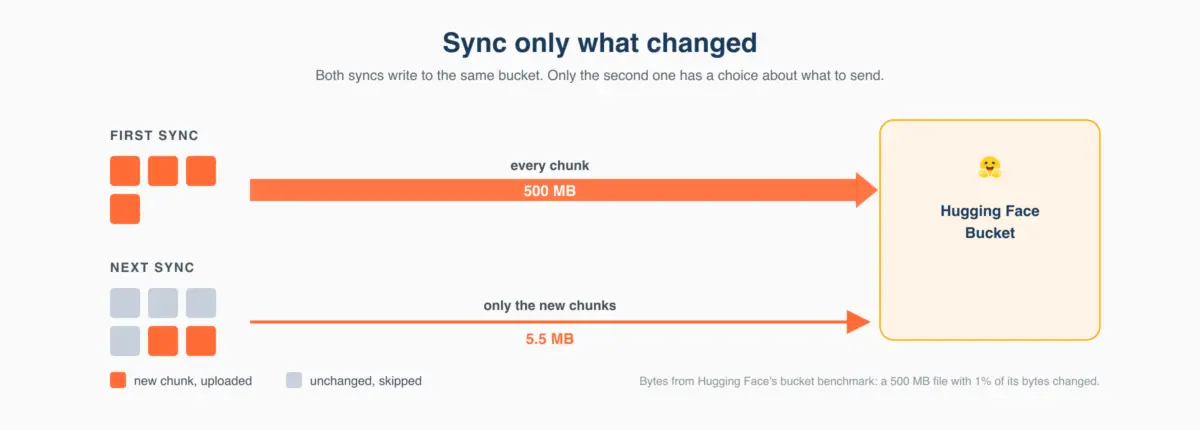
Strands Robots solves this by integrating with Hugging Face Storage Buckets backed by Xet object storage. Xet implements content-defined chunking. Rather than splitting files at rigid byte intervals, chunk boundaries dynamically follow the underlying data content. If a few bytes are inserted or modified, only the specific chunk containing the change is affected, leaving adjacent chunk boundaries untouched.
When an agent syncs an ongoing recording session—which naturally rolls over into new Parquet and MP4 shards as files fill up—subsequent sync operations upload only the newly appended trailing shards and the single partially filled shard that grew. The rest of the dataset is instantly recognized, eliminating redundant data transfers.
Stage 3: Zero-Download GPU Training via Streaming
Traditionally, training a robotic policy on collected episodes required downloading hundreds of gigabytes of video and telemetry data to local storage, leaving expensive GPU clusters idle during the transfer window.
Strands Robots eliminates this bottleneck by streaming datasets directly from the Hub into the training loop. Utilizing LeRobot’s StreamingLeRobotDataset integrated into the Strands framework, training jobs read data frame-by-frame over network byte-range requests.
reader = sim.stream_dataset("my-org/robot-fave/cube_pick", repo_type="bucket",
    shuffle=False, max_num_shards=1, buffer_size=1,
)

for frame in reader:
    frame["observation.images.front"]   # (3, H, W) tensor, decoded on-the-fly
    frame["observation.state"]           # joint vector from Parquet shard
    frame["action"]
    break
Nothing touches the local disk except a lightweight meta/ folder containing schema definitions, dataset statistics, and episode indices. Camera video frames are decoded dynamically on the fly from remote MP4 shards as the data loader iterates. For environments lacking specialized video codecs on edge hardware, options like drop_videos=True allow proprioceptive-only streaming, bypassing video decoding entirely.

When paired with modern distributed training frameworks or native LeRobot trainers, this streaming architecture allows GPUs to begin processing batches almost instantaneously, maximizing hardware utilization.
Stage 4: Hardware Deployment and Loop Closure
Once training concludes and a new policy checkpoint is generated, the final stage closes the loop: deployment back to the physical hardware.
Because the Strands Robots SDK maintains a uniform interface across simulation and reality, moving a policy from a virtual environment to a physical robotic arm requires changing a single keyword argument (mode="real"):
robot = Robot("so100", mode="real", port="/dev/ttyACM0",
              cameras="front": "type": "opencv", "index_or_path": "/dev/video0", "fps": 30)
agent = Agent(tools=[robot])
agent("Pick up the red cube.")
The newly trained policy executes continuous actions on the physical hardware. The demonstrations gathered by the robot during this real-world execution are captured in the exact same LeRobot format, ready to be synced back to the storage bucket for the next iterative training cycle.
Supporting Context & Metrics: Performance and Efficiency
The architectural choices embedded within the Strands Robots data loop yield profound operational efficiencies, which can be quantified across several core metrics:
- Upload Bandwidth Reduction: Internal benchmarks on Xet-backed Hugging Face Storage Buckets demonstrate that content-defined chunking reduces data transfer volumes by approximately 4x across diverse enterprise workloads. For instance, when modifying 1% of a 500 MB dataset, subsequent uploads move a mere 5.5 MB, compared to re-uploading the entire 500 MB payload in legacy object storage systems.
- CDN Pre-Warming & Throughput: Hugging Face’s edge infrastructure pre-warms bucket data near major cloud regions. Cold reads on 10 GB payloads achieve roughly 780 MB/s, jumping to over 1,086 MB/s when warm. At 100 GB payloads, warm throughput climbs past 1,124 MB/s (measured on AWS
m5dn.24xlargeinstances inus-east-1), ensuring that training data loaders never starve high-end GPUs of data. - Training Velocity: On a single NVIDIA L4 GPU (
g6.4xlarge), executing 500 optimizer steps of the Action Chunking with Transformers (ACT) policy (featuring 51.6M parameters and an effective batch size of 8) over a 120-frame episode completes in a mere 133 seconds. - Ecosystem Adoption: The foundational LeRobot dataset format has achieved widespread industry validation, underpinning over 90,000 datasets and models on the Hugging Face Hub contributed by more than 8,000 publishers, ensuring complete interoperability for any tool built on the LeRobot stack.
Official Statements & Ecosystem Perspectives
The release of Strands Robots and its deep integration with Hugging Face Storage Buckets represents a strategic convergence of cloud infrastructure and edge robotics.
Engineering leads behind the initiative emphasize that the primary goal of the SDK is to remove the "glue code" tax that has traditionally slowed down embodied AI research. “By unifying simulation, hardware abstractions, and the LeRobot dataset standard into a cohesive agentic loop, developers can stop writing custom ingestion scripts and focus entirely on policy iteration,” notes documentation from the Strands Labs open-source repository.

Furthermore, the integration of Xet-backed buckets directly addresses the scaling bottlenecks of multi-robot fleets. As organizations scale from a single experimental arm to fleets collecting data across multiple geographical locations, mutable buckets provide a frictionless working layer. Teams can collect, cleanse, and iterate on multi-terabyte robotics datasets without incurring the prohibitive latency and storage costs historically associated with version-controlled dataset migrations.
Future Outlook: Fleet Scaling, VLAs, and Beyond
As robotic learning transitions from narrow, single-task manipulation models to massive Vision-Language-Action (VLA) foundation models (such as GR00T and Cosmos 3), the demands on data pipelines will only intensify.
The Strands Robots framework is architected precisely for this transition. While the current examples frequently highlight compact architectures like ACT, the underlying TrainSpec and Trainer lifecycles are designed to be provider-agnostic. Fine-tuning multi-modal VLAs on streamed datasets follows the identical API pattern, swapping out provider strings and base model configurations while leaving the surrounding agentic infrastructure untouched.
Looking forward, the integration of multi-robot meshes—where a single agent orchestrates a fleet of heterogeneous robots writing in parallel to shared storage buckets—promises to accelerate data collection campaigns exponentially. Because bucket streaming and dataset synchronization operate natively within the hf:// namespace, scaling from a single developer laptop to an enterprise-grade robotic data factory requires no re-architecture of the underlying data plumbing.
For developers, researchers, and enterprise engineers looking to build autonomous robotic loops that continuously learn from their physical environments, Strands Robots provides a robust, open-source foundation. The code, notebooks, and full documentation are available under the Apache 2.0 license via the official Strands Labs GitHub repository.
