

Executive Overview
At its inaugural AI and Autonomy Day hosted in Palo Alto, California, American electric vehicle manufacturer Rivian laid out a sweeping, ambitious vision for the future of its hardware and software ecosystem. Following months of anticipation—sparked initially by the disclosure of a newly formed AI subsidiary dubbed Mind Robotics during its Q3 2025 financial earnings report—CEO RJ Scaringe and his executive team pulled back the curtain on a comprehensive proprietary tech stack.
The headline announcements represent a definitive pivot toward vertical integration. Rivian introduced its first-generation custom-designed silicon chip, the Rivian Autonomy Processor (RAP1), which powers the upcoming Gen 3 Autonomy Computer (Autonomy Compute Module 3, or ACM3). Alongside this hardware breakthrough, the company unveiled a multi-modal, multi-LLM data foundation known as Rivian Unified Intelligence (RUI), a new AI assistant launching in early 2026, a software-based Large Driving Model (LDM) designed to scale toward Level 4 autonomy, and—perhaps most surprisingly for a brand that previously leaned heavily into vision-only architectures—the integration of LiDAR technology into future production models, starting with the upcoming R2 platform.
These announcements signal that Rivian is no longer content relying solely on third-party suppliers or generic off-the-shelf processing units. By bringing foundational AI, custom silicon, and advanced sensor suites in-house, Rivian is positioning itself alongside industry pioneers like Tesla and Lucid, while charting a distinct path toward autonomous commercialization through a new subscription service named Autonomy+.
Detailed Chronology: From Mind Robotics to the Palo Alto Reveal
The road to the December 11, 2026, AI and Autonomy Day began quietly in late 2025. During Rivian’s Q3 2025 financial disclosures, the automaker dropped a brief yet tantalizing piece of corporate restructuring news: the establishment of Mind Robotics, a dedicated AI research and development spinoff. This entity joined the company’s previously announced e-bike brand, ALSO, as part of a broader corporate strategy to diversify its intellectual property portfolio beyond core EV manufacturing.
However, when pressed by media outlets and financial analysts for specifics regarding Mind Robotics, Rivian’s communications team slammed the door on immediate questions, promising a dedicated deep-dive event scheduled for December. That promise materialized in Palo Alto, where tech journalists, investors, and automotive enthusiasts gathered to witness the unveiling of Rivian’s comprehensive autonomy roadmap.
The event was structured to address two primary pillars: Artificial Intelligence infrastructure (spanning corporate logistics, vehicle diagnostics, and cabin interaction) and advanced autonomy (focused on transitioning from Level 2 driver assistance to eyes-off, point-to-point Level 4 capabilities). By grouping these technologies under unified internal frameworks, Rivian demonstrated how its hardware and software engineering teams have spent the past several years laying the groundwork for a scalable, software-defined vehicle architecture.
![Rivian AI & Autonomy Day: In-house silicon chip, next-gen AI platform, LiDAR for Level 4 self-driving [Video]](https://i0.wp.com/electrek.co/wp-content/uploads/sites/3/2025/12/Rivian-autonomy-R2-LiDAR-front.jpg?resize=1200%2C628&quality=82&strip=all&ssl=1)
Technological Deep Dive: Silicon, Sensors, and Software
Rivian’s announcements can be broken down into three core technological categories: custom silicon processing, multi-modal sensor arrays (including the re-introduction of LiDAR), and advanced machine-learning driving models.
1. Custom Silicon: The RAP1 and ACM3 Architecture
At the heart of Rivian’s new vehicle intelligence strategy is the Rivian Autonomy Processor (RAP1). Designed explicitly for vision-centric, heavy-duty AI inference workloads, RAP1 serves as the computational engine for the company’s Gen 3 Autonomy Computer, commercialized as the Autonomy Compute Module 3 (ACM3).
Featuring a robust 1,600 sparse TOPS (Tera Operations Per Second) inference capability, the ACM3 architecture allows Rivian vehicles to process vast amounts of real-time camera and sensor data locally on the vehicle without relying on cloud-based processing bottlenecks. This localized processing power is critical for reducing latency in split-second driving scenarios, ensuring that collision avoidance, path planning, and trajectory prediction occur instantaneously.
2. The Return of LiDAR and Multi-Modal Sensor Integration
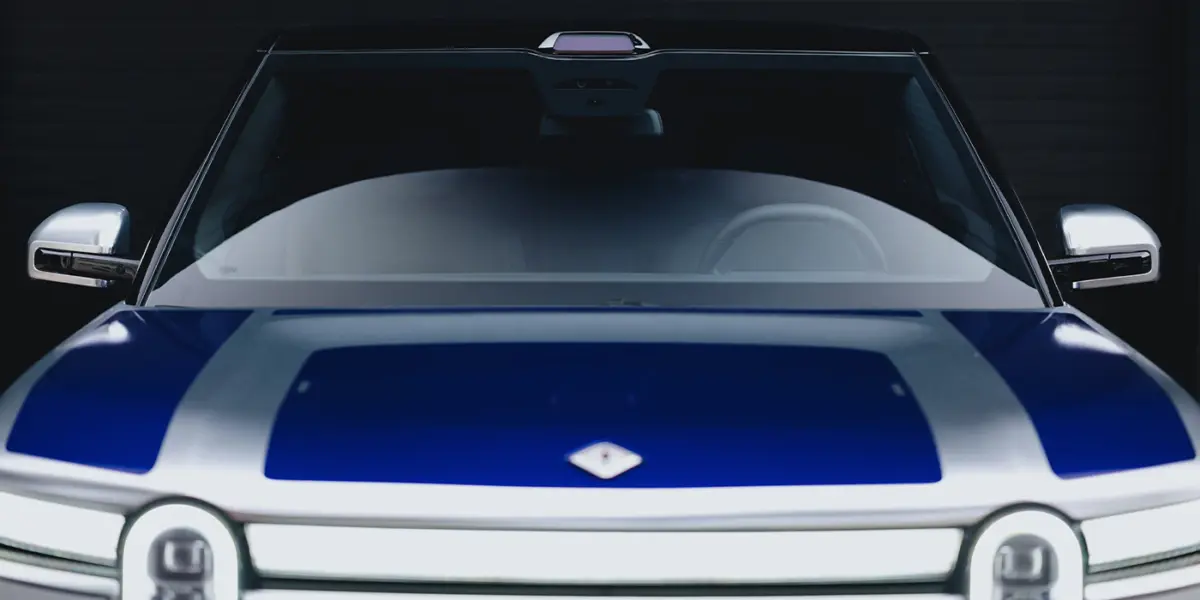
Perhaps the most notable physical modification showcased during the Palo Alto event was observed on a specially wrapped Rivian R2—affectionately styled to resemble Star Wars’ R2-D2—which featured a roof-mounted LiDAR sensor.
For years, the automotive industry has been sharply divided over perception strategies. While companies like Tesla have fiercely championed pure-vision systems (relying exclusively on camera suites and neural networks), and others have followed suit, a significant cohort of automakers and autonomy developers have maintained that active sensors like LiDAR are indispensable for achieving true, safety-critical Level 4 autonomy.
Rivian has officially chosen the multi-modal route. According to company presentations, LiDAR will be integrated into future R2 models alongside the ACM3 computer, drastically augmenting the vehicle’s existing camera and radar suite. Rivian stated that LiDAR provides high-resolution, three-dimensional spatial data and vital sensory redundancy, drastically improving real-time object detection and boundary recognition when confronting edge cases—such as low-light environments, inclement weather, or obscure road debris—that occasionally confound pure-vision systems.
![Rivian AI & Autonomy Day: In-house silicon chip, next-gen AI platform, LiDAR for Level 4 self-driving [Video]](https://electrek.co/wp-content/uploads/sites/3/2025/12/Rivian-autonomy-R2-LiDAR-front.jpg?quality=82&strip=all&w=1400)
3. The Large Driving Model (LDM) and Autonomy+
On the software front, Rivian introduced its Large Driving Model (LDM), an end-to-end training loop inspired by the architecture of Large Language Models (LLMs). Rather than relying on hard-coded rules for every conceivable driving scenario, the LDM ingests massive telemetry datasets gathered from the existing Rivian fleet.
To optimize the model’s decision-making process, Rivian utilizes Group-Relative Policy Optimization (GRPO), a reinforcement learning technique that trains the network to mimic ideal driving strategies harvested from human behavioral data. These software enhancements will be pushed out to Gen 2 R1 models in the near future, unlocking Universal Hands-Free (UHF) driving capabilities across more than 3.5 million miles of mapped roadways throughout the United States and Canada.
To monetize these advanced features, Rivian announced Autonomy+, a dedicated autonomy subscription tier launching in early 2026. Consumers will be able to access the feature via a one-time lifetime purchase of $2,500 or through a recurring monthly subscription of $49.99, which includes continuous over-the-air software improvements and expanded routing capabilities.
4. Rivian Unified Intelligence (RUI) and the New AI Assistant
Beyond vehicle operation, Rivian is weaving AI into its broader corporate and consumer ecosystem through Rivian Unified Intelligence (RUI). This shared, multi-modal data foundation supports diagnostics, service infrastructure, and predictive maintenance.
For vehicle owners, the most immediate manifestation of RUI is the brand-new Rivian Assistant. Scheduled to launch in early 2026 across both Gen 1 and Gen 2 R1 vehicles, the conversational AI assistant leverages advanced multi-LLM capabilities to handle complex cabin commands, vehicle inquiries, and route optimization naturally and intuitively. Simultaneously, service technicians will utilize RUI-backed diagnostic tools to rapidly isolate and resolve complex electronic and mechanical issues across the service network.
Supporting Context and Metrics
To properly contextualize Rivian’s announcements, it is helpful to examine the current landscape of the electric vehicle market and the capital-intensive nature of autonomy development:
![Rivian AI & Autonomy Day: In-house silicon chip, next-gen AI platform, LiDAR for Level 4 self-driving [Video]](https://electrek.co/wp-content/uploads/sites/3/2025/12/Rivian-autonomy-AI-assistant.jpg?quality=82&strip=all&w=1024)
- Hardware Specs: The newly unveiled ACM3 computer relies on the proprietary RAP1 chip, boasting 1,600 sparse TOPS of inference performance.
- Geographic Coverage: Universal Hands-Free (UHF) driving capabilities will immediately scale to encompass over 3.5 million miles of designated roadways across the US and Canada upon rollout.
- Pricing Model: Autonomy+ will debut in early 2026, structured around a $2,500 upfront fee or a $49.99 monthly recurring subscription.
- Deployment Timeline: The Gen 3 hardware architecture, the new AI Assistant, and the Autonomy+ subscription framework are slated for deployment in early 2026, with LiDAR integration following closely behind on upcoming R2 production units.
Level 4 autonomy—defined as full self-driving capability within specific operational design domains where human intervention is not required—remains the holy grail of the modern automotive sector. By committing to an in-house hardware and software stack, Rivian is joining an elite, albeit expensive, club of automakers willing to shoulder massive research and development expenditures to secure proprietary intellectual property.
Official Statements
Addressing the media and investors during the keynote presentation, Rivian Founder and CEO RJ Scaringe emphasized the transformative nature of the company’s new engineering direction:
"I couldn’t be more excited for the work our teams are driving in autonomy and AI. Our updated hardware platform, which includes our in-house 1,600 sparse TOPS inference chip, will enable us to achieve dramatic progress in self-driving to ultimately deliver on our goal of delivering L4. This represents an inflection point for the ownership experience—ultimately being able to give customers their time back when in the car."
Expounding upon the engineering rationale behind adding LiDAR to the upcoming vehicle architecture, Rivian’s technical briefings highlighted that active sensing remains an unmatched tool for redundancy:
"LiDAR will augment the company’s multi-modal sensor strategy, providing detailed, three-dimensional spatial data and redundant sensing, and improving real-time detection for the edge cases of driving."
Future Outlook and Industry Implications
Rivian’s AI and Autonomy Day marks a critical milestone in the company’s corporate maturation. By shifting from an assembly-focused EV startup to a vertically integrated technology company, Rivian is insulating itself from the supply chain vulnerabilities that have historically plagued automotive manufacturers.
![Rivian AI & Autonomy Day: In-house silicon chip, next-gen AI platform, LiDAR for Level 4 self-driving [Video]](https://electrek.co/wp-content/themes/ninetofive/dist/images/google-preferred-source-badge-dark.png)
From a strategic perspective, owning proprietary intellectual property—spanning custom motors, inverters, silicon chips, and AI software stacks—provides brands like Rivian, Tesla, and Lucid with substantial long-term leverage. Unlike legacy internal combustion engine (ICE) manufacturers, whose capital expenditures are fragmented across legacy powertrains, hybrids, plug-in hybrids, and battery-electric vehicles, pure-play BEV makers can focus their R&D budgets entirely on software-defined vehicle architectures.
Furthermore, this vertical integration opens up lucrative ancillary revenue streams through potential technology licensing agreements. Rivian’s high-profile joint venture with the Volkswagen Group—which will supply next-generation EV electronics and software architectures to vehicles including upcoming Scout Motors models—demonstrates that proprietary platforms can be monetized beyond Rivian-branded vehicles.
As Rivian prepares to roll out its Autonomy+ subscription, deploy the ACM3 computer, and integrate LiDAR into the R2 platform through 2026, the true test will lie in real-world validation. Consumers and automotive critics alike will scrutinize how well the Large Driving Model performs on public roads and whether the hardware upgrades deliver on the promise of true, eyes-off Level 4 autonomy. For now, however, Rivian has firmly established itself as a serious contender in the race to define the future of software-defined mobility.
