The automotive world has long viewed the legendary Nürburgring Nordschleife as the ultimate proving ground. Spanning over 12 grueling miles through the German Eifel countryside, its dizzying elevation changes, blind crests, unforgiving barriers, and wildly disparate asphalt surfaces present a punishing obstacle course for both machine and driver. Over decades, automakers have utilized this grueling asphalt ribbon to validate engineering concepts, fine-tune suspension setups, and—perhaps most importantly—secure bragging rights through blistering lap times.
For years, the battle for Nürburgring supremacy was fought exclusively by elite human drivers backed by multi-million-dollar racing budgets. Brands like Porsche, Tesla, NIO, and Mercedes-Benz have continually pushed the envelope of internal combustion and electric vehicle (EV) performance. However, a seismic shift occurred on June 8, 2026, when Chinese consumer electronics giant turned automotive powerhouse, Xiaomi, shattered a monumental paradigm.
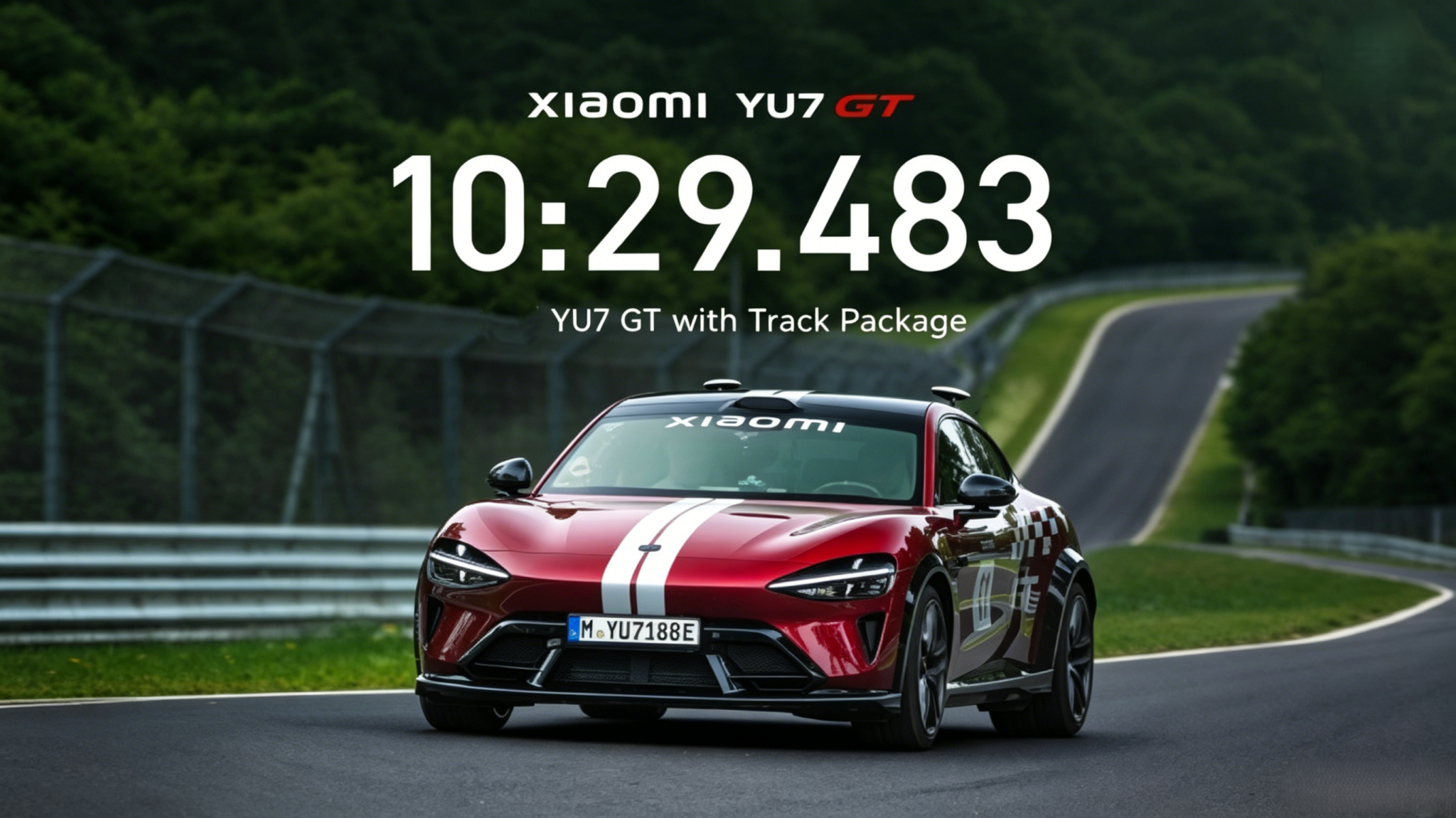
Returning to the historic circuit, Xiaomi did not simply set another human-driven benchmark. Instead, the company achieved a historic milestone: the first officially timed, entirely autonomous lap of the Nürburgring Nordschleife, utilizing a modified version of its high-performance YU7 GT electric SUV.
With zero human occupants inside the cabin—and no safety driver waiting to grab a dead-man’s switch—the YU7 GT completed the 12.9-mile circuit in 10:29.483. While this time leaves a three-minute deficit compared to human-driven performance records, it represents a watershed moment for autonomous driving systems. Xiaomi’s bold endeavor signals that the intersection of artificial intelligence and ultra-high-performance track driving has officially moved from theoretical R&D labs to the real world. This comprehensive report breaks down Xiaomi’s chronological track campaign, the technical implications of this historic autonomous run, historical context in autonomous racing, and what the future holds for machine-driven motorsport.
Detailed Chronology: Xiaomi’s Nürburgring Assault
To fully appreciate the gravity of Xiaomi’s autonomous achievement, one must examine the meteoric rise of the brand’s automotive division at the Nürburgring. Xiaomi’s entry into the electric vehicle space has been characterized by aggressive ambition, rapid iteration, and an uncompromising desire to challenge established automotive legacies.
The SU7 Ultra Era: Claiming Four-Door and Production Crowns
Xiaomi’s pursuit of Nürburgring glory began in earnest with the high-performance variant of its SU7 Ultra sport sedan. Initially, the tech company shocked the industry by bringing a stripped-down prototype version of the SU7 Ultra to the track, instantly claiming the title of the fastest four-door car ever—gasoline or electric—to conquer the circuit.
Unsatisfied with relying solely on prototype machinery to prove its engineering prowess, Xiaomi returned shortly thereafter with a mass-produced, non-stripped iteration of the vehicle. This spec-sheet-accurate production model successfully captured the all-time production EV record at the Nürburgring, though that specific crown has since changed hands in the fiercely competitive EV landscape.
The YU7 GT and the SUV Record
Refusing to rest on its laurels, Xiaomi expanded its vehicle lineup and its racing ambitions by bringing the YU7 GT SUV to Germany. Equipped with a dedicated track package, the YU7 GT proved that high-riding crossovers could rival dedicated sports cars. It obliterated the competition by setting the overall SUV record—besting every rival, internal combustion engine (ICE) and electric alike—with a staggering time of 7:22.755.
June 8, 2026: The First Official Autonomous Lap
Even after conquering sedans, production EVs, and SUVs with human drivers at the helm, Xiaomi’s engineering teams sought an entirely new frontier. On June 8, 2026, the company achieved its most radical feat yet. Utilizing a specially prepared YU7 GT outfitted with an advanced autonomous driving suite and track package, Xiaomi completed the Nordschleife with nobody inside the vehicle.
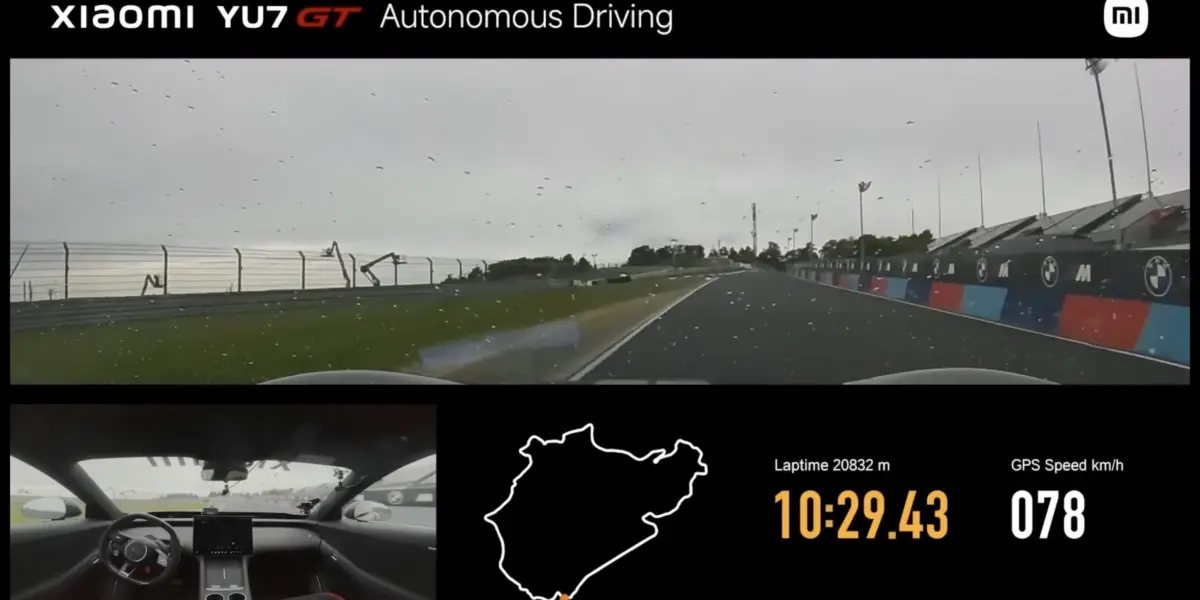
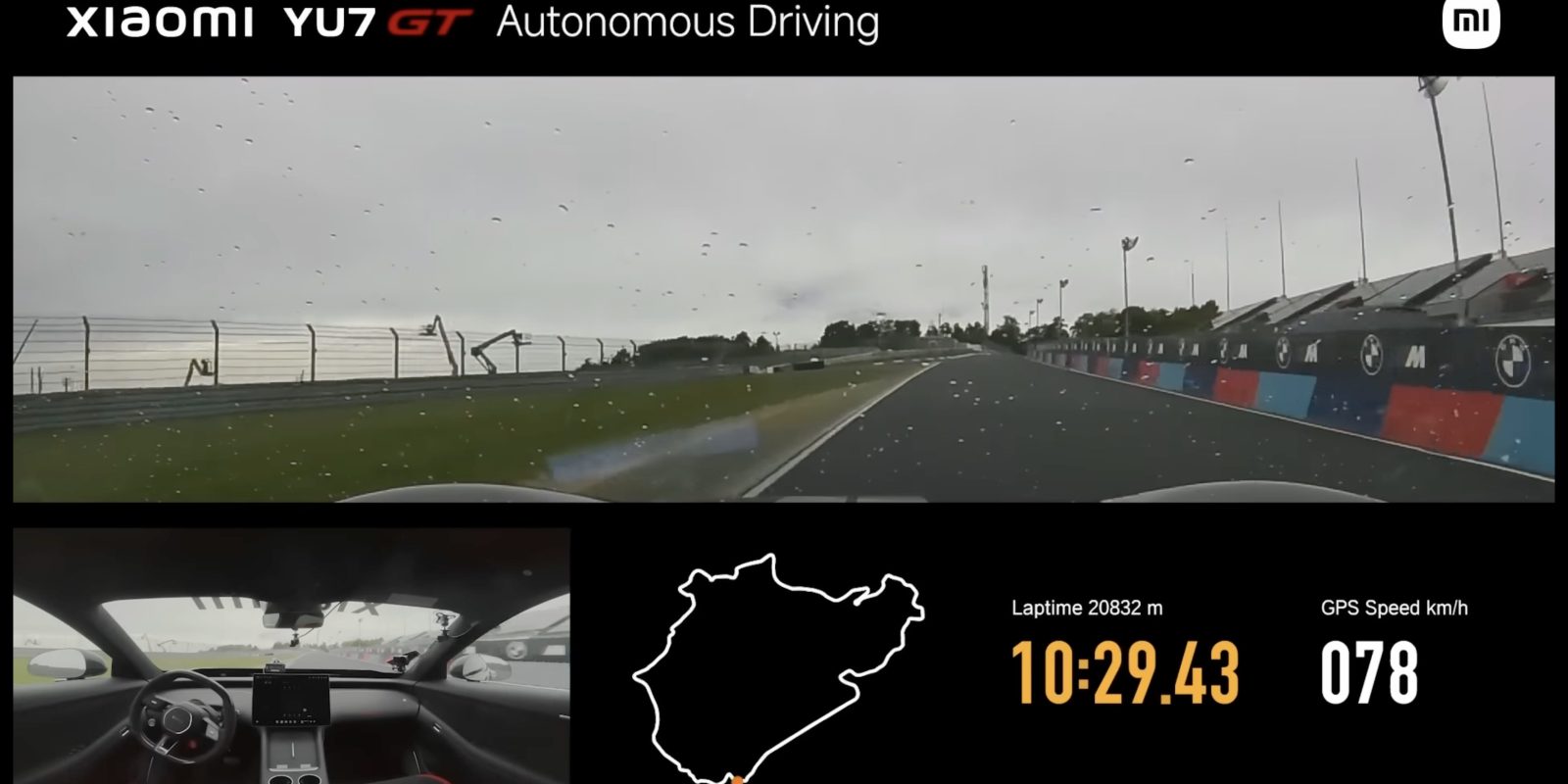
The official timekeeper verified a completed lap of 10:29.483, marking the very first officially timed, driverless autonomous lap in the storied history of the Nürburgring. Complete with onboard camera angles proving the driver’s seat was entirely empty, the run instantly ignited global discussions regarding the maturity of autonomous vehicle (AV) software and its applicability to high-speed dynamic environments.
Supporting Context & Metrics: Analyzing the 10:29.483 Run
At first glance, a lap time of 10 minutes and 29 seconds raises eyebrows among motorsport enthusiasts. On a circuit where top-tier human-driven performance hovers under the seven-minute mark, a three-minute performance gap is massive. To put the time into perspective, vintage 1930s Grand Prix race cars and even heavily laden commercial delivery vans, such as the Ford Transit, have posted comparable or faster times around the Nordschleife.
However, evaluating Xiaomi’s autonomous lap through the lens of traditional racing metrics misses the point. This run was never intended to outpace Max Verstappen or a professional factory test driver. Instead, it was an exploratory stress test for autonomous machine learning, sensor fusion, and vehicle dynamics at speeds previously thought unachievable by software alone.
Telemetry and Track Behavior
Analyzing the official telemetry and onboard footage released by Xiaomi and the Nürburgring reveals fascinating insights into how the YU7 GT’s autonomous system interprets the track:
Pace and Apex Management: Throughout the video, the vehicle navigates the circuit with steady, calculated composure. It does not aggressively attack curbs or push tires to the absolute edge of their friction circles. Instead, the software prioritizes safety margins and predictable vehicle trajectory over outright cornering aggression.
Straight-Line Velocity: Despite its conservative cornering approach, the vehicle proves it has plenty of raw electric power. On the legendary Flugplatz and Döttinger Höhe back straightaways, the driverless YU7 GT stretches its legs, successfully climbing up to 130 mph (210 km/h). Maintaining 130 mph in an uncrewed vehicle requires absolute stability, exceptional aerodynamic downforce management, and unwavering confidence in the steering actuators.
The Software Dilemma: Xiaomi’s standard consumer-facing autonomous driving suites are engineered for structured public roadways, highway driving, and low-speed urban environments. They are explicitly not programmed to manage 130 mph straights or high-G lateral cornering forces. Therefore, the YU7 GT utilized a proprietary, highly customized software calibration explicitly built for closed-circuit track execution.
Official Statements and Industry Perspective
In the wake of the record-setting run, Xiaomi was remarkably transparent about the limitations and the strategic intent behind the event. Rather than boasting that the autonomous YU7 GT could rival human champions, company representatives framed the feat as an essential stepping stone.
"This is a starting point, not an end point," Xiaomi executives noted, emphasizing that testing autonomous systems at the extreme limits of physics provides invaluable data that cannot be replicated on closed test tracks or computer simulations.
Industry analysts have pointed out that validating autonomous algorithms at Nürburgring speeds yields dividends for everyday consumer safety. When an autonomous vehicle encounters a sudden, catastrophic emergency on a public highway—such as a highway obstruction or a blown tire at 75 mph—the underlying perception, planning, and control systems must possess the split-second reflex capabilities honed through high-speed track testing. By pushing the hardware and software envelope in a controlled, albeit extreme, environment like the Nordschleife, Xiaomi is aggressively accelerating the safety validation timeline for its mass-market autonomous fleets.
Historical Context: The Long Road to Autonomous Racing
Xiaomi’s milestone does not happen in a vacuum. The concept of uncrewed, computer-driven motorsport has a complex history filled with ambitious experiments, spectacular failures, and steady technological evolution.
The Rise and Fall of Roborace
A decade prior to Xiaomi’s Nordschleife run, the motorsport world was captivated by the announcement of Roborace, a planned support series for the all-electric Formula E championship. Roborace promised a future where identical, futuristic-looking autonomous racing cars would compete wheel-to-wheel, powered solely by artificial intelligence algorithms developed by competing tech teams.
Unfortunately, the reality of early machine-learning capabilities fell short of the marketing hype:
The Buenos Aires Crash: During early exhibition runs, the inaugural events suffered high-profile setbacks, including a dramatic, unassisted crash into the barriers during a demonstration in Buenos Aires.
Man vs. Machine Showdowns: Roborace later pivoted to host human-versus-machine matchups. While professional human drivers consistently outpaced the AI-driven vehicles, Roborace engineers managed to close the gap significantly over time, eventually boasting lap times within 8% of a representative human benchmark—a much tighter delta than Xiaomi’s current Nürburgring run, albeit on much shorter, smoother circuits.
Time Trial Pivots: Roborace eventually transitioned into a time-trial format rather than full wheel-to-wheel combat, hosting structured seasons before ultimately scaling back operations.
Modern Academic and Collegiate Initiatives
Today, autonomous racing primarily thrives within elite academic ecosystems. Initiatives like the Indy Autonomous Challenge (IAC) and Formula Student Driverless pit universities from around the globe against one another. Using modified Indy-style racing chassis, these student teams program complex AI models to race head-to-head on iconic ovals and road courses like the Indianapolis Motor Speedway and the Las Vegas Motor Speedway.
However, these collegiate challenges typically focus on specific tactical maneuvers—such as drafting, overtaking, and maintaining formation at constant speeds—rather than absolute time-attack lap records across undulating, unpredictable mountain terrain like the Nürburgring. This is precisely why Xiaomi’s achievement stands out: it transitions autonomous testing out of flat, controlled ovals and university labs into the most dangerous, variable road circuit on earth.
Future Outlook: What Next for Autonomous Performance?
Xiaomi’s successful completion of a driverless Nürburgring lap opens Pandora’s box for the future of both consumer automotive technology and motorsport entertainment.
As artificial intelligence models become increasingly sophisticated through deep learning and neural network expansion, the performance gap between human drivers and autonomous vehicles will inevitably shrink. While purists may lament the absence of a living, breathing driver wrestling a steering wheel through the Caracciola-Karussell, the engineering data harvested from these trials will directly trickle down to consumer vehicles.
We are rapidly approaching an era where consumer cars will not only drive themselves safely in bumper-to-bumper traffic but will also possess the dynamic reflexes to handle high-stress emergency evasive maneuvers at highway speeds with superhuman precision. Xiaomi has firmly planted its flag in the German asphalt, proving that the future of the Nürburgring will be shaped not just by horsepower and carbon fiber, but by lines of code and artificial intelligence.
As Xiaomi continues to refine its autonomous software architecture, one question remains: how long will it take before an autonomous vehicle breaks the coveted 10-minute barrier, and eventually, challenges the human records altogether? If Xiaomi’s recent trajectory is any indication, that future may arrive sooner than anyone expects.