

Executive Overview
The intersection of artificial intelligence, mechanical engineering, and real-world deployment is accelerating at an unprecedented pace. In this week’s comprehensive survey of the global robotics landscape, curated by the editorial team at IEEE Spectrum, we bear witness to a watershed moment for the industry: the realization of a full-scale, 11-vs-11 humanoid robot soccer match at RoboCup 2026. This milestone—alongside aquatic drones mimicking diving birds, next-generation general-purpose AI learning models, and dexterous multi-degree-of-freedom robotic hands—signals that robotics is transitioning rapidly from controlled laboratory environments to unpredictable real-world arenas.
This report synthesizes the most significant hardware breakthroughs, software model upgrades, and policy discussions shaping the current horizon of robotics. As the industry looks ahead to landmark events including RSS 2026 in Sydney, the Summer School on Multi-Robot Systems in Prague, Actuate 2026 in San Francisco, IROS 2026 in Pittsburgh, and the Humanoids Summit in Seoul, the imperative for robust national robotics strategies, uniform safety standards, and resilient supply chains has never been more urgent.
Detailed Chronology: Key Innovations and Milestones
1. Autonomous Soccer Reaches New Heights at RoboCup 2026
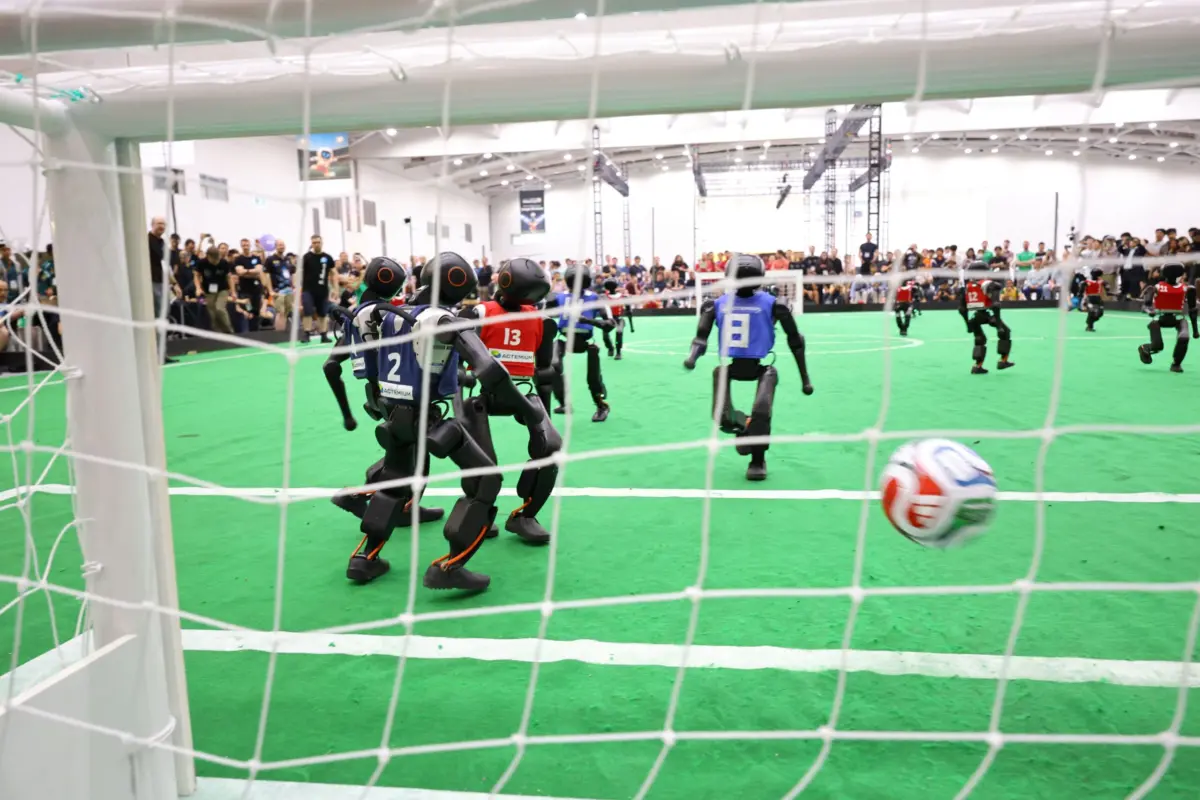
For the first time in the history of robotics, two full teams of autonomous humanoid robots took to the pitch to compete in a regulation-style 11-vs-11 soccer match. Held during the midsize league events at RoboCup 2026 in Incheon, South Korea—with notable clashes such as Tech United versus IRIS—this achievement brings one of the discipline’s most enduring grand challenges closer to commercial and technical maturity.
Complementing this laboratory-to-stadium progression, Boston Dynamics brought its flagship humanoid, Atlas, pitchside at NYNJ Stadium. Amidst an 80,000-strong crowd gathered for a high-profile international fixture between Brazil and Norway, Atlas not only executed complex human-like victory and player celebrations but actively participated in the proceedings by delivering the match ball to kick off the second half.
2. Bio-Inspired Engineering: The Aquatic-Aerial Drone
Engineers at MIT and EPFL in Lausanne, Switzerland, have successfully designed and tested a novel hybrid robot capable of seamless transition between distinct physical mediums. Modeled after the biomechanics of diving birds, the robot can swim efficiently underwater before executing a powerful flapping motion to break the surface tension and launch directly into sustained aerial flight.
This breakthrough offers researchers an invaluable physical platform to study the fluid dynamics of multi-environment locomotion. More broadly, it lays the groundwork for a new class of dual-domain drones capable of environmental monitoring, search-and-rescue operations, and aquatic infrastructure inspection without requiring surface-level recovery vessels.
3. Dexterous Manipulation and the Humanoid Hand Revolution
Physical interaction with unstructured human environments relies heavily on end-effector capability. Addressing this, 1x announced a foundational redesign of robotic hands for its NEO platform. Engineered to match or exceed human-level dexterity, strength, safety, and reliability, these 25-degree-of-freedom (DoF) hands utilize a fully actuated tendon-driven system integrated with rich tactile sensing and built-in mechanical compliance. The architecture enables true in-hand manipulation, precision tool usage, and delicate interaction with fragile objects.
Concurrently, other industry players continue to push the boundaries of deployment readiness. Agility Robotics demonstrated precise force control by putting its bipedal robot, Digit, on grilling duty to mark the holiday season, highlighting how advanced payload handling translates directly into fine motor operations. Meanwhile, developers across the humanoid ecosystem—including Figure, Unitree, EngineAI, Sanctuary, and UBTECH—are rapidly iterating on form factors designed to handle repetitive labor, logistics, and interactive companionship.
4. Machine Learning and General-Purpose Intelligence: GEN-1
Hardware advancements are increasingly bottlenecked by software adaptability. Addressing this scaling challenge, Generalist introduced GEN-1, a pioneering general-purpose AI model designed to achieve mastery across a wide spectrum of simple physical tasks.
According to preliminary performance metrics, GEN-1 elevates average task success rates to an astonishing 99 percent—a stark contrast to the 64 percent baseline of previous models. Furthermore, the model completes tasks approximately three times faster than current state-of-the-art systems while requiring a mere one hour of specific robot training data to achieve these performance thresholds. This leap forward dramatically accelerates the commercial viability of general-purpose robots across diverse commercial sectors.
5. Hardware-Level Locomotion and Proximity Sensing
Navigating discrete, irregular terrain—such as stepping stones or rubble—remains a historic challenge for legged robots. Traditional methodologies rely heavily on dense environment reconstruction via onboard cameras or LiDAR. However, these systems are chronically vulnerable to latency, visual occlusions, and heavy computational overhead.
Recent breakthroughs detailed in academic preprints bypass these visual bottlenecks by integrating proximity sensors directly into the bottom of a quadruped’s feet. This hardware-level feedback loop allows for safe, terrain-seeking autonomous locomotion that reacts instantaneously to surface shifts without the latency of heavy vision processing pipelines.
Supporting Context and Metrics
To contextualize the velocity of modern robotics development, industry analysts and research institutions track several key performance indicators across hardware durability, software learning speed, and economic viability.
| Metric / Innovation Area | Previous Benchmark / Approach | Current Breakthrough (2026) | Impact on Industry |
|---|---|---|---|
| Humanoid Soccer | Small-scale teams (e.g., 3-vs-3 or 5-vs-5) | Full-scale 11-vs-11 hardware matches (RoboCup 2026) | Validates multi-agent coordination and real-time physical autonomy. |
| Robot Learning (GEN-1) | 64% average success rate on physical tasks | 99% success rate, 3x execution speed | Opens commercial viability through rapid, low-data model training. |
| Dexterous Manipulation | Limited-DoF parallel-jaw grippers | 25-DoF tendon-driven hands with tactile sensing (1x NEO) | Enables human-level tool usage and delicate in-hand object manipulation. |
| Locomotion Navigation | Dense camera/LiDAR environment reconstruction | Foot-integrated proximity sensors for blind terrain adaptation | Eliminates visual latency and computational overhead in legged robots. |
| Hybrid Locomotion | Specialized single-medium vehicles | Aquatic-aerial flapping drones (MIT/EPFL) | Merges air and water operations for advanced search and rescue. |
Official Statements and Industry Perspectives
The convergence of corporate expansion, academic research, and regulatory policy has brought robotic systems into the public sector spotlight.
Speaking at the Humanoids Summit in Seoul, Brendan Schulman, Vice President of Policy at Boston Dynamics, emphasized the vital relationship between technological capability and government engagement. Schulman underscored how platforms like the Spot quadruped and the Atlas humanoid are successfully migrating out of controlled industrial manufacturing facilities and into complex infrastructure inspection and public safety roles.
"The intersection of artificial intelligence and robotics—driven by large behavioral models and reinforcement learning—allows modern systems to navigate slippery floors and autonomously avoid workplace hazards in real time," Schulman noted during his keynote address. "However, sustainable industry growth requires a proactive national robotics strategy focused on rigorous workforce training, harmonized safety standards, and ethical frameworks to support supply chain resilience and global competitiveness."
This sentiment is echoed throughout the research community. As Dr. Christian Hubicki of the Optimal Robotics Lab humorously observed while judging robot soccer mechanics, the intuitive behaviors now exhibited by autonomous agents are beginning to mirror human strategy—even if the underlying code is governed by complex reinforcement learning algorithms rather than athletic intuition.
Future Outlook: The Road Ahead
As the robotics community prepares for the upcoming conference circuit—including RSS 2026 in Sydney (July 13–17), the Multi-Robot Systems Summer School in Prague (July 29–August 4), Actuate 2026 in San Francisco (August 18–19), the Humanoids Summit in Seoul (September 22–23), and IROS 2026 in Pittsburgh (September 27–October 1)—the trajectory of the field is unmistakably clear.
The barriers separating digital simulation from physical reality are falling. With general-purpose AI learning models like GEN-1 drastically lowering the data requirements for skill acquisition, and hardware platforms achieving human-level dexterity and locomotion reliability, the commercial deployment of autonomous systems is poised for exponential growth.
Over the next decade, the challenge for engineers and policymakers alike will no longer be proving what robots can do in isolated demonstrations, but rather ensuring their safe, ethical, and seamless integration into the daily fabric of human society.
